Shark Night (2011)

The budget for Shark Night was reportedly somewhere in the neighborhood of $25 million. So where did the money go?

My guess is $24 million went to the 3D effects (which don’t magically appear on my TV—I even tried wearing an old pair of glasses, but all I got was a migraine) and the rest was divvied up between fake blood, a few hair metal songs, and (hopefully) a decent payday for one of the coolest character actors going, Donal Logue.

Judging by the results, Will Hayes and Jesse Studenberg probably got a case of beer and a couple frozen pizzas. For cryin’ out loud, this even had a theatrical release and it’s only marginally better than something from the Asylum crew, who would have at least had the decency to throw in a little nudity.

The story (such as it is) concerns a group of reasonably attractive Tulane college students who decide to drop the books and have a wild weekend at Sara’s (Sara Paxton) McMansion on the shores of Lake Pontchartrain—a body of water that’s allegedly got enough salt in it to sustain gangs of roving ravenous sharks.

In case you’re interested, the prevailing theory is that the sharks arrived as the result of a particularly tempestuous hurricane season, but this notion is quickly discarded when local rednecks Dennis and Red (Chris Carmack and Joshua Leonard) confess to stocking the pond with 45 varieties of shark (out of a possible 350!) in order to shoot footage of idiots getting eaten for “a cable channel.”

Really? That’s the best we can do?

There’s gallons of blood, but not much gore in Shark Night, and the effects (which include sharks leaping balletically out of the water to chomp people in trees and boats) are ludicrous and lame enough to be for Crockasaurus Meets Robo Squid (Hey, I have a script!), on SyFy Channel.

The previously mentioned Donal Logue is always worth watching (especially in his late, lamented FX series Terriers), and he manages to sneak off with a couple of scenes as a metalhead sheriff, but the rest of the cast is unremarkable.

And the sharks? Those fish should go back to school.

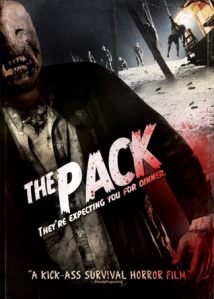
The Pack (2010)

Stop the Interwebs! In fact, just drop what you’re doing for the next 81 minutes, crack a cold one, and summon The Pack from your Netflix netherworld. Don’t think! Just watch, because it’s a gem, a Horrificflicks revelation.

The Pack, a French-dubbed rural nightmare, is quite simply the most finely rendered horror film I’ve seen in a long, long time, at least since Neil Marshall’s The Descent. It’s successful in every sense: Original yet referential; gory but restrained; funny but not goofy, and it’s not horror lite, either.

It’s chock-a-block with cringe-inducing scenes, but the delicious jolt of shock doesn’t get washed away in a tedious “pain for the sake of watching pain” tidal wave. It’s too artfully evocative (it’s a beautifully shot movie) and carefully orchestrated to be mere torture porn, but it is relentless—like a dream that keeps going from bad to worse.

Final (Only?) Girl Charlotte Massott (the gutsy and striking Émilie Dequenne), is driving through uncharacteristically blighted French countryside, cranking speed metal, and smoking. Some bikers have been on her ass, hassling her for a while, so she decides to pick up Max (Benjamin Biolay), a hitchhiker who is perhaps a touch less sinister than the bikers she’s trying to avoid. She pulls up and says, “If you pull out your dick, I’ll hammer you!” With a stone impassive face that he wears for the entire movie, Max replies, “It’s too cold anyway.” (Practically a Truffaut opening!)

Evidently Charlotte is a remarkably trusting soul, because she takes a catnap while Max (whom she’s known for about 6 minutes) drives. When she wakes up, they’ve stopped at a ramshackle backwoods saloon/gas station/arcade, run by massive Madame La Speck (Yolande Moreau, whose maternal, Kathy Bates-like performance is terrific). At this point, the wheels come off for Charlotte and everything gets real weird and bleak, real quick.

A true horrorphile will be happier than a puppy in puke spotting subtle and shady references to Psycho (“Oh, Mother!”), The Texas Chainsaw Massacre (horrible hillbillies); Night of the Living Dead (flesh-eating, blood-sucking stumbling humanoids); and Pumpkinhead (farm setting, hayseed occultism, genuinely frightening beastie[s], lots of shots of windmills), not too mention every variation of Why Strangers Passing Through Blighted Lonely Territory Should Never Pick Up Hitchhikers, Much Less Go To Their Lair.

Writer-director Franck Richard’s The Pack boasts so many well-chosen fiendish delights, that I could sit here all day singling out its virtues. Instead, I’ll just point out a couple:

It’s a real shock when the monsters arrive. They don’t look stock or schlocky. I would compare them favorably to something dreamed up by Guillermo Del Toro.

The acting is strong across the board, including Phillippe Nahon, a Charles Durning lookalike who plays a Columbo-ish cop, and wears a shirt that reads “I Fuck On The First Date” throughout the film.

The action gets progressively grimmer, but Richard doesn’t dwell overly long on the suffering. There is a “circle of life” at work here that’s hideous in its organic inevitability. Make no mistake, no one will be disappointed with their level of discomfort.

Even so, The Pack never panders; it’s never sensational and garish for its own sake. Rather it has a soupçon of Tim Burton’s fairy-tale-gone-horribly-wrong sensibility, combined with Sam Raimi’s quick, decisive cuts. And the gruesome proceedings are tastefully seasoned with odd, welcome interludes of humor.

If I really had to compare The Pack to another film, it would be Clint Eastwood’s The Unforgiven: It’s genre filmmaking utilized to its full potential. It’s a familiar template that Richard is working from, but he raises the bar on quality and originality to the ceiling. I kept thinking I knew what was going on, because I’ve seen these stranded-motorist scenarios in hundreds of movies. But I was always surprised by something far stranger than I was expecting.

I kept waiting for the other shoe to drop, but instead, Richard kicked my ass with it. To my fellow fans hungry for a quality horror experience, all I can add is, go and enjoy. Heck, I may watch it again. What’s 81 minutes on a Sunday?

Shadow Puppets (2007)

Several folks (mostly attractive women) wake up in a mental institution, dressed in generic undies, with no memory of who they are or how they got there.

They spend the remainder of the film wandering around the facility while trying to steer clear of a dark, shadowy, spider-type thing with a face, that shows up once in a while to kill someone.

Despite the presence of genre-pedigreed actors James Marsters (Spike from Buffy and Angel, who hasn’t aged well); Tony Todd (the Candyman himself!); and Joleen Blalock (she was the Vulcan hottie from that lame Star Trek series with Scott Bakula), there really isn’t much to recommend Shadow Puppets.

This is another one of those annoying “walkabout” movies, with endless scenes of wary characters moving (very slowly) through a largely featureless industrial landscape.

It’s an approach that’s quite different from a movie like Cube, for example, where shocking and creepy details emerge from both the alien environment and the characters’ own heads.

We do discover the identities of the captives, but it doesn’t add up to anything worth writing down. We learn the origin of the smoky, spider thing, but it’s all argle bargle that’s forgotten two seconds after the explanation is delivered. (“It’s the distilled essence of the victims’ life forces,” or some such drivel.)

Note to writer-director Michael Winnick: If we don’t care about the monster or the characters, then you’re going to need lots more gore and gals to maintain a passable level of interest from the average horror fan.

And a brawny dude in a rubber suit would have been a major improvement in the monster department.

Zombie Apocalypse (2011)

Pas·tiche /paˈstē-SH

Noun: An artistic work in a style that imitates that of another work, artist, or period.

Today’s vocabulary word is pastiche, as in, “The Ving Rhames movie Zombie Apocalypse is a pastiche of the popular television show The Walking Dead.”

And that’s about it. There’s nothing groundbreaking or envelope-pushing at work here. It’s pure comfort food, executed with very little verve.

You know the drill. A ragtag band of plague survivors try to avoid being eaten by zombies long enough to make it to Catalina Island where the remains of the government has setup housekeeping.

Ving Rhames is Henry, a sledgehammer-swinging bad-ass, which pretty much makes him the most developed personality among this group of stock characters.

There’s also Julian (Johnny Pacar), a wisecracker who quotes Wordsworth; Mack (Gary Weeks), a leader-type who looks and acts like Ryan Reynolds; Ramona (Taryn Manning), the whiny girl who grows up fast; and Cassie (Lesley-Ann Brandt), the hot chick with the sword.

Spoiler: Some of these people don’t make it.

What Zombie Apocalypse has going for it is a breezy pace. The action rolls along at a steady clip, never really bogging down with unnecessary backstory. This group is almost always ass-down in the frying pan.

On the flip-side, the special effects are cheesily rendered CGI bullshit which extinguishes a great deal of the fright factor. People should be afraid of zombies because seeing their own flesh chewed from their bones while still alive is scary.

Blobs of drawn-on blood splatter is not. This technique is also used for countless zombie headshots, and it looks cheap and amateurish.

If you’re starving for an undead fix, this one will barely make a dent in your hunger. It’s like a zombie chowing down on an anorexic: Not much meat on them bones.

Rare Exports: A Christmas Tale (2010)

I suppose it’s a little early for Christmas revelry, but this uncanny Finnish import written and directed by Jalmari Helander is reason enough to get in a (twisted) holiday mood. Creepy and often hilarious, Rare Exports has the look and feel of a wondrous Spielberg project (E.T. meets Super 8?), right down to the charismatic leading moppet (Onni Tommila) who intuitively understands that a certain unearthly entity (in this case, Santa Claus) does not come in peace.

On Christmas Eve in the remote hinterlands of Finland, a corporate-sponsored archeological expedition digs up a towering, horned creature frozen in ice. Pietari (Tommila) deduces it to be the “real” Santa Claus, a fearful demon who brutally kills naughty children. Meanwhile, his father (Jorma Tommila) and his fellow reindeer hunters have captured a vicious, wizened old bearded man, whom they wish to exchange with the corporate bosses for enough money to get them all through the winter. Chaos reigns for a time, leading up to a left-field ending that works once you give it a chance to sink in.

As one might expect, given the Spielberg sensibility, the key to the story is the relationship between a boy and his widowed father, the latter trying desperately to protect and provide for his son—who at the same time is hoping to prove to his dad that he’s a brave and resourceful young man, and perfectly capable of protecting himself. It’s a heartwarming coming-of-age fable replete with an evil giant Santa and a whole bunch of murderous elves. Given that premise, it’s mostly gore free, but the disturbing picture of jolly ol’ St. Nick depicted here, is more than enough to inspire Christmas nightmares in the heads of impressionable children of all ages. I approve this message.

2-Headed Shark Attack (2011)

I love it when a plan comes together. I really wanted my 50th review for Horrificflicks to be something special, and lo and behold, along comes 2-Headed Shark Attack to bite me on the ass.

It’s an almost symphonic work of schlock, directed with the expert hand of a born showman; namely Christopher Ray, the son of cheap-thrills pioneer, Fred Olen Ray (Hollywood Chainsaw Hookers, Attack of the 60 Foot Centerfolds, a couple of Emmanuel flicks, and countless examples of Grade-Z, straight-to-video trash under various pseudonyms).

The plot? A college class on a field trip to the ocean (I guess), gets its pleasure boat scuttled by a two-headed shark.

A bunch of the students, including Hulk Hogan’s daughter Brooke (who probably got to college on a stripping scholarship), along with their meatball professor (Charlie O’Connell—because trying to get his brother Jerry would have sunk the budget), take a dinghy to a nearby atoll to wait things out.

Meanwhile, the professor’s doctor wife, (Carmen Electra—damn, wish she was my primary care provider!) remains on board the slowly sinking boat in order to sunbathe. Oh, and the atoll (which is better landscaped than the 18th hole at Augusta) is also crumbling into the ocean. Sure! Why not?

Like his stylistic godfather Roger Corman, director Christopher Ray demonstrates considerable facility with the mutant sea monster genre. Yes, most of the time, the shark is seen as a video-game quality, aquatic animation. But when the two-headed terror chows down on his desperately dog-paddling victims, Ray brings in the cheesily constructed shark heads so we can get a closeup of flailing folks gushing the gore while being chomped to pieces.

As far as I’m concerned, that’s the mark of a superior filmmaker. Ray instinctively understands that CGI mayhem just isn’t tough enough, and he delivers the puppets for that much-needed personal touch.

I don’t watch movies like 2-Headed Shark Attack because I want to gain insights into the human condition. I just want to see loads of teenagers messily eaten.

Have I mentioned recently that I don’t like teenagers? Yes, even ones that look to be in their early 30s.

Other things I loved about 2-Headed Shark Attack:

• The shark thoughtfully holds off attacking some skinny dippers until we get a healthy dose of nudity.

• The wildly inconsistent shoreline topography that fluctuates between barren rock and palmy tropical oasis.

• The survivors are supposedly shipwrecked “hundreds of miles from anywhere” but during wide-angle shots there are other boats on the horizon.

• The deserted fishing village has a cement dock, a couple of extra motor boats, and a “No Fishing” sign on it—not to mention a church that looks like it was hastily built by a pack of drunk cub scouts that couldn’t decide between a rustic chapel and a shed.

• Idiotic dialogue that affords endless opportunities for MST3K-style riffing (e.g., the sage advice shouted to a hapless swimmer trying to out-stroke the pursuing predator: “Hurry up!”).

• The only explanation offered to account for the appearance of a two-headed shark: “It happens sometimes. Snakes, cows, kittens…”

• The class is comprised of much-too-old-to-be-college-student meat sacks who mostly get eaten.  And spunky amazon Brooke Hogan has a future in the business as the wise-cracking, ass-kicking girl. Every movie needs one. You’ll see.

Legend of the Bog (2009)

Bog men. Can’t say I’ve seen too many.

Hell, I don’t even know how to categorize it. I’m going to go with “monster” since bullets don’t stop them and they’ve been preserved in peat for 2,000 years—even though this particular “bog body” looks more like a cross between Tor Johnson and Curly Howard: In other words, big, bald, and on a mindless rampage.

An assortment of Irish folks, including an archaeologist (Jason Barry), his foxy assistant (Nora-Jane Noone, who has the best pouty face this side of Mila Kunis), and a bitchy, ambitious real estate developer (Shelly Goldstein), get lost on the moors (“I told ye to mind the moors!”) and incur the wrath of a recently resurrected 2,000 year-old-man bog man (Adam Fogerty).

The bog man is being hunted by Hunter (Vinnie Jones, a.k.a. The Juggernaut in X-Men: Last Stand), who is understandably disappointed to discover that his conventional weapons are useless against the massive savage. Can the archaeologist figure out how to return the brute to his soggy coffin?

The problem with Legend of the Bog is that it tries to cram too many elements into a modest story and the plot sinks like a weighted body into a bottomless mud hole. OK, so we have a reanimated bog man who needs to keep himself hydrated regularly to survive.

Fine. It’s part of his DNA or something.

Then, we find out the seemingly random bunch of victims aren’t random at all, a development that adds nothing whatsoever to our emotional attachment to them.

Why did writer-director Brendan Foley bother to somehow justify a killing spree by this hairless gorilla? Waste of time.

On top of that, we’re saddled with a “who cares” romantic subplot, and a shower scene that contains no nudity.

Again, why bother?

Atrocious (2010)

I’m quite good at suspending my disbelief. Trust me, when it comes to horror, I have a very limber set of standards in that department.

And as much as I liked Atrocious, a found-footage frightener from Spain, I had some serious reservations believing that central characters July (Clara Morelada) and her brother Cristian (Cristian Valencia), would continue to schlep their camcorders around after figuring out that a fiendish killer is stalking them at their family’s rural retreat.

“Oh my God, there’s a fiendish killer in the house with us! Do you have a spare battery pack?”

Uh huh. It’s a shame too, because Atrocious has the makings of a crackerjack movie.

Teen siblings July and Cristian are spending their vacation with Mom (Chus Pereiro), Dad (Xavi Doz), and adorable kid brother Jose (Sergi Martin) at a Spanish country estate that comes equipped with its own massive hedge maze.

The pair fancy themselves as intrepid ghost-hunting, mystery solvers so they bring along two video cameras, which is a stroke of luck for the cops when they discovery that everyone’s been murdered about a week later.

After sifting through 37 hours of footage, the final cut serves as the movie itself. If you surmised that there would be an abundance of chaotic night scenes frantically shot by the protagonists whilst lost in the hedge maze, give yourself a gold star.

There is some first-rate fright footage here. And the actors playing July and Cristian are very good, very natural. Atrocious is worth the time it takes to watch, but the surfeit of film (not to mention battery power) is a contrivance that each viewer will have to sort out for themselves.

It doesn’t ruin the experience, but you may find yourself (as I did) shouting, “Oh come on, already!” at the screen on several occasions.

Triangle (2009)

I have to say, Triangle is a nifty thriller—albeit one that’s more like a cruise through the Twilight Zone, rather than an in-your-face horror spectacle.

It’s a fairly compelling riff on the concept of converging realities, duover days, and a rip in the time/space continuum, that forces one woman to relive the events of one unfortunate afternoon in a seemingly endless loop.

H-o-t single mom Jess (Melissa George) climbs aboard a spacious sailboat with a bunch of reasonably attractive Australians pretending to be Americans (it’s supposedly set in Florida, but this is an Aussie production complete with slippery accents) for a weekend of pleasure boating.

Somehow they get blown off course by a freak storm and end up capsized. The waterlogged survivors scurry aboard a deserted ocean liner/Flying Dutchman that just happens to be steaming by, and the stage is set for something sinister.

Jess tries desperately to repair their fate, even as she and her friends are hopelessly caught up in a Moebius strip of action, while we gather up the clues that are dutifully dropped by writer/director Christopher Smith.

Lines of dialogue are repeated throughout, as multiple versions of Jess look on from different perspectives each time she rewinds back to their boarding of the ghost ship.

Hint: The myth of Sisyphus is discussed briefly.

Triangle is another film that suffers from a slight case of the wanders (i.e., characters spend far too much time poking around like tourists in an antique mall), but even so, it’s an effective piece of genre entertainment, in which the Groundhog’s Day rules of reality result in the cast being murdered several times in various ways.

Saving money on the number of actors that need to be paid by having them slaughtered over and over, makes good economic sense—and helps shape a subtly scary seafaring saga, as poor Jess comes to the slow realization that she’s been running around this damned ship for a helluva long time.

And there’s not even a shuffleboard court or a wave pool.

Quarantine 2: Terminal (2011)

It’s a lesser effort than the first Quarantine, but I consider it a worthy sequel nonetheless, because most of the time, sequels suck ass.

Why would I be interested in an inferior distillation of an original formula? (Go back to Halloween II and work your way toward the present; the exceptions being Romero’s Dead films.)

However, I must wag a stern finger at writer/director John Pogue, for blowing an opportunity to make his movie substantially better.

I was sold on the premise right away. The same virus that caused the apartment dwellers to go berserk with a case of the man munchies in the original movie, breaks out again. Only this time on a plane. That’s right: Zombies on a Plane.

And not the slow, shuffling kind, either. These guys are strong, agile, and ready to rock and roll at 20,000 feet. My point is, if Pogue had contained the action to the cabin of a plane, he could have ratcheted up the tension tenfold.

In addition to zombies, you add the possibility of the plane plummeting to the ground—not to mention claustrophobia.

Instead, Pogue chooses to let his harried cast land the plane, and then hide in the basement of an airport, where, for the rest of the movie, they walk around a featureless industrial landscape in the dark.

The place is surrounded by soldiers who shoot anyone who emerges, but that’s not nearly as frightening as the prospect of a plummeting plane.

Pogue even had a formidable lead zombie in Ralph (George Back), an overweight, drunken golfer who proves extremely difficult to bring down once he’s succumbed to the virus. Big boy can wreak some serious havoc!

Despite some wasted potential, Quarantine 2 is a very watchable feature, with gallons of gore, that moves along at a brisk clip—until everyone gets lost at the airport.