Mayhem (2017)

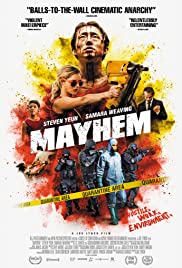
For every miserable corporate cog subjected to the petty tyranny of a jagoff boss, there is Mayhem. Watch and laugh yourself silly as chaos and cruelty erupt in the bowels of a Fortune 500 company. (Ewww)

Derek Cho (Steven Yeun, from The Walking Dead) is an up-and-coming financial analyst working for a mega-corp overseen by cokehead asshole John Towers (Steven Brand).

When Towers conspires to have Derek take the fall for a botched account, the young financier vows vengeance—and gets an opportunity almost immediately thanks to an airborne virus that’s causing citizens to forget their inhibitions and act out violent thoughts and impulses.

Now there’s a stroke of luck!

With the skyscraper under quarantine, Derek scales the corporate ladder in a rage of bloodlust, accompanied by an angry client (Samara Weaving, who’s building an impressive genre resume) with a nail gun and her own ax to grind.

Director Joe Lynch (Wrong Turn 2) douses Mayhem in bloody waves of comic gore, following Derek’s rise to the top and revenge against treacherous co-workers. Lynch takes the Jewish mother approach to doling out the carnage, and the effects are wickedly clever.

The action is fierce, funny, and fast, with tight fight choreography and no unnecessary character development. We get exactly what we want: Ascending floors of hi-octane slaughter, whereh any sharp or blunt object within reach comes into play.

Lynch and writer Mattias Caruso pull back just a smidgen from complete anarchy by instilling in Derek a deep streak of decency that even a raging virus can’t overcome.

Ultimately, Mayhem strikes a huge sympathetic chord familiar to the working wounded everywhere. Who hasn’t fantasized about going nuclear on the boss? Or your meathead co-workers? Or the zombies in HR?

And who the hell took Derek’s coffee cup?

Offload those feelings of negativity that are affecting your productivity. Take stock of your potential and join us for a short morale meeting. If you fully appreciate the soul-crushing mundanity of Office Space, then Mayhem could be a life-changing cathartic event.

Happy Death Day (2017)

Can beleaguered sorority girl Tree Gelbman (Jessica Rothe) solve her own murder on her birthday?

Happy Death Day swipes the central motif from Bill Murray’s romantic comedy Groundhog Day, and sticks a knife in it, as Tree gets to relive the same day over and over, concluding with her vicious murder at the hands of a baby masked maniac.

Tree begins her recurring day by waking up in the dorm room bed of Carter (Israel Broussard), a dorky, but genuinely nice guy.

From there, she stumbles past a collection of local collegiate color, blows off a former date, ignores a birthday cupcake, dodges her dad on the phone, goes to a lunch meeting with house Big Sister Danielle (Rachel Matthews), makes out with her handsome (married) professor (Charles Aitken), and attends her own surprise party.

As in Groundhog’s Day, Tree gradually realizes that she’s been a selfish bitch, and uses her birthday mulligan to mend fences with Dad (Jason Bayle), roommate Laurie (Ruby Modine), and Carter, to whom she’s grown quite attached.

Tree even contrives to knock off a serial killer (Rob Mello) that’s in the vicinity, but to no avail. Someone keeps murdering her.

Director Chris Landon (son of Little House papa Michael Landon, and director of Freaky) and writer Scott Lobdell cram a ton of entertainment into a borrowed concept, giving equal time to solving Tree’s murder and improving her interpersonal skills.

Jessica Rothe demonstrates grace under fire (except when she’s losing her shit), evolving from a reckless bimbo to a quick-thinking warrior who won’t let go of her seemingly endless lives without a fight.

Happy Death Day is surprisingly funny and moving, inspiring a sequel two years later, as well as plans for a third film.

I’ll let you know how it all plays out.

Note: The Netflix miniseries Russian Doll, created by Natasha Lyonne and Amy Poehler, has a similar Do Over Death Day angle. Just sayin’.

His House (2020)

Yes, you should watch His House. It’s captivating and terrifying from the opening scene and never looks back.

London filmmaker Remi Weekes makes a stunning debut with a ghost story about Sudanese refugees trying to start a new life in England. But you know it’s going to take them a while to unpack all that trauma.

Bol Majur (Sope Dirisu) and his wife Rial (Wunmi Mosaku) have survived multiple tragedies escaping their war-torn homeland, leaving behind a deceased daughter and rival tribes with guns bent on annihilating each other.

In England, the Majurs are assigned a shabby government house and their lives are overseen by grumbling official Mark Essworth (Matt Smith), who seems peeved that the refugees aren’t grateful enough.

The Majurs are warned in no uncertain terms that they must stay in their assigned unit and observe innumerable conditions or they will be sent back to Sudan (and certain death).

The new abode comes with faulty wiring, peeling wallpaper, and plenty of ghosts, led by their seething daughter Nyagak (Malaika Wakoli-Abigaba), who has not passed on peacefully.

Bol tries to rationalize and pretend everything is fine, but slowly begins to lose his grip as the pressure of appearing happy and grateful in a haunted house takes its toll, and he freaks out in front of Essworth.

Rial wants to go back home, but Bol digs in and confronts their tormentor—and a deal is struck.

His House demands a thorough investigation for which you’ll be amply rewarded. Remi Weekes is a major talent with superb cinematic instincts.

With Bol and Rial trapped inside their house, Weekes tightens into claustrophobic closeups, and we’re practically a fly on the wall, witnessing encounters with the undead that grow increasingly disturbing.

Outside, the landscape is ruined, desolate, and confusing. When Rial asks for directions, she’s told by a rambunctious bunch of Black English schoolboys to “Go back to Africa.”

Weekes adds unlikely racism to a mounting list of stressors bedeviling a determined couple who’ve already been through hell, thank you very much.

Yet, as we all know, you can’t have a new beginning until old accounts have been settled. Somehow.

Vampire Clay (2017)

Art school kids in rural Japan fall victim to demonic sculpting material—film at 11.

Pack your plausibility away for Vampire Clay, an energized lump of J-Horror with decent practical effects that make for scenes of memorable chaos.

Nutshell: A handful of art students in a Japanese village attempt to escape poverty by demonstrating sufficient talent to attend a real school in Tokyo. Kaori (Ena Fujita), has already studied in Tokyo and her sculptures put her at the top of the class.

Things take a turn for the weird when Kaori finds a mysterious bag of clay that almost seems to come alive at her touch. Using it in her figurines releases the spirit of an evil sculptor whose blood has tainted the art supplies.

The newly sentient substance wreaks havoc on Kaori’s rivals, swallowing other students whole, and eventually coalescing into a creepy golem that looks like it was drawn by Paul Frank.

Orchestrated by writer-director Soichi Umezawa, Vampire Clay reveals subtler layers beyond the gross and gruesome, as the economic necessity of abandoning village life looms as a grim specter haunting every frame.

Apparently, competition for getting into multi-discipline programs at a decent Japanese college is extreme.

Seeing artists consumed by their work isn’t the freshest metaphor around, but it makes for first-rate spectacle.

The Pyramid (2014)

What, no Mummy?

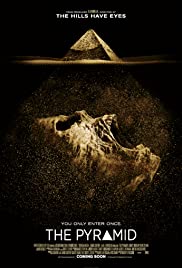
You’d think a horror movie called The Pyramid would have the decency to trot out a few bandage-wrapped shufflers for Old Times’ sake, but director Gregory Levasseur (better known as the writer for High Tension and The Hills Have Eyes) decided to go another way.

Nutshell: An archaeological expedition enters a previously undiscovered pyramid, awakening several inhabitants, including feline zombie servants of Bas, and apparently the god Anubis himself.

Egyptian curses. We never learn.

The defilers of the sacred tomb spend the majority of their screen time crawling through ancient, perfectly symmetrical tunnels in search of an exit, triggering deadly traps and getting mauled by a wrathful jackyl-headed CGI monster that’s actually not too shabby to behold.

The most riveting sequence involves a woman helplessly impaled on wooden stakes being slowly eaten by undead cats. Needless to say, this predicament doesn’t sit well with the victim, who howls for release.

Though The Pyramid is ostensibly a found-footage feature, the POV is all over the place so it’s best not to focus on this aspect.

Instead, settle in for a fast-moving conveyer belt of doomed tomb raiders meeting their fates in memorably macabre fashion.

Again, no mummies are featured in The Pyramid. But the curse is a killer.

Overlord (2018)

Underwhelmed is more like it.

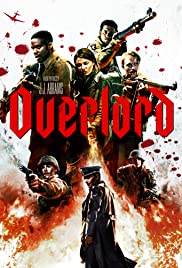
By most standards, Overlord is a pretty cool WW II movie about a platoon of parachutists dropped behind enemy lines in occupied France. Told from the point of view of a nervous black soldier (Jovan Adepo), the squad members who don’t perish upon landing hit the ground and regroup near a small village.

Their mission is to blow up a strategic tower held by the Nazis to pave the way for the imminent Allied invasion.

The soldiers discover that the Nazis are performing weird science experiments on the local peasant community and Boyce (Adepo) pauses the mission to lend a hand.

This is all well and good, if you’re in the mood for a bracing war movie. My complaint with name producer J.J. Abrams is that Overlord underperforms as a horror movie.

While the battle sequences are reasonably compelling, we don’t get to the monster portion of the program till well past the 70-minute mark.

And to be honest, it was just okay. Fine even.

The effects, makeup and set demolition are on point, and Kommander Wafner (Pilou Asbaek) is a formidable uber-villain.

But director Julius Avery and writer Billy Ray spend far too much screen time cooped up in the attic of plucky French partisan Chloe (Mathilde Ollivier), establishing the presence of Chloe’s dopey kid brother Paul (Gianny Taufer).

As we all know, this is for the sole purpose of predictably using him as a hostage bargaining chip going forward.

I wish that the brain trust behind Overlord would have allotted more time and energy to creating memorable monsters, with less concern for conventional plot devices.

The nasty Nazi hybrids that we spend the entire film waiting for, are too few and far between to mount much of a threat, and that’s my chief beef.

I recall a trailer for Overlord two years ago that blew me away, breathlessly hinting at Third Reich abominations the likes of which we’ve never seen.

Unfortunately, I’ve seen Frankenstein’s Army, and it’s a much better and weirder horror movie, along similar lines.

Despite my ire, this isn’t a negative review. Overlord is solid entertainment that promises more than it delivers, never really cashing in on the story’s monstrous potential.


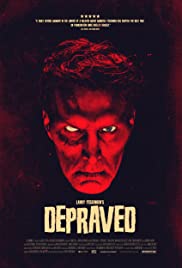
Depraved (2019)

Big Apple underground auteur Larry Fessenden has been referred to as a 21st Century Roger Corman, not only for his ability to nurture talented indie directors (Jim Mickle and Ti West, among others), but presumably because his productions tend to be of the fast and cheap variety.

Yet Corman’s monster matinees bear little resemblance to Fessenden’s sparse, puzzling, and always provocative genre features like Wendigo, Habit, and The Last Winter, where flawed, well-meaning characters encounter or create something that fundamentally changes who they are and the world they live in.

In Depraved, Fessenden’s ambitious, miniature rendering of Frankenstein, we meet Henry, a shell-shocked Army doctor (David Call) who reanimates an assemblage of body parts (Alex Breaux) with the help of his benefactor, Polidori (Joshua Leonard), a scheming pharmaceutical engineer. The only marginally monstrous creature is dubbed Adam, which Henry admits sounds “corny” at first.

Instead of a mad scientist’s laboratory, we get an airy Brooklyn loft where Henry tries to be a supportive creator, but he’s constantly interrupted by his worried girlfriend Liz (Ana Kayne), and bored, impatient Polidori, who impulsively takes Adam out for a night on the town, replete with strippers, whiskey, and cocaine.

Henry proves ill-equipped to be a mentor, with his own wartime trauma never far from the surface. When Adam runs away from the loft in search of female companionship, Henry properly freaks out.

Meanwhile, Adam meets Shelley (Addison Timlin), a pretty barfly who likes Iggy Pop, but it wasn’t meant to be.

As is usually the case in Fessenden films, things don’t work out because his characters are so clearly defined (and doomed) by their inability to adapt to a changing world.

Depraved deserves more attention, especially since Universal Pictures seems bloody determined to reboot its monster franchise after one dismal, expensive flop (The Mummy) and one surprising hit (The Invisible Man).

Fessenden is exactly the sort of budget-friendly, problem-solving hired gun who could (and should) figure into their long-range plans. With Depraved, he ably demonstrates that his take on classic horror honors the past, but can’t wait for the future.


Trick (2019)

By the narrowest of margins, I’m going to recommend Trick.

It was barely compelling enough for me to see it through, largely based on a gutsy performance by Omar Epps as FBI agent Mike Denver, a haunted man tracking a Halloween-masked serial killer.

Epps is the big fish in this cinematic small pond and acquits himself as a true professional, elevating a maxed-out credit-card budget and a ponderous script to a level that is almost entirely serviceable.

Nutshell: Anonymous adolescent Patrick (“Trick”) Weaver (Thomas Niemann) becomes an internet celebrity after flipping his mask and stabbing a bunch of classmates at a Halloween party. Despite being gutted by a fireplace poker, falling out a five-story window, and getting shot several times by Denver and Sheriff Jayne (Ellen Adair), Trick’s body is never found.

Coincidentally, teens in neighboring towns are similarly slaughtered on subsequent Halloweens, leading a determined Denver to ponder the possibility of a copycat killer—or one that’s seemingly returned from the grave.

Director and co-writer Patrick Lussier is an industry lifer with editing credits that date back to MacGyver in the late 1980s. It’s not surprising that Trick is competently crafted in terms of action and pace, and there’s more than enough blood and guts to pacify the psychos.

However, if you’re paying attention at all, there are plot holes aplenty, and when some characters we barely know reveal themselves to be key figures in a vast conspiracy, the effect is more confusing than clarifying.

Mostly what you get with Trick are familiar bloody tropes taped together in haphazard fashion, in the hope that genre fans will recognize and appreciate a very modest tribute.


Southbound (2015)


The Allman Brothers were right. The road goes on forever—in hell!

With its parallel storylines laid out in nonlinear fashion, Southbound plays like a supernatural Pulp Fiction. Characters overlap briefly in a moment of transition, and the next tale of damnation/redemption begins, with narration by a lonesome DJ (Larry Fessenden), who functions as a sort of high desert Crypt Keeper on the road to nowhere.

“The Way In” and “They Way Out” are the bookend narratives that frame the action, as a pair of hit men (Matt Bettinelli-Olpin and Chad Villela) attempt to outrun their fates on an infernal stretch of highway that has no exits, no cell phone reception, and no hope.

An all-girl rock band tries to keep it together despite creative differences and being bewitched by wholesome cultists (led by Dana Gould), in “Siren.”

A distracted driver (David Bruckner) creams a woman in distress and calls 911 for help in “The Accident.” Sounds sensible, but who answers the phone?

An obsessed avenger (David Yow) searches for his sister in a small town populated by unfriendly folks.

For anyone who’s never seen an episode of The Twilight Zone, this might be a plot spoiler, but it becomes pretty obvious, pretty fast, that these events are taking place in the Netherworld.

Both the the highway itself and the little communities it serves are a perpetual purgatory where lost souls can relive the worst nights of their lives on a continuous loop.

Some characters develop self-awareness and accept life in limbo, finding it preferable to being torn apart by demons, as befalls anyone foolish enough to think there’s a way out through the desert.

Plot spolier #2. There isn’t.

The various segments are written and directed by an assortment of creatives, some more talented than others, but the overall entertainment value offered by Southbound is bountiful indeed. Yes, it’s worth the trip.

Added Value: Take a drink whenever a character says, “What the fuck?”


Bone Eater (2007)

If revisiting primetime TV stars from the 1980s is your idea of a good time, then you and Bone Eater should be very happy together. Just turn off the lights and lock up when you’re done.

From Hollywood’s dustiest concept drawer comes this Southwestern yawner about a greedy developer (like there’s any other kind) whose earth-moving antics awaken a Native American demon that looks like a giant Rastafarian skeleton. It can jump really high and rides a ghost horse.

Bruce Boxleitner, from Scarecrow & Mrs. King, is a rather WASP-y looking Native American sheriff forced to summon the courage and wisdom of his ancestors to smite the foul creature back to hell or wherever.

Michael Horse (Twin Peaks), Veronica Hamel (Hill Street Blues), and William Katt (The Greatest American Hero), appear just long enough to illicit cries of “Wait! What show were they on?” from the hopefully long-in-the-tooth viewing audience.

Not enough sci-fi star power, you say? How about Gil Gerard (Buck Rogers) and Walter Koenig (Star Trek) for some added sizzle? Hey, we all gotta eat.

Veteran schlock purveyor Jim Wynorski (Not Of This Earth, Chopping Mall, and lots of cable porn), is responsible for this bloodless crapfest, that features janky CGI, vanishing subplots, and a handful of familiar faces reciting crap dialogue.

It’s worth noting that Wynorski used a pseudonym for his work on Bone Eater. Do not engage.

Note: Can we retire the damn flute flourish that has been associated with Native Americans onscreen since forever? It’s become a tiresome cliche.