Hyenas (2011)

Now here’s an example of the much-talked-about “so bad it’s good” genre.

Yes, it’s definitely possible to have a movie that’s rife with crap writing, indifferent acting, and feckless direction that is nonetheless diverting. Of course, Hyenas is helped out by sporadic nudity, but writer-director Eric Weston seemed to inject his actors with a certain “who gives a shit” elan, that goes a long way toward keeping the laughably lame action watchable.

Ambulatory side of beef Costas Mandylor plays Gannon, a grieving bad-ass whose wife and baby were ambushed and devoured by a pack of shape-shifting hyena folk that came to America during the days of the slave trade.

He teams up with Crazy Briggs (Meshach Taylor from Designing Women, who can’t decide if his character is supposed to be a Rasta, a Cajun, or a Delta bluesman) to thin the pack, since the cunning predators are becoming plentiful and increasingly aggressive.

Meanwhile, in one of the subplots that no one cares about, the small Arizona town where the story takes is seething with adolescent unrest, as a dipshit bunch of townies are looking to rumble with the local Latino contingent.

Somehow, these storylines overlap somewhere down the line, and it all boils down to a final battle in a nearby abandoned copper mine where shit will be blowing up shortly.

Weston fearlessly tacks on endless scenes that have absolutely nothing to do with were-hyenas and their taste for human flesh, but the effects and gore are serviceable, and hyena Alpha female Wilda (Christa Campbell) generously removes her top on several occasions, which helps mitigate the annoyance factor of the lousy acting.

Amanda Aardsma in particular, who plays devious hyena hottie Valerie, delivers one of the most mind-blowingly awful dramatic performances I’ve witnessed in recent memory. She’d have to study with Lee Strasberg for 10 years just to improve enough to be cast as an understudy in a community theater production of West Side Story.

But either in spite of, or thanks to the graceless ineptitude on display, Hyenas kept me engaged. I would recommend it as a bland-tastic palate cleanser between better films.

Malevolence (2004)

I believe the concept of crooks on the lam hiding out in a haunted house dates back to Buster Keaton. True, in Malevolence, the crooks are hiding next door to a haunted house—and it’s only haunted inasmuch as there’s a deranged serial killer living there. A very similar motif is used (more successfully, I might add) in the Andy Serkis black comedy The Cottage (2008). But Malevolence is not a waste of time.

Julian (R. Brandon Johnson) and Marilyn (Heather McGee) are the couple we’re supposed to care about, but they’re not all that likable. They get mixed up in a bank heist with Marilyn’s hoodlum brother Max (Keith Chambers) which concludes with everyone fleeing the scene and Max mortally wounded. As Marilyn thoughtfully reminds Julian several times that it’s his stupid fault her brother took a bullet, one gets the distinct feeling that this couple ain’t gonna make it. Meanwhile, the other member of their gang, Kurt (Richard Glover, a poor man’s Jeff Conaway), kidnaps a young mother and her tomboy daughter, and takes them to the remote hideout where the robbers are supposed to reconnoiter and divide the money. Unfortunately, the hideout isn’t quite remote enough; right next door there’s a decrepit factory farm inhabited by a bargain-brand Michael Myers (the Halloween killer, not Austin Powers) who brings his steely chopping knife to the party.

Nothing too subtle at work in Malevolence; it’s a lot of chasing back and forth outside at night, with a little bit of Ed Gein rural weirdness mixed in. Writer, director, producer, and composer Stevan Mena does a competent job of keeping things lean and tense, though his protagonists suffer from a kind of collective amnesia that prevents them from making sure the killer is dead, which probably would have shortened the movie by a good 20 minutes. Come on people, it’s the 21st Century! You know as well I do that if you’re fortunate enough to knock the maniac down, you MUST continue to beat on the body till it resembles guacamole. And we’ve known this for at least 25 years.

The Midnight Meat Train (2008)

I haven’t read enough Clive Barker to decide if I’m a fan or not, but he certainly spins a fascinatingly lurid yarn. The Midnight Meat Train is based on one of his short stories, and it’s a bloody fun ride, even though I kept thinking I was watching a chopped up version that had scenes missing. There are moments when the action inexplicably jumps from Point A to Point M, and you wonder how the hell we got here.

A right-before-he-got famous Bradley Cooper plays Leon, a wannabe artsy photographer trying to capture “the beating heart of New York City” to impress snooty art dealer Susan Hoff (Brooke Shields), who advises him to take more chances, and not run away when danger rears its ugly head. He starts hanging out in the subway during the wee hours of the morning and stumbles upon a very dapper and intense-looking butcher (Vinnie Jones, in a silent part), and is immediately compelled to follow him around. (How do we know he’s a butcher? Well, he carries a meat mallet the size of Mjolnir, for one thing.) Sure enough, it appears his new-found subject is a methodical serial killer who’s been making late-night subway riders disappear for quite some time. Poor Leon realizes too late, that the butcher’s grisly nocturnal rituals are all a part of (sung in Elton John voice) “the c-i-r-c-l-e of l-i-i-i-f-e!”

Anytime you pad out a short story into a feature length film, there’s going to be filler, and The Midnight Meat Train is no exception, but for the most part, director Ryuhel Kitamura and screenplay scribe Jeff Buhler keep it fast and gruesome. The ending is pure Whiskey Tango Foxtrot, but it’s not a cop-out. It’s surprisingly weird and horrible, and hints at a “bigger picture” that’s even more terrible than we had first supposed. And that, folks, is what good horror should do. What, no sequel?

The Woman in Black (2012)

Also known as Harry Potter and the Angry Mother’s Ghost.

OK, I made that up, but The Woman in Black is noteworthy for reasons other than the presence of Daniel Radcliffe.

The movie marks the return of the Hammer Films imprint. As a lineal descendant of stately Brit-horror celluloid like The Brides of Dracula and Night Creatures, The Woman in Black is a worthy addition, with an expansive sense of dread invoked by proper gothic storytelling.

True, it comes rattling with haunted house tropes that are as well worn as Jacob Marley’s chains, but my admiration for its almost-gentlemanly ability to coax scares remains undiminished.

Radcliffe plays Arthur Kipps, a morose young attorney with a broken heart, who apparently has been slacking on the job after the death of his wife. Kipps is told by a less-than-sympathetic boss to get his lawyer ass to a remote village to sort out the paperwork of a recently deceased client.

Problem 1: The villagers remove the welcome mat upon his arrival.

Problem 2: The paperwork resides at Eelmarsh House, a decaying mansion that appears to be sinking into a swamp.

Problem 3: The house is fiercely haunted by the ghost of a woman who lost her son due to the negligence of the house’s previous occupants.

Problem 4: Whenever the ghost gets restless, village children start dying.

Problem 5: The ghost is restless now, so Kipps takes it into his head to play ghostbuster and lay the spirit to rest, perhaps in an effort to come to terms with his own tragic past.

The storyline advances in predictable fashion, but even so, it’s a reliable yarn that crackles like a fresh log on the fire. Rather than recalling vintage Hammer stock, I was reminded of The Changeling with George C. Scott; a familial tragedy with a supernatural revenge motif that’s told earnestly, but with skill and vigor.

However, I must point out one incredible scene that makes me wonder what director James Watkins and writer Susan Hill (based on her novel) were smoking at lunch break.

Kipps hits upon the outré idea of recovering the body of the young boy who drowned in the marsh, in an attempt to appease the pissed-off apparition.

So he and his friend Mr. Daily (Ciarán Hinds) go gamely splashing around underwater near the boy’s grave marker until they find and retrieve the muddy little bugger from his aquatic resting place.

For some reason, this sequence reminds me of poor Bela Lugosi in Bride of the Monster, forced to wrestle with an inanimate octopus in a cold tank of water.

I would just like to ask Watkins and Hill, who in the hell would ever entertain such an outlandish scheme for even a moment? Nobody, that’s who, and certainly not a clever young wizard.

Cabin in the Woods (2011)

Autobiographical side bar: I am old, old, old. I am not Li’l Sharky, Teen Sharky, or even Adult Contemporary Sharky. I’m Ol’ Sharky, an ancient relic from a cooler and weirder world. I carried Agamemnon’s sword; argued with Aristotle; and dogged Cleopatra like she was made of bacon. I shit the pyramids and danced with dinosaurs. I used to carpool to work with Gilgamesh, and even he called me “Gramps.” So when I tell you that I don’t go to the movies much anymore, you’ll begin to understand why. It’s too risky. I can’t be away from my climate-controlled condo for lengthy periods or my aorta will explode. I tried once, and the Visigoths that run the multiplex refused to let me pitch my oxygen tent in the theater. Bastards. All bastards.

Even so, I found myself in the vicinity of a theater with time to kill yesterday, so I purchased a ticket for the moving pictures and saw Cabin in the Woods. I’m very glad that I did. Joss Whedon is getting justifiably blown by critic and fanboy alike for hitting a box-office home run with The Avengers, but that’s no reason to overlook this marvelous muffin basket of a monster movie that he produced, co-wrote, and (second unit) directed. Sadly, the specifics of the story arc prevent a detailed critique, but let’s just say that this is a horror movie on a grand “meta” scale that dwarfs Wes Craven’s Scream series.

What Whedon does with Cabin in the Woods is place the late 20th century horror movie, and more specifically the subcategory known as Hack and Stack (a.k.a. Doomed Teenage Campers), into a miraculous context, one that weds the most dreadful aspects of Lovecraft and Phillip K. Dick. Whedon has created a horror movie mythos that dares to explain why its characters make such monumentally bad decisions, and why it’s imperative that the fools suffer before meeting their (mostly determined) gruesome fate. It’s a groovy concept, but really, just this once.

I don’t anticipate a rash of imitators, because this looks to be a genre only big enough for one. And Cabin in the Woods is it. At the same time, I can understand why some horror fans didn’t care for it. To them I would say, don’t think of this movie as an attempt to subvert the genre in a contrived or overly clever way—it’s more of an elegant novelty, an intricate lark that stands as a singular testament to outside-the-box thinking. In other words, Whedon’s laughing with us, and not at us.

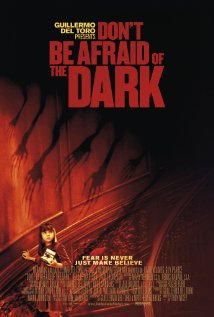
Don’t Be Afraid of the Dark (2010)

Seems to me there was a fair amount of interchat about this slick remake of a revered 1973 made-for-television movie—and most of it wasn’t flattering. “Not Del Toro enough,” was the general consensus. “Horror by numbers.”

Guillermo del Toro, director and writer (he co-wrote and produced this one) of such treasured titles as The Devil’s Backbone, Pan’s Labyrinth, and the Hellboy flicks, certainly carries a weighty pedigree.

But I don’t agree with conventional wisdom.

To me, Are You Afraid of the Dark is textbook Del Toro: a lonely, uprooted child moves into a creepy, dangerous environment and must confront an evil presence.

Any of that ring a bell?

The child in this case is Sally (Bailee Madison), a petulant and defensive kid who’s being shuffled off to live with her architect father Alex (Guy Pierce) and his girlfriend Kim (the cute-as-a-button Katie Holmes), while they fix up a sprawling baronial country estate in Rhode Island.

Editor’s Note: If I was a petulant and defensive child I would have wet my pants at the prospect of living in this friggin’ castle. It even has ruins! Eeeeee!

Anyway, Sally soon becomes aware that the house is infested with mean little varmints that live in the basement who want her to “come and play with them.”

However, as the introductory flashback reveals, these are murderous wee folk—vicious furry anthropoids about the size of rats who carry blades, whisper dark threats, and snack on the teeth of children.

They also hate light. The story builds slowly (perhaps too slowly, for some), as Alex believes his daughter has gone bonkers, while the more sympathetic Kim finds Sally’s tale has the ring of truth.

And then their construction foreman turns up sliced to ribbons, to really complicate things.

While it’s true that Don’t Be Afraid of the Dark moves at a leisurely pace, I really didn’t mind, because newbie director Troy Nixey obviously stuck pretty close to Guillermo del Toro’s script (co-written with Matthew Robbins), so the mood and tension are deftly elevated, as our heroine Sally descends, a centimeter at a time, deeper into the bowels of the awful house and its fiendish inhabitants.

The blood and guts are doled out sparingly, but that’s to be expected in a movie that’s more a grim fairy tale than a body count buffet. It’s also a very, very handsome film and unusually absorbing.

Recommended.

The Pack (2010)

Stop the Interwebs! In fact, just drop what you’re doing for the next 81 minutes, crack a cold one, and summon The Pack from your Netflix netherworld. Don’t think! Just watch, because it’s a gem, a Horrificflicks revelation.

The Pack, a French-dubbed rural nightmare, is quite simply the most finely rendered horror film I’ve seen in a long, long time, at least since Neil Marshall’s The Descent. It’s successful in every sense: Original yet referential; gory but restrained; funny but not goofy, and it’s not horror lite, either.

It’s chock-a-block with cringe-inducing scenes, but the delicious jolt of shock doesn’t get washed away in a tedious “pain for the sake of watching pain” tidal wave. It’s too artfully evocative (it’s a beautifully shot movie) and carefully orchestrated to be mere torture porn, but it is relentless—like a dream that keeps going from bad to worse.

Final (Only?) Girl Charlotte Massott (the gutsy and striking Émilie Dequenne), is driving through uncharacteristically blighted French countryside, cranking speed metal, and smoking. Some bikers have been on her ass, hassling her for a while, so she decides to pick up Max (Benjamin Biolay), a hitchhiker who is perhaps a touch less sinister than the bikers she’s trying to avoid. She pulls up and says, “If you pull out your dick, I’ll hammer you!” With a stone impassive face that he wears for the entire movie, Max replies, “It’s too cold anyway.” (Practically a Truffaut opening!)

Evidently Charlotte is a remarkably trusting soul, because she takes a catnap while Max (whom she’s known for about 6 minutes) drives. When she wakes up, they’ve stopped at a ramshackle backwoods saloon/gas station/arcade, run by massive Madame La Speck (Yolande Moreau, whose maternal, Kathy Bates-like performance is terrific). At this point, the wheels come off for Charlotte and everything gets real weird and bleak, real quick.

A true horrorphile will be happier than a puppy in puke spotting subtle and shady references to Psycho (“Oh, Mother!”), The Texas Chainsaw Massacre (horrible hillbillies); Night of the Living Dead (flesh-eating, blood-sucking stumbling humanoids); and Pumpkinhead (farm setting, hayseed occultism, genuinely frightening beastie[s], lots of shots of windmills), not too mention every variation of Why Strangers Passing Through Blighted Lonely Territory Should Never Pick Up Hitchhikers, Much Less Go To Their Lair.

Writer-director Franck Richard’s The Pack boasts so many well-chosen fiendish delights, that I could sit here all day singling out its virtues. Instead, I’ll just point out a couple:

It’s a real shock when the monsters arrive. They don’t look stock or schlocky. I would compare them favorably to something dreamed up by Guillermo Del Toro.

The acting is strong across the board, including Phillippe Nahon, a Charles Durning lookalike who plays a Columbo-ish cop, and wears a shirt that reads “I Fuck On The First Date” throughout the film.

The action gets progressively grimmer, but Richard doesn’t dwell overly long on the suffering. There is a “circle of life” at work here that’s hideous in its organic inevitability. Make no mistake, no one will be disappointed with their level of discomfort.

Even so, The Pack never panders; it’s never sensational and garish for its own sake. Rather it has a soupçon of Tim Burton’s fairy-tale-gone-horribly-wrong sensibility, combined with Sam Raimi’s quick, decisive cuts. And the gruesome proceedings are tastefully seasoned with odd, welcome interludes of humor.

If I really had to compare The Pack to another film, it would be Clint Eastwood’s The Unforgiven: It’s genre filmmaking utilized to its full potential. It’s a familiar template that Richard is working from, but he raises the bar on quality and originality to the ceiling. I kept thinking I knew what was going on, because I’ve seen these stranded-motorist scenarios in hundreds of movies. But I was always surprised by something far stranger than I was expecting.

I kept waiting for the other shoe to drop, but instead, Richard kicked my ass with it. To my fellow fans hungry for a quality horror experience, all I can add is, go and enjoy. Heck, I may watch it again. What’s 81 minutes on a Sunday?

Legend of the Bog (2009)

Bog men. Can’t say I’ve seen too many.

Hell, I don’t even know how to categorize it. I’m going to go with “monster” since bullets don’t stop them and they’ve been preserved in peat for 2,000 years—even though this particular “bog body” looks more like a cross between Tor Johnson and Curly Howard: In other words, big, bald, and on a mindless rampage.

An assortment of Irish folks, including an archaeologist (Jason Barry), his foxy assistant (Nora-Jane Noone, who has the best pouty face this side of Mila Kunis), and a bitchy, ambitious real estate developer (Shelly Goldstein), get lost on the moors (“I told ye to mind the moors!”) and incur the wrath of a recently resurrected 2,000 year-old-man bog man (Adam Fogerty).

The bog man is being hunted by Hunter (Vinnie Jones, a.k.a. The Juggernaut in X-Men: Last Stand), who is understandably disappointed to discover that his conventional weapons are useless against the massive savage. Can the archaeologist figure out how to return the brute to his soggy coffin?

The problem with Legend of the Bog is that it tries to cram too many elements into a modest story and the plot sinks like a weighted body into a bottomless mud hole. OK, so we have a reanimated bog man who needs to keep himself hydrated regularly to survive.

Fine. It’s part of his DNA or something.

Then, we find out the seemingly random bunch of victims aren’t random at all, a development that adds nothing whatsoever to our emotional attachment to them.

Why did writer-director Brendan Foley bother to somehow justify a killing spree by this hairless gorilla? Waste of time.

On top of that, we’re saddled with a “who cares” romantic subplot, and a shower scene that contains no nudity.

Again, why bother?

Atrocious (2010)

I’m quite good at suspending my disbelief. Trust me, when it comes to horror, I have a very limber set of standards in that department.

And as much as I liked Atrocious, a found-footage frightener from Spain, I had some serious reservations believing that central characters July (Clara Morelada) and her brother Cristian (Cristian Valencia), would continue to schlep their camcorders around after figuring out that a fiendish killer is stalking them at their family’s rural retreat.

“Oh my God, there’s a fiendish killer in the house with us! Do you have a spare battery pack?”

Uh huh. It’s a shame too, because Atrocious has the makings of a crackerjack movie.

Teen siblings July and Cristian are spending their vacation with Mom (Chus Pereiro), Dad (Xavi Doz), and adorable kid brother Jose (Sergi Martin) at a Spanish country estate that comes equipped with its own massive hedge maze.

The pair fancy themselves as intrepid ghost-hunting, mystery solvers so they bring along two video cameras, which is a stroke of luck for the cops when they discovery that everyone’s been murdered about a week later.

After sifting through 37 hours of footage, the final cut serves as the movie itself. If you surmised that there would be an abundance of chaotic night scenes frantically shot by the protagonists whilst lost in the hedge maze, give yourself a gold star.

There is some first-rate fright footage here. And the actors playing July and Cristian are very good, very natural. Atrocious is worth the time it takes to watch, but the surfeit of film (not to mention battery power) is a contrivance that each viewer will have to sort out for themselves.

It doesn’t ruin the experience, but you may find yourself (as I did) shouting, “Oh come on, already!” at the screen on several occasions.

Tale of the Mummy (1998)

Here’s another sleeper that I owe to the fine folks over at the Horror Movie A Day site (horror-movie-a-day.blogspot.com). Thanks gents!

I was just recently bemoaning the fact that mummies are an underutilized movie monster. (And don’t bring up that crappy CGI-riddled Brendan Fraser series. Because it sucks, that’s why not!)

So why the reluctance to embrace the mummy? They’re undead, like vampires and zombies—but they aren’t as charismatic as the former, nor as utilitarian as the latter. They’re slow, predictable, and only deadly in confined spaces.To paraphrase Stephen King, “Uh oh, the mummy is chasing us. We’d better walk away briskly.”

Fortunately, in Tale of the Mummy, veteran rock video director Russell Mulcahy (Razorback, Highlander) gives us Talos, a decent mummy upgrade from the ol’ Universal Pictures shuffler, and then smartly pumps up the Egyptian mysticism in order to flesh out the frights. Mulcahy’s predilection for flash-and-pop visuals works well here, making even the drearier parts of London look suitably glam-noir.

As these things so often do, the story begins with a doomed archeological expedition, this one led by (a round of applause, please) Sir Christopher Lee, as Sir Richard Turkel. He and his cohorts unwisely enter the cursed tomb of Talos, a cruel and sadistic ex-pharaoh whose spirit gets awakened, only to be freed by Turkel’s granddaughter Samantha (Louise Lombard) 50 years later.

Talos wastes no time in wasting various reincarnated versions of himself (including a dog!), harvesting their organs in preparation for an impending planetary alignment that could restore him to full power (not a good thing for humanity, needless to say).

His main method of murder is rather clever, animating his bandages to flutter about formlessly in the breeze before strangling his victims. Tale of the Mummy is a fun, visually sumptuous yarn, one that moves quickly and looks great doing so.

Bonus: The cast is chock-full of familiar faces, and character-actor fan-boys and girls will squeal with delight at cameos by Christopher Lee, Shelley Duvall, Michael Lerner, and Jon Polito, not to mention young unknowns like Gerard Butler, Jack Davenport, and Sean Pertwee, who get some decent screen time here to pad those resumes for future greatness.

More mummies? Please?