The Babadook (2014)

babadook

Not to put too fine a point on it, but The Badadook is one of the most emotionally devastating horror movies I’ve ever seen.

It’s quite a brilliant film that manages to be both a dark, heroic fairy tale and a grimmer-than-grim slice-of-life family drama about an overworked mother who tries, but can’t cope with her eccentric son’s disturbing behavior anymore.

It’s also about a terrified young boy who’s mother might be going insane.

Amelia (Essie Davis, who shines like a young Jessica Lange) is the harried widowed mother of Samuel (Noah Wiseman), a clever but damaged young boy who doesn’t fit in at school or with friends. Amelia’s husband died in a car accident on the way to the hospital the night she gave birth, so she too has a dark cloud of unresolved issues that follows her around like a nervous dog.

Mother and son clearly love each other, but their life is difficult, to say the least. One night, during the evening bedtime story, Samuel selects the wrong book and an evil spirit is loosed in the house.

As if they didn’t have enough trouble…

The combination of Amelia’s waking, working nightmare of a life, and the additional strain placed on her by the malign presence that’s settled in her home creates an unrelenting pressure cooker that would crumble a commando.

The Babadook is without gore and very little violence, yet it’s brutally draining, recalling both Polanski’s Repulsion and William Friedkin’s The Exorcist for its merciless plunge into the sea of madness.

Australian writer-director Jennifer Kent presents us with a tale that cuts uncomfortably close to the bone, because she had the nerve to invent two characters who are believable, likable, sympathetic—and profoundly haunted.

True, in the past, I’ve griped about movies that waste time on character development when all we really want is mayhem. The Babadook is exactly the opposite. It’s a realistic character-driven story in which we hope that misfortune can be averted because we’ve grown emotionally attached to the protagonists.

The bottom line, that bad things happen to good people, is more horrifying than a thousand dead campers.

Mr. Jones (2013)

mrjones

The consensus opinion on writer-director Karl Mueller’s feature-length debut is that it has all the makings of a first-class frightener—but falls apart at the end, like a child’s first soufflé. I think the finale boils down to two possibilities, neither of which ruined the experience, in my opinion. In Mr. Jones, Mueller has created a vivid, found-footage nightmare that runs its course effectively, before running smack-dab into an ambiguous conclusion. Ambiguous, in this instance, does not mean half-assed or inexplicable.

Nutshell: An attractive couple severs its ties with civilization and sets up housekeeping in a remote mountainous locale (The Sierra Nevada range, if I had to guess). Scott (Jon Foster) is intent on making a nature documentary, that fizzles out before it starts. Girlfriend Penny (Sarah Jones) is worried about her partner, who’s gone off his medication and lost interest in the film project that would undoubtedly make them both rich and famous. (Add sarcasm font to the preceding statement.)

They soon become aware of a mysterious neighbor who gambols around in a hooded cloak, and Penny deduces that it is none other than Mr. Jones, a reclusive artist famous for creating unsettling life-sized scarecrows that got shipped out to seemingly random recipients around the world. And now their documentary has a new subject!

As the couple investigates Mr. Jones further, it becomes apparent that the artist is some sort of sorcerer or shaman who’s guarding the borders where various dimensions overlap. Penny’s convinced he’s benign, but Scott isn’t so sure. During a massive storm, all hell breaks loose and the fledgling filmmakers lose each other in the chaos. Queue up an ending that leaves us with more questions than answers, and roll credits.

I thoroughly enjoyed Mr. Jones. It successfully keeps us off balance, unsure of anything that’s taking place before our eyes. As for the ending that got stuck in everyone’s craw, there are two possible explanations. The first is that Scott, upon abandoning his meds (for what condition, we’re not told) has a reality break from which there is no return. The footage they’ve shot suggests that Mr. Jones is Scott himself, but this is hard to verify since there seem to be good and evil versions of both characters running around.

The other theory is that Scott did something to screw up the wards that Jones had put in place to protect our world against impending evil, resulting in the latter’s death. Now it’s up to Scott take his place as the new dimensional guardian. Which is only fair, if you ask me.

Haunter (2013)

MV5BMjEwNDc1MTI3Ml5BMl5BanBnXkFtZTgwNjI5ODU0MDE@._V1_SY317_CR0,0,214,317_AL_

Can a plucky ghost solve a mystery and prevent a murder? A thoughtfully askew haunted house tale, Haunter tells the story of a fiendish serial killer (Stephen McHattie) through the eyes of one of his victims, a teenage ghost named Lisa (Abigail Breslin, who is excellent). She and the rest of her deceased family are tragically housebound in a time loop on the day that her father Bruce (Peter Outerbridge) succumbs to the influence of the murderer’s evil spirit and kills his kinfolk. Needless to say, all attempts to escape the house result in failure.

Lisa has “woken up” to the fact that she and her loved ones are doomed to relive the same day over and over, and she rightfully sees no future in it. Sensing another presence in the house, Lisa does her best Nancy Drew impression to figure out what’s going on and discovers that a different family (in the present day) is dwelling in the house and are in danger of repeating her family’s fate, as the killer’s ghostly presence is on the verge of causing another dad to turn homicidal.

Director Vincenzo Natali and writer Brian King bring a number of fresh elements to Haunter, particularly the idea that a lost soul can redeem itself by trying to save another. Breslin, nattily attired in her Siouxsie and the Banshees sweatshirt and Chuck Taylors, is winningly courageous as a sullen teen (spirit) who decides to quit wallowing in her own misery to battle the malignant entity that caused her untimely demise. Haunter is both compelling and reasonably horrifying without being accompanied by buckets of blood or resorting to tired tropes. It flows like a cracking good YA novel—one that’s dandy entertainment for the whole ghost family.

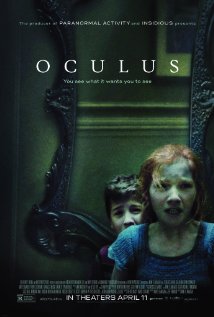
Oculus (2013)

MV5BMzE1NzM4MjEyNV5BMl5BanBnXkFtZTgwMjYzMjMzMTE@._V1_SX214_AL_

Speaking as a somewhat jaded horror buff, there are definitely times when the surfeit of unmitigated crap available on Fear.com, Netflix, Amazon and Hulu can weigh heavy on the soul. To make matters worse, it’s often the same unmitigated crap wherever you look! Sure, I enjoy revisiting familiar tropes as much as the next pinhead (A camping trip? What a lovely idea! I’ll bring my videocamera so we can capture each magic murder… I mean, moment!), but there are times when the self-imposed limitations placed on the genre can shred one’s patience. If boredom and burnout levels are approaching critical, I suggest spending an evening with Oculus, director/cowriter Mike Flanagan’s deceptively devastating homage to a haunted mirror.

Eleven years ago, Kaylie Russell and her younger brother Tim watched in horror as their father Alan (Rory Cochrane, from Dazed and Confused!) murdered their mother Marie (Katee Sackhoff, from Battlestar Galactica!). Young Tim (Brenton Thwaites) grows up in a mental institution while Kaylie (Karen Gillan) reaches adulthood with a burning desire to banish the evil spirit that haunts the mirror in her father’s study that she believes to be responsible for his descent into murder and madness.

Tim and Kaylie are reunited when the former is released from the booby hatch on his 21st birthday, and she wastes no time in collaring her kid brother to help her destroy the cursed object. Much to her dismay, Tim has learned his mental health lessons well, and is currently convinced that his sister is cut from the same crazy cloth as Daddy.

Oculus works for the very reason that so many fright flicks don’t: the characters. Flanagan takes his time with the telling details that go into the construction of the doomed Russell family. Alan is a hardworking and caring father, but he’s a control freak and prone to rages. Marie adores her children, but doesn’t have the tightest grip on reality. Kaylie is the dominant child who simultaneously protects her brother and encourages him to take increasingly desperate measures fueled by her obsession with the evil looking glass.

The actual onscreen horror is judiciously portioned out; the movie is neither swimming in blood nor dry as a bone. The vast and vivid array of outré details are seamlessly stitched into the action—and the reason they will scare the soup out of you is because director Flanagan expertly mixes illusion, fantasy and reality to the point where we can’t trust the information that our eyes are transmitting. When that happens, it’s all over, baby. Enjoy! I know I did.


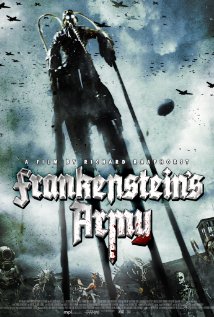
Frankenstein’s Army (2013)

MV5BMjA1NDE0MzcyMF5BMl5BanBnXkFtZTcwNTU2MzA3OQ@@._V1_SY317_CR5,0,214,317_AL_

OK, this bad boy rocks.

If you haven’t seen anything worth inviting into your Netflix queue lately, Frankenstein’s Army is a brilliant remedy.

What we have here is a disturbing Weird War tale with steampunk accoutrements fitted into a “found-footage” frame, with a visual aesthetic that’s bold and nightmarishly distinctive.

In the waning days of World War II, Russian troops are streaming into Germany, wreaking havoc along the way. One such unit is accompanied by Captain Dimitri (Alexander Mercury), a cameraman making a documentary about these “heroic” soldiers.

While holed up in a bombed-out village, the group discovers a church converted into a mad scientist’s lab and are soon set upon by the most outré pack of Nazi zombie-robot-monsters I’ve ever seen.

Frankenstein’s Army is a Czech/US/Netherlands co-production filmed in the Czech Republic, which perhaps goes a long way toward explaining its unique appeal.

A hearty shake of my flippers goes to director and story man Richard Raaphorst, who hits a horror home run his first time at bat.

Admittedly, the lengths needed to preserve the found-footage premise become increasingly (and purposely, I think) absurd as a 70-year-old Soviet movie camera is able to capture pristine audio while getting tossed around like a Samsung at a frat party.

But Raaphorst is a filmmaker with vision: his nimble mind invents extraordinary beings, and like Dr. Frankenstein (Karl Roden), he has the ability to bring them to life.

He’s clearly not just another fawning acolyte of Sam Raimi or Tim Burton—if anything, his work reminds me of England’s once-reigning madman, Ken Russell.

Take it from me, Frankenstein’s Army is some very fresh hell, indeed. Highly recommended.

Camp Hell (2010)

MV5BMTM3MjIxOTc1Nl5BMl5BanBnXkFtZTcwNDU1MzI4Mg@@._V1_SY317_CR0,0,214,317_

I think that if a movie is featured on Fearnet Channel it should, in fact, be a horror movie.

While writer-director George Van Buskirk is able to cobble together a few ominous sequences, Camp Hell, for the most part, is a tepid coming-of-age film in which brooding protagonist Tommy Leary (Will Denton) decides that the fundamentalist sect of the Judeo-Christian faith that has enveloped his family and friends is not to his liking.

On behalf of everyone who managed to sit through this sleepy spectacle, I would just like to add, “Congratulations.”

And “Who gives a shit?”

Obviously Van Buskirk must be connected to “somebody” in the filmmaking community, because he managed to cajole Andrew McCarthy, Dana Delany, Bruce Davidson and Jesse Eisenberg into appearing in this painfully amateurish production, that looks like it was shot on Super 8.

Throughout its 99 interminable minutes, Camp Hell (originally titled Camp Hope—Oooh! Scary!) attempts to dress-up an adolescent lad’s clumsily symbolic account of losing both his virginity and his religion, with occasional references to Satan, who seems to be lurking in the bushes at Camp Hope, a strict Christian camp run by authoritarian asshole Father Phineas (Davidson).

Sadly, there is no Satan, no demon, no monster, no murder, no nothing, no kidding.

Even the scene where Tommy dry humps his girlfriend for the first time, and thus opening the doorway to all sorts of temptations and pleasures of the flesh—has all the drama and passion of a QuikBooks tutorial. 

The power of Christ and I compel you to avoid Camp Hell.


Stitches (2012)

Unknown

Come on, send in the clowns already!

In this case, the horrific harlequin is none other than Richard “Stitches” Grindel (Ross Noble), a kid-hating misanthrope who lives in an old school bus on the outskirts of town.

After a fatal encounter with a party of very naughty children, the vengeful jester rises from his clown grave to seek bloody revenge. My hat is off to Irish writer-director Conor McMahon (From The Dark, Dead Meat), who has fashioned a frenetic visual fun-house of grotesquery that rivals Peter Jackson’s Dead Alive in both gushy gore and belly laughs.

Like most clowns, Stitches is down on his luck and needs to occasionally tap the lucrative birthday party circuit to keep his kinky girlfriend in hooker shoes.

Sadly, the brats attending Tommy’s party are narcissistic sociopaths suffering from ADD, and instead of being treated to an inspiring afternoon of professional buffoonery, they torment the miserable merrymaker to death!

Tying his clown shoes together results in a face-plant into the dishwasher where a carelessly placed carving knife awaits.

Frankly, these little turds deserve to die horribly, and they do, in a rash of over-the-top impalings, gougings, and decapitations that follows in the wake of Stitches’ sinister resurrection ceremony conducted by his malevolent clown brethren.

If you only see one movie about a zombie clown this year, make it Stitches. You’ll be glad you did.

Night of the Demon (1957)

MV5BNTY2NDY2NTkwNV5BMl5BanBnXkFtZTcwNTI3OTkxMQ@@._V1_SY317_CR3,0,214,317_

Let’s dispense with the chit-chat and get down to the Nitty Gritty Dirt Band: Whether you see it as Night of the Demon (the full-length British feature) or Curse of the Demon (the American version with 12 minutes edited out), you’re in for a sweet ride.

Based on the M.R. James short story “Casting the Runes” this black-and-white creep-a-thon is required viewing in the horror canon—and if your tender sensibilities can’t fathom a scary movie without a shower scene or diced camper, then I suggest you move on.

Generic 1950s leading man Dana Andrews stars as John Holden, an American psychiatrist and skeptic, who travels to England to expose “devil cult” leader Julian Karswell (Niall McGinnis) as a fraud.

The problem is, he isn’t one, and soon Holden realizes the avuncular Karswell has slipped him a piece of paper with a powerful curse on it. (I think it translates as “Hey demon, please mangle and mutilate whatever sorry sack of shit has the misfortune to be in possession of this here paper. K? Thanks!”)

Karswell coolly informs Holden that he will be taking a dirt nap in three days, prompting the spooked shrink and his comely sidekick (Peggy Cummins) to race around the English countryside in search of a solution.

Credit the skills of veteran director Jacques Tourneur for creating a true atmospheric classic. Demon, as well as previous films such as The Cat People, I Walked With a Zombie, and the noir masterpiece Out of the Past (Robert Mitchum’s best movie?) demonstrate Tourneur’s finesse with camera angles and his juggling of light and shadow to create menace.

The apocryphal story of Demon concerns the studio’s decision to have an actual demon appear at the beginning and end of the film, contrary to the wishes of Tourneur.

IMHO, it would have been a fine movie without it, but I appreciate the effort to give viewers a nightmare they can take home with them. It’s really not a bad demon; I’ve seen much worse.

Werewolf: The Beast Among Us (2012)

MV5BMjA0OTM0MzAyNV5BMl5BanBnXkFtZTcwOTUyNjQ1OA@@._V1_SY317_CR17,0,214,317_

If, like me, you viewed the Hugh Jackman vehicle Van Helsing as mere brain-dead spectacle, then be of good cheer. Werewolf: The Beast Among Us is an efficient example of how to perform genre gene splicing without relying on a bombardment of cheesy CGI to impress the yokels in the third row.

It’s sort of a rollicking Eastern European cowboy version of John Carpenter’s Vampires with a few wink-worthy nods to Jaws, steampunk fashion and the original Wolf Man—including a reprise of Maria Ouspenskia’s famous gypsy poem (“Even a man that’s pure of heart/And says his prayers by night…”).

Somewhere in the dark forests of Transylvania, in the latter part of the 19th century, a merry band of werewolf hunters rolls into a village currently under siege from members of the lycanthrope community. But, as several characters knowingly declare, “this is no ordinary werewolf!”

The hunters are led by taciturn gunslinger Charles (Ed Quinn) and the swashbuckling Stefan (Adam Croasdell), and aided in their quest by local lad Daniel (Guy Wilson), a medical student working for the town doctor (Stephen Rea). As the nimrods close in on an exceptionally wily werewolf, the townsfolk begin to realize that there is indeed, a “beast among us.”

Perhaps due to its obvious budget limitations (Hello, it’s filmed in Romania!), director Louis Morneau pumps up the fun factor and relies on a capable supporting cast (Rea, Stephen Bauer, Nia Peeples) to tell this ripping werewolf yarn.

The hunters are a posse of cool killers, especially Kazia (Ana Ularu), who fries her foes with a makeshift flamethrower and Fang (Florin Piersic) who takes a bite out of crime with his silver choppers. The werewolf CGI isn’t particularly inspired, but Morneau wisely lets a guy in a suit handle the closeup carnage when limbs are torn off and guts are gushing.

A genuinely pleasant surprise.

The Attic (2007)

MV5BMjExODI2OTg1NF5BMl5BanBnXkFtZTcwNjEzOTEzMg@@._V1_SY317_CR0,0,214,317_

I haven’t really watched Mad Men, so actress Elisabeth Moss is kind of a revelation to me. If you haven’t seen her in the miniseries Top of the Lake, directed by Jane Campion, I suggest you do so, because it’s totally brilliant, and so is she.

In The Attic, a younger Moss portrays Emma, the increasingly delusional protagonist in a rural-goth take on Polanski’s Repulsion. Wait, did I say delusional? Perhaps she’s just a curious insect that’s wandered into the wrong fly trap.

Emma lives in a house near the woods. Her father (John Savage) and mother (Catherine Mary Stewart; who could ever forget the classic Night of the Comet?) are hopeful that she’ll finally want to go to college, but Emma prefers traipsing around the house in her nightie or exploring the creepy attic with her developmentally disabled brother Frankie (Tom Malloy, who also wrote the script).

A psychiatrist (Thomas Jay Ryan) is called in by the parents, but Emma proves to be a patient with more layers than a blooming onion.

Moss is riveting as Emma, an unmoored girl in the wrong place at the wrong time. Is she going insane? Has she been possessed by a malevolent house spirit? Are Mom and Dad conspiring against her?

Like Rover with a new soup bone, you’ll be chewing on the possibilities for a while. That said, The Attic is by no means perfect: Director Mary Lambert (Pet Semetary, lots of Madonna videos) definitely built this one to be a slow burner—rich in atmospheric dread but with the action (and bloodletting) more strategically rationed.