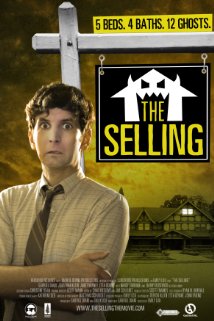
The Selling (2011)

MV5BMjI0ODYwNzY0MV5BMl5BanBnXkFtZTcwNTUyMTkxOA@@._V1_SX214_-1

M’lady did not care for The Selling, at all. She thought it was corny and childish. Total amateur hour. Long pointless scenes. An unfunny comedy. For the most part, I agreed with her, and still do—yet I quite liked it. Apparently, girls not only mature faster than boys, they mature far longer. Does that make sense?

The truth is, The Selling is nothing more than an old-fashioned spook-house comedy, a genre that peaked somewhere around the time of The Ghost and Mr. Chicken. And my inner 12-year-old (which greatly resembles my outer 50-year-old), was delighted. I giggled like a mental patient all the way through it. M’lady thinks me deranged, or at least a case for arrested development. Maybe deranged development is most accurate.

Screenwriter and star Gabriel Diani is dweeby Los Angeles real estate agent Richard Scarry—you know, like the children’s author—who needs to make a pile of dough in a hurry to pay for his mother’s cancer treatment, which, unsurprisingly, is ungodly expensive.

Richard and his dopey pal Dave (Jonathan Klein) get talked into buying a murder house by hot/conniving Realtor Mary Best (Janet Varney) and are then forced to somehow fix-up and flip a house that’s haunted by the 12 victims of a serial killer known as the Sleep Stalker.

The Selling is at its best in the world of real estate chicanery, as our knucklehead protagonists attempt to get an extremely haunted house ready for a “showing.” Meek little Richard attempts to reason with the ghosts, telling them that he is, in fact, in a rather tight spot, and has no choice but to try and sell the house. The ghosts respond with a volley of plagues that would have driven saner, smarter men to head for the hills.

Richard and Dave are not Ghostbusters or even especially competent; they’re just a pair of goofy schnooks that get in over their heads. At least Richard is rewarded with a romantic interest, the extremely bubbly paranormal blogger Ginger Sparks (Etta Divine) who helps them make contact with the spirit world. Comedian Simon Helberg has a small part, and veteran scene chewer Barry Bostwick shows up as a bumbling exorcist.

From all accounts, this was a shoe-string operation, financed the friend-and-family way. So I have to give it up for Diani and director Emily Lou. Here they have cinematic evidence of sufficient wit and inventive moxie to handle a bigger budget. The Selling never tries to be anything more than a sweet, amusing and somewhat corny contemporary haunted house flick. And it more than meets that modest goal.

ParaNorman (2012)

MV5BMjA1OTU1NDM3N15BMl5BanBnXkFtZTcwMjYxNTg0Nw@@._V1._SY317_

I live in Portland, so I like to keep up on what the locals are up to. ParaNorman is the second feature from Laika Studios, the stop-motion animation outfit from neighboring Hillsboro that was responsible for the Neil Gaiman adaptation Coraline from a few years back. I dug that one, and I also quite liked ParaNorman, though it was less visually stimulating than its predecessor. Still, for a piece of family entertainment, it was surprisingly entertaining.

Norman Babcock is a young man with the uncanny Sixth Sense ability to see ghosts as easily as he sees the living bullies who torment him on a daily basis. He’s a friendless outcast—except for happy-go-lucky imbecile Neil—and even his mom, dad, and ditzy blond sister Courtney don’t understand him.

Norman lives in Blithe Hollow, a community cursed by a witch who was hanged 300 years before by the superstitious citizenry. Every year the witch threatens to come back, raise the dead, and exact her revenge on the town. And this year, she’s going to succeed, unless weirdo Norman can save the day.

Writer/director Chris Butler creates a vivid array of characters that manage to transcend cliche by imbuing them with the ability to learn from their mistakes and grow. The parents, the bully, the dumb jock, the paranoid townspeople, the zombies, even the witch herself—a raging ghost with a grudge—are given the chance to redeem themselves and move on as better people (or monsters or whatever).

There are thoughtful and delicate layers to the story that prove hugely rewarding. It’s also a damn funny film (a rarity in the “family friendly” department), and I thoroughly enjoyed the scenes where Norman watches zombie movies while his dead grandmother sits knitting on the couch nearby, or when his friend Neil gets to play fetch with the ghost of his pug, who’s now in two pieces after getting run over by a car. Cute for sure, but also genuinely affecting.

My only real beef is with the art direction, as the movie’s color palette is a relentless combination of brown, black, and purple, and my eyes got a little bored. It’s also rough and unpolished looking, but I believe this is deliberate, since ParaNorman is at heart a homage to the title character’s beloved Grade-Z, cheap-o horror movies.

The Road (2011)

MV5BMTA0ODg4OTc5NDNeQTJeQWpwZ15BbWU3MDU5Mjg4MDc@._V1._SY317_CR2,0,214,317_

Purely for marketing purposes, they should have called this movie something other than The Road. The Cormac-McCarthy-post-apocalypse-tale-turned-Viggo-Mortensen vehicle was barely two years old, and it’s hard to create word-of-mouth excitement if you have to continually explain that the movie you’re recommending is not that one. But recommend it I will.

This curious import from the Philippines is both a fearsome ghost story and a very soulful meditation on evil, and more specifically “the sins of the father” concept.

Three restless teens borrow a car and go out for a midnight joy ride. None has a driver’s license, so they turn off the freeway and head down an old unmarked road—and the trap is sprung!

A nightmarish sequence ensues as the kids are stalked by vengeful ghosts and an unseen killer. Eventually the cops arrive on the scene under the command of recently decorated Detective Luis (TJ Trinidad) who sees uncanny parallels in this case to those of an old unsolved homicide.

There are plenty of supernatural fright elements at play in The Road, but writer-director Yam Laranas puts the most muscle into telling a ghost story born of an all-too-familiar domestic tragedy. The movie is a triptych of tales (the present, the past, the distant past) that remain firmly rooted in a poison tree that bears deadly fruit. (Note: trees don’t figure into the story; this is what we call a metaphor.)

The pace can be a bit sluggish, but in my opinion, the added weight given to characters and landscape makes The Road a much more vivid trip.

The Innkeepers (2011)

Based on viewings of The House of the Devil and now The Innkeepers, I feel prepared to weigh in on writer/director Ti West.

He’s certainly a talented visual stylist; there is some awesome, unsettling snake-crawling camera work in The Innkeepers. He knows how to build tension; his films are painstakingly set up, as the female protagonists become ever-so-slowly enmeshed in a deadly web fueled by their own curiosity.

My beef with West is that in both cases, the payoff falls short. It’s as if he’s used up all his tricks in the first three-quarters of a slow-burning movie before deciding to end the thing with … I dunno, ghosts or some shit. It’s really frustrating.

Nutshell: Claire (the plucky Sara Paxton) and Luke (Pat Healy) are stuck with desk duty for the last weekend of business at The Yankee Pedlar, a century-old hotel somewhere on the east coast.

Luke has a paranormal website that tracks “supernatural” events from the hotel, as it’s rumored to be haunted by a jilted bride who hung herself several decades earlier.

For the final 48 hours, the bored employees double-down on their investigations in order to get hard evidence of an actual spook.

There is a definite post-modern vibe to The Innkeepers (sassy pants celeb Lena Dunham even has a cameo as an overly chatty barista), that’s somewhat distracting. Luke and Claire are funny and likable, but in a generic, woefully underdeveloped way, and they come across as “types” rather than characters.

Paxton gives it her all, but the film’s transition from meta, self-aware horror movie to genuine horror movie is clumsy. When the ghosts start to make their presence known, I honestly didn’t know whether to prepare myself for scares or to just keep the action at an analytical arm’s length, as I’d done up to now.

The first half of the movie is so … tame and lightly goofy, it could almost be a spooky after-school special or latter-day Disney film. And then there’s ghosts.

This probably isn’t my most articulate review, as I’m still debating the merits of the Ti West oeuvre. What I can say for sure is that there’s something crucial missing from his films, perhaps a willingness on West’s part to commit to either tongue-in-cheek hipster amiability or full-tilt frights.

He’s trying to have his cake and eat it too, and his work seems disjointed, neither fish nor fowl—and his finales are decidedly unsatisfying.

In the words of Mrs. Sharky, who watched this one with me, “That’s it? Hell, this movie could have been 20 minutes long and you wouldn’t have missed a thing.”

In other words, your patience is not rewarded.

The Reeds (2010)

Boy, I hate it when my tranquil weekend of boating with friends turns into a blood-soaked nightmare.

After thousands of movies in which a back-to-nature retreat results in death and dismemberment, you’d think people would just stay the eff home. Watch Nature Channel, or some shit. But noo-oo-oo!

Three unexceptional couples hit upon the brilliant idea of renting a boat for a river excursion through a remote British waterway that’s choked with (cue the title) reeds!

So what form of doom will they encounter on their nautical getaway? Ruthless delinquents as in Eden Lake? An insidious beastie from the depths? Piranhas? Killer kelp?

Nope, the crew gets mired in a tragic feedback loop between an angry loner and a bunch of scruffy mute kids, who are seemingly locked in an eternal spiral of antagonism—despite the fact that the rugrats have been dead for decades. Talk about holding a grudge…

The claustrophobic spell cast by the forlorn, colorless landscape gives The Reeds a crucial boost of atmosphere, and the silent band of urchins are a creepy lot. And while director Nick Cohen is possessed of sufficient skills to keep things relatively interesting, it’s a glacially-paced affair without much in the way of action—though the anchor impalement scene was a welcome highlight.

The Reeds is worth a viewing, but only if it’s a slow news day and all your chores are done.

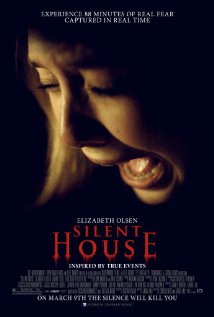
Silent House (2011)

Seldom have I had such a thoughtful and productive conversation while sitting through a “haunted house” movie. For this I should thank my brainy friend Kaja Katamay who chose to watch it with me. Since there’s very little dialog, we were free to analyze, theorize, and hypothesize all through Silent House and not miss a word. (And no one told us to STFU!) Our observations about the characters proved uncannily accurate: I suggested that Sarah (Elizabeth Olsen, fetching younger sister of Ashley and Mary-Kate) behaved as though she’d suffered a traumatic episode, and Kaja suspected the supporting cast of treachery. Right on both counts.

Nutshell: Sarah meets up with her father, John (Adam Trese), and Uncle Peter (Eric Sheffer Stevens) to help fix up and hopefully flip the family summer house. Things don’t work out quite as well they do on Property Brothers, as Sarah becomes increasingly anxious while wandering through the rambling hacienda. Just so you know: the house is completely boarded up to discourage vandals. There’s no electricity. Cell phones no workee.

Directors Chris Kentis and Laura Lau—who previously helmed Open Water, chose to film Silent House in real time as if it were one continuous shot. It wasn’t, but this audacious gambit definitely adds a sense of first-person urgency to the events as they unfold, especially as Sarah gets closer and closer to the heart of darkness. By the way, Elizabeth Olsen acquits herself quite well in what must have been a demanding role. As Sarah, she’s a 21st century upgrade to the Scream Queen: she’s a victim who tries ineffectually to keep her fear buried in the sub-conscious, until she has no choice but to fight back—and emerge triumphant.

The Woman in Black (2012)

Also known as Harry Potter and the Angry Mother’s Ghost.

OK, I made that up, but The Woman in Black is noteworthy for reasons other than the presence of Daniel Radcliffe.

The movie marks the return of the Hammer Films imprint. As a lineal descendant of stately Brit-horror celluloid like The Brides of Dracula and Night Creatures, The Woman in Black is a worthy addition, with an expansive sense of dread invoked by proper gothic storytelling.

True, it comes rattling with haunted house tropes that are as well worn as Jacob Marley’s chains, but my admiration for its almost-gentlemanly ability to coax scares remains undiminished.

Radcliffe plays Arthur Kipps, a morose young attorney with a broken heart, who apparently has been slacking on the job after the death of his wife. Kipps is told by a less-than-sympathetic boss to get his lawyer ass to a remote village to sort out the paperwork of a recently deceased client.

Problem 1: The villagers remove the welcome mat upon his arrival.

Problem 2: The paperwork resides at Eelmarsh House, a decaying mansion that appears to be sinking into a swamp.

Problem 3: The house is fiercely haunted by the ghost of a woman who lost her son due to the negligence of the house’s previous occupants.

Problem 4: Whenever the ghost gets restless, village children start dying.

Problem 5: The ghost is restless now, so Kipps takes it into his head to play ghostbuster and lay the spirit to rest, perhaps in an effort to come to terms with his own tragic past.

The storyline advances in predictable fashion, but even so, it’s a reliable yarn that crackles like a fresh log on the fire. Rather than recalling vintage Hammer stock, I was reminded of The Changeling with George C. Scott; a familial tragedy with a supernatural revenge motif that’s told earnestly, but with skill and vigor.

However, I must point out one incredible scene that makes me wonder what director James Watkins and writer Susan Hill (based on her novel) were smoking at lunch break.

Kipps hits upon the outré idea of recovering the body of the young boy who drowned in the marsh, in an attempt to appease the pissed-off apparition.

So he and his friend Mr. Daily (Ciarán Hinds) go gamely splashing around underwater near the boy’s grave marker until they find and retrieve the muddy little bugger from his aquatic resting place.

For some reason, this sequence reminds me of poor Bela Lugosi in Bride of the Monster, forced to wrestle with an inanimate octopus in a cold tank of water.

I would just like to ask Watkins and Hill, who in the hell would ever entertain such an outlandish scheme for even a moment? Nobody, that’s who, and certainly not a clever young wizard.

Cabin in the Woods (2011)

Autobiographical side bar: I am old, old, old. I am not Li’l Sharky, Teen Sharky, or even Adult Contemporary Sharky. I’m Ol’ Sharky, an ancient relic from a cooler and weirder world. I carried Agamemnon’s sword; argued with Aristotle; and dogged Cleopatra like she was made of bacon. I shit the pyramids and danced with dinosaurs. I used to carpool to work with Gilgamesh, and even he called me “Gramps.” So when I tell you that I don’t go to the movies much anymore, you’ll begin to understand why. It’s too risky. I can’t be away from my climate-controlled condo for lengthy periods or my aorta will explode. I tried once, and the Visigoths that run the multiplex refused to let me pitch my oxygen tent in the theater. Bastards. All bastards.

Even so, I found myself in the vicinity of a theater with time to kill yesterday, so I purchased a ticket for the moving pictures and saw Cabin in the Woods. I’m very glad that I did. Joss Whedon is getting justifiably blown by critic and fanboy alike for hitting a box-office home run with The Avengers, but that’s no reason to overlook this marvelous muffin basket of a monster movie that he produced, co-wrote, and (second unit) directed. Sadly, the specifics of the story arc prevent a detailed critique, but let’s just say that this is a horror movie on a grand “meta” scale that dwarfs Wes Craven’s Scream series.

What Whedon does with Cabin in the Woods is place the late 20th century horror movie, and more specifically the subcategory known as Hack and Stack (a.k.a. Doomed Teenage Campers), into a miraculous context, one that weds the most dreadful aspects of Lovecraft and Phillip K. Dick. Whedon has created a horror movie mythos that dares to explain why its characters make such monumentally bad decisions, and why it’s imperative that the fools suffer before meeting their (mostly determined) gruesome fate. It’s a groovy concept, but really, just this once.

I don’t anticipate a rash of imitators, because this looks to be a genre only big enough for one. And Cabin in the Woods is it. At the same time, I can understand why some horror fans didn’t care for it. To them I would say, don’t think of this movie as an attempt to subvert the genre in a contrived or overly clever way—it’s more of an elegant novelty, an intricate lark that stands as a singular testament to outside-the-box thinking. In other words, Whedon’s laughing with us, and not at us.

The Messengers (2007)

Please tell me if there’s an existing category for this well-chewed cinematic scenario: Family suffers urban-based trauma and decides to relocate to a nice, quiet, haunted house in the boonies.

The Shining is the most obvious example, but there are dozens of pale imitations, including this quaint little Kristen Stewart vehicle from five years back.

Directed by Hong Kong power players the Pang Brothers (The Eye films, Bangkok Dangerous, among others), The Messengers is first and foremost, a serviceable platform for Stewart’s photogenic petulance, brought to the screen courtesy of the boffo box-office returns fromThe Twilight saga.

Rising to the challenge, the spunky teen actually carries the movie. Of course, when you’re costarring with bored stiffs like Dylan McDermott (Dad) and Penelope Ann Miller (Mom), you needn’t have been Lee Strasberg’s star pupil to dominate the screen.

To her credit, Stewart gamely steps up to the plate, exuding Buffy confidence while delivering her lines with Locklearian panache.

BTW, am I the only one who confuses Dylan McDermott with Dermot Mulroney? Surely not!

In The Messengers, Stewart stars as Jess, the rebellious progeny of McDermott and Miller, who are leaving the temptations of Sodom and Gomorrah in the rear-view mirror in order to get back to the land, specifically as sunflower farmers in rural Saskatchewan.

You gotta admit; that’s a new one.

Sure enough, the family’s optimism for a fresh start is soon crushed to crumbs when it appears that their rustic farmhouse comes with creepy crawly specters of the previous occupants, who fell victim to a case of Jack Torrance Syndrome, also known as Daddy’s Got The Ax, Again.

This was a Ghost House production and Sam Raimi was one of the executive producers. The Pangs do a decent job of combining their talent for weaving blankets of dread with Raimi’s trademark splashy spook-tacular shocks.

The Messengers is a 100 percent sustainable movie, since the entire plot consists of recycled materia. Even so, the filmmakers went to considerable effort to pique our interest, and we don’t have to work too hard to swallow the Ghoul-Aid.

Please read the last sentence in a Crypt Keeper voice. It sounds better.

At the moment I’m leaning toward “Buyer Beware” as the name of this genre. “Real Estate Gone Wrong,” maybe? “Glengarry Glen MURDER?”

The Oregonian (2011)

I’ve been employed as a writer and editor in Portland since 1994 (more or less).

So when I saw that a new horror entry on Netflix had the same name as our daily newspaper, I just assumed it was the terrifying story of an aging copy editor with limited skills trying to remain employed in the face of career obsolescence.

For better or for worse, this is not the case. Instead, writer-director Calvin Reeder works awfully hard to create a symbolic nightmare—with marginal results.

The Oregonian opens on a girl (Lindsay Pulsipher, from True Blood; think Reese Witherspoon’s disturbed kid sister) driving away from a farm (and a drunk abusive father figure). This is followed by a a vague car accident in which “the Oregonian” (Pulsipher, I guess) smashes a couple of unlucky picnickers into pickle relish.

When she regains her senses (if in fact, she ever does), the titular damsel finds herself lost in a weirdly malign universe that bears a striking resemblance to David Lynch’s subconscious.

Looking for help, and finding nothing of the sort, the girl meets a menacing witch (more of a ticked-off art teacher, really); a guy in a truck who doesn’t speak (much) but gives her a ride, before collapsing at the conclusion of a massive, multicolored piss.

There’s also a tall guy in a green fuzzy monster suit who probably represents some part of her psyche that she’s unwilling to confront.

It seems like Reeder is trying to tell us something, but he ain’t using his words.

Instead, it’s Lynch, Lynch, Lynch, as far as the eye can see. The soundtrack is crammed with shrieks, radio static, buzzers, voices, and other intrusive distractions.

The lonesome, rainy sets could be Twin Peaks B-roll, even down to a shot of the girl walking across the same railroad bridge that poor Ronette Pulaski wandered over, lo those many years ago.

Reeder gets a points for being a dexterous (though derivative) visual stylist, but his fevered homage is more endurance test than entertainment.

I could withstand films like The Oregonian back when I was young and my head was still supple; now I just want my 90 minutes back.