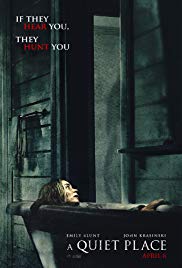
A Quiet Place (2018)

Count me among those who thought A Quiet Place was an adaptation of the excellent Tim Lebbon novel, The Silence. The similarities are many, but chief among them is that both stories take place after the world has been decimated by blind, winged predators that attack sounds.

Furthermore, in each case the plot revolves around a family with a hearing impaired daughter, who have managed to stay alive due to their mastery of sign language. Coincidence? I hope Lebbon got paid for his trouble.

Real-life couple John Krasinski (who also directs and co-wrote the script) and Emily Blunt, star as Lee and Evelyn Abbott, the parents of three, whoops, make that two kids, who live the quiet life on several rural acres.

Perhaps not thinking far enough ahead, Lee and Evelyn conceive another baby, which, as we all know, never make any noise. If you can get passed this rather obvious lapse in logic, then you should remain emotionally invested enough to make it through the entire movie, as Mom and Dad heroically protect their offspring from flying terrors that look like gargoyles imagined by H.P. Lovecraft.

The Abbott clan’s desperate need to remain stone silent under any circumstances (including childbirth and stepping on a goddamn nail) keeps the stress level near the tipping point. And then it spills over into the audience where it belongs.

As the title suggests, the biggest change of pace happening here horror-wise, is the lack of not only dialogue, but sounds in general. A Quiet Place exists in an enviably noise-free environment, where children are encouraged to play the Quiet Game on a full-time basis, lest they become lunch.


Crawl (2019)

Treated myself to a new movie from Amazon, and settled on Crawl, the turbid tale of Haley, a dutiful daughter (Kaya Scodelario), who drives into the heart of a Florida hurricane to rescue her injured dad (Barry Pepper).

Complication One: Dad’s trapped in the cellar of their family home and it’s rapidly filling up with water.

Complication Two: The rising floodwaters are teeming with bloodthirsty alligators.

This is not an intricate narrative, and director Alexandre Aja (High Tension, Piranha 3D, The Hills Have Eyes) wisely keeps the focus on what’s going to pop out of the water next. There is some obligatory backstory about the bond between father and daughter, forged while the the latter trained to be a competitive swimming champion, but it’s just enough to make the audience understand that Haley has a fighting chance against the gators.

As the waters rise, Aja tightens the screws to the point where one can’t help shouting out words of encouragement to Haley and her pop, such as, “Get out of there, dummy!” or “Stop thinking about old swim meets and haul ass!”

There’s not much dialogue in Crawl. Seriously, the script is probably like 10 pages long, and both Scodelario and Pepper play their parts to the hilt while submerged in bloody water. Ultimately, the movie succeeds because Aja never allows us the leisure time to get bored with their plight.

It’s one crisis after another, and they’re usually hungry.

Bad Moon (1996)

Werewolves, like mummies, have been relegated to second-tier movie monsters, no question. Just ask Benicio Del Toro.

On the other hand, there are fantastic werewolf movies, that any cinephile worth their silver bullets should pay rapt attention to this Halloween season. Joe Dante’s The Howling and John Landis’ American Werewolf In London (both released in 1981) are two crucial examples. If you haven’t had the hair-raising pleasure, get on them before the wolfsbane blooms. Chop, chop!

Since lycanthropes get little love from the critics, I’m going to point you in the direction of something rare and valuable: a very watchable werewolf fable with a hero dog, called Bad Moon.

Written and directed by legendary weirdo Eric Red (screenwriter of The Hitcher and Near Dark, among others), the movie stars deadpan tough guy Michael Paré, who, once upon a time, was a somewhat bankable actor (Eddie and the Cruisers, 1983, Streets of Fire, 1984).

Here, Paré sinks his teeth into a meaty role as a cursed photojournalist visiting his widowed sister Janet (Mariel Hemingway) in the wooded wilds of the Pacific Northwest.

Unbeknownst to Janet and her son Brett (lovable towhead Mason Gamble), beloved Uncle Ted recently emerged from the jungle after a nasty scrape with a vicious lupine predator, and everyone around him is looking more like Today’s Special with each passing hour.

Fortunately, Thor (Primo), the family German Shepherd, isn’t fooled by this man who looks familiar but smells all wrong. I mean, come on, who goes jogging in the woods all night long?

And thus begins a very real pissing match between guardian and invader.

Other than one sex scene and a few moments of grisly flesh shredding, Bad Moon could be an old Disney film. There’s an inquisitive child, a virtuous mom, a sinister uncle, and a really brave dog.

I’m as surprised as anyone that I got so wrapped up in a boy-and-his-dog movie that I was legit cheering for the fearless canine to save Mom from the Big Bad Werewolf.

Michael Paré and Mariel Hemingway get top billing, but the dog steals the show, plain and simple.

Good boy, Thor.


It Comes At Night (2017)

th

Earning someone’s trust can be tough. If we factor in a deadly plague that’s already wiped out a significant portion of the population, well, then it gets exponentially tougher, especially for two families under one roof.

With It Comes At Night, writer/director Trey Edward Shults has crafted a taut, apocalyptic domestic drama awash in tension and nervous decisions. It’s a movie that’s small in scale, but it carries a sobering interpersonal message that continues to stare humanity in the face.

Paul (Joel Edgerton) is a survivalist ensconced with his family in a deep-woods compound. Everyone wears gas masks and rubber gloves on group expeditions outside, like setting fire to Grandpa (David Pendleton), so we can safely assume something’s in the air.

The shrinking, demoralized tribe eventually welcomes another fleeing family into its barricaded midst, and for a short time new friendships blossom and an alliance is formed. But can real trust survive a viral holocaust? This dilemma weighs heavy on both sides, eventually spelling doom for all parties.

The horrors afoot in It Comes At Night are never fully explained and we have very little by way of actual facts to go on. All the unanswered questions make the danger even more menacing, as speculation and fear take the wheel. What the hell is the source of the contagion? Is there an antidote? How many people are still alive? What’s happening in the rest of the world?

We don’t know. We’ll never know. Not in this story.

Malevolent (2018)

malevolent

When your life is full of evil secrets, ghosts are an occupational hazard—and even a phony ghostbuster can save the day.

American college student Angie (Florence Pugh) is the front for a paranormal investigation racket in Glasgow.

Led by her brother Jackson (Ben Lloyd-Hughes), the four-person team sets up gadgets and spook detectors around the “haunted” house, while Angie makes contact with the restless spirit, imploring them to shuffle off their post-mortal coil. Jackson then swoops in to handle the messy but necessary financial arrangements.

It helps their reputation immensely that Angie and Jackson’s mother was a renowned psychic in her own right, albeit one who came to a sad end.

As word gets around, the team is contacted by Mrs. Green (Celia Imrie), the headmistress at a secluded foster home. Apparently the spirits of three murdered schoolgirls are stirring things up and nobody can get a proper night’s sleep.

There are few surprises in Malevolent, but it’s a tale well-told, as the ghost hunters unwrap a horrible mystery that won’t stay buried, even as their new client begins to suspect she’s been duped by some hustlers.

It’s a handsomely mounted British production, and director Olaf De Fleur effectively uses the decay and desolation of a once-grand estate to act as a visual metaphor for the darkness within.

As the ambivalent Angie, Florence Pugh turns in admirable work. Her point of view is chaotic and troubled, remaining duty bound to her conniving brother, but also coming to the realization that her mother was much more than a lunatic.

Like Del Toro’s The Devil’s Backbone, the presence of ghost children is both terrifying and tragic, blameless victims of sinister intentions who must find a way to be heard so that a longstanding injustice may be rectified.


Dead Shack (2017)

Warning: Stranger Things template in full effect.

A trio of nosy teens and their piss-poor adult supervision spend a weekend at a cabin in the woods. What could possibly go wrong? Since the name of the film is Dead Shack, we can assume they don’t get their cleaning deposit back.

Jason (Matthew Nelson-Mahood) gets roped into a camping trip by his obnoxious friend Colin (Gabriel LaBelle), which works out fine since he has a major crush on Colin’s sister Summer (Lizzie Boys).

Along for the ride are Colin and Summer’s party hearty dad Roger (Donavon Stinson) and his bored alcoholic girlfriend Lisa (Valerie Tian), who has zero interest in bedding down in the boonies with a bunch of goofy adolescents. At least not while sober.

Inevitably, the snoopy kids stumble upon a neighboring house owned by a lady in body armor (Lauren Holly) with a passel of undead kinfolk who need regular meals. Tonight’s Special: You!

Unfortunately, Roger and Lisa are too busy playing cards and getting plastered to listen to such an outlandish story, so it’s up to these wily misfit teenagers to save the day.

Dead Shack lives up to its potential and delivers splashy fun and flying body parts in Raimi-esque abundance.

With all the baggage present, director Peter Ricq could simply have allowed these characters to speak their minds, give voice to their dissatisfaction, and engage in Dysfunctional Family Feud for the entire weekend, but then we’d have a Tennessee Williams play instead of a grisly and often-amusing Zombie Comedy (Zom-Com).

We liked it. Worth a look.


The Meg (2018)

MV5BMjg0MzA4MDE0N15BMl5BanBnXkFtZTgwMzk3MzAwNjM@._V1_UX182_CR0,0,182,268_AL_

[To be read with Australian accent]

“That’s not a shark. (pause) Now that’s a shark!”

You win. The Meg stars the biggest shark in sea monster cinema history, so it’s got that going for it. There’s also oodles of action heroics by the reliably shirtless Jason Stathem, a laconic swab with the gumption to save a darling little Pekinese dog from a watery grave right before the end credits.

This is hardly a spoiler. The titular apex predator is indeed a massive beast, but it wreaks precious little carnage on the civilian population. The body count is supplied principally by members of an underwater research station bankrolled by slacker billionaire Morris, played by Rainn Wilson.

His gonzo turn is a standout among a cast that includes such standard plug-and-play characters as a sassy black scientist (Page Kennedy) who sure as hell can’t swim and never signed up for any of this shit.

Stathem is Jonas Taylor, a hard-drinking rescue diver still haunted by a few lives lost during a risky mission several years before. In need of redemption, Taylor returns to the briny deep when his ex-wife Lori (Jessica MacNamee), is marooned and besieged by a prehistoric killing machine at the most remote spot on the ocean floor.

Rather than rekindle with the ex, Taylor is more or less thrown into the arms of Suyin (Bingbing Li), a fetching single mom marine biologist whom he obligingly rescues on several subsequent occasions. For sheer volume of last-second escapes, The Meg is up there with Raiders of the Lost Ark.

But it’s an earlier Steven Spielberg blockbuster that fans still venerate as Lord of the Deep in the giant critter genre. At that point in his career (1975), young Spielberg hadn’t become commodified as the ultimate family friendly filmmaker.

In Jaws, the dog disappears. Remember the kid on the beach throwing the stick to a black lab named Pippet? You see the dog swimming and then the stick washes up on the shore. Spielberg’s movie is both bloodier and scarier, even 40 years later. Current audience research indicates a missing dog won’t cut it with a 21st century crowd.

There is certainly nothing as hair-raising as Ben Gardner’s floating head in The Meg. Instead, it’s a serviceable CGI popcorn flick content to elicit a few gasps—rather than a chorus of screams.

Don’t Breathe (2016)

There’s much to admire about Don’t Breathe, a nasty, audacious thriller directed and co-written by Fede Alvarez and released by Sam Raimi’s Ghost House Pictures. The technical finesse demonstrated throughout adds considerable impact and Raimi-esque flourish to the action, which unfortunately becomes increasingly preposterous under the weight of too many plot points.

Rocky (Jane Levy) is a hardworking single-mom burglar with dreams of relocating to sunny California from her blighted hometown of Detroit (actually filmed in Hungary—way to save money, team!). She and her coworkers Alex (Dylan Minnette) and Money (Daniel Zovatto) tumble onto a caper that looks like a piece of cake: bust into a blind man’s pad and steal a pile of cash that is supposedly on the premises, the result of a huge settlement he reached after a rich girl killed his daughter in a car accident.

The little old blind man (a scary Stephen Lang) turns out to be a chiseled combat veteran with a Rottweiller and a labyrinthine basement full of dangerous secrets, and the bad-ass burglars are soon trapped in a dark house with an even badder-ass “victim.”

The twists and turns that ensue range from deft and effective to downright ludicrous. If Alvarez didn’t feel the need to pad the script with unnecessary dramatic tropes (dead daughter, bad mother memories, male suitor rivalry, pregnancy), he might have had a lean, mean survival flick in the tradition of John Carpenter or Wes Craven. To his credit, he almost pulls it off.

The contrast between the lithe tracking shots of abandoned neighborhoods being slowly retaken by nature, to the tightly focused and creeping claustrophobia of the blind man’s lair is skillfully rendered, and Alvarez earns bonus points for keeping tensions taut.

Sadly, the director undermines that tension with his penchant for telegraphing every development well before it happens with cutaway shots to objects that will play a significant role further down the line.

It’s an annoyingly condescending move designed to eliminate any obligation on the viewer’s part to pay attention. Alvarez cheerfully introduces us to a hammer, a piece of glass, a crowbar, a remote, a couple pairs of shoes, and a pistol hidden under a mattress just so we aren’t surprised when they reappear later.

Sam Raimi can get away with this chicanery in his own movies, but here it falls flat and goes splat.

SaveSave

SaveSave

SaveSave

SaveSave

SaveSave

Train To Busan (2016)

In this case, go ahead and believe the hype. Yeon Sang-ho’s nervy South Korean zombies-on-a-train epic is getting rave reviews, and deservedly so. Not only is Train To Busan a tightly wound horror movie, it’s also a tense disaster film in the spectacle tradition of Irwin Allen.

First and foremost, Train is an expertly paced thriller that darts deftly between hysteria-inducing sequences of undead mobs running amok, and scenes of quiet love and devotion between a father (Gong Yoo) and his daughter (Kim Su-an) that actually succeed in developing their characters to the point where we can root for them in good conscience.

Harried, overworked fund manager Seok-woo must escort his demanding daughter on a train trip to visit her mother and his estranged wife. As so often happens, real life gets in the way of even the best-laid plans, as a nearby chemical leak causes average citizens to turn hungry, fast, and ferocious. The featured zombies have a rubbery acrobatic grace as they gamely snap back to life after succumbing to lethal bites.

All too quickly the train is overrun with bloodthirsty berserkers, and the supporting players emerge from the chaos. There’s a tough guy and his pregnant wife; a high school baseball team; a sociopathic tycoon, and a pair of spinster sisters. Alliances form and crumble, and as we learned in Romero’s original, a house divided cannot stand. As usual, the rich guy can’t be trusted.

Nonetheless, these characters routinely sacrifice themselves for the good of the remaining survivors, continually casting humanity in a noble light. Seok-woo begins the story as an ineffectual office drone, but through attrition and necessity, evolves believably into a hero to save his child.

Director Yeon Sang-ho displays uncanny action-film finesse at times, contrasting the closed-room claustrophobia of the train interior with sweeping panoramic views of an embattled choo-choo chugging down the tracks to its final destination. Train To Busan is indeed a grim ride to survival, but it’s a satisfying one. And the scenery is magnificent.

SaveSave

Krampus (2015)

mv5bmjk0mjmzmti3nv5bml5banbnxkftztgwodeyodkxnze-_v1_ux182_cr00182268_al_

When it comes to seasonal horror fare, Christmas is starting to give Halloween a run for its money, even if you don’t count deranged Santas stalking overbaked adolescents.

Michael Dougherty’s Krampus qualifies as first-rate family entertainment capable of engaging several generations of house pests. It’s got suspense and a bit of gore, but not much actual violence. Think of it as more dark urban fairy tale, or perhaps a Scrooge variation conceived by Tim Burton. (I even watched it with a sensitive friend to make sure it passed the brutality test.)

Like the Dickens’ tale, Krampus is appropriate for the whole clan because of the valuable lessons it imparts. When young Max (Emjay Anthony) is forced to spend another holiday with his cretinous cousins, his increasingly bad humor brings down the wrath of the titular Yuletide deity, an angry “Anti” Claus who will bloody well give you something to cry about, if your Christmas spirit is found wanting.

In other words, he takes instead of gives.

Soon, his family’s snug suburban home is a frozen wasteland with menacing snow men appearing in the yard, setting the table for ol’ Krampus and his hideous helpers to work some dark magic.

A spirited cast, led by Adam Scott (Parks and Recreation), Toni Collette (United States of Tara), David Koechner (Anchor Man) and Alison Tolman (Fargo) work some magic of their own, giving expert comic performances across the board. The movie certainly qualifies as a dark comedy, but the characters reveal surprising depth and decency.

Co-writer and director Dougherty shows a firmer hand with heroism here than he did with either of the X-Men features on his resume.

Like Willy Wonka and the Chocolate Factory (Gene Wilder, RIP), Krampus relishes in the teaching of lessons to naughty kids and their clueless parents. All the petty griping, selfishness, and stupidity gets shoved aside as survival becomes the season’s hottest gift idea.