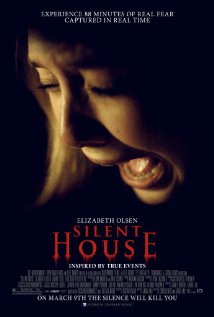
Silent House (2011)

Seldom have I had such a thoughtful and productive conversation while sitting through a “haunted house” movie. For this I should thank my brainy friend Kaja Katamay who chose to watch it with me. Since there’s very little dialog, we were free to analyze, theorize, and hypothesize all through Silent House and not miss a word. (And no one told us to STFU!) Our observations about the characters proved uncannily accurate: I suggested that Sarah (Elizabeth Olsen, fetching younger sister of Ashley and Mary-Kate) behaved as though she’d suffered a traumatic episode, and Kaja suspected the supporting cast of treachery. Right on both counts.

Nutshell: Sarah meets up with her father, John (Adam Trese), and Uncle Peter (Eric Sheffer Stevens) to help fix up and hopefully flip the family summer house. Things don’t work out quite as well they do on Property Brothers, as Sarah becomes increasingly anxious while wandering through the rambling hacienda. Just so you know: the house is completely boarded up to discourage vandals. There’s no electricity. Cell phones no workee.

Directors Chris Kentis and Laura Lau—who previously helmed Open Water, chose to film Silent House in real time as if it were one continuous shot. It wasn’t, but this audacious gambit definitely adds a sense of first-person urgency to the events as they unfold, especially as Sarah gets closer and closer to the heart of darkness. By the way, Elizabeth Olsen acquits herself quite well in what must have been a demanding role. As Sarah, she’s a 21st century upgrade to the Scream Queen: she’s a victim who tries ineffectually to keep her fear buried in the sub-conscious, until she has no choice but to fight back—and emerge triumphant.

Devil (2010)

I missed the memo on why exactly M. Night Shyamalan is now considered such a lame-o. I didn’t see Lady in the Water and I started to watch The Happening but bailed out for some mundane reason unrelated to the quality of the film.

So what happened? Did these two movies suck so unbelievably badly that they reduced the Shyamalan brand to a punch line? And now I’ve built up such a load of anxiety that I can’t bring myself to watch them.

I didn’t realize Devil was co-written and produced by Shyamalan or I might have steered clear, but I’m reasonably glad that I didn’t. Sure, it’s rife with his trademark glib spirituality (or Old Testament as folklore) with a side dish of “you just gotta believe sometimes.”

Even so, it’s a modestly effective thriller about five people trapped in an elevator—one of whom might be Lucifer.

Taking place in a thoroughly modern skyscraper in a thoroughly modern metropolis, five seemingly unrelated people get into an elevator car and become trapped between floors. A dramatic storm sent by obviously sinister forces moves into the area and messes with the electrical system, so getting them out proves complicated.

Detective Bowden (Chris Messina) is the cop on the scene who attempts to organize their rescue, with some help from Ramirez (Jacob Vargas), a particularly devout building security guard who doesn’t like what he’s seeing on the video monitor from the stranded elevator.

Devil offers legitimately frightening scenes as the trapped characters begin freaking out from the steadily increasing paranoia, claustrophobia, and growing suspicion that one among them is not what he/she seems.

More than just a morality play (although there are similarities), the story hangs on a basic Twilight Zone premise that Satan is real, and that from time to time he likes to go out amongst the people in the guise of a particularly unpleasant collections agent.

Seriously, if you’re on this list, you have very few options.

Creature (2011)

Lucky me! I was in the mood for a good ol’ monster matinee and I found one.

It ain’t exactly Ingmar Bergman, but it gets the job done; the horror movie equivalent of a shot and a beer. Creature more than meets the minimum daily requirement of gore and casual nudity, with just enough plot to complement, rather than complicate, the visual carnage.

A half-dozen camping buddies pitch their tents in a remote patch of the Louisiana bayou (“They’re dead already!” I shouted gleefully at the dogs) after being told the tale of Grimly, a local legend that haunts the vicinity searching for food—and a bride.

Note to Doomed Campers: Is your skepticism really more powerful than the possibility that a local legend has some basis in fact? Use your heads people!

Anyway, Grimly is a monstrous human-gator hybrid worshipped by the indiginous population (hillbillies swamp rats), who pass the time of day steering tourists toward the wonders of the bayou.

I’m not sure what the swamp rats get out of this arrangement, but Grimly has a well-stocked pantry and uh, lots of brides. Yes, I am fully aware that the suggestion of a gator-man impregnating some unfortunate lass is going to be a deal-breaker in most households, but the concept does goes back to Greek mythology.

Fortunately, there’s no onscreen miscegenation. And in the interest of full disclosure, I’ll also mention there’s a recurring subplot about incest. Taboos mean nothing when you live in a swamp, I suppose.

The campers are actually a better lot than the usual walking cliches, thankfully eschewing the typical Jock-Nerd-Stoner-Slut-Virgin hierarchy.

Instead, we get a pair of not-too-stupid veterans from Afghanistan, a weird brother and sister team (sshhh!), and the soldiers’ nubile girlfriends, who have no qualms about doffing their duds when the mood strikes them.

The swamp rats include name actors Sid Haig (Chopper) and Pruitt Taylor Vince (Grover) who both lend dependable gravitas to Fred Andrews’ often distracted direction. Speaking of Sid Haig, there’s even a Spider Baby reference!

As for the monster itself, after suffering through an endless parade of shitty CGI creatures that look like they were created on an old Amiga computer, a big guy in a halfway decent rubber suit works just fine for me—even though at times Grimly suspiciously resembles an off-duty Teenage Mutant Ninja Turtle sans shell.

I’d also like to give a shout-out to the Louisiana film industry, who seem to be doing a bang-up job of luring horror movie companies to bayou country, pumping needed money into local economies.

Strong work, one and all!

Hyenas (2011)

Now here’s an example of the much-talked-about “so bad it’s good” genre.

Yes, it’s definitely possible to have a movie that’s rife with crap writing, indifferent acting, and feckless direction that is nonetheless diverting. Of course, Hyenas is helped out by sporadic nudity, but writer-director Eric Weston seemed to inject his actors with a certain “who gives a shit” elan, that goes a long way toward keeping the laughably lame action watchable.

Ambulatory side of beef Costas Mandylor plays Gannon, a grieving bad-ass whose wife and baby were ambushed and devoured by a pack of shape-shifting hyena folk that came to America during the days of the slave trade.

He teams up with Crazy Briggs (Meshach Taylor from Designing Women, who can’t decide if his character is supposed to be a Rasta, a Cajun, or a Delta bluesman) to thin the pack, since the cunning predators are becoming plentiful and increasingly aggressive.

Meanwhile, in one of the subplots that no one cares about, the small Arizona town where the story takes is seething with adolescent unrest, as a dipshit bunch of townies are looking to rumble with the local Latino contingent.

Somehow, these storylines overlap somewhere down the line, and it all boils down to a final battle in a nearby abandoned copper mine where shit will be blowing up shortly.

Weston fearlessly tacks on endless scenes that have absolutely nothing to do with were-hyenas and their taste for human flesh, but the effects and gore are serviceable, and hyena Alpha female Wilda (Christa Campbell) generously removes her top on several occasions, which helps mitigate the annoyance factor of the lousy acting.

Amanda Aardsma in particular, who plays devious hyena hottie Valerie, delivers one of the most mind-blowingly awful dramatic performances I’ve witnessed in recent memory. She’d have to study with Lee Strasberg for 10 years just to improve enough to be cast as an understudy in a community theater production of West Side Story.

But either in spite of, or thanks to the graceless ineptitude on display, Hyenas kept me engaged. I would recommend it as a bland-tastic palate cleanser between better films.

We Need To Talk About Kevin (2011)

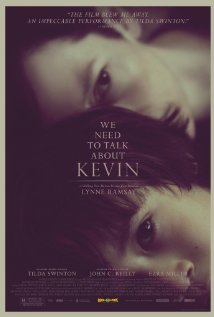
We Need To Talk About Kevin is like one of those nightmare scenarios where the babysitter (finally) figures out that the phone calls are coming from inside the house. In this case, the phone calls are coming from inside the family. Much of this movie’s acclaim comes from Tilda Swinton’s bravura performance as the long-suffering mother of a burgeoning sociopath—and justifiably so. But let’s not overlook writer-director Lynne Ramsay’s achievements, as she raises a ton of tricky questions about parental responsibility. The lovely Barbara and I stayed up well past the credits discussing all the uncomfortable implications. Interestingly enough, we came to the same conclusion: we would have smothered the kid with a pillow and chopped him up in the bathtub. And that is why I love the lovely Barbara.

In nonlinear fashion, we become acquainted with Eva (Swinton), her not-very-observant husband Franklin (John C. Reilly), and their obviously malevolent offspring, the titular Kevin. The viewer lurches between the past and the present (a surprisingly smooth ride!), watching in growing alarm as Kevin seems to take an immediate dislike to his mother, torturing her through his formative years by crying incessantly, refusing to learn the mechanics of potty training, and by feigning good-natured amiability around the clueless Franklin. You don’t need a house call from Dr. Plotspoiler to quickly intuit that at some point, Kevin will go down the rabbit hole and emerge as a fully formed monster.

Once the story is set on its inevitable course, the questions start coming hard and fast: Is Kevin just Satan in a diaper? That’s the easy answer, but as Kevin grows into a handsome teenager (Ezra Miller), we get the nagging suspicion that Eva and Kevin are more alike than we’d first thought. Mother and son greatly resemble one another, and during a night out together (a date?), look more like a couple than Eva and Franklin ever do. One of the only times in the movie that Kevin approves of his mother is when he discovers that her wit is every bit as vicious as his own.

The finale of We Need To Talk About Kevin is also maddeningly ambiguous. Does Eva continue to visit her son in prison because: 1) She feels responsible for his crime? 2) She’s punishing herself for her failure to socialize the little fiend? 3) She is tormenting him in return? A very provocative, original, and disturbing movie—even more so because of the depth of skill and artistry that went into its making.

Malevolence (2004)

I believe the concept of crooks on the lam hiding out in a haunted house dates back to Buster Keaton. True, in Malevolence, the crooks are hiding next door to a haunted house—and it’s only haunted inasmuch as there’s a deranged serial killer living there. A very similar motif is used (more successfully, I might add) in the Andy Serkis black comedy The Cottage (2008). But Malevolence is not a waste of time.

Julian (R. Brandon Johnson) and Marilyn (Heather McGee) are the couple we’re supposed to care about, but they’re not all that likable. They get mixed up in a bank heist with Marilyn’s hoodlum brother Max (Keith Chambers) which concludes with everyone fleeing the scene and Max mortally wounded. As Marilyn thoughtfully reminds Julian several times that it’s his stupid fault her brother took a bullet, one gets the distinct feeling that this couple ain’t gonna make it. Meanwhile, the other member of their gang, Kurt (Richard Glover, a poor man’s Jeff Conaway), kidnaps a young mother and her tomboy daughter, and takes them to the remote hideout where the robbers are supposed to reconnoiter and divide the money. Unfortunately, the hideout isn’t quite remote enough; right next door there’s a decrepit factory farm inhabited by a bargain-brand Michael Myers (the Halloween killer, not Austin Powers) who brings his steely chopping knife to the party.

Nothing too subtle at work in Malevolence; it’s a lot of chasing back and forth outside at night, with a little bit of Ed Gein rural weirdness mixed in. Writer, director, producer, and composer Stevan Mena does a competent job of keeping things lean and tense, though his protagonists suffer from a kind of collective amnesia that prevents them from making sure the killer is dead, which probably would have shortened the movie by a good 20 minutes. Come on people, it’s the 21st Century! You know as well I do that if you’re fortunate enough to knock the maniac down, you MUST continue to beat on the body till it resembles guacamole. And we’ve known this for at least 25 years.

Prometheus (2012)

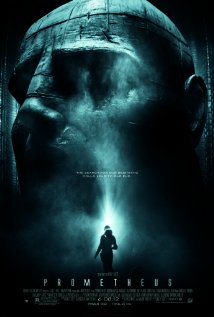
An ambitious and overwrought failure. Whereas Ridley Scott’s Alien (1979) surely ranks among the upper tier of 20th century horror cinema, it’s “prequel” is more like a latter day George Lucas Star Wars gewgaw: too acutely aware of its own lofty place in our cultural consciousness, and as a result, trips all over itself trying to catch lightning in a jar a second time. Prometheus looks sensational, but the story is pure hash, and it’s certainly not horror, despite occasional horrifying imagery. Sadly, it’s another example of corporate hubris: a big-budget, hastily rewritten spectacle that no one knew what to do with.

If I sound bitter, it’s because I am. After shelling out $17.25 to see Prometheus in IMAX 3D, and another $15 for a bottle of water, a small popcorn, and a box of M&Ms, I was treated to a movie that reached for the heavens—and pulled a muscle doing so. Scientific sweethearts Elizabeth Shaw (Noomi Rapace) and her partner Charlie Holloway (Logan Marshall-Green) find some provocative cave paintings that lead them to outer space aboard the titular vessel in search of “the engineers” who may have created mankind. Naturally, there is a crew to escort them, but they’re a flimsily drawn bunch that includes Janek, the sturdy captain (Idris Elba), Vickers, a cranky company bitch (Charlize Theron), and David, an affable, secretive mandroid (Michael Fassbender). Naturally David’s protocol and that of the corporation aren’t exactly in perfect sync. After a few years in cryo-sleep, the crew awakens to find themselves hovering over the planet depicted in an assortment of prehistoric murals. Shaw and Holloway are gung-ho to “meet their makers” but they end up badly disappointed. Welcome to the club!

Once again, Prometheus is fairly sumptuous in the high-tech eye candy department, but the failure of writers Jon Spaights and Damon Lidelof to come up with a character we can invest ourselves in weighs heavy. Noomi Rapace as Shaw is the best of the lot, but most of the time it seems like various attributes of Ripley, Dallas, Ash, and Parker  are simply doled out sparingly to everyone on board. It’s like looking forward to a gourmet meal and getting pricey, reheated leftovers.

Furthermore, it’s easy to see that there isn’t a firm hand at the wheel. My goodness, how many back and forth trips between the ship and the alien station are there? It feels like half the movie is spent getting into and out of space suits and then very slowly trekking to the next location. The suffocating atmosphere of dread and isolation that made the original movie such a tension fest, is nowhere to be found. Instead, there’s a forlorn flourish of heroic horns, ala John Williams, that wells up every now and then as if to remind us that this is meant to be an epic tale of exploration and valor, you know, like Star Wars. I suspect that too many opinions and too much studio meddling scuttled this ship, because Prometheus ends up way off course.

Grizzly Park (2008)

No sense beating around the bush: Grizzly Park flat-out sucks. But it’s a scrappy sort of crappy, that you can almost, sort of, grudgingly admire.

Writer/director Tom Skull is obviously a rank amateur; I’ve seen children’s birthday party videos that were more professionally shot and edited. The acting, from top to bottom, is godawful. Plot points are gathered and randomly discarded without a second thought (e.g., why bother to give a character a gun if it’s never used?).

To give credit where it’s due, the gore effects, when they finally appear, aren’t too shabby. Oh, and they use a real bear.

Eight young adults (who seem to range in age from 18-35) are assigned community service for various offenses and because they’re all grotesque examples of humanity. Vain, selfish, shallow, stupid, greedy, bigoted, you name it—there’s nary a deadly sin left unaccounted for in this bunch.

These hateful dipshits are assigned to no-nonsense disciplinarian Ranger Bob (Glenn Morshower), who guides them deep into the wilderness of Grizzly Park, where they must pick up litter and (more importantly) serve as a snack tray for the wild critters of the forest.

There’s also an escaped maniac running around, but he’s so quickly dispatched by the ravenous bear that you wonder why Skull bothered to introduce him in the first place. Just another tossed plot point.

The tone of Grizzly Park careens from horny adolescent “humor” (it’s not in the least bit funny) to vague, weak-ass moralizing, to guts and gore—and you won’t care one little bit.

Eden Lake (2008)

Talk about grueling; Eden Lake makes Straw Dogs look like a Frankie and Annette double feature. Writer-director James Watkins (The Woman in Black) methodically stokes the fear furnace until the tension is nearly unbearable—but you don’t dare look away.

By firmly establishing his protagonists as something more than pale quaking stereotypes, Watkins succeeds where Eli Roth and James Wan fall short; namely giving the viewer a good reason to be shocked and horrified about the cruelties inflicted on them.

In search of a romantic weekend, Steve (Michael Fassbender) and his girlfriend Jenny (Kelly Reilly) drive way out to hell and gone in the English countryside to camp on a secluded beach that’s about to become the centerpiece of a condo development. The couple incurs the wrath of local juvenile delinquents on BMX bikes and things rapidly spin out of control. Sure, it’s all a big joke, till someone gets hurt—or in this case, killed.

While Steve and Jenny definitely do not deserve their eventual fates, it can be rightly said that the awful shit pit they land in is due mostly to Steve being a colossal asshole who should have just walked away before everything went to hell. He has several chances to do so, but his idiotic pride won’t let him.

Eden Lake should look familiar: the plot is nearly identical to The Strangers (or Deliverance, The Hills Have Eyes, The Texas Chainsaw Massacre, and Wrong Turn, for that matter). Above all else, never ever pitch your tent in an isolated rural area, especially after witnessing the casual cruelty of the locals.

But there is a critical difference. There’s no explanation for the amorality and astonishing lack of empathy on the part of the teens in The Strangers. Boredom maybe? Gangsta rap? Point and shoot video games? Guess we’ll never know.

In Watkins’ film, the young miscreants are squarely under the sway of Brett (Jack O’Connell), the group’s psychotic Alpha male, who, like any good tyrant, whittles away his subjects’ humanity with bullying and threats. (I kept thinking of African child soldiers, forced under impossible pressure into remorseless killers.)

Each nightmarish escalation of the action is presented as a transgression that could have been avoided, but also as a disturbingly believable development, considering the hellish circumstances the characters find themselves in. And that is why Eden Lake is so damn terrifying and transfixing.

The Midnight Meat Train (2008)

I haven’t read enough Clive Barker to decide if I’m a fan or not, but he certainly spins a fascinatingly lurid yarn. The Midnight Meat Train is based on one of his short stories, and it’s a bloody fun ride, even though I kept thinking I was watching a chopped up version that had scenes missing. There are moments when the action inexplicably jumps from Point A to Point M, and you wonder how the hell we got here.

A right-before-he-got famous Bradley Cooper plays Leon, a wannabe artsy photographer trying to capture “the beating heart of New York City” to impress snooty art dealer Susan Hoff (Brooke Shields), who advises him to take more chances, and not run away when danger rears its ugly head. He starts hanging out in the subway during the wee hours of the morning and stumbles upon a very dapper and intense-looking butcher (Vinnie Jones, in a silent part), and is immediately compelled to follow him around. (How do we know he’s a butcher? Well, he carries a meat mallet the size of Mjolnir, for one thing.) Sure enough, it appears his new-found subject is a methodical serial killer who’s been making late-night subway riders disappear for quite some time. Poor Leon realizes too late, that the butcher’s grisly nocturnal rituals are all a part of (sung in Elton John voice) “the c-i-r-c-l-e of l-i-i-i-f-e!”

Anytime you pad out a short story into a feature length film, there’s going to be filler, and The Midnight Meat Train is no exception, but for the most part, director Ryuhel Kitamura and screenplay scribe Jeff Buhler keep it fast and gruesome. The ending is pure Whiskey Tango Foxtrot, but it’s not a cop-out. It’s surprisingly weird and horrible, and hints at a “bigger picture” that’s even more terrible than we had first supposed. And that, folks, is what good horror should do. What, no sequel?