Cabin in the Woods (2011)

Autobiographical side bar: I am old, old, old. I am not Li’l Sharky, Teen Sharky, or even Adult Contemporary Sharky. I’m Ol’ Sharky, an ancient relic from a cooler and weirder world. I carried Agamemnon’s sword; argued with Aristotle; and dogged Cleopatra like she was made of bacon. I shit the pyramids and danced with dinosaurs. I used to carpool to work with Gilgamesh, and even he called me “Gramps.” So when I tell you that I don’t go to the movies much anymore, you’ll begin to understand why. It’s too risky. I can’t be away from my climate-controlled condo for lengthy periods or my aorta will explode. I tried once, and the Visigoths that run the multiplex refused to let me pitch my oxygen tent in the theater. Bastards. All bastards.

Even so, I found myself in the vicinity of a theater with time to kill yesterday, so I purchased a ticket for the moving pictures and saw Cabin in the Woods. I’m very glad that I did. Joss Whedon is getting justifiably blown by critic and fanboy alike for hitting a box-office home run with The Avengers, but that’s no reason to overlook this marvelous muffin basket of a monster movie that he produced, co-wrote, and (second unit) directed. Sadly, the specifics of the story arc prevent a detailed critique, but let’s just say that this is a horror movie on a grand “meta” scale that dwarfs Wes Craven’s Scream series.

What Whedon does with Cabin in the Woods is place the late 20th century horror movie, and more specifically the subcategory known as Hack and Stack (a.k.a. Doomed Teenage Campers), into a miraculous context, one that weds the most dreadful aspects of Lovecraft and Phillip K. Dick. Whedon has created a horror movie mythos that dares to explain why its characters make such monumentally bad decisions, and why it’s imperative that the fools suffer before meeting their (mostly determined) gruesome fate. It’s a groovy concept, but really, just this once.

I don’t anticipate a rash of imitators, because this looks to be a genre only big enough for one. And Cabin in the Woods is it. At the same time, I can understand why some horror fans didn’t care for it. To them I would say, don’t think of this movie as an attempt to subvert the genre in a contrived or overly clever way—it’s more of an elegant novelty, an intricate lark that stands as a singular testament to outside-the-box thinking. In other words, Whedon’s laughing with us, and not at us.

Vampire Bats (2005)

It’s always a treat to see the lovely Lucy Lawless (Xena: Warrior Princess) in front of the camera, even if it’s in a throwaway rabid critter movie like Vampire Bats.

She’s such a beguiling screen presence (and I love her so much) that she could bring grace, good humor and glamour to anything, including a car insurance commercial.

Sorry Flo, your days are numbered.

Lawless stars as Maddy Rierdon, a plucky animal behavior specialist who teaches at Tate University, a campus nestled comfortably somewhere in Louisiana bayou country.

A bunch of forgettable students (can we please invent some new collegiate stereotypes? I’m bored with these!) stir up the local bat population by blasting shitty techno music at weekend swamper parties.

The helpful Maddy informs the authorities that the bats have mutated into double-fanged killers by feeding on insects that have hatched near a contaminated sewage treatment plant. (Like we give a shit, perfesser!)

We the audience are treated to several scenes of bats wreaking havoc at parties (biting, flying, chewing, sucking, etc). For some reason, Brett Butler (the actress, not the ball player) and late-night talk show host Craig Ferguson have teensy parts, and Timothy Bottoms plays a mayor that looks like George W. Bush.

I shall now damn Vampire Bats with faint praise: It’s not boring or incompetently filmed. That said, there’s not much to recommend it either, other than Ms. Lawless.

Whether or not that’s sufficient to sustain your attention during the 90-minute running time is a question you’ll have to decide for yourself.

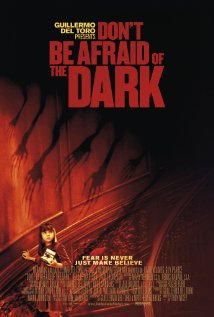
Don’t Be Afraid of the Dark (2010)

Seems to me there was a fair amount of interchat about this slick remake of a revered 1973 made-for-television movie—and most of it wasn’t flattering. “Not Del Toro enough,” was the general consensus. “Horror by numbers.”

Guillermo del Toro, director and writer (he co-wrote and produced this one) of such treasured titles as The Devil’s Backbone, Pan’s Labyrinth, and the Hellboy flicks, certainly carries a weighty pedigree.

But I don’t agree with conventional wisdom.

To me, Are You Afraid of the Dark is textbook Del Toro: a lonely, uprooted child moves into a creepy, dangerous environment and must confront an evil presence.

Any of that ring a bell?

The child in this case is Sally (Bailee Madison), a petulant and defensive kid who’s being shuffled off to live with her architect father Alex (Guy Pierce) and his girlfriend Kim (the cute-as-a-button Katie Holmes), while they fix up a sprawling baronial country estate in Rhode Island.

Editor’s Note: If I was a petulant and defensive child I would have wet my pants at the prospect of living in this friggin’ castle. It even has ruins! Eeeeee!

Anyway, Sally soon becomes aware that the house is infested with mean little varmints that live in the basement who want her to “come and play with them.”

However, as the introductory flashback reveals, these are murderous wee folk—vicious furry anthropoids about the size of rats who carry blades, whisper dark threats, and snack on the teeth of children.

They also hate light. The story builds slowly (perhaps too slowly, for some), as Alex believes his daughter has gone bonkers, while the more sympathetic Kim finds Sally’s tale has the ring of truth.

And then their construction foreman turns up sliced to ribbons, to really complicate things.

While it’s true that Don’t Be Afraid of the Dark moves at a leisurely pace, I really didn’t mind, because newbie director Troy Nixey obviously stuck pretty close to Guillermo del Toro’s script (co-written with Matthew Robbins), so the mood and tension are deftly elevated, as our heroine Sally descends, a centimeter at a time, deeper into the bowels of the awful house and its fiendish inhabitants.

The blood and guts are doled out sparingly, but that’s to be expected in a movie that’s more a grim fairy tale than a body count buffet. It’s also a very, very handsome film and unusually absorbing.

Recommended.

Shark Night (2011)

The budget for Shark Night was reportedly somewhere in the neighborhood of $25 million. So where did the money go?

My guess is $24 million went to the 3D effects (which don’t magically appear on my TV—I even tried wearing an old pair of glasses, but all I got was a migraine) and the rest was divvied up between fake blood, a few hair metal songs, and (hopefully) a decent payday for one of the coolest character actors going, Donal Logue.

Judging by the results, Will Hayes and Jesse Studenberg probably got a case of beer and a couple frozen pizzas. For cryin’ out loud, this even had a theatrical release and it’s only marginally better than something from the Asylum crew, who would have at least had the decency to throw in a little nudity.

The story (such as it is) concerns a group of reasonably attractive Tulane college students who decide to drop the books and have a wild weekend at Sara’s (Sara Paxton) McMansion on the shores of Lake Pontchartrain—a body of water that’s allegedly got enough salt in it to sustain gangs of roving ravenous sharks.

In case you’re interested, the prevailing theory is that the sharks arrived as the result of a particularly tempestuous hurricane season, but this notion is quickly discarded when local rednecks Dennis and Red (Chris Carmack and Joshua Leonard) confess to stocking the pond with 45 varieties of shark (out of a possible 350!) in order to shoot footage of idiots getting eaten for “a cable channel.”

Really? That’s the best we can do?

There’s gallons of blood, but not much gore in Shark Night, and the effects (which include sharks leaping balletically out of the water to chomp people in trees and boats) are ludicrous and lame enough to be for Crockasaurus Meets Robo Squid (Hey, I have a script!), on SyFy Channel.

The previously mentioned Donal Logue is always worth watching (especially in his late, lamented FX series Terriers), and he manages to sneak off with a couple of scenes as a metalhead sheriff, but the rest of the cast is unremarkable.

And the sharks? Those fish should go back to school.

The Pack (2010)

Stop the Interwebs! In fact, just drop what you’re doing for the next 81 minutes, crack a cold one, and summon The Pack from your Netflix netherworld. Don’t think! Just watch, because it’s a gem, a Horrificflicks revelation.

The Pack, a French-dubbed rural nightmare, is quite simply the most finely rendered horror film I’ve seen in a long, long time, at least since Neil Marshall’s The Descent. It’s successful in every sense: Original yet referential; gory but restrained; funny but not goofy, and it’s not horror lite, either.

It’s chock-a-block with cringe-inducing scenes, but the delicious jolt of shock doesn’t get washed away in a tedious “pain for the sake of watching pain” tidal wave. It’s too artfully evocative (it’s a beautifully shot movie) and carefully orchestrated to be mere torture porn, but it is relentless—like a dream that keeps going from bad to worse.

Final (Only?) Girl Charlotte Massott (the gutsy and striking Émilie Dequenne), is driving through uncharacteristically blighted French countryside, cranking speed metal, and smoking. Some bikers have been on her ass, hassling her for a while, so she decides to pick up Max (Benjamin Biolay), a hitchhiker who is perhaps a touch less sinister than the bikers she’s trying to avoid. She pulls up and says, “If you pull out your dick, I’ll hammer you!” With a stone impassive face that he wears for the entire movie, Max replies, “It’s too cold anyway.” (Practically a Truffaut opening!)

Evidently Charlotte is a remarkably trusting soul, because she takes a catnap while Max (whom she’s known for about 6 minutes) drives. When she wakes up, they’ve stopped at a ramshackle backwoods saloon/gas station/arcade, run by massive Madame La Speck (Yolande Moreau, whose maternal, Kathy Bates-like performance is terrific). At this point, the wheels come off for Charlotte and everything gets real weird and bleak, real quick.

A true horrorphile will be happier than a puppy in puke spotting subtle and shady references to Psycho (“Oh, Mother!”), The Texas Chainsaw Massacre (horrible hillbillies); Night of the Living Dead (flesh-eating, blood-sucking stumbling humanoids); and Pumpkinhead (farm setting, hayseed occultism, genuinely frightening beastie[s], lots of shots of windmills), not too mention every variation of Why Strangers Passing Through Blighted Lonely Territory Should Never Pick Up Hitchhikers, Much Less Go To Their Lair.

Writer-director Franck Richard’s The Pack boasts so many well-chosen fiendish delights, that I could sit here all day singling out its virtues. Instead, I’ll just point out a couple:

It’s a real shock when the monsters arrive. They don’t look stock or schlocky. I would compare them favorably to something dreamed up by Guillermo Del Toro.

The acting is strong across the board, including Phillippe Nahon, a Charles Durning lookalike who plays a Columbo-ish cop, and wears a shirt that reads “I Fuck On The First Date” throughout the film.

The action gets progressively grimmer, but Richard doesn’t dwell overly long on the suffering. There is a “circle of life” at work here that’s hideous in its organic inevitability. Make no mistake, no one will be disappointed with their level of discomfort.

Even so, The Pack never panders; it’s never sensational and garish for its own sake. Rather it has a soupçon of Tim Burton’s fairy-tale-gone-horribly-wrong sensibility, combined with Sam Raimi’s quick, decisive cuts. And the gruesome proceedings are tastefully seasoned with odd, welcome interludes of humor.

If I really had to compare The Pack to another film, it would be Clint Eastwood’s The Unforgiven: It’s genre filmmaking utilized to its full potential. It’s a familiar template that Richard is working from, but he raises the bar on quality and originality to the ceiling. I kept thinking I knew what was going on, because I’ve seen these stranded-motorist scenarios in hundreds of movies. But I was always surprised by something far stranger than I was expecting.

I kept waiting for the other shoe to drop, but instead, Richard kicked my ass with it. To my fellow fans hungry for a quality horror experience, all I can add is, go and enjoy. Heck, I may watch it again. What’s 81 minutes on a Sunday?

Shadow Puppets (2007)

Several folks (mostly attractive women) wake up in a mental institution, dressed in generic undies, with no memory of who they are or how they got there.

They spend the remainder of the film wandering around the facility while trying to steer clear of a dark, shadowy, spider-type thing with a face, that shows up once in a while to kill someone.

Despite the presence of genre-pedigreed actors James Marsters (Spike from Buffy and Angel, who hasn’t aged well); Tony Todd (the Candyman himself!); and Joleen Blalock (she was the Vulcan hottie from that lame Star Trek series with Scott Bakula), there really isn’t much to recommend Shadow Puppets.

This is another one of those annoying “walkabout” movies, with endless scenes of wary characters moving (very slowly) through a largely featureless industrial landscape.

It’s an approach that’s quite different from a movie like Cube, for example, where shocking and creepy details emerge from both the alien environment and the characters’ own heads.

We do discover the identities of the captives, but it doesn’t add up to anything worth writing down. We learn the origin of the smoky, spider thing, but it’s all argle bargle that’s forgotten two seconds after the explanation is delivered. (“It’s the distilled essence of the victims’ life forces,” or some such drivel.)

Note to writer-director Michael Winnick: If we don’t care about the monster or the characters, then you’re going to need lots more gore and gals to maintain a passable level of interest from the average horror fan.

And a brawny dude in a rubber suit would have been a major improvement in the monster department.

Zombie Apocalypse (2011)

Pas·tiche /paˈstē-SH

Noun: An artistic work in a style that imitates that of another work, artist, or period.

Today’s vocabulary word is pastiche, as in, “The Ving Rhames movie Zombie Apocalypse is a pastiche of the popular television show The Walking Dead.”

And that’s about it. There’s nothing groundbreaking or envelope-pushing at work here. It’s pure comfort food, executed with very little verve.

You know the drill. A ragtag band of plague survivors try to avoid being eaten by zombies long enough to make it to Catalina Island where the remains of the government has setup housekeeping.

Ving Rhames is Henry, a sledgehammer-swinging bad-ass, which pretty much makes him the most developed personality among this group of stock characters.

There’s also Julian (Johnny Pacar), a wisecracker who quotes Wordsworth; Mack (Gary Weeks), a leader-type who looks and acts like Ryan Reynolds; Ramona (Taryn Manning), the whiny girl who grows up fast; and Cassie (Lesley-Ann Brandt), the hot chick with the sword.

Spoiler: Some of these people don’t make it.

What Zombie Apocalypse has going for it is a breezy pace. The action rolls along at a steady clip, never really bogging down with unnecessary backstory. This group is almost always ass-down in the frying pan.

On the flip-side, the special effects are cheesily rendered CGI bullshit which extinguishes a great deal of the fright factor. People should be afraid of zombies because seeing their own flesh chewed from their bones while still alive is scary.

Blobs of drawn-on blood splatter is not. This technique is also used for countless zombie headshots, and it looks cheap and amateurish.

If you’re starving for an undead fix, this one will barely make a dent in your hunger. It’s like a zombie chowing down on an anorexic: Not much meat on them bones.

Rare Exports: A Christmas Tale (2010)

I suppose it’s a little early for Christmas revelry, but this uncanny Finnish import written and directed by Jalmari Helander is reason enough to get in a (twisted) holiday mood. Creepy and often hilarious, Rare Exports has the look and feel of a wondrous Spielberg project (E.T. meets Super 8?), right down to the charismatic leading moppet (Onni Tommila) who intuitively understands that a certain unearthly entity (in this case, Santa Claus) does not come in peace.

On Christmas Eve in the remote hinterlands of Finland, a corporate-sponsored archeological expedition digs up a towering, horned creature frozen in ice. Pietari (Tommila) deduces it to be the “real” Santa Claus, a fearful demon who brutally kills naughty children. Meanwhile, his father (Jorma Tommila) and his fellow reindeer hunters have captured a vicious, wizened old bearded man, whom they wish to exchange with the corporate bosses for enough money to get them all through the winter. Chaos reigns for a time, leading up to a left-field ending that works once you give it a chance to sink in.

As one might expect, given the Spielberg sensibility, the key to the story is the relationship between a boy and his widowed father, the latter trying desperately to protect and provide for his son—who at the same time is hoping to prove to his dad that he’s a brave and resourceful young man, and perfectly capable of protecting himself. It’s a heartwarming coming-of-age fable replete with an evil giant Santa and a whole bunch of murderous elves. Given that premise, it’s mostly gore free, but the disturbing picture of jolly ol’ St. Nick depicted here, is more than enough to inspire Christmas nightmares in the heads of impressionable children of all ages. I approve this message.

The Messengers (2007)

Please tell me if there’s an existing category for this well-chewed cinematic scenario: Family suffers urban-based trauma and decides to relocate to a nice, quiet, haunted house in the boonies.

The Shining is the most obvious example, but there are dozens of pale imitations, including this quaint little Kristen Stewart vehicle from five years back.

Directed by Hong Kong power players the Pang Brothers (The Eye films, Bangkok Dangerous, among others), The Messengers is first and foremost, a serviceable platform for Stewart’s photogenic petulance, brought to the screen courtesy of the boffo box-office returns fromThe Twilight saga.

Rising to the challenge, the spunky teen actually carries the movie. Of course, when you’re costarring with bored stiffs like Dylan McDermott (Dad) and Penelope Ann Miller (Mom), you needn’t have been Lee Strasberg’s star pupil to dominate the screen.

To her credit, Stewart gamely steps up to the plate, exuding Buffy confidence while delivering her lines with Locklearian panache.

BTW, am I the only one who confuses Dylan McDermott with Dermot Mulroney? Surely not!

In The Messengers, Stewart stars as Jess, the rebellious progeny of McDermott and Miller, who are leaving the temptations of Sodom and Gomorrah in the rear-view mirror in order to get back to the land, specifically as sunflower farmers in rural Saskatchewan.

You gotta admit; that’s a new one.

Sure enough, the family’s optimism for a fresh start is soon crushed to crumbs when it appears that their rustic farmhouse comes with creepy crawly specters of the previous occupants, who fell victim to a case of Jack Torrance Syndrome, also known as Daddy’s Got The Ax, Again.

This was a Ghost House production and Sam Raimi was one of the executive producers. The Pangs do a decent job of combining their talent for weaving blankets of dread with Raimi’s trademark splashy spook-tacular shocks.

The Messengers is a 100 percent sustainable movie, since the entire plot consists of recycled materia. Even so, the filmmakers went to considerable effort to pique our interest, and we don’t have to work too hard to swallow the Ghoul-Aid.

Please read the last sentence in a Crypt Keeper voice. It sounds better.

At the moment I’m leaning toward “Buyer Beware” as the name of this genre. “Real Estate Gone Wrong,” maybe? “Glengarry Glen MURDER?”

Troll Hunter (2010)

A trio of Norwegian college students armed with a video camera chases a man they suspect of being a bear poacher.

As it turns out, Hans the hunter (Otto Jesperson) has a much more arcane purpose to his clandestine activities, namely regulating the troll population on behalf of the Norwegian government.

Like most people who’ve sat through Troll Hunter, I dug the hell out of its confident blending of mockumentary, humor, horror, and conspiracy theory.

The troll FX are wizardly; the “mythical” giants are marvelous creations that come to life as sinister (though familiar) fairy tale terrors with a taste for automobile tires and sheep.

As Hans explains to the incredulous students, there are all kinds of trolls: Some are 200 feet tall. Some have more than one head. Some can be found under bridges. And they all live in particular territories.

It’s Hans’ job to track and kill the creatures if they leave their stomping grounds, lest they upset the delicate balance of nature, which usually ends up with people getting crushed or eaten.

Writer-director André Ovredal has a keen sense of all the disparate elements at work here, and his cinematic finesse in creating a vivid mythology on the fly instantly makes him a filmmaker worth following.

If I had to make a complaint, it’s that Troll Hunter is a little light on gore and fright intensity. There is a jaunty lightness of mood that permeates the action, resulting in plot developments—like the death of a major character—that lack any genuine impact.

In other words, Ovredal sacrifices fear for fun.

It’s not much of a misstep, and it goes a long way toward explaining the movie’s popularity at indie and second-run cinemas. Gambling on an audience’s preference for snickering instead of screaming is probably a smart move if you’re looking down the road at career longevity.