The Battery (2012)

MV5BMjAxMTk2NDcxM15BMl5BanBnXkFtZTcwMjQ0ODA0OQ@@._V1_SY317_CR0,0,214,317_AL_

I suppose The Battery qualifies as a zombie movie—but just barely.

Until the finale, you can count the number of undead appearances on one hand. First and foremost, it’s a post-apocalyptic road movie that owes more to Samuel Beckett than it does George Romero.

Gorehounds with ADD are going to hate this film because it’s slower than a senior citizen square dance and probably a lot less bloody. It’s also an extremely frugal production. Seriously, the budget was probably less than what I have in my checking account.

I am currently unemployed—thanks for asking!

Even with so many things stacked against it, I have to give an admiring thumbs-up to The Battery and to writer, director, and star Jeremy Gardner, who bravely ran with the idea of having very little money at his disposal, and used that freedom to create something unique: a bleak, absurdist buddy movie about two minor-league baseball players dodging the dead on the backroads of Connecticut.

After months on the road, our two main characters have become a study in contrasts. Ben (Gardner), the team’s catcher, is a bearded outdoorsman, a brawny survivor-type who does most of the heavy lifting (hunting, fishing, zombie-killing) in the relationship.

Mickey (Adam Cronheim), a relief pitcher, is a sullen romantic who spends most of his time lost in thought with a pair of headphones fixed over his ears. Despite the presence of the jovial and optimistic Ben, Mickey is depressed and desperately misses his old life.

One fine day, the pair pick up a stray communication on their walkie-talkies, leading them to believe there is a fortified community in the area. Ben, who is content with camping and living outside, wants to steer clear. Mickey wants a home. A bed. A roof over his head. And maybe a girl.

This is the doomed conflict at the heart of The Battery—the terrible necessity of freedom, as personified by Ben, who refuses to be trapped in any situation, and Mickey’s need for comfort and security.

In the end, freedom trumps comfort, as one might expect given the dire circumstances. But Gardner’s languid, lengthy scenes of Ben and Mickey brushing their teeth, playing catch, listening to music and generally farting around, imply that it takes two souls to make a life worth fighting for.

Positive and negative, yin and yang, pitcher and catcher.

Fun Fact: “The Battery” refers to the pitcher and catcher in ye olde baseball vernacular.

Barricade (2012)

MV5BMTc3MDI4Mzk3Ml5BMl5BanBnXkFtZTcwMzg4NjI0OA@@._V1_SY317_CR5,0,214,317_AL_

In which the hunky star of Will & Grace (Eric McCormack) gets the opportunity to go all Jack Torrance while snowed in at a remote cabin with his two nervous children. However, instead of chasing his kids around with an axe, he attempts to prove his mettle by protecting them against ghosts—and a really nasty case of the flu.

Terrance Shade (McCormack) is a recently widowed MD who’s never really bonded with daughter Cynthia (Conner Dwelly) and son Jake (Ryan Grantham). After his wife’s unexpected demise, he decides to take his estranged offspring to an isolated mountain cabin for Christmas. On the Bad Idea scale, this rates near the tippy top, because, as the kids remind Pops again and again, he’s not handy, hardy, or even barely competent at wilderness survival. The whole Shade clan comes down with a bug courtesy of the town sheriff/shopkeeper/landlord (Donnelly Rhodes), and Terrance begins to see and hear things that cause him to come unhinged in a big way.

The crux of Barricade becomes readily apparent all too soon: Is Terrance hallucinating or is there an actual evil spirit loose in the house that’s causing them no end of misery? Why does Terrance keep flipping in and out of consciousness? Are the family members being haunted by their own sense of loss and guilt over the death of the wife/mother?

It’s not really much of a mystery, but director Andrew Currie and writer Michaelbrent Collings make sure that the atmosphere is suitably tense and claustrophobic throughout, and McCormack delivers a first-rate performance as the hapless patriarch trying his best to keep his children out of harm’s way. A very watchable little fright flick.


Camp Hell (2010)

MV5BMTM3MjIxOTc1Nl5BMl5BanBnXkFtZTcwNDU1MzI4Mg@@._V1_SY317_CR0,0,214,317_

I think that if a movie is featured on Fearnet Channel it should, in fact, be a horror movie.

While writer-director George Van Buskirk is able to cobble together a few ominous sequences, Camp Hell, for the most part, is a tepid coming-of-age film in which brooding protagonist Tommy Leary (Will Denton) decides that the fundamentalist sect of the Judeo-Christian faith that has enveloped his family and friends is not to his liking.

On behalf of everyone who managed to sit through this sleepy spectacle, I would just like to add, “Congratulations.”

And “Who gives a shit?”

Obviously Van Buskirk must be connected to “somebody” in the filmmaking community, because he managed to cajole Andrew McCarthy, Dana Delany, Bruce Davidson and Jesse Eisenberg into appearing in this painfully amateurish production, that looks like it was shot on Super 8.

Throughout its 99 interminable minutes, Camp Hell (originally titled Camp Hope—Oooh! Scary!) attempts to dress-up an adolescent lad’s clumsily symbolic account of losing both his virginity and his religion, with occasional references to Satan, who seems to be lurking in the bushes at Camp Hope, a strict Christian camp run by authoritarian asshole Father Phineas (Davidson).

Sadly, there is no Satan, no demon, no monster, no murder, no nothing, no kidding.

Even the scene where Tommy dry humps his girlfriend for the first time, and thus opening the doorway to all sorts of temptations and pleasures of the flesh—has all the drama and passion of a QuikBooks tutorial. 

The power of Christ and I compel you to avoid Camp Hell.


Rubber (2010)

MV5BMTU2Nzg2NDQ2Nl5BMl5BanBnXkFtZTcwMDk5MjMzNA@@._V1_SX214_

Oh, France! What a nation of jolly, irreverent provocateurs you are! Why did writer/director Quentin Dupieux make a “horror” movie about a sentient car tire with terrifying telekinetic powers? As Lieutenant Chad (Steve Spinella) says many times during the film’s introduction, “No reason.”

In the middle of desert nowhere, a tire comes to life and uses its psychic ability to make heads explode. Nearby, an audience of nitwits watches the action through binoculars. The tire becomes obsessed with a beautiful woman (Roxane Mezquida) in a Volkswagen and trails her to a decrepit motel.

To his credit, Dupieux has made a marvelously intricate and witty movie that poses a passel of burning questions to its audience. (That would be you and me. The audience with the binoculars has been poisoned with bad turkey—except for the guy in the wheelchair played  by Wings Hauser.) It would be easy to dismiss Rubber as absurdist twaddle with a side of pretension, but it’s filmed so cunningly through low-angle cameras that roll us right along with the murderous tire, that it becomes a brutally hypnotic experience. And by then, it’s too late.

Unlike similar exercises in reflexive filmmaking by Dupieux’s highbrow cinematic forebears (Godard and Wenders come to mind), Rubber maintains a much-needed sense of its own playfulness that keeps the whole business from sinking under the weight of its concept.

Even while some of the characters ponder the reality of the situation as if they were in a staged reading of Rosencrantz and Guildenstern Are Dead, Dupieux seems to be more interested in why we’re still watching this nonsense. You see, Monsieur Director, as nonsense goes, Rubber is hard to ignore. Will there be a sequel with the tricycle?

Devil’s Pass (2013)

MV5BMjMzOTMxMTA3N15BMl5BanBnXkFtZTgwNDg4MDAwMDE@._V1_SX214_

With a found-footage narrative similar to The Frankenstein Theory—film crew blunders into a frozen hell searching for answers to an unsolved mystery—Devil’s Pass provides sufficient diversions for an afternoon of chilly thrills.

Plus, it’s directed by former A-list filmmaker Renny Harlin (Cliffhanger, Die Hard 2, The Long Kiss Goodnight) who seems to have fallen off the map of late.

A five-person film crew from the University of Oregon (Woooot! Ducks represent!) retraces the steps of the Dyatlov Expedition, a Russian team that perished under mysterious circumstances in the Ural Mountains in 1959.

Why anyone would want to follow the path of a doomed expedition defies comprehension, but as team leader Holly King (Holly Goss) notes gleefully on camera, “We got a grant!”

Once they land in the former Soviet Union, the crew is bedeviled by a failing GPS navigator, huge footprints in the snow that randomly appear and disappear, and some scary sounds in the night.

All this leads to the discovery of a huge door in the mountainside and hints that the Russian military has been messing around with alien technology.

The finale of Devil’s Pass makes a passable attempt at explaining all the questions that have emerged during the movie’s running time, but it’s still kind of a train wreck.

So instead of yeti we get teleporting ghouls that maybe used to be human? Sure, ok, whatever. The bottom line is that it’s a grueling and unpredictable trip that’s worth taking.

Don’t trip over the plot holes along the way.

Maniac (2012)


MV5BMjI2NjMxMTQ5MV5BMl5BanBnXkFtZTcwODczMTQ3OQ@@._V1_SY317_CR0,0,214,317_

I distinctly remember seeing the original Maniac (1980) at the drive-in the year it came out.

It was an especially garish example of grindhouse sleazery directed by William Lustig (Maniac Cop, Vigilante), with splashy gore effects by the great Tom Savini, and starring Joe Spinell (The Godfather II, Taxi Driver) as Frank Zito, a lumpy schlub on a murderous rampage.

Whether he was obliterating necking teens with a shotgun, strangling hookers, or scalping his victims in order to dress up his mannequin collection, Zito proved a memorably demented protagonist.

For this slick, slightly less lurid remake, Lustig teamed with Franco fiends Alexandre Aja, Gregory Levasseur (writers) and Franck Khalfoun (director) to recast Frodo Bag… er, Elijah Wood as the prolific psycho with the crippling Mommy issues.

Frank Zito (Wood) is the rodentish owner of a vintage mannequin store obsessed with Anna (Nora Arnezeder), a beautiful photographer, who happens by his shop to admire his magnificent collection of dress forms.

When Frank isn’t awkwardly wooing Anna, he’s out skewering, strangling, slicing, and scalping a string of unlucky ladies who remind him of his horribly skanky mother. Can the love of a good woman redeem a savage killer? No, of course not. What a ridiculous idea.

Director Khalfoun charts the action with a very aggressive POV camera (Wood is seen mostly in reflections), that straps us into the driver’s seat of considerable carnage—a feverish perspective that most viewers should find deeply unsettling.

Wood portrays Zito as a shaky mess of neuroses and unchecked rage, a rather alarming change from the mild-mannered hobbit that we followed through three epic movies on his sojourn to Mount Doom.

Here, Wood’s character is on a different kind of quest; trying to annihilate the memories of the woman responsible for making him the man(iac) he is today.

Needless to say, not for squeamish or sensitive souls.

The Attic (2007)

MV5BMjExODI2OTg1NF5BMl5BanBnXkFtZTcwNjEzOTEzMg@@._V1_SY317_CR0,0,214,317_

I haven’t really watched Mad Men, so actress Elisabeth Moss is kind of a revelation to me. If you haven’t seen her in the miniseries Top of the Lake, directed by Jane Campion, I suggest you do so, because it’s totally brilliant, and so is she.

In The Attic, a younger Moss portrays Emma, the increasingly delusional protagonist in a rural-goth take on Polanski’s Repulsion. Wait, did I say delusional? Perhaps she’s just a curious insect that’s wandered into the wrong fly trap.

Emma lives in a house near the woods. Her father (John Savage) and mother (Catherine Mary Stewart; who could ever forget the classic Night of the Comet?) are hopeful that she’ll finally want to go to college, but Emma prefers traipsing around the house in her nightie or exploring the creepy attic with her developmentally disabled brother Frankie (Tom Malloy, who also wrote the script).

A psychiatrist (Thomas Jay Ryan) is called in by the parents, but Emma proves to be a patient with more layers than a blooming onion.

Moss is riveting as Emma, an unmoored girl in the wrong place at the wrong time. Is she going insane? Has she been possessed by a malevolent house spirit? Are Mom and Dad conspiring against her?

Like Rover with a new soup bone, you’ll be chewing on the possibilities for a while. That said, The Attic is by no means perfect: Director Mary Lambert (Pet Semetary, lots of Madonna videos) definitely built this one to be a slow burner—rich in atmospheric dread but with the action (and bloodletting) more strategically rationed.

Twixt (2011)

MV5BMTQ1MjAwODg5MV5BMl5BanBnXkFtZTcwNTkwNDA5OQ@@._V1_SY317_CR9,0,214,317_


Distinguished filmmaker (and winemaker) Francis Ford Coppola returns to his horror roots!

As we all know, one of his first films was the 1963 gothic thriller Dementia 13 for Roger Corman’s American International Pictures.

And like his earlier film, Twixt is an eerie, dreamlike story with revolving color/black and white scenery, and a narrative that shifts gears between reality, dream world, and the mind of a desperate writer trying to get in touch with his long-lost muse.

Hall Baltimore (Val Kilmer), described by one fan as “a bargain-basement Stephen King,” is out on an aimless book tour for his latest hack-job horror novel.

He rolls into Swann Valley, a sleepy little California community, and is immediately pounced upon by wannabe writer and town sheriff Bobby LaGrange (Bruce Dern), who wants to collaborate on a new book. “The whole town is haunted!” he tells the writer with glee.

Baltimore is an alcoholic, an indifferent husband, and a grieving father who’s clearly at the end of his rope, so he agrees to let the loony lawman show him the town.

And soon a new story is born, featuring a corpse with a stake through its heart, the ghost of Edgar Allen Poe, a dangerously pale girl with braces, a haunted hotel, and a clock tower that’s inhabited by “the devil himself.”

Obviously, Twixt is not on a par (or scale) with Coppola masterworks like The Godfather or Apocalypse Now. Plot points come and go, some resolved, some disappearing like lint in a stiff breeze.

But it’s a consistently intriguing little flick that’s both a horror whodunit and a tale about a tapped-out artist who needs to reconnect with his talent in order to survive.

For rabid cinephiles, the movie includes appearances by the likes of David Paymer, Joanne Whalley (Kilmer’s wife), Don Novello (a.k.a. Father Guido Sarducci!) and Elle Fanning, not to mention an introduction read by Tom Waits.

Ultimately, though, it’s Coppola who makes all the right moves, perhaps signaling a return to more creative endeavors than stomping on grapes.

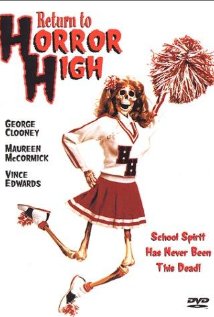
Return to Horror High (1987)

MV5BMjA5NjIzNzcxNl5BMl5BanBnXkFtZTcwODU3ODUxMQ@@._V1_SY317_CR6,0,214,317_

Once again I’ve been overtaken by a bout of idiotic nostalgia, so hold onto something. Let us return now, to the mid-1980s, a time when George Clooney was a nobody; when women strutted about in loose-fitting jumpsuits, and men wore break-dancing pants and white sneakers—all the better to flee from the axe-wielding maniacs, who seemed to be popping up everywhere.

Return to Horror High wears the trappings of a slasher film, but it’s really more of a sly primer on the genre as well as a goofy tribute to those resourceful filmmakers who routinely found a way to finish a crappy movie that no one would even admit to watching in the first place, because slasher movies have no redeeming qualities. And yet, watch them we do.

A schlocky horror picture crew sets up shop in an abandoned high school, where a few years before, a series of grisly murders took place. (Let’s face it, we’re not here for non-grisly murders.) Somehow, the killer was never found! (Which doesn’t say much for the competence of the local constabulary. Just sayin’.)

As the film crew, including cheapskate producer Harry Sleerik (the great Alex Rocco), director Josh Forbes (Scott Jacoby), and leading lady Callie Cassidy (Lori Lethin, from Bloody Birthday and The Prey, among others), feverishly tries to re-create the mayhem of the original murders, they begin to notice that both actors and techs are disappearing all over the place.

The premise allows writer/director Bill Froehlich to zoom in on the nuts and bolts of the slasher movie, even as his characters gamely go about the business of unmasking a killer and finishing the stupid film. “Why do people walk into dark basements without a flashlight?” wails Callie, as she and her policeman boyfriend Steven (Brendan Hughes) prepare to do exactly that.

Return to Horror High is like Truffaut’s Day for Night—as directed by Roger Corman. It both lances and enhances the illusion of low-budget filmmaking, and in doing so, offers up periodic glimpses of why so many of us cheerfully waste our lives watching such wretched nonsense.

Froehlich layers past and present like a cake boss, telling the story of the original massacre, the making of the film, and the comic police investigation (featuring Maureen “Marsha, Marsha, Marsha” McCormick) that follows, all with a wink, and a few timely “meta” observations from the cast.

When Callie objects to having her shirt torn open in a meaningless scene, Harry realizes a compromise is called for. “Write ’em a hopeful, life-affirming scene where they talk about love and children—and make sure it’s set in the showers,” he commands the hapless writer.

Note: A very young and boyish George Clooney does indeed get top billing, even though he only lasts about 10 minutes. That’s called shrewd marketing. Harry would approve.

Jug Face (2013)

MV5BMjI2ODI0Nzg2Nl5BMl5BanBnXkFtZTcwNzM4MzU2OQ@@._V1_SY317_CR3,0,214,317_

“There’s some weird shit going on in the woods out there.”

I’m quite impressed with Jug Face, an absorbing and shockingly original jolt of indie-horror from writer-director Chad Crawford Kinkle.

I would almost venture to call it “magical realism” but that term fails to capture the profound depths of despair plumbed by teen protagonist Ada (Lauren Ashley Carter) as she tries to avoid getting tossed into a pit as a sacrificial offering to the nameless creature that serves as deity and protector to her ignorant hillbilly kinsfolk.

Jug Face is  mighty grim stuff. Somewhere in the Appalachians, a degenerate community of yokels lives off the grid, dependent on sales of white lightning and dutifully tending the thing in the pit to maintain their squalid existence.

Ada, who has an arranged marriage to a doughy village boy in her future, is in love with her sullen brother Jessaby (Daniel Manche) who knocks up the unlucky lass whilst they’re cavorting in the woods.

Meanwhile, the thing in the pit is unhappy and Dwai (Sean Bridgers), the village idiot savant/high priest can’t figure out what’s wrong. Normally, when the god is restless, Dwai is compelled to bake a jug that looks like one of the villagers, who is then thrown to the deity.

So not only is Ada facing a loveless marriage while carrying her brother’s baby, but it appears she’s next on the pit parade.

The filth and blind ignorance in this hick settlement is so thick you’d need a weed whacker to get through it. It’s the act of “committing a sin” in such a terrible, unforgiving environment that accounts for the real horror in Jug Face, more so than the angry Lovecraftian entity in their midst.

Poor Ada tries everything she can think of to avoid the pit, but the superstitious ties that bind (and strangle) these slack-jawed citizens are simply too strong.

Reminiscent of Winter’s Bone, another film about an isolated community with its own strict code of behavior, Jug Face is like an anthropological field trip—or a bad dream induced by leftover Indian food.

In either case, you’ll be very grateful to wake up safe and sound in your own bed.