The Attic (2007)

MV5BMjExODI2OTg1NF5BMl5BanBnXkFtZTcwNjEzOTEzMg@@._V1_SY317_CR0,0,214,317_

I haven’t really watched Mad Men, so actress Elisabeth Moss is kind of a revelation to me. If you haven’t seen her in the miniseries Top of the Lake, directed by Jane Campion, I suggest you do so, because it’s totally brilliant, and so is she.

In The Attic, a younger Moss portrays Emma, the increasingly delusional protagonist in a rural-goth take on Polanski’s Repulsion. Wait, did I say delusional? Perhaps she’s just a curious insect that’s wandered into the wrong fly trap.

Emma lives in a house near the woods. Her father (John Savage) and mother (Catherine Mary Stewart; who could ever forget the classic Night of the Comet?) are hopeful that she’ll finally want to go to college, but Emma prefers traipsing around the house in her nightie or exploring the creepy attic with her developmentally disabled brother Frankie (Tom Malloy, who also wrote the script).

A psychiatrist (Thomas Jay Ryan) is called in by the parents, but Emma proves to be a patient with more layers than a blooming onion.

Moss is riveting as Emma, an unmoored girl in the wrong place at the wrong time. Is she going insane? Has she been possessed by a malevolent house spirit? Are Mom and Dad conspiring against her?

Like Rover with a new soup bone, you’ll be chewing on the possibilities for a while. That said, The Attic is by no means perfect: Director Mary Lambert (Pet Semetary, lots of Madonna videos) definitely built this one to be a slow burner—rich in atmospheric dread but with the action (and bloodletting) more strategically rationed.

Twixt (2011)

MV5BMTQ1MjAwODg5MV5BMl5BanBnXkFtZTcwNTkwNDA5OQ@@._V1_SY317_CR9,0,214,317_


Distinguished filmmaker (and winemaker) Francis Ford Coppola returns to his horror roots!

As we all know, one of his first films was the 1963 gothic thriller Dementia 13 for Roger Corman’s American International Pictures.

And like his earlier film, Twixt is an eerie, dreamlike story with revolving color/black and white scenery, and a narrative that shifts gears between reality, dream world, and the mind of a desperate writer trying to get in touch with his long-lost muse.

Hall Baltimore (Val Kilmer), described by one fan as “a bargain-basement Stephen King,” is out on an aimless book tour for his latest hack-job horror novel.

He rolls into Swann Valley, a sleepy little California community, and is immediately pounced upon by wannabe writer and town sheriff Bobby LaGrange (Bruce Dern), who wants to collaborate on a new book. “The whole town is haunted!” he tells the writer with glee.

Baltimore is an alcoholic, an indifferent husband, and a grieving father who’s clearly at the end of his rope, so he agrees to let the loony lawman show him the town.

And soon a new story is born, featuring a corpse with a stake through its heart, the ghost of Edgar Allen Poe, a dangerously pale girl with braces, a haunted hotel, and a clock tower that’s inhabited by “the devil himself.”

Obviously, Twixt is not on a par (or scale) with Coppola masterworks like The Godfather or Apocalypse Now. Plot points come and go, some resolved, some disappearing like lint in a stiff breeze.

But it’s a consistently intriguing little flick that’s both a horror whodunit and a tale about a tapped-out artist who needs to reconnect with his talent in order to survive.

For rabid cinephiles, the movie includes appearances by the likes of David Paymer, Joanne Whalley (Kilmer’s wife), Don Novello (a.k.a. Father Guido Sarducci!) and Elle Fanning, not to mention an introduction read by Tom Waits.

Ultimately, though, it’s Coppola who makes all the right moves, perhaps signaling a return to more creative endeavors than stomping on grapes.

Return to Horror High (1987)

MV5BMjA5NjIzNzcxNl5BMl5BanBnXkFtZTcwODU3ODUxMQ@@._V1_SY317_CR6,0,214,317_

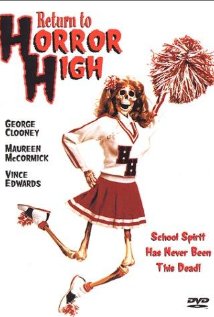
Once again I’ve been overtaken by a bout of idiotic nostalgia, so hold onto something. Let us return now, to the mid-1980s, a time when George Clooney was a nobody; when women strutted about in loose-fitting jumpsuits, and men wore break-dancing pants and white sneakers—all the better to flee from the axe-wielding maniacs, who seemed to be popping up everywhere.

Return to Horror High wears the trappings of a slasher film, but it’s really more of a sly primer on the genre as well as a goofy tribute to those resourceful filmmakers who routinely found a way to finish a crappy movie that no one would even admit to watching in the first place, because slasher movies have no redeeming qualities. And yet, watch them we do.

A schlocky horror picture crew sets up shop in an abandoned high school, where a few years before, a series of grisly murders took place. (Let’s face it, we’re not here for non-grisly murders.) Somehow, the killer was never found! (Which doesn’t say much for the competence of the local constabulary. Just sayin’.)

As the film crew, including cheapskate producer Harry Sleerik (the great Alex Rocco), director Josh Forbes (Scott Jacoby), and leading lady Callie Cassidy (Lori Lethin, from Bloody Birthday and The Prey, among others), feverishly tries to re-create the mayhem of the original murders, they begin to notice that both actors and techs are disappearing all over the place.

The premise allows writer/director Bill Froehlich to zoom in on the nuts and bolts of the slasher movie, even as his characters gamely go about the business of unmasking a killer and finishing the stupid film. “Why do people walk into dark basements without a flashlight?” wails Callie, as she and her policeman boyfriend Steven (Brendan Hughes) prepare to do exactly that.

Return to Horror High is like Truffaut’s Day for Night—as directed by Roger Corman. It both lances and enhances the illusion of low-budget filmmaking, and in doing so, offers up periodic glimpses of why so many of us cheerfully waste our lives watching such wretched nonsense.

Froehlich layers past and present like a cake boss, telling the story of the original massacre, the making of the film, and the comic police investigation (featuring Maureen “Marsha, Marsha, Marsha” McCormick) that follows, all with a wink, and a few timely “meta” observations from the cast.

When Callie objects to having her shirt torn open in a meaningless scene, Harry realizes a compromise is called for. “Write ’em a hopeful, life-affirming scene where they talk about love and children—and make sure it’s set in the showers,” he commands the hapless writer.

Note: A very young and boyish George Clooney does indeed get top billing, even though he only lasts about 10 minutes. That’s called shrewd marketing. Harry would approve.

Jug Face (2013)

MV5BMjI2ODI0Nzg2Nl5BMl5BanBnXkFtZTcwNzM4MzU2OQ@@._V1_SY317_CR3,0,214,317_

“There’s some weird shit going on in the woods out there.”

I’m quite impressed with Jug Face, an absorbing and shockingly original jolt of indie-horror from writer-director Chad Crawford Kinkle.

I would almost venture to call it “magical realism” but that term fails to capture the profound depths of despair plumbed by teen protagonist Ada (Lauren Ashley Carter) as she tries to avoid getting tossed into a pit as a sacrificial offering to the nameless creature that serves as deity and protector to her ignorant hillbilly kinsfolk.

Jug Face is  mighty grim stuff. Somewhere in the Appalachians, a degenerate community of yokels lives off the grid, dependent on sales of white lightning and dutifully tending the thing in the pit to maintain their squalid existence.

Ada, who has an arranged marriage to a doughy village boy in her future, is in love with her sullen brother Jessaby (Daniel Manche) who knocks up the unlucky lass whilst they’re cavorting in the woods.

Meanwhile, the thing in the pit is unhappy and Dwai (Sean Bridgers), the village idiot savant/high priest can’t figure out what’s wrong. Normally, when the god is restless, Dwai is compelled to bake a jug that looks like one of the villagers, who is then thrown to the deity.

So not only is Ada facing a loveless marriage while carrying her brother’s baby, but it appears she’s next on the pit parade.

The filth and blind ignorance in this hick settlement is so thick you’d need a weed whacker to get through it. It’s the act of “committing a sin” in such a terrible, unforgiving environment that accounts for the real horror in Jug Face, more so than the angry Lovecraftian entity in their midst.

Poor Ada tries everything she can think of to avoid the pit, but the superstitious ties that bind (and strangle) these slack-jawed citizens are simply too strong.

Reminiscent of Winter’s Bone, another film about an isolated community with its own strict code of behavior, Jug Face is like an anthropological field trip—or a bad dream induced by leftover Indian food.

In either case, you’ll be very grateful to wake up safe and sound in your own bed.

Shallow Ground (2004)

MV5BMTQ3MTc3NDk4M15BMl5BanBnXkFtZTcwNjUyMDgyMQ@@._V1_SY317_CR15,0,214,317_

A screwy mish-mash of elements somehow makes for a modestly entertaining melange of mayhem.

Even though the overall execution is just slightly north of made-for-TV and the performances indicate that the actors were given perhaps an hour to familiarize themselves with the script, Shallow Ground managed to keep me engaged. Never underestimate the value of abundant gore and the occasional unclothed actress, I suppose.

The story reveals itself in very haphazard, what-the-hell fashion, as if a team of lemurs was busily typing out new scenes even as the cameras commenced rolling.

In a middle-of-nowhere rural community called Shallow Valley, a tiny police department is in the midst of disbanding when a naked young man (Rocky Marquette) covered in blood makes an unwelcome appearance.

Apparently, the townspeople are packing up after the completion of a nearby dam (don’t ask why, they just are), and Sheriff Jack Shepherd (a gaunt, haunted, and inexplicably Irish Timothy V. Murphy), still tormented by an unsolved murder from a year before, has to deal with a new string of deaths that are somehow connected to the presence of the mysterious blood-splattered adolescent.

The conclusion of Shallow Ground is clumsy and confused as writer-director Sheldon Wilson, another enthusiastic Sam Raimi acolyte, requests that the viewer obligingly stitch together several disparate story lines: the accidental death of a local man and his daughter during the dam’s construction, the subsequent disappearances of several people connected with the dam project, a crooked deputy (Stan Kirsch) who murders a drug dealer in a nearby large city (huh?), and a vengeful hausfrau (Patty McCormack from The Bad Seed!) with an axe to grind.

It doesn’t coalesce in any meaningful way, but in this case the sum of Shallow Ground‘s grisly parts are (barely) enough to sustain us to the hastily constructed finale.

You will have questions. For me, it was why is the incidental tension music so shitty and stupidly applied?

Shadow (2009)

MV5BMTM4NzIzODg0OF5BMl5BanBnXkFtZTcwMTM0NzEwNA@@._V1_SY317_CR1,0,214,317_

You’ll have to roll with some changes in this Italian horror import, but ultimately, I think it’s worth it to do so.

Shadow begins as a fairly standard-issue case of strangers beware, before shifting gears about halfway through into a nasty bit of torture porn, and finally revealing itself in a Twilight Zone-meets-Dalton Trumbo finale.

David (Jake Muxworthy), an American soldier recently returned from the front lines of Afghanistan, decides a bicycle trip through a remote patch of Eastern Europe will help him unwind.

He meets a pretty fellow cyclist (Karin Testa) who invites him in to share her tent, and soon both are on the run from a pair of bloodthirsty poachers. (Ottaviano Blitch and Chris Coppola).

But wait! There’s more! After a few skirmishes, David and the poachers find themselves the unwilling guests of the evil Mortis (Nuot Arquint), a bony, bald albino with a penchant for inflicting pain—which he does.

And then there’s a twist ending that actually works for me.

What Shadow has going for it is devilishly effective tension escalation. Circumstances get increasingly grim without deteriorating into a pointless bloody mess, and Mortis has to be one of the creepiest kooks to come along in a long time.

Some of you will not care for the conclusion, but I appreciated the “one last surprise” card being played. Rather than a rip-off, I consider it a rather creative solution.

See for yourself. I doubt you’ll be disappointed, because this trip is a trip.

The Road (2011)

MV5BMTA0ODg4OTc5NDNeQTJeQWpwZ15BbWU3MDU5Mjg4MDc@._V1._SY317_CR2,0,214,317_

Purely for marketing purposes, they should have called this movie something other than The Road. The Cormac-McCarthy-post-apocalypse-tale-turned-Viggo-Mortensen vehicle was barely two years old, and it’s hard to create word-of-mouth excitement if you have to continually explain that the movie you’re recommending is not that one. But recommend it I will.

This curious import from the Philippines is both a fearsome ghost story and a very soulful meditation on evil, and more specifically “the sins of the father” concept.

Three restless teens borrow a car and go out for a midnight joy ride. None has a driver’s license, so they turn off the freeway and head down an old unmarked road—and the trap is sprung!

A nightmarish sequence ensues as the kids are stalked by vengeful ghosts and an unseen killer. Eventually the cops arrive on the scene under the command of recently decorated Detective Luis (TJ Trinidad) who sees uncanny parallels in this case to those of an old unsolved homicide.

There are plenty of supernatural fright elements at play in The Road, but writer-director Yam Laranas puts the most muscle into telling a ghost story born of an all-too-familiar domestic tragedy. The movie is a triptych of tales (the present, the past, the distant past) that remain firmly rooted in a poison tree that bears deadly fruit. (Note: trees don’t figure into the story; this is what we call a metaphor.)

The pace can be a bit sluggish, but in my opinion, the added weight given to characters and landscape makes The Road a much more vivid trip.

Chromeskull: Laid To Rest 2 (2011)

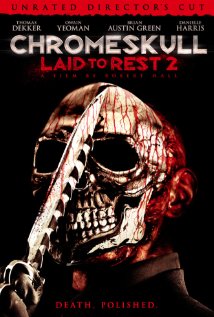
Pardon me while I spill my gushing guts. I admired the heck out of the original Laid To Rest, but the sequel is everything the second installment of a film series should be: bigger, artistically bolder, and rife with disturbing implications. (See Evil Dead—Evil Dead II. )

Like the Raimi films, LTR2 is an evolutionary leap beyond its predecessor, as it takes virtually the same story and creates a whole universe for it to live in. And like Romero’s zombie epics, Chromeskull has the chutzpah to place a modern horror film into the larger and more provocative context of a thoroughly corrupt and predatory society—one that bares a striking resemblance to our own.

Even though writer-director Robert Hall’s sophomore effort isn’t quite in the same league as the aforementioned films and folks, it’s still a bloody good time.

The second film opens just moments after the conclusion of the first: The relentless killer known as Chromeskull (Nick Principe) is apparently kaput after having his noggin pulverized by a pair of plucky survivors, but modern science can do amazing things these days.

The mutilated maniac is heroically raced to a hospital and sewn back together by the finest surgeons money can buy and so embarks on a three-month convalescence. See, it turns out Chromeskull can afford top-drawer health care—he’s friggin’ rich, the CEO of his own shadow corporation.

Like any successful man, he’s got disgruntled employees and ambitious rivals, or in this case both, in the person of his right-hand flunky Preston, played with gonzo panache by 90210‘s Brian Austin Green!

While the boss gets his head back together, Preston entertains ideas of moving up in the company.

Naturally, another woman is methodically stalked and many people are gutted, carved, and filleted in excruciating detail. A big round of applause should be directed to the special makeup effects team of Cris Alex and Joe Badiali, who seem to be cut from the same gruesome cloth as the master himself, Tom Savini.

Laid To Rest 2 is a rockin’ righteous bloodbath. The kills are teeth-gritting in their unfettered savagery, as Chromeskull is clearly a man(?) who loves his work and has a near fetishistic reverence for his tools—which should serve as inspiration to his ungrateful underlings.

Seeing the boss working the line and getting his hands dirty is an increasingly rare thing in corporate America.

The Tall Man (2012)

Is The Tall Man HINO (Horror in Name Only)?

Sure, it takes place in a brooding rural slum ala Winter’s Bone (except this one’s on the West Coast—Washington, to be exact), and it’s about a prolific bogeyman who abducts children in a dried-up mining town.

What ensues is a provocatively ambiguous thriller (and yes, it is thrilling) with a fairly blunt social agenda.

Cold Rock, Washington is a mildewed husk of a town decomposing in the overgrown backwoods of Washington. The local Chamber of Commerce undoubtedly has its hands full trying to lure tourists to a cheerless gray community where 18 children have disappeared over the past few years.

A focused and fascinating Jessica Biel plays Julia, a recently widowed nurse living in the area who tends to the medical needs of the hapless hillbillies in her sector. Shit gets personal when her beloved toddler gets snatched from her house by the legendary “Tall Man.”

Julia channels her inner Ellen Ripley and sets out to get her bambino back.

The tagline should have been: “Who’s The Monster Here?” The Tall Man is a brisk, well-crafted, and shifty film that never allows you to get comfortable from any perspective.

And while the supernatural elements are mostly of the red-herring variety, there is a very real horror at its heart—namely are we becoming a society that might require fantastically drastic social engineering in order to survive?

Echoes of P.D. James’ Children of Men and Dennis Lehane’s Gone Daddy Gone bubble to the murky surface.

You have been warned.

Dread (2009)

A beastly unsettling adaptation of a Clive Barker short story by writer/director Anthony DiBlasi, Dread doesn’t require supernatural elements—other than bad dreams—to really make us squirm in our seats.

Sure, Barker’s psycho-sexual hot potatoes (blood, sex, domination, and cruelly testing one’s limits) are in play, but it’s a character-driven nightmare first and foremost, as a student film about mapping out the territory of fear runs amok and lives are annihilated in the process.

Film student and Johnny Deppleganger Stephen Grace (Jackson Rathbone) meets Quaid (Shaun Evans), a charismatic loner, who wastes no time in reeling his new pal into exploring the roots and boundaries of real fear, and soon a student film project is born.

With the help of Cheryl (Hanne Steen), a fellow film studies major, the young auteurs interview a range of students about their earliest and most profound memories of fear.

Quaid, who seems to be majoring in villainy with a minor in degradation, believes their project lacks juice, so he takes it upon himself to “take things to the next level.”

By the way, never trust anyone who uses this expression.

Dread succeeds on the strength of its well-drawn characters, particularly in the homo-erotic jousting between the curious, but virtuous, Stephen, and the increasingly deranged and manipulative Quaid, a fellow who was obviously, in the words of the most articulate sociopath in the world, Dexter Morgan, “born of blood.”

DiBlasi takes his time, slow-cooking the horror till it’s falling off the bone. And in Quaid we have a charming sadist with his own terrifying baggage, who actually believes he’s helping people “confront the beast” by tormenting them with the things they fear the most, in the hope that they be destroyed and born anew, as fearless warriors.

Needless to say, his victims don’t appreciate the effort. There’s gratitude for you.