The Conjuring (2013)

MV5BMTM3NjA1NDMyMV5BMl5BanBnXkFtZTcwMDQzNDMzOQ@@._V1_SX214_

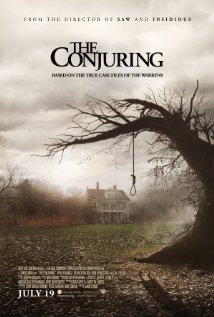
The most recent production from Saw-teur James Wan reaped over $130 million at the box office—and with good reason.

The Conjuring is a ripping ghost yarn that is subtle and suggestive in its creepiness and, when necessary, opens the taps into a full-tilt Good vs Evil battle royal (in the Judeo-Christian tradition) culminating in a no-holds-barred exorcism showdown.

It also re-introduces fright fans to Ed and Lorraine Warren, a formidable tag-team of real-life ghost-busters, played here by Patrick Wilson and Vera Farmiga.

This particular haunted house party takes place in 1971, in the 19th century Rhode Island home of Roger and Carolyn Perron (Ron Livingstone and Lili Taylor).

The Perrons and their five daughters get tossed around by sinister forces, necessitating the intervention of the Warrens, who set up cameras, tape recorders, and other vintage ghost-hunting paraphernalia.

Lorraine deduces that the central spook is a witch that tried to sacrifice her baby to Satan before hanging herself some 150 years prior, and whose modus operandi is to possess the mother and compel her to kill her child. In this case, Carolyn Perron has five to choose from!

The Conjuring doesn’t break new ground, but it serves up all your favorite ghost tropes piping hot, with top-notch special effects, a great cast, and expert escalation of terror. Here, the haunting is like a vicious tar baby, ensnaring any poor fool that comes along.

Even the Warrens, who are professionals and should know better, get swept up in a Satanic tsunami that poses a direct threat to their own daughter, who the couple left at home in the care of Grandma.

Speaking of which, the Warrens’ story is worth investigating. They’re the founders of the New England Society for Psychic Research, and claim to have been involved in “10,000” haunting adventures.

Old Sharky says check ’em out!

Grim (1995)

MV5BODUzMDk5NjUyOF5BMl5BanBnXkFtZTcwMjkzODQyMQ@@._V1_SY317_CR5,0,214,317_

Since when does a movie made in the 90s look like a movie made in the 70s? When it’s made in England, pretending to be Virginia! It certainly helps explain the abundance of denim jackets in this thing, that’s for sure.

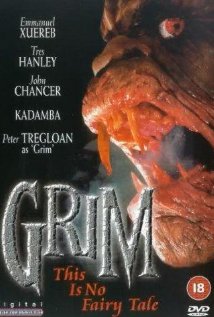
Nutshell: Rob (Emmanuel Xuereb—he’s good in anything!) is a mining expert inspecting a series of tunnels and caves under a housing in development in “Virginia” (actually, Coleford, Gloucestershire) where folks have been disappearing. He and a bunch of concerned homeowners go spelunking into the bowels of the earth and are set upon by a magic troll-like being who can walk through walls.

The creature (Peter Tregloan) is the best thing about this SPoS—a toothy brute who bites and kills some of his victims, while others are imprisoned, presumably to be scarfed at a future date. By the way, the monster is initially summoned by some bored New Age suburbanites playing with a homemade Ouija board.

Grim is an idiotic film, but it’s the right kind of idiotic, as writer-director Paul Matthews leaves plenty of lengthy silences in the script so viewers can hurl snarky comments with impunity (a perfect movie for MST3K-style riffing). The story also gets increasingly (and I would argue “winningly”) bizarre, contains a decent amount of bloodletting, and leads to a WTF finale, with a minor character helplessly snared in a completely FUBAR situation. Grim is an amusing time-waster with an OK monster—nothing more, nothing less.

Shallow Ground (2004)

MV5BMTQ3MTc3NDk4M15BMl5BanBnXkFtZTcwNjUyMDgyMQ@@._V1_SY317_CR15,0,214,317_

A screwy mish-mash of elements somehow makes for a modestly entertaining melange of mayhem.

Even though the overall execution is just slightly north of made-for-TV and the performances indicate that the actors were given perhaps an hour to familiarize themselves with the script, Shallow Ground managed to keep me engaged. Never underestimate the value of abundant gore and the occasional unclothed actress, I suppose.

The story reveals itself in very haphazard, what-the-hell fashion, as if a team of lemurs was busily typing out new scenes even as the cameras commenced rolling.

In a middle-of-nowhere rural community called Shallow Valley, a tiny police department is in the midst of disbanding when a naked young man (Rocky Marquette) covered in blood makes an unwelcome appearance.

Apparently, the townspeople are packing up after the completion of a nearby dam (don’t ask why, they just are), and Sheriff Jack Shepherd (a gaunt, haunted, and inexplicably Irish Timothy V. Murphy), still tormented by an unsolved murder from a year before, has to deal with a new string of deaths that are somehow connected to the presence of the mysterious blood-splattered adolescent.

The conclusion of Shallow Ground is clumsy and confused as writer-director Sheldon Wilson, another enthusiastic Sam Raimi acolyte, requests that the viewer obligingly stitch together several disparate story lines: the accidental death of a local man and his daughter during the dam’s construction, the subsequent disappearances of several people connected with the dam project, a crooked deputy (Stan Kirsch) who murders a drug dealer in a nearby large city (huh?), and a vengeful hausfrau (Patty McCormack from The Bad Seed!) with an axe to grind.

It doesn’t coalesce in any meaningful way, but in this case the sum of Shallow Ground‘s grisly parts are (barely) enough to sustain us to the hastily constructed finale.

You will have questions. For me, it was why is the incidental tension music so shitty and stupidly applied?

The Selling (2011)

MV5BMjI0ODYwNzY0MV5BMl5BanBnXkFtZTcwNTUyMTkxOA@@._V1_SX214_-1

M’lady did not care for The Selling, at all. She thought it was corny and childish. Total amateur hour. Long pointless scenes. An unfunny comedy. For the most part, I agreed with her, and still do—yet I quite liked it. Apparently, girls not only mature faster than boys, they mature far longer. Does that make sense?

The truth is, The Selling is nothing more than an old-fashioned spook-house comedy, a genre that peaked somewhere around the time of The Ghost and Mr. Chicken. And my inner 12-year-old (which greatly resembles my outer 50-year-old), was delighted. I giggled like a mental patient all the way through it. M’lady thinks me deranged, or at least a case for arrested development. Maybe deranged development is most accurate.

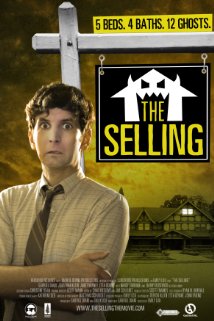
Screenwriter and star Gabriel Diani is dweeby Los Angeles real estate agent Richard Scarry—you know, like the children’s author—who needs to make a pile of dough in a hurry to pay for his mother’s cancer treatment, which, unsurprisingly, is ungodly expensive.

Richard and his dopey pal Dave (Jonathan Klein) get talked into buying a murder house by hot/conniving Realtor Mary Best (Janet Varney) and are then forced to somehow fix-up and flip a house that’s haunted by the 12 victims of a serial killer known as the Sleep Stalker.

The Selling is at its best in the world of real estate chicanery, as our knucklehead protagonists attempt to get an extremely haunted house ready for a “showing.” Meek little Richard attempts to reason with the ghosts, telling them that he is, in fact, in a rather tight spot, and has no choice but to try and sell the house. The ghosts respond with a volley of plagues that would have driven saner, smarter men to head for the hills.

Richard and Dave are not Ghostbusters or even especially competent; they’re just a pair of goofy schnooks that get in over their heads. At least Richard is rewarded with a romantic interest, the extremely bubbly paranormal blogger Ginger Sparks (Etta Divine) who helps them make contact with the spirit world. Comedian Simon Helberg has a small part, and veteran scene chewer Barry Bostwick shows up as a bumbling exorcist.

From all accounts, this was a shoe-string operation, financed the friend-and-family way. So I have to give it up for Diani and director Emily Lou. Here they have cinematic evidence of sufficient wit and inventive moxie to handle a bigger budget. The Selling never tries to be anything more than a sweet, amusing and somewhat corny contemporary haunted house flick. And it more than meets that modest goal.

Devil (2010)

I missed the memo on why exactly M. Night Shyamalan is now considered such a lame-o. I didn’t see Lady in the Water and I started to watch The Happening but bailed out for some mundane reason unrelated to the quality of the film.

So what happened? Did these two movies suck so unbelievably badly that they reduced the Shyamalan brand to a punch line? And now I’ve built up such a load of anxiety that I can’t bring myself to watch them.

I didn’t realize Devil was co-written and produced by Shyamalan or I might have steered clear, but I’m reasonably glad that I didn’t. Sure, it’s rife with his trademark glib spirituality (or Old Testament as folklore) with a side dish of “you just gotta believe sometimes.”

Even so, it’s a modestly effective thriller about five people trapped in an elevator—one of whom might be Lucifer.

Taking place in a thoroughly modern skyscraper in a thoroughly modern metropolis, five seemingly unrelated people get into an elevator car and become trapped between floors. A dramatic storm sent by obviously sinister forces moves into the area and messes with the electrical system, so getting them out proves complicated.

Detective Bowden (Chris Messina) is the cop on the scene who attempts to organize their rescue, with some help from Ramirez (Jacob Vargas), a particularly devout building security guard who doesn’t like what he’s seeing on the video monitor from the stranded elevator.

Devil offers legitimately frightening scenes as the trapped characters begin freaking out from the steadily increasing paranoia, claustrophobia, and growing suspicion that one among them is not what he/she seems.

More than just a morality play (although there are similarities), the story hangs on a basic Twilight Zone premise that Satan is real, and that from time to time he likes to go out amongst the people in the guise of a particularly unpleasant collections agent.

Seriously, if you’re on this list, you have very few options.

The Woman in Black (2012)

Also known as Harry Potter and the Angry Mother’s Ghost.

OK, I made that up, but The Woman in Black is noteworthy for reasons other than the presence of Daniel Radcliffe.

The movie marks the return of the Hammer Films imprint. As a lineal descendant of stately Brit-horror celluloid like The Brides of Dracula and Night Creatures, The Woman in Black is a worthy addition, with an expansive sense of dread invoked by proper gothic storytelling.

True, it comes rattling with haunted house tropes that are as well worn as Jacob Marley’s chains, but my admiration for its almost-gentlemanly ability to coax scares remains undiminished.

Radcliffe plays Arthur Kipps, a morose young attorney with a broken heart, who apparently has been slacking on the job after the death of his wife. Kipps is told by a less-than-sympathetic boss to get his lawyer ass to a remote village to sort out the paperwork of a recently deceased client.

Problem 1: The villagers remove the welcome mat upon his arrival.

Problem 2: The paperwork resides at Eelmarsh House, a decaying mansion that appears to be sinking into a swamp.

Problem 3: The house is fiercely haunted by the ghost of a woman who lost her son due to the negligence of the house’s previous occupants.

Problem 4: Whenever the ghost gets restless, village children start dying.

Problem 5: The ghost is restless now, so Kipps takes it into his head to play ghostbuster and lay the spirit to rest, perhaps in an effort to come to terms with his own tragic past.

The storyline advances in predictable fashion, but even so, it’s a reliable yarn that crackles like a fresh log on the fire. Rather than recalling vintage Hammer stock, I was reminded of The Changeling with George C. Scott; a familial tragedy with a supernatural revenge motif that’s told earnestly, but with skill and vigor.

However, I must point out one incredible scene that makes me wonder what director James Watkins and writer Susan Hill (based on her novel) were smoking at lunch break.

Kipps hits upon the outré idea of recovering the body of the young boy who drowned in the marsh, in an attempt to appease the pissed-off apparition.

So he and his friend Mr. Daily (Ciarán Hinds) go gamely splashing around underwater near the boy’s grave marker until they find and retrieve the muddy little bugger from his aquatic resting place.

For some reason, this sequence reminds me of poor Bela Lugosi in Bride of the Monster, forced to wrestle with an inanimate octopus in a cold tank of water.

I would just like to ask Watkins and Hill, who in the hell would ever entertain such an outlandish scheme for even a moment? Nobody, that’s who, and certainly not a clever young wizard.

The Messengers (2007)

Please tell me if there’s an existing category for this well-chewed cinematic scenario: Family suffers urban-based trauma and decides to relocate to a nice, quiet, haunted house in the boonies.

The Shining is the most obvious example, but there are dozens of pale imitations, including this quaint little Kristen Stewart vehicle from five years back.

Directed by Hong Kong power players the Pang Brothers (The Eye films, Bangkok Dangerous, among others), The Messengers is first and foremost, a serviceable platform for Stewart’s photogenic petulance, brought to the screen courtesy of the boffo box-office returns fromThe Twilight saga.

Rising to the challenge, the spunky teen actually carries the movie. Of course, when you’re costarring with bored stiffs like Dylan McDermott (Dad) and Penelope Ann Miller (Mom), you needn’t have been Lee Strasberg’s star pupil to dominate the screen.

To her credit, Stewart gamely steps up to the plate, exuding Buffy confidence while delivering her lines with Locklearian panache.

BTW, am I the only one who confuses Dylan McDermott with Dermot Mulroney? Surely not!

In The Messengers, Stewart stars as Jess, the rebellious progeny of McDermott and Miller, who are leaving the temptations of Sodom and Gomorrah in the rear-view mirror in order to get back to the land, specifically as sunflower farmers in rural Saskatchewan.

You gotta admit; that’s a new one.

Sure enough, the family’s optimism for a fresh start is soon crushed to crumbs when it appears that their rustic farmhouse comes with creepy crawly specters of the previous occupants, who fell victim to a case of Jack Torrance Syndrome, also known as Daddy’s Got The Ax, Again.

This was a Ghost House production and Sam Raimi was one of the executive producers. The Pangs do a decent job of combining their talent for weaving blankets of dread with Raimi’s trademark splashy spook-tacular shocks.

The Messengers is a 100 percent sustainable movie, since the entire plot consists of recycled materia. Even so, the filmmakers went to considerable effort to pique our interest, and we don’t have to work too hard to swallow the Ghoul-Aid.

Please read the last sentence in a Crypt Keeper voice. It sounds better.

At the moment I’m leaning toward “Buyer Beware” as the name of this genre. “Real Estate Gone Wrong,” maybe? “Glengarry Glen MURDER?”

Tale of the Mummy (1998)

Here’s another sleeper that I owe to the fine folks over at the Horror Movie A Day site (horror-movie-a-day.blogspot.com). Thanks gents!

I was just recently bemoaning the fact that mummies are an underutilized movie monster. (And don’t bring up that crappy CGI-riddled Brendan Fraser series. Because it sucks, that’s why not!)

So why the reluctance to embrace the mummy? They’re undead, like vampires and zombies—but they aren’t as charismatic as the former, nor as utilitarian as the latter. They’re slow, predictable, and only deadly in confined spaces.To paraphrase Stephen King, “Uh oh, the mummy is chasing us. We’d better walk away briskly.”

Fortunately, in Tale of the Mummy, veteran rock video director Russell Mulcahy (Razorback, Highlander) gives us Talos, a decent mummy upgrade from the ol’ Universal Pictures shuffler, and then smartly pumps up the Egyptian mysticism in order to flesh out the frights. Mulcahy’s predilection for flash-and-pop visuals works well here, making even the drearier parts of London look suitably glam-noir.

As these things so often do, the story begins with a doomed archeological expedition, this one led by (a round of applause, please) Sir Christopher Lee, as Sir Richard Turkel. He and his cohorts unwisely enter the cursed tomb of Talos, a cruel and sadistic ex-pharaoh whose spirit gets awakened, only to be freed by Turkel’s granddaughter Samantha (Louise Lombard) 50 years later.

Talos wastes no time in wasting various reincarnated versions of himself (including a dog!), harvesting their organs in preparation for an impending planetary alignment that could restore him to full power (not a good thing for humanity, needless to say).

His main method of murder is rather clever, animating his bandages to flutter about formlessly in the breeze before strangling his victims. Tale of the Mummy is a fun, visually sumptuous yarn, one that moves quickly and looks great doing so.

Bonus: The cast is chock-full of familiar faces, and character-actor fan-boys and girls will squeal with delight at cameos by Christopher Lee, Shelley Duvall, Michael Lerner, and Jon Polito, not to mention young unknowns like Gerard Butler, Jack Davenport, and Sean Pertwee, who get some decent screen time here to pad those resumes for future greatness.

More mummies? Please?

A Haunting in Salem (2011)

Take a teaspoon of The Shining, a sprinkle of The Amityville Horror, stir in a tiny budget, and garnish with an intense, odd-looking little actor as your leading man, and what have you got? I’d say a “C”, maybe a “C+”.

New sheriff Wayne Downs (Bill Oberst Jr.) moves his super-hot wife (Courtney Abbiati) and two kids to Salem, Massachusetts, and settles into an old Gothic manor house that comes with the job. (Nice perk!)

As luck would have it, the joint is haunted by the ghosts of 19 pissed-off witches who were burned and hanged back in the the late 1600s—by the town sheriff— and were subsequently laid to rest on the property where Downs and his brood are currently taking up residence.

The house also comes with a brain-damaged gardener (Where does he live?) who mumbles dire warnings about the ghosts and is soon dispatched by same.

The Realtor neglected to mention any of this, but it does have a lovely bonus space that could be converted into a guest bedroom or a cathedral for your Black Mass, your Satanic rituals, or whatnot.

A Haunting in Salem isn’t a memorable film. It’s a painfully familiar tale and director Shane Van Dyke (one of Dick’s grandchildren; another, Cary, plays a local cop) doesn’t have the money or the chops to bring anything new to this haunted house party.

The frights, in addition to being rote and predictable, are few and far between. The story is set in a huge, historic mansion, but it looks like the cast and crew were only permitted to shoot in a couple of the rooms, which becomes distracting once you notice that every scene takes place in either the kitchen, the bathroom, the hall, or the daughter’s bedroom.

It’s only the earthy presence of Bill Oberst Jr. as the determined sheriff that gives the flimsy plot a solid grounding. He’s a sawed-off plug of a man with curiously scarred features who perpetually looks like he’s on the verge of a very messy nervous breakdown.

Thus, he’s perfectly cast as the husband and father that the rest of the family believes is going cuckoo, so their unease around him is palpable.

Also, the body language between the sheriff and his tall gorgeous wife Carrie reveals that they’re definitely not comfortable around each other.

Any tension is good tension, I always say. Now make it work!

The Shrine (2010)

Imagine my surprise and color me impressed: this gritty Canadian feature kind of rocks.

You keep thinking you know “what kind” of movie you’re watching, and then suddenly you don’t. The Shrine manages the difficult trick of being able to switch gears without wrecking the engine.

It starts out as a warning to tourists against touring Eastern Europe without letting others know your whereabouts—because the worst will happen.

Guaranteed.

In this case, an American backpacker disappears in a small Polish town, which motivates a trio of journalists to investigate the enigmatic community, where such occurrences are all too common.

I might add that this is a grossly inaccurate portrayal of a journalist. Anyone still fortunate enough to work for a newspaper or magazine at this time is most decidedly not curious about anything—unless it’s figuring out how to hold onto a job that will soon be farmed out to interns.

Then comes the first shift, and now you’re watching one of those creepy Iron Curtain faux snuff films, and you consider getting up to water the plants.

But then Sam Raimi arrives and everything goes all Evil Dead. To conclude the festivities, we get a metaphysical mud-wrestling match, straight out of The Exorcist.

The Shrine works because it subverts our point of view so deftly that we don’t even realize that we should probably pick a side in this apocalyptic death match.

Not only that, but it succeeds in the way that (earlier reviewed film) Spiderhole failed—it provides us with a valid reason for scenes of squirm-inducing cruelty.

I swear, if you know that someone is being savaged as part of the plot, and not simply because we like the sound of screaming, it goes down a lot easier.

And now, a hearty round of applause for writer-director Jon Knautz, who did a superb job of juggling themes, tones, and terror. So tell us Jon: What’s next?