Body At Brighton Rock (2019)

Two words: Deceptively simple.

On the surface, writer-director Roxanne Benjamin’s Body At Brighton Rock is about a novice national park employee (Karina Fontes) who discovers a corpse on a remote hiking trail.

Benjamin vaults from this premise into a a vast, confusing wilderness where predators lurk behind every tree, and a tenderfoot’s training is put to the test.

We quickly learn that part-time park guide Wendy (Fontes) isn’t the most motivated employee, after she shows up late (again) for the daily assignment posting. Wendy’s friends waste no time in reminding her that she’s more of an “indoor” type and not really suited to the more rugged demands of national park stewardship.

Shamed by her coworkers’ low opinion, Wendy swaps duties with her pal Maya (Emily Althaus), and sets out on a lengthy hike to post new seasonal signs all the way up a distant peak.

As it turns out, Wendy’s posse is very perceptive. The neophyte ranger loses her map and ends up in the middle of nowhere with a dead cell phone and a walkie-talkie that looks like it came out of a cereal box.

Let’s add one dead body, a vaguely menacing stranger (Casey Adams), and claw marks on tree bark to ensure young Wendy spends a sleepless night jumping at every snapped twig.

Body At Brighton Rock looks and sounds like a survival situation, and it is. But Benjamin intuitively pushes a number of buttons that ramp up the tension to include Wendy’s understandable self-doubts about her ability to handle some very intense circumstances.

The movie also works as an engrossing coming-of-age vision quest with a bit of Hitchcock’s The Trouble With Harry thrown in for good measure.

Deceptively simple, highly recommended.


Crawl (2019)

Treated myself to a new movie from Amazon, and settled on Crawl, the turbid tale of Haley, a dutiful daughter (Kaya Scodelario), who drives into the heart of a Florida hurricane to rescue her injured dad (Barry Pepper).

Complication One: Dad’s trapped in the cellar of their family home and it’s rapidly filling up with water.

Complication Two: The rising floodwaters are teeming with bloodthirsty alligators.

This is not an intricate narrative, and director Alexandre Aja (High Tension, Piranha 3D, The Hills Have Eyes) wisely keeps the focus on what’s going to pop out of the water next. There is some obligatory backstory about the bond between father and daughter, forged while the the latter trained to be a competitive swimming champion, but it’s just enough to make the audience understand that Haley has a fighting chance against the gators.

As the waters rise, Aja tightens the screws to the point where one can’t help shouting out words of encouragement to Haley and her pop, such as, “Get out of there, dummy!” or “Stop thinking about old swim meets and haul ass!”

There’s not much dialogue in Crawl. Seriously, the script is probably like 10 pages long, and both Scodelario and Pepper play their parts to the hilt while submerged in bloody water. Ultimately, the movie succeeds because Aja never allows us the leisure time to get bored with their plight.

It’s one crisis after another, and they’re usually hungry.

The Meg (2018)

MV5BMjg0MzA4MDE0N15BMl5BanBnXkFtZTgwMzk3MzAwNjM@._V1_UX182_CR0,0,182,268_AL_

[To be read with Australian accent]

“That’s not a shark. (pause) Now that’s a shark!”

You win. The Meg stars the biggest shark in sea monster cinema history, so it’s got that going for it. There’s also oodles of action heroics by the reliably shirtless Jason Stathem, a laconic swab with the gumption to save a darling little Pekinese dog from a watery grave right before the end credits.

This is hardly a spoiler. The titular apex predator is indeed a massive beast, but it wreaks precious little carnage on the civilian population. The body count is supplied principally by members of an underwater research station bankrolled by slacker billionaire Morris, played by Rainn Wilson.

His gonzo turn is a standout among a cast that includes such standard plug-and-play characters as a sassy black scientist (Page Kennedy) who sure as hell can’t swim and never signed up for any of this shit.

Stathem is Jonas Taylor, a hard-drinking rescue diver still haunted by a few lives lost during a risky mission several years before. In need of redemption, Taylor returns to the briny deep when his ex-wife Lori (Jessica MacNamee), is marooned and besieged by a prehistoric killing machine at the most remote spot on the ocean floor.

Rather than rekindle with the ex, Taylor is more or less thrown into the arms of Suyin (Bingbing Li), a fetching single mom marine biologist whom he obligingly rescues on several subsequent occasions. For sheer volume of last-second escapes, The Meg is up there with Raiders of the Lost Ark.

But it’s an earlier Steven Spielberg blockbuster that fans still venerate as Lord of the Deep in the giant critter genre. At that point in his career (1975), young Spielberg hadn’t become commodified as the ultimate family friendly filmmaker.

In Jaws, the dog disappears. Remember the kid on the beach throwing the stick to a black lab named Pippet? You see the dog swimming and then the stick washes up on the shore. Spielberg’s movie is both bloodier and scarier, even 40 years later. Current audience research indicates a missing dog won’t cut it with a 21st century crowd.

There is certainly nothing as hair-raising as Ben Gardner’s floating head in The Meg. Instead, it’s a serviceable CGI popcorn flick content to elicit a few gasps—rather than a chorus of screams.

Don’t Breathe (2016)

There’s much to admire about Don’t Breathe, a nasty, audacious thriller directed and co-written by Fede Alvarez and released by Sam Raimi’s Ghost House Pictures. The technical finesse demonstrated throughout adds considerable impact and Raimi-esque flourish to the action, which unfortunately becomes increasingly preposterous under the weight of too many plot points.

Rocky (Jane Levy) is a hardworking single-mom burglar with dreams of relocating to sunny California from her blighted hometown of Detroit (actually filmed in Hungary—way to save money, team!). She and her coworkers Alex (Dylan Minnette) and Money (Daniel Zovatto) tumble onto a caper that looks like a piece of cake: bust into a blind man’s pad and steal a pile of cash that is supposedly on the premises, the result of a huge settlement he reached after a rich girl killed his daughter in a car accident.

The little old blind man (a scary Stephen Lang) turns out to be a chiseled combat veteran with a Rottweiller and a labyrinthine basement full of dangerous secrets, and the bad-ass burglars are soon trapped in a dark house with an even badder-ass “victim.”

The twists and turns that ensue range from deft and effective to downright ludicrous. If Alvarez didn’t feel the need to pad the script with unnecessary dramatic tropes (dead daughter, bad mother memories, male suitor rivalry, pregnancy), he might have had a lean, mean survival flick in the tradition of John Carpenter or Wes Craven. To his credit, he almost pulls it off.

The contrast between the lithe tracking shots of abandoned neighborhoods being slowly retaken by nature, to the tightly focused and creeping claustrophobia of the blind man’s lair is skillfully rendered, and Alvarez earns bonus points for keeping tensions taut.

Sadly, the director undermines that tension with his penchant for telegraphing every development well before it happens with cutaway shots to objects that will play a significant role further down the line.

It’s an annoyingly condescending move designed to eliminate any obligation on the viewer’s part to pay attention. Alvarez cheerfully introduces us to a hammer, a piece of glass, a crowbar, a remote, a couple pairs of shoes, and a pistol hidden under a mattress just so we aren’t surprised when they reappear later.

Sam Raimi can get away with this chicanery in his own movies, but here it falls flat and goes splat.

SaveSave

SaveSave

SaveSave

SaveSave

SaveSave

Grizzly (1976)

grizzly

The trouble with being a middle-aged horror fan is never being able to quite remember where you heard something about a certain movie. I knew at one time, but now… that bit of data is gone forever, swallowed up by a sinkhole full of quicksand in my head that’s growing larger every day. (I would estimate it to be roughly the size of Rhode Island, at the moment.)

Anyway, I’d like to have a word with whomever advised me that Grizzly was “Jaws with a bear,” and “a classic gore-fest.” Sure, there’s blood and a respectable body count, but nothing that compares with Ben Gardner’s head floating out of a hole in the hull of his boat. Plus, Jaws had Spielberg, Richard Dreyfuss, Roy Schieder, and Robert Shaw. Grizzly has to make do with director William Girdler and a cast of ham-and-eggers.

So there’s a grizzly bear running amok in a Georgia state park and it’s up to a chain-smoking park ranger (Christopher George), a goofy naturalist who dresses in animal furs (Richard Jaeckel), and a cynical ‘Nam vet helicopter pilot (Andrew Prine) to stop the beast. l

This arduous task takes up the entire running time of the movie, which is stone-cold boring except for periodic bear maulings, and frankly, they’re no great shakes in the blood and guts department.

Despite the fact that I found Grizzly on Hulu Plus under the designation “Classics”, I would hesitate to put it into any special category other than “Ho-Hum & Hokey.”

A much better film of this type is John Frankenheimer’s Prophecy, about a pollution-spawned mutant grizzly on the rampage. Go find that one, instead.

Mountain Monsters (2012)

images

It’s not a movie, but if you’re lucky enough to have Channel 201, Destination America, you must watch this incredible show.

Apparently the hills of West Virginia are teeming with all manner of cryptozoological fauna, including the Moth Man, the Grass Man, wolf men, dog men, devil dogs, wampus beasts, and every distant relative of Bigfoot known to mankind.

So who you gonna call? John “Trapper” Tice and his AIMS (Appalachian Investigators of Mysterious Sightings) team, that’s who!

Trapper and his boys like nothing more than an excuse to go crashing through the woods at night in search of legendary beasts spotted by their hillbilly brethren.

Besides Trapper, there’s Jeff, who’s in charge of research. In other words, he has a laptop and knows how to use it. Willy and Wild Bill build all sorts of outlandish traps, pits, and snares, in hopes of capturing a heretofore unknown specimen. They’ve never succeeded, but by god, it ain’t for lack of trying!

Huckleberry (Woooot! Team Huckleberry!) is a hunter and tracker with a ready supply of guns, ammo, and thermal-imaging gear. (“Wait! There’s something there! *pause* Now it’s gone!”)

And then there’s Buck, the fat-guy comic relief, who once locked eyes with the Moth Man himself—and fell over hypnotized! On camera! At least once per episode, Buck will gaze in wonder at sketchy video evidence of their mythical quarry (usually a misshapen shadow or tree branch that moved) and exclaim, “That thing’s huge!”

Needless to say, AIMS has never brought home any appreciable evidence of wolf men, aliens, blue devils, or thunderbirds. But I sleep safely at night knowing that these fearless investigators… are really, really far away across the country and unlikely to mistake me for the Beast of Bray Road or the bloodsucking Devil Dog of Logan County and fill my hide with buckshot.

Mountain Monsters is a hoot and it’s must-see TV. It’s also been renewed for a second season!


The Bay (2012)

The director of one of my favorite non-horror movies (Diner) hangs out his genre shingle in the found-footage eco-thriller The Bay.

Yep, Oscar-winning writer-director Barry Levinson, best-known for marquee attractions like Good Morning Vietnam, The Natural, and Rain Man, takes the no-name, low-budget road this time around, but still manages to scare the bejeebers out of me with a seemingly plausible environmental disaster scenario set in a small Chesapeake Bay community.

The story unfolds via video edited together from various sources, chiefly confiscated footage seized by government agents—after the fact. Former news station intern Donna Thompson (Kether Donohue) is interviewed on camera about a harrowing incident that has left her traumatized and paranoid.

The year is 2009 and the picturesque town of Claridge, Maryland is preparing for a festive Fourth of July weekend. (Considering the number of horrible things that happen to small towns during annual tourist-trap wingdings, I say we outlaw all community celebrations—forever!)

The assembled footage reveals that the polluted waters of the Chesapeake Bay are infested with parasites, now whimsically grown to the size of collies from steroids in the chicken manure dumped in the water from unscrupulous neighboring factory farms.

The nasty little critters infect the local water supply and cause the citizenry to boil over in gross, awful boils and blisters before the monstrous isopods grow to full size and chew themselves free of their human hosts.

The lion’s share of the blame for this catastrophic turn of events goes to Mayor Stockman (Frank Deal), a crooked, money grubbing shitheel who willfully ignores environmental regulations and dooms his community. Needless to say, he will not be getting my vote come re-election time.

If you’ve seen The Blair Witch Project you’ll be fairly familiar with the dramatic structure. The stitched-together scenes evolve from mundane and curious bits of exposition to choppy, nightmarish fragments, that show an all-American town overrun by fast-moving alien predators.

Fans of Discovery Channel fair like The Monsters Inside Me will no doubt be charmed and delighted as the hideous parasites soon have the run of the place requiring the feds to step in and hush up the whole affair.

It’s no masterpiece, but Levinson and writer Michael Wallach definitely succeed in creating an intense, effective piece of enviro-horror that doesn’t waste any time, thanks to a minimum of preachiness and pretense with “the message.” Recommended.

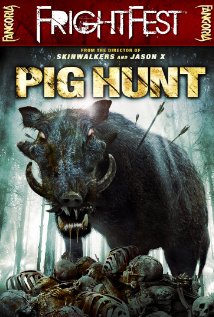
Pig Hunt (2008)

Now this is more like it! Plenty of weird shit as far as the eye can see.

Writers Zack Anderson and Robert Mailer Anderson and director James Isaac are obviously genre geeks—observant viewers will spot references to Alien, Road Warrior, even Apocalypse Now—who understand exactly what elements will best play in Peoria.

Blood sure, but even more, carnage. There’s enough carnage in Pig Hunt to fill Carnagie Hall. Yeah, I know.

Rugged leading man John (Travis Aaron Wade), his super-hot girlfriend Brooks (Tina Huang), and John’s three dopey bro buds drive out to the California equivalent of Appalachia, to go hunting for wild pigs on property owned by John’s uncle, who perished under mysterious circumstances.

But since the movie is named Pig Hunt, probably not all that mysterious. Look, just play along!

The gang goes through all the familiar check points (or plot points, if you prefer): They stop at a backwoods general store for directions—this one run by blues harmonica great Charlie Musselwhite, who gives them dire warnings—and encounter a hostile clan of indiginous rurals, a rattlesnake, and a van containing a muscular black gentlemen with a hippie-chick entourage, part of a nearby weed-growing commune.

Somewhere in here, we discover that John grew up around these parts, and that he’s actually a skilled hunter and woodsman, unlike his three hopelessly doomed friends.

Some hillbilly acquaintances of John come a-visiting, and they all decide to go hunting for “the Ripper”, a legendary 3,000 pound killer hog that most likely wasted John’s uncle—and the train goes off the rails, big time.

This sounds like it has all the makings of Troma Team farce, but somehow Pig Hunt avoids broad comedic pitfalls, and plays it somewhat straight.

The Andersons actually have the guts to develop the characters beyond stereotype to the point that I actually felt sorry for John’s friend Quincy (Trevor Bullock), a gentle chef who accompanies his more macho comrades. He and his beloved dog Wolfgang come to a bad end that they really didn’t deserve (though, to be fair, Quincy has no more business being outside the urban landscape than Ned Beatty does).

Collateral damage, as it turns out.

What the filmmakers demonstrate most effectively in Pig Hunt is that it’s the various human tribes (duh!) that wreak the most havoc, and that in order to survive, you have to become the biggest monster of all.

Hell, the giant pig is almost an afterthought until the one-hour point in the film. Bonus: The music is by Primus bassist Les Claypool, who also doubles as Preacher, one of the bloodthirsty hillbillies.

I love that shit.

Grizzly Park (2008)

No sense beating around the bush: Grizzly Park flat-out sucks. But it’s a scrappy sort of crappy, that you can almost, sort of, grudgingly admire.

Writer/director Tom Skull is obviously a rank amateur; I’ve seen children’s birthday party videos that were more professionally shot and edited. The acting, from top to bottom, is godawful. Plot points are gathered and randomly discarded without a second thought (e.g., why bother to give a character a gun if it’s never used?).

To give credit where it’s due, the gore effects, when they finally appear, aren’t too shabby. Oh, and they use a real bear.

Eight young adults (who seem to range in age from 18-35) are assigned community service for various offenses and because they’re all grotesque examples of humanity. Vain, selfish, shallow, stupid, greedy, bigoted, you name it—there’s nary a deadly sin left unaccounted for in this bunch.

These hateful dipshits are assigned to no-nonsense disciplinarian Ranger Bob (Glenn Morshower), who guides them deep into the wilderness of Grizzly Park, where they must pick up litter and (more importantly) serve as a snack tray for the wild critters of the forest.

There’s also an escaped maniac running around, but he’s so quickly dispatched by the ravenous bear that you wonder why Skull bothered to introduce him in the first place. Just another tossed plot point.

The tone of Grizzly Park careens from horny adolescent “humor” (it’s not in the least bit funny) to vague, weak-ass moralizing, to guts and gore—and you won’t care one little bit.

Cabin in the Woods (2011)

Autobiographical side bar: I am old, old, old. I am not Li’l Sharky, Teen Sharky, or even Adult Contemporary Sharky. I’m Ol’ Sharky, an ancient relic from a cooler and weirder world. I carried Agamemnon’s sword; argued with Aristotle; and dogged Cleopatra like she was made of bacon. I shit the pyramids and danced with dinosaurs. I used to carpool to work with Gilgamesh, and even he called me “Gramps.” So when I tell you that I don’t go to the movies much anymore, you’ll begin to understand why. It’s too risky. I can’t be away from my climate-controlled condo for lengthy periods or my aorta will explode. I tried once, and the Visigoths that run the multiplex refused to let me pitch my oxygen tent in the theater. Bastards. All bastards.

Even so, I found myself in the vicinity of a theater with time to kill yesterday, so I purchased a ticket for the moving pictures and saw Cabin in the Woods. I’m very glad that I did. Joss Whedon is getting justifiably blown by critic and fanboy alike for hitting a box-office home run with The Avengers, but that’s no reason to overlook this marvelous muffin basket of a monster movie that he produced, co-wrote, and (second unit) directed. Sadly, the specifics of the story arc prevent a detailed critique, but let’s just say that this is a horror movie on a grand “meta” scale that dwarfs Wes Craven’s Scream series.

What Whedon does with Cabin in the Woods is place the late 20th century horror movie, and more specifically the subcategory known as Hack and Stack (a.k.a. Doomed Teenage Campers), into a miraculous context, one that weds the most dreadful aspects of Lovecraft and Phillip K. Dick. Whedon has created a horror movie mythos that dares to explain why its characters make such monumentally bad decisions, and why it’s imperative that the fools suffer before meeting their (mostly determined) gruesome fate. It’s a groovy concept, but really, just this once.

I don’t anticipate a rash of imitators, because this looks to be a genre only big enough for one. And Cabin in the Woods is it. At the same time, I can understand why some horror fans didn’t care for it. To them I would say, don’t think of this movie as an attempt to subvert the genre in a contrived or overly clever way—it’s more of an elegant novelty, an intricate lark that stands as a singular testament to outside-the-box thinking. In other words, Whedon’s laughing with us, and not at us.