The Babadook (2014)

babadook

Not to put too fine a point on it, but The Badadook is one of the most emotionally devastating horror movies I’ve ever seen.

It’s quite a brilliant film that manages to be both a dark, heroic fairy tale and a grimmer-than-grim slice-of-life family drama about an overworked mother who tries, but can’t cope with her eccentric son’s disturbing behavior anymore.

It’s also about a terrified young boy who’s mother might be going insane.

Amelia (Essie Davis, who shines like a young Jessica Lange) is the harried widowed mother of Samuel (Noah Wiseman), a clever but damaged young boy who doesn’t fit in at school or with friends. Amelia’s husband died in a car accident on the way to the hospital the night she gave birth, so she too has a dark cloud of unresolved issues that follows her around like a nervous dog.

Mother and son clearly love each other, but their life is difficult, to say the least. One night, during the evening bedtime story, Samuel selects the wrong book and an evil spirit is loosed in the house.

As if they didn’t have enough trouble…

The combination of Amelia’s waking, working nightmare of a life, and the additional strain placed on her by the malign presence that’s settled in her home creates an unrelenting pressure cooker that would crumble a commando.

The Babadook is without gore and very little violence, yet it’s brutally draining, recalling both Polanski’s Repulsion and William Friedkin’s The Exorcist for its merciless plunge into the sea of madness.

Australian writer-director Jennifer Kent presents us with a tale that cuts uncomfortably close to the bone, because she had the nerve to invent two characters who are believable, likable, sympathetic—and profoundly haunted.

True, in the past, I’ve griped about movies that waste time on character development when all we really want is mayhem. The Babadook is exactly the opposite. It’s a realistic character-driven story in which we hope that misfortune can be averted because we’ve grown emotionally attached to the protagonists.

The bottom line, that bad things happen to good people, is more horrifying than a thousand dead campers.

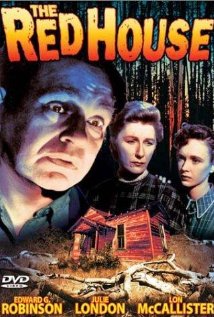
The Red House (1947)

redhouse

This is one of those oddball old films that I must have seen five or six trauma-inducing times as a kid, and heard nothing about since. Thanks for reuniting us, Hulu Plus! Warning: This film is in glorious black and white. There’s no need to adjust your sets.

Written and directed by Hollywood utility man Delmer Daves (The Petrified Forest, Dark Passage, A Summer Place, Destination Tokyo, 3:10 To Yuma, among others) and based on a novel by George Agnew Chamberlain, The Red House is a legitimately creepy, rural gothic, coming-of-age mystery.

It’s also a master-class in acting taught by Edward G. Robinson, a man mostly remembered for his snarling gangster roles, such as the sadistic Johnny Rocco in the Bogart/Bacall thriller Key Largo, but whose career continued for another 25 years.

Amidst a wild bucolic countryside sits the sprawling Morgan Farm, where we find Pete Morgan (EGR), his sister Ellen (Dame Judith Anderson), and their adopted ward-daughter-person Meg (Allene Roberts), who has a crush on Pete’s new hired hand, her high school classmate Nath (Lon McCallister).

One night, Nath decides to take a shortcut home through the woods, despite frantic pushback from Pete. While the lad insists that he must go through the woods to save time, Pete has a convincing anxiety attack, warning him about screams in the night coming from … The Red House! (dun, dun, Dun!)

Meg continues to moon over Nath, who’s in an unsatisfying relationship with Tibby (Julie London), a trampy rich girl who only has eyes for the brutish town poacher (Rory Calhoun, who wears an Elvis Presley pompadour several years before the King himself).

Meg and Nath find themselves thrown together, and decide to find that mysterious Red House in the woods.

While not horror per se, The Red House is thoroughly marinated in dread, with heavy dramatic anguish at every turn—including a surprising amount of smoldering teenage lust.

Certainly one could read Meg and Nath’s obsessive quest to find the “Red House” in the woods as the prelude to a sexual awakening.

I’ll have you know, I studied this shit in school.

The dreamy score by incomparable Hollywood composer Miklos Rozsa (Ben-Hur, Spellbound, Double Indemnity, among others), guides each scene to strange, delirious heights, and the film’s outré ending damaged my dreams for years. Or months, maybe.

Edward G. Robinson is sublime as a basically decent man with too many secrets—and a slippery grasp on reality. As his head submerges in the final scene, there is a lifetime of pain etched on his broken countenance.

The Red House is an ideal feature to pull out on a night when everybody swears they’ve seen everything.

Grizzly (1976)

grizzly

The trouble with being a middle-aged horror fan is never being able to quite remember where you heard something about a certain movie. I knew at one time, but now… that bit of data is gone forever, swallowed up by a sinkhole full of quicksand in my head that’s growing larger every day. (I would estimate it to be roughly the size of Rhode Island, at the moment.)

Anyway, I’d like to have a word with whomever advised me that Grizzly was “Jaws with a bear,” and “a classic gore-fest.” Sure, there’s blood and a respectable body count, but nothing that compares with Ben Gardner’s head floating out of a hole in the hull of his boat. Plus, Jaws had Spielberg, Richard Dreyfuss, Roy Schieder, and Robert Shaw. Grizzly has to make do with director William Girdler and a cast of ham-and-eggers.

So there’s a grizzly bear running amok in a Georgia state park and it’s up to a chain-smoking park ranger (Christopher George), a goofy naturalist who dresses in animal furs (Richard Jaeckel), and a cynical ‘Nam vet helicopter pilot (Andrew Prine) to stop the beast. l

This arduous task takes up the entire running time of the movie, which is stone-cold boring except for periodic bear maulings, and frankly, they’re no great shakes in the blood and guts department.

Despite the fact that I found Grizzly on Hulu Plus under the designation “Classics”, I would hesitate to put it into any special category other than “Ho-Hum & Hokey.”

A much better film of this type is John Frankenheimer’s Prophecy, about a pollution-spawned mutant grizzly on the rampage. Go find that one, instead.

Mr. Jones (2013)

mrjones

The consensus opinion on writer-director Karl Mueller’s feature-length debut is that it has all the makings of a first-class frightener—but falls apart at the end, like a child’s first soufflé. I think the finale boils down to two possibilities, neither of which ruined the experience, in my opinion. In Mr. Jones, Mueller has created a vivid, found-footage nightmare that runs its course effectively, before running smack-dab into an ambiguous conclusion. Ambiguous, in this instance, does not mean half-assed or inexplicable.

Nutshell: An attractive couple severs its ties with civilization and sets up housekeeping in a remote mountainous locale (The Sierra Nevada range, if I had to guess). Scott (Jon Foster) is intent on making a nature documentary, that fizzles out before it starts. Girlfriend Penny (Sarah Jones) is worried about her partner, who’s gone off his medication and lost interest in the film project that would undoubtedly make them both rich and famous. (Add sarcasm font to the preceding statement.)

They soon become aware of a mysterious neighbor who gambols around in a hooded cloak, and Penny deduces that it is none other than Mr. Jones, a reclusive artist famous for creating unsettling life-sized scarecrows that got shipped out to seemingly random recipients around the world. And now their documentary has a new subject!

As the couple investigates Mr. Jones further, it becomes apparent that the artist is some sort of sorcerer or shaman who’s guarding the borders where various dimensions overlap. Penny’s convinced he’s benign, but Scott isn’t so sure. During a massive storm, all hell breaks loose and the fledgling filmmakers lose each other in the chaos. Queue up an ending that leaves us with more questions than answers, and roll credits.

I thoroughly enjoyed Mr. Jones. It successfully keeps us off balance, unsure of anything that’s taking place before our eyes. As for the ending that got stuck in everyone’s craw, there are two possible explanations. The first is that Scott, upon abandoning his meds (for what condition, we’re not told) has a reality break from which there is no return. The footage they’ve shot suggests that Mr. Jones is Scott himself, but this is hard to verify since there seem to be good and evil versions of both characters running around.

The other theory is that Scott did something to screw up the wards that Jones had put in place to protect our world against impending evil, resulting in the latter’s death. Now it’s up to Scott take his place as the new dimensional guardian. Which is only fair, if you ask me.

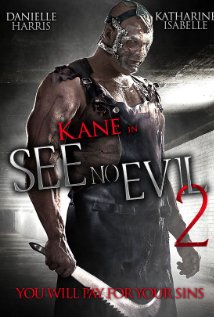
See No Evil 2

SeeNoEvil2

In which righteously indestructible maniac Jacob Goodnight (wrestler Glenn “Kane” Jacobs) rises from the grave morgue to massacre another troop of teens late twenty somethings who can’t keep it in their pants.

As you may recall from the first See No Evil, Goodnight continually feels the shame of his lustful adolescent urges, and painful memories of the puritanical punishment dished out by his psychotic mother have become his default setting.

Hail the avenging prude!

As directed by the Twisted Twins, Jen and Sylvia Soska, who brilliantly helmed American Mary, See No Evil 2 is a perfectly acceptable hack and stack with an exemplary cast.

The incomparable Katherine Isabelle (American Mary, Ginger Snaps) is certainly one of the most compelling actresses in the horror genre, and she brings oodles of panache to the part of Tamara, a charmingly depraved vixen victim of the rampaging Goodnight.

Dependable Final Girl Danielle Harris (The Hatchet trilogy) also acquits herself nicely as morgue assistant Amy, the secret object of affection of fellow cadaver cutter Seth (Kaj-Erik Eriksen).

Not that being somewhat virtuous will save anybody here from a seven foot tall, one-eyed gorilla armed with all sorts of nasty looking sharp things.

If I had to gripe about anything, it would have to be a shortage of stylistically memorable mayhem. After all, the Soska Twins are responsible for the dazzling American Mary, one of the most original and provocative horror movies of the last few years.

See No Evil 2 seems a bit perfunctory in comparison, but given the nature of indie cinema these days, filmmakers with artistic inclinations are often tasked with creating conventional fare, in order to earn a payday that will result in something more profound and personal.

I believe that to be the case here.

Willow Creek (2013)

willowcreek

Comedian-turned-director Bobcat Goldthwaite has proven himself to be a thoughtfully provocative filmmaker; first with the Robin Williams tragi-com World’s Greatest Dad, followed by the let’s-shoot-all-the-douchebags black comedy God Bless America.

So what does Bobcat bring to the table with Willow Creek, his found-footage fright flick about a yuppie couple in search of Bigfoot? A legitimately scary movie with a harsh message for dilettante daytrippers, and that also happens to mirror the narrative structure of The Blair Witch Project.

Jim (Bryce Johnson, a poor man’s Matthew Modine) is a Sasquatch enthusiast who’s keen on visiting the Willow Creek wilderness where the famous Bigfoot footage was shot by Roger Patterson in 1967. Jim’s girlfriend Kelly (Alexie Gilmore) is along to keep him company.

After interviewing some folks about the legendary creature, the curious couple is strongly advised to abandon the project by two different locals. As it turns out, this was excellent advice that should have been taken to heart.

The whole trip is treated as quite a merry lark until the 42-minute mark when Jim and Kelly find that their campsite has been ransacked. It is at that point that Kelly sensibly says, “I want to go home.” This is followed by a long and harrowing night sequence with the frightened couple trapped in their tent as something roars and stomps around right outside.

The protagonists in Willow Creek, while basically decent and likable, are in no way up to the task at hand, namely, confronting the unknown. Most of the blame goes to Jim, an irresponsible man-child who carelessly follows his whims without a second thought. Kelly, while more of a pragmatist, is too self-absorbed to recognize what a dangerous situation they’ve stumbled into. They’re nice enough, but they reek of frivolous bourgeois entitlement.

Ultimately, their flimsy relationship falls apart in the face of a challenge that they were stunningly unprepared for. To be fair, though, being menaced by a howling legend in the Forest Primeval would test the mettle of even the most devoted couple.

Shrooms (2007)

MV5BNDMxODM5NTY2OV5BMl5BanBnXkFtZTcwNTE5NzQ5MQ@@._V1_SY317_CR5,0,214,317_AL_

If you can get past the movie’s ludicrous premise, Shrooms is actually a fairly tight little thriller about another camping trip gone to hell. But that premise is a real whopper. Allow me to vent for a moment.

WHY THE HELL WOULD A GROUP OF FRIENDS WANT TO TRAVEL ALL THE WAY TO IRELAND—where five out of the six have never been—TO PICK MUSHROOMS AND TRIP BALLS? EVEN BETTER, THEIR GUIDE TAKES THEM TO A BLIGHTED WILDERNESS THAT’S INHABITED BY TRAUMATIZED FORMER INHABITANTS OF A HOME FOR WAYWARD YOUTH THAT WAS RUN BY A CRACKPOT RELIGIOUS SECT THAT TORTURED AND ABUSED ITS INMATES? AND NOW, IT’S RUMORED TO BE HAUNTED BY THE GHOST OF A SADISTIC MONK AND THE LITTLE SACK-HEADED FERAL CHILD WHO TRIED TO KILL HIM. WHY, THAT’S PERFECT! THAT’S EXACTLY WHERE I WOULD WANT TO CHOW DOWN ON HALLUCINOGENS, ALONG WITH MY BEST BUDDIES THAT I DON’T REALLY LIKE AND WHO DON’T LIKE EACH OTHER. SHEESH! WASN’T THE HAUNTED ABATTOIR AVAILABLE? OR A REALLY VENGEFUL AMERICAN-INDIAN BURIAL GROUND?

To their credit, director Paddy Breathnach and writer Pearse Elliott deliver enough shocks and shivers to keep us on full alert. But this trip was doomed from the get-go and this little troop of backpackers never stood a chance.


The Battery (2012)

MV5BMjAxMTk2NDcxM15BMl5BanBnXkFtZTcwMjQ0ODA0OQ@@._V1_SY317_CR0,0,214,317_AL_

I suppose The Battery qualifies as a zombie movie—but just barely.

Until the finale, you can count the number of undead appearances on one hand. First and foremost, it’s a post-apocalyptic road movie that owes more to Samuel Beckett than it does George Romero.

Gorehounds with ADD are going to hate this film because it’s slower than a senior citizen square dance and probably a lot less bloody. It’s also an extremely frugal production. Seriously, the budget was probably less than what I have in my checking account.

I am currently unemployed—thanks for asking!

Even with so many things stacked against it, I have to give an admiring thumbs-up to The Battery and to writer, director, and star Jeremy Gardner, who bravely ran with the idea of having very little money at his disposal, and used that freedom to create something unique: a bleak, absurdist buddy movie about two minor-league baseball players dodging the dead on the backroads of Connecticut.

After months on the road, our two main characters have become a study in contrasts. Ben (Gardner), the team’s catcher, is a bearded outdoorsman, a brawny survivor-type who does most of the heavy lifting (hunting, fishing, zombie-killing) in the relationship.

Mickey (Adam Cronheim), a relief pitcher, is a sullen romantic who spends most of his time lost in thought with a pair of headphones fixed over his ears. Despite the presence of the jovial and optimistic Ben, Mickey is depressed and desperately misses his old life.

One fine day, the pair pick up a stray communication on their walkie-talkies, leading them to believe there is a fortified community in the area. Ben, who is content with camping and living outside, wants to steer clear. Mickey wants a home. A bed. A roof over his head. And maybe a girl.

This is the doomed conflict at the heart of The Battery—the terrible necessity of freedom, as personified by Ben, who refuses to be trapped in any situation, and Mickey’s need for comfort and security.

In the end, freedom trumps comfort, as one might expect given the dire circumstances. But Gardner’s languid, lengthy scenes of Ben and Mickey brushing their teeth, playing catch, listening to music and generally farting around, imply that it takes two souls to make a life worth fighting for.

Positive and negative, yin and yang, pitcher and catcher.

Fun Fact: “The Battery” refers to the pitcher and catcher in ye olde baseball vernacular.

All the Boys Love Mandy Lane (2006)

MV5BMzM0MjU1MzUzMF5BMl5BanBnXkFtZTcwMjcwNDQyOQ@@._V1_SY317_CR0,0,214,317_AL_

On the surface, All the Boys Love Mandy Lane looks like a fairly typical stalk and stab adventure.

You know the drill: a passel of comely teens in a rural location begin to notice that attendance is dropping sharply. But director Jonathan Levine and writer Jacob Foreman make a number of astute moves that raise the quality level significantly.

Levine proves himself to be an able visual stylist; his lingering shots of young faces smiling in the sun give Mandy Lane an almost languid European sensibility—which enhances the impact of sudden violent interludes.

Characters are a bit more evolved (and less annoying) than the usual doomed-camper stereotypes, and the yearning desire that they feel for the dream girl in their midst is perfectly understandable.

Finally, the absence of supernatural elements makes the ensuing murder spree grimly realistic and even more disturbing.

The titular maiden (Amber Heard) is a seemingly unattainable innocent beauty that stokes the collective fire of her lusty classmates. When the subject of Mandy Lane comes up various boys call “first dibs” as if that will help their cause.

A clutch of her school chums finally prevail on Mandy to spend the weekend partying at a remote ranch owned by Red’s (Aaron Himelstein) family. The concept of summer fun is quickly quashed as a string of murders leads to a very ambiguous conclusion.

Some of the plot points are easy to figure out and some are not, but Levine uses the accelerator sparingly and lets the action play out in a naturalistic setting.

True, some viewers may experience a twinge of boredom here and there, but danger, in the form of a psycho in a hoodie, is never far away.

Recommended.


Mr. Hush (2011)

MV5BNTYxMjU3MTQ1Nl5BMl5BanBnXkFtZTcwMDU4Mzg5Nw@@._V1_SX214_AL_

Nope, no sugarcoating around here. Your life will not be enhanced in any way, shape or form by watching Mr. Hush. It’s a terminally amateurish effort from writer/director David Lee Madison about a dude named Holland Price (Brad Loree, a poor man’s, I don’t know, Eric Roberts?), an unfortunate soul who opens the door to the wrong trick-or-treater. Here’s a life hack for you buddy: Don’t let a man into your house who is dressed as a priest and calling himself “Father Flanagan” (Edward X. Young) on Halloween night unless you’ve been looking forward to seeing your wife’s throat cut and your daughter abducted.

Bad luck, right? We leap 10 years into the future and Price is a dish dog at a greasy spoon with a tiny little crush on Debbie (Connie Giordano) the new waitress. She’s a widow with a teenage daughter, he’s a widower with a perpetual case of the blues, so they tentatively embark on a relationship. Oh hark! Is that a knock at the door? Before Price can say “boo” to a goose, the very same maniac reappears, looking not a day older, to carve up his new special lady. What are the odds?

Mr. Hush would be utterly unwatchable without the meaty contributions of Edward X. Young, as a charmingly hammy community theater villain who seems to be enjoying the hell out of himself, even firing off a perfectly terrible joke after he’s impaled by the shards of a Louisville Slugger. And yep, that’s Evil Ed from Fright Night, Stephen Geoffreys, as the killer’s psychotic little helper who dresses like a homeless backup dancer from Michael Jackson’s “Bad” video. Sadly, it’s not enough to compensate for the leaden pace, goofy-ass script and fatal cheapness of the production.