Frogs (1972)

Ray Milland won a Best Actor Oscar courtesy of his spirited dip into dipsomania in Billy Wilder’s Lost Weekend (1946), so let’s cut him some slack for Frogs, an unintentionally hilarious stinker from American International Pictures.

First things first: At no point in the film is anyone eaten by a giant frog. The poster is complete bullshit.

Since it’s a horror movie with an environmental message, Milland is cast as Jason Crockett, a venomous industrialist in a wheelchair ruling over a polluted private island plantation, fussed over by his feckless family intent on currying the old man’s financial favor.

Keeping Milland company is a naked-lipped Sam Elliott playing Pickett Smith, a hippie nature photographer in a canoe accidentally swamped by Clint Crockett (Adam Roarke), one of the patriarch’s progeny of sycophants and spoiled brats.

The exception is Karen Crockett (Joan Van Ark from Knot’s Landing), a lovely and luminous free spirit, who naturally gravitates to Smith, the stranger in the group, and the only other decent human being for miles.

It seems the senior Crockett wants his island free of frogs, and presumably snakes, spiders, gators, gulls, geckos, skinks, skunks, squirrels, and any other member of the animal kingdom that dares show its face.

“I still believe man is master of the universe,” he sneers at Smith.

Crockett instructs his minions to spray pesticides on the flora and fauna surrounding the estate. The flora and fauna don’t care for this one bit and mount a counter attack.

There is not a single sequence in the movie that isn’t punctuated (padded) with additional nature footage of creeping critters hopping and slithering closer to the Crockett house. Frogs are lobbed haphazardly into frame by production assistants, occasionally piling up in abundance, and photographed from menacing low angles to show they clearly mean business.

Directed by TV veteran George McCowan, Frogs boasts some of the most howlingly cheap and awful death scenes ever, rivaling poor Bela Lugosi wrestling an inanimate octopus in Ed Wood’s Bride of the Monster.

I was reminded of this as I watched Stuart Martindale (George Skaff), a bald guy in a velour suit, forced to grapple with an unconscious crocodile.

A snapping turtle claims one victim! Another gets lost in the swamp chasing butterflies, and after what seems like several weeks of wandering and weeping, finally succumbs to a surfeit of snake bites.

Yet another of Crockett’s foppish relatives ends up poisoned in a closed greenhouse thanks to a bunch of reptiles shattering multiple bottles of industrial strength pesticide, as is their wont.

The best/worst demise, undoubtedly belongs to Michael Martindale (David Gilliam), which involves being cocooned by moss and having spiders spilled upon his person, including one right in the mouth.

As for Ray Milland, the conservative think-tank commander goes down with the ship, deserted by everyone including his dog. He is seen taking his final agonizing breath amidst another barrage of tossed toads, glaringly accompanied to the grave by Les Baxter’s shrieking, atonal score.

What a sorry way to croak!

Frogs isn’t so bad it’s good. But the low-rent laughs are all over the place, just like the titular terrors who pounce on Crockett’s star-spangled birthday cake, ruining his crappy family celebration.

Remember: Environment good! Old rich white men bad! Too bad this populist message didn’t help George McGovern in ’72.

Parasite (2019)

When was the last time a horror movie won a Best Picture Oscar?

How about a horror movie from South Korea?

Wait! Is this even actually horror?

Bong Joon Ho’s Parasite was recently named the best movie of the 21st century by the New York Times, as well as in a poll of more than 500 actors, writers, and assorted Hollywood riff raff.

The accolades were enough to prompt a rewatch, so the wife and I buckled in with a tasty spread from Hawaiian Bros Grill, and let the good times roll.

We open on the Kim clan, a quartet of creative and industrious con artists living in a smelly basement apartment in Seoul. Bong’s set design standards are incredibly detailed, with the Kims’ ridiculous elevated toilet serving as a mocking throne over their scheming degradation.

From the squalid floor of their stinking dungeon, the Kims watch as a parade of drunks pee on their window to the outside world.

Fortunately, son Ki-woo (Lee Sun-kyun) lands a gig as a tutor to a bored rich high school girl (Jo Yeo-jeong) and soon, through Machiavellian machinations and good old teamwork, the enterprising Kims have securely attached themselves to the wealthy, but blandly oblivious Park family, serving comically in a number of unlikely household occupations.

As the title implies, the Kims dig deep into their new situation, even taking on airs of pretension themselves, while pillaging the fancy foods in the bourgeois pantry.

Speaking of pantries, the Parks’ fabulous modern house is itself a metaphor for a society that could do a better job of feeding and housing its less-prosperous citizens.

Consider the plight of Oh Geun-sae, (Park Myung-hoon) the hider in the house with nowhere else to go. The husband of the Parks’ former housekeeper has gone insane living on food scraps in a hidden underground bunker. It’s his terror at the prospect of being homeless that’s responsible for the blood that eventually flows all over a beautifully manicured backyard.

Parasite is a marvelous creature, neither fish nor foul, bursting with darkly comic observations about the pathetic need to feel superior—to anyone. The Kims want that smug insulation of their own, but they don’t pass the smell test.

The American Dream, at least in South Korea, involves fastening yourself to a fat host. While waiting for the trickle down to take effect, you must keep others away from the living meal ticket.

Bong’s masterpiece makes for a wondrously uncomfortable safari through a human ecosystem. Parasite is mind-growing artistry containing an ocean of insights on the class struggle, all awaiting your repeated viewing.

That’s called time well spent. Ask the New York Times.

Final Destination: Bloodlines (2025)

Note: Final Destination: Bloodlines works just fine as a stand-alone feature. It’s not necessary to be familiar with the previous films, but it helps provide context.

The Final Destination franchise is pure boilerplate. Someone has a realistic, sweat-inducing vision of an impending disaster and manages to save lives that would have otherwise been lost in the carnage.

In Bloodlines, it becomes painfully clear that rules are rules when it comes to your expiration date. Through careful vigilance, Iris Campbell (Gabrielle Rose)—who saved a ton of folks from perishing in the nerve-wracking collapse of a Space Needle-like restaurant 50 years ago—is able to keep the Reaper at bay by cloistering herself away as a hermit in a one-room fortified cabin in the middle of nowhere.

Even so, you can’t hide forever.

Iris’s granddaughter Stefani Reyes (Kaitlyn Santa Juana) and Stefani’s younger brother Charlie (Teo Briones) are next in line to be shredded out of existence unless they can somehow solve the pattern of Death’s List.

Recurring character William John Bludworth (Tony Todd) is a mystical mortician who provides cryptic clues for at-risk protagonists throughout the six-film series. As he tells the latest batch of soon-to-be goners, “Death doesn’t like being cheated.”

Note 2: This was Todd’s last screen performance, and the distinguished horror actor exits in classic fashion, addressing the characters (and us) thusly: “I intend to enjoy the time I have left, and I suggest you do the same. Life is precious. Enjoy every single second. You never know when. Good luck.”

The prospect of being exceedingly vulnerable to dismemberment in everyday situations is the cake and frosting in this formula. Here is the reason we bought the tickets. How do these poor fools meet their doom? Will it be artful and intricate or just the sudden splat of another ill-timed bus?

As usual, the focus falls on objects seen around the house or existing in nature, and directors Zach Lipovsky and Adam Stein helpfully tick off all the nearby instruments of destruction for our consideration, just before the tragic events unfold in Rube Goldberg fashion.

A wayward shard of broken glass in someone’s cocktail should cause a bloody catastrophe, and it does, but the process is open to variables coming into play.

The only certainty here is someone is going out with a bang, style points appreciated.

“Death doesn’t take no for an answer,” Bludworth reminds us.

So it’s no surprise when Death catches up with you, he’s justifiably pissed that you got away, and that’s why the elements leading to the inevitable demise are so squishy and graphic. It’s a warning to anyone who thinks they can escape a (gruesome) fate.

It also provides us with the “aahhh” moment; a cathartic conclusion of a fancy fireworks display.

Final Destination: Bloodlines is a succinct, stylish summation of the entire series, an invitation to certain death that deals us in; a rousing game of Clue with extra corpses.

Like a heckling a good/bad movie, the joy of watching Final Destination: Bloodlines is best shared interactively with friends and family. Everyone can choose a victim and figure out their own Mousetrap method of mutilation.

Wheee!

Frailty (2001)

The late Bill Paxton (1955–2017) will always be remembered for his distinguished genre credentials. As the not-so-brave Private Hudson in Aliens (1986), he got all the best lines, including “Game over, man!”

A year later he was part of a kick-ass vampire gang in the criminally underrated Near Dark, reunited with his Aliens costars, Lance Henriksen and Jenette Goldstein.

Still not impressed? How about this action? Paxton is the only actor to play a character killed by a Predator (Predator 2, 1990), a Xenomorph (Aliens) and a Terminator (The Terminator, 1984).

Serious respect!

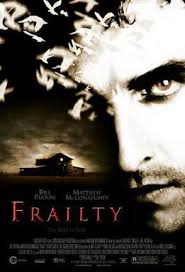
In Frailty, Paxton directs and stars as a mild-mannered mechanic who becomes a divinely inspired killer after a visitation from an angel.

Rather than keep this to himself, he awakens his two young sons Fenton (Matt O’Leary) and Adam (Jeremy Sumpter), informing them that they will be helping Dad destroy demons in human form.

Adam, the younger son, is gung-ho to please his avenging father, while older brother Fenton doesn’t like the idea one bit.

Too bad the Lord’s will must be served.

The brothers’ upbringing is recounted years later by a grown-up Fenton (Matthew McConnaughy) to incredulous FBI agent Wesley Doyle (Powers Boothe), who reluctantly gets reeled into a twisted tale of a family under the dominion of a terribly unbalanced man.

As a director, Paxton imbues Frailty with a naturalistic, small-town feel that makes the episodic violence particularly jarring. As an actor, he delivers a nuanced, but emotionally reserved performance that evokes a little sympathy and a whole lot of terror.

Anyone expecting the unhinged Hudson, or perhaps the belligerent bully Chet from Weird Science will see nothing of the sort here.

By the time he locks Fenton in the basement for a week (no food, one glass of water per day) in an effort to drive out any demonic influences, the horror has gotten uncomfortably real, as Paxton dons the face of unblinking fundamental fanaticism, reminiscent in tone of Kevin Smith’s Red State.

Bill Paxton’s ability to goose the tension as a filmmaker in Frailty, is more than matched by his extraordinary performance as an ordinary man called upon to serve God by fighting evil.

But it’s not easy. Just ask Abraham.

Sinners (2025)

Enthusiastically recommended and watch out at awards time!

Sinners is the fifth collaboration between writer-director Ryan Coogler (Creed, Black Panther, Fruitvale Station) and star Michael B. Jordan, and it’s an epic whopper of a movie with a blistering blues soundtrack and a depth of soul not typically found in an era of easily disgested entertainment options.

Twin brothers Smoke and Stack (both played by Jordan) return to Clarksdale, Mississippi—after working for Al Capone’s mob in Chicago for seven years—determined to open a juke joint, a place where hard-working sharecroppers and field hands can be free to eat, drink, and dance the night away.

The brothers have contrasting demeanors, but their ambition, to own something free and clear that’s designed to serve the black community, is helped greatly by the large amounts of cash they’ve brought back from the Windy City.

Smoke recruits his former lover Annie (Wunmi Mosaku), a New Orleans hoodoo practitioner, to cook catfish for the crowd, while Stack hustles hooch and henchmen in an effort to keep the peace in their new joint.

On opening night, the club is jammed with folks stomping away to spirited music provided by guitar prodigy Sammy Moore (Miles Caton) and blues elder statesmen Delta Slim (Delroy Lindo).

Coogler is in absolute artistic control of the frenetic proceedings, and the verve and excitement he is able to capture during the dance sequences is unreal. We’re talking mesmeric scenes flowing so organically they’re worthy of repeated watches on their own.

While patrons shake and shimmy, Coogler enlarges the cultural lens to include a heartfelt vision of artists—past and future—caught in the dervish rhythms of the juke joint, and the effect is breathtaking.

“Blues weren’t forced on us like that religion,” Slim tells Sammy. “We brought this with us from home.”

Just when we’re having a peak cultural moment, a trio of vampires disguised as itinerant Irish folk musicians, crash the party and a bloodbath ensues.

There is no reason to believe, as some grumpy critics have implied, that Sinners unexpectedly goes off the rails at this point. Coogler doesn’t bring in the undead as a deux machina or as a concession to a larger, edgier demographic.

The taking of blood and the quick assimilation (exploitation) of blacks into a “protective” white society is a historical hot-button issue at play in Sinners, but it’s far from the only one.

There’s subtext and pointed references worth investigating everywhere, including a mysterious connection between the Choctaw Tribe and Irish immigrants. It’s all intentional on Coogler’s part, as he dares us to consider alternative histories to the ones we’ve been spoon fed.

Visually, musically, and dramatically, Sinners kicks more ass than a 1000 superhero flicks. Add yours to the queue.

Dr. Giggles (1992)

“Laughter is the best medicine.”

As played by a thoroughly committed Larry Drake (Benny Stowitz from L.A. Law!), this titular sawbones could have been a contender, worth at least two sequels, minimum.

Dr. Giggles is an early release from Dark Horse Comics, so no reason for there not to be a franchise.

As a child, Evan Rendell Jr. (Drake) watched the angry citizens of Moorehigh haul his father, the town doctor, out of his home office and stone him to death. Apparently, the locals were none-to-pleased with Rendell Senior’s research methods, which included killing seven patients in search of a healthy heart to transplant into his own dying wife.

Hey! You can’t make an omelet without breaking a few eggs.

Young Rendell is institutionalized and grows up into an adult lunatic with a fixation on physicians. He escapes after dissecting his captors, and heads back to Moorehigh tittering like a freshly sprung Michael Myers.

Final Girl Jennifer Campbell (Holly Marie Combs, Piper from Charmed!) is an anxious high school student with heart valve problems set on a collision course with the hysterical healer, while a bunch of her friends and neighbors fall victim to Rendell’s house calls, dying horribly under the madman’s medical ministrations.

A hearty round of applause to Drake, who giggles and puns his way through the slaughter with verve and panache, a maniacal glint in his bulging eyes.

“Wait till you see my bill,” he crows after skewering another unlucky chump with his antique surgical implements.

Like any good doctor, Rendell is torn between his duty to the community (killing them), and carrying on his father’s quest to find a heart, in this case to “save” Jennifer.

The fact that he’s a self-taught surgeon doesn’t inspire much confidence, though. That’s why the patient needs to be strapped to the table—for her own good.

Dr. Giggles is premium slasher carnage punctuated with corny jokes. If it’s wrong, I don’t wanna be right.

The doctor will slay you now.

In A Violent Nature (2024)

There’s quite a bit more here than meets the eye.

In A Violent Nature is not, as I had been told, a slasher movie told from the killer’s point of view.

Instead, writer-director Chris Nash dials up a multitude of perspectives, as if the doomed campers were being chased through a high-tech forest equipped with dozens of surveillance angles to choose from.

Stupid, soon-to-be-deceased college students rent a cabin in the woods. While hiking they disturb a memorial to Johnny, a mentally challenged boy who got bullied to death 70 years before.

Straight away we witness a now monstrous Johnny rise from the grave to seek revenge, and we spend considerable time riding shotgun alongside this unstoppable fiend as he makes an inspired mess out of the clueless kids.

Sometimes the murders are super gory, (the girl doing yoga gets some major stretching bodywork done) and some happen at a distance in the blink of an eye, as when a comely swimmer disappears below the waterline with a yelp from across the lake.

Nash keeps refreshing the views. He employs a static wilderness cam that dispassionately records long shots of the killer walking from one side of the frame to another. Next thing you know, we’re sitting on his shoulder, then a bird’s eye view, then a worm’s eye view.

With a string of cameras at his disposal, Nash asks us to consider the single-minded plight of a creative mutilator, in this case one that wears an old-time fireman’s mask, giving him the appearance of a predatory insect.

When Johnny occasionally pauses in his gruesome quest, we can get inside his horrible head and watch the wheels turn as he considers how best to maximize his menace, though he does remove his mask to play with a toy car at one point, a tragic reminder that this thing was once a happy child.

The undead death dealer featured in In A Violent Nature isn’t a killing machine, however. He wordlessly seems to enjoy the hunt and clearly takes pride in his victim-stalking and construction of murderous tableaux.

Johnny is obviously an artist, inviting us along to spy on his process. Now there’s a view you won’t see every day.

The Resident (2011)

It’s Hammer Time!

A release from the revived (and revered) Hammer Films imprint, The Resident traces its ancestry from gothic mysteries, slasher cinema, erotic thrillers, and Hitchcock’s Psycho.

It’s even got Christopher Lee in a supporting role! Doesn’t get more Hammer than that.

Oscar winner Hilary Swank portrays Juliet, a frazzled ER doctor on the fly from a failed relationship. In search of new lodgings, she chances upon an old building with a spectacular view of the Brooklyn Bridge, owned by Max (Jeffrey Dean Morgan), a charming landlord who resides on the premises with his ailing grandfather August (Christopher Lee).

When Juliet flirts with and kisses Max, it seems perfectly natural. He and Juliet are both attractive and successful people, their mutual interest is a given. She’s also lonely and drinks too much wine.

Finnish writer-director Antti Jokinen infuses the standard melodrama in The Resident, with a willingness to get uncomfortably close to his characters. Juliet isn’t sleeping well and can’t shake the feeling that someone is invading her space.

It’s not much of a mystery, as we learn that Max, the guy who owns the building, is indeed a highly disturbed individual, but perhaps not unreasonably so. It could be argued that Juliet’s reckless behavior with the heart of an unstable suitor is the cause of all the misery.

“You kissed me first,” he reminds her. And when Juliet has the nerve to get back together with her asshole ex, the wheels really come off.

Jokinen’s use of floating and flying camerawork is absorbing, making a mostly single-set apartment appear to be filled with more passages and secret doors than the Vatican.

The Resident is better than it has a right to be, largely thanks to Jeffrey Dean Morgan’s impressively layered performance as Max, a tortured soul who maybe just wanted to meet a nice girl. And a doctor to boot!

Morgan isn’t shy about delving the creepier depths of Max’s obsession, whether it’s licking Juliet’s hand from beneath her bed while she sleeps, or having a little cuddle party with her clothes, he’s clearly an actor unafraid of committing to a role.

Anyone expecting an arrogant and antagonistic villain in the vein of The Walking Dead’s Negan will, I thnk, be surprised by Morgan’s ability to generate menace, revulsion, and sympathy—right up until the bloody nail-gun finale.

The Hunt (2020)

Rich people hunting poor people for sport. Yeah, so what?

Richard Connell’s short story, The Most Dangerous Game, featuring a Russian nobleman tracking an American captive on a private island, is the source material for this concept, and it was published just over 100 years ago!

A familiar premise, but in The Hunt, it’s all about where you stand politically that determines your fate. Always room for innovation.

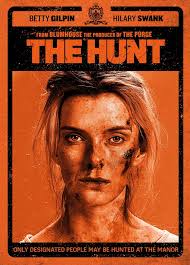
The setup is pure boilerplate, as a dozen seemingly random folks are kidnapped and transferred to a private hunting reserve called The Manor, where they’re given weapons to defend themselves against their affluent captors.

But something’s just a little off. The victims are not what they seem, and neither are the hunters.

Writers Damon Lindelof (Lost) and Nick Cuse drop little hints throughout the film about who exactly is hunting who, and the reveal is both unexpected and fertile ground for hilarity, as liberals, who aren’t all that competent with guns, try to exterminate right-wing pundits, podcasters, and NRA supporters.

The Hunt leaves no room for good guys and bad guys, but Crystal (Betty Gilpin), an ex-military badass who was captured by mistake, takes the entire operation down, culminating in vicious hand-to-hand combat with Hilary Swank, the mastermind of the whole scenario.

The action sequences are tightly and efficiently orchestrated, particularly during a deadly shootout in a Mom & Pop grocery store, where in between salvos of bullets, a shopkeeper (Amy Madigan) wonders why one of the gunmen (Ike Barenholtz) feels the need to own so many guns?

Director Craig Zobel maintains a whippingly brisk level of excitement peppered with acidic observations from everyone involved, which should lead to repeat viewings in order to extract hidden gems.

Need to mend some fences after the election? The Hunt should satisfy both ends of the American politcial spectrum, and most points in between, as long as we haven’t lost the ability to laugh at our foolish selves.

The Final Girls (2015)

It started with Back to the Future, of course, the idea that a troubled teen could fix the present by kicking ass in the past.

The Happy Death Day series introduces horror into the equation, and recent stabs at the genre include Totally Killer, a film reviewed here.

The Final Girls adds even more spice to the stew, as Max (Taissa Farmiga), grieving the death of her Scream Queen mother, Amanda Cartwright (Malin Ackerman), gets dumped into the early 1980s after a catastrophe at a screening of Mom’s most famous feature, Camp Bloodbath.

Director Todd Strauss-Schulson and writers Joshua John Miller and M.A. Fortin have a ball with a group of contemporary adolescents spun 40-plus years into the past to be fodder for a Jason Voorhees-style killing machine at a doomed summer camp.

Like the Scream franchise, the ability to adapt and survive by figuring out the “rules” of a slasher movie is the name of the game in The Final Girls, but the action also affords Max the chance to not only reconnect with her mother, but to act as a sort of spiritual advisor to a character carelessly described as “the shy girl with a guitar and a clipboard.”

Max and her friends travel even further back in time to witness the origin of the camp killer in the 1950s, and they all notice when the world around them is in black and white. One of them reckons she’s having a stroke because she’s suddenly colorblind!

The cinematography by Elle Smolkin also grabs our attention with a bevy of unbelievable shots, such as the killer, set ablaze, chasing the kids in slow motion. Or the apocalyptic purple sky during Max’s final battle.

There’s frightening fun in abundance, but there’s also inside jokes about lame movie stereotypes such as the airhead slut Tina (Angela Trimbur), who must be tied up to keep her from stripping off her clothes and summoning the killer.

Adam Devine from Workaholics delivers boffo laughs as Kurt, a one-dimensional stud from Hollywood’s disposable character drawer, who somehow makes his quest for endless nooky a righteous cause.

The Final Girls is an excellent example of a teen time-travel traumatic adventure. Maybe one of the best.