The Babadook (2014)

babadook

Not to put too fine a point on it, but The Badadook is one of the most emotionally devastating horror movies I’ve ever seen.

It’s quite a brilliant film that manages to be both a dark, heroic fairy tale and a grimmer-than-grim slice-of-life family drama about an overworked mother who tries, but can’t cope with her eccentric son’s disturbing behavior anymore.

It’s also about a terrified young boy who’s mother might be going insane.

Amelia (Essie Davis, who shines like a young Jessica Lange) is the harried widowed mother of Samuel (Noah Wiseman), a clever but damaged young boy who doesn’t fit in at school or with friends. Amelia’s husband died in a car accident on the way to the hospital the night she gave birth, so she too has a dark cloud of unresolved issues that follows her around like a nervous dog.

Mother and son clearly love each other, but their life is difficult, to say the least. One night, during the evening bedtime story, Samuel selects the wrong book and an evil spirit is loosed in the house.

As if they didn’t have enough trouble…

The combination of Amelia’s waking, working nightmare of a life, and the additional strain placed on her by the malign presence that’s settled in her home creates an unrelenting pressure cooker that would crumble a commando.

The Babadook is without gore and very little violence, yet it’s brutally draining, recalling both Polanski’s Repulsion and William Friedkin’s The Exorcist for its merciless plunge into the sea of madness.

Australian writer-director Jennifer Kent presents us with a tale that cuts uncomfortably close to the bone, because she had the nerve to invent two characters who are believable, likable, sympathetic—and profoundly haunted.

True, in the past, I’ve griped about movies that waste time on character development when all we really want is mayhem. The Babadook is exactly the opposite. It’s a realistic character-driven story in which we hope that misfortune can be averted because we’ve grown emotionally attached to the protagonists.

The bottom line, that bad things happen to good people, is more horrifying than a thousand dead campers.

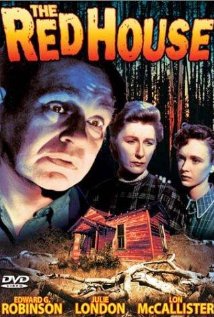
The Red House (1947)

redhouse

This is one of those oddball old films that I must have seen five or six trauma-inducing times as a kid, and heard nothing about since. Thanks for reuniting us, Hulu Plus! Warning: This film is in glorious black and white. There’s no need to adjust your sets.

Written and directed by Hollywood utility man Delmer Daves (The Petrified Forest, Dark Passage, A Summer Place, Destination Tokyo, 3:10 To Yuma, among others) and based on a novel by George Agnew Chamberlain, The Red House is a legitimately creepy, rural gothic, coming-of-age mystery.

It’s also a master-class in acting taught by Edward G. Robinson, a man mostly remembered for his snarling gangster roles, such as the sadistic Johnny Rocco in the Bogart/Bacall thriller Key Largo, but whose career continued for another 25 years.

Amidst a wild bucolic countryside sits the sprawling Morgan Farm, where we find Pete Morgan (EGR), his sister Ellen (Dame Judith Anderson), and their adopted ward-daughter-person Meg (Allene Roberts), who has a crush on Pete’s new hired hand, her high school classmate Nath (Lon McCallister).

One night, Nath decides to take a shortcut home through the woods, despite frantic pushback from Pete. While the lad insists that he must go through the woods to save time, Pete has a convincing anxiety attack, warning him about screams in the night coming from … The Red House! (dun, dun, Dun!)

Meg continues to moon over Nath, who’s in an unsatisfying relationship with Tibby (Julie London), a trampy rich girl who only has eyes for the brutish town poacher (Rory Calhoun, who wears an Elvis Presley pompadour several years before the King himself).

Meg and Nath find themselves thrown together, and decide to find that mysterious Red House in the woods.

While not horror per se, The Red House is thoroughly marinated in dread, with heavy dramatic anguish at every turn—including a surprising amount of smoldering teenage lust.

Certainly one could read Meg and Nath’s obsessive quest to find the “Red House” in the woods as the prelude to a sexual awakening.

I’ll have you know, I studied this shit in school.

The dreamy score by incomparable Hollywood composer Miklos Rozsa (Ben-Hur, Spellbound, Double Indemnity, among others), guides each scene to strange, delirious heights, and the film’s outré ending damaged my dreams for years. Or months, maybe.

Edward G. Robinson is sublime as a basically decent man with too many secrets—and a slippery grasp on reality. As his head submerges in the final scene, there is a lifetime of pain etched on his broken countenance.

The Red House is an ideal feature to pull out on a night when everybody swears they’ve seen everything.

Mr. Jones (2013)

mrjones

The consensus opinion on writer-director Karl Mueller’s feature-length debut is that it has all the makings of a first-class frightener—but falls apart at the end, like a child’s first soufflé. I think the finale boils down to two possibilities, neither of which ruined the experience, in my opinion. In Mr. Jones, Mueller has created a vivid, found-footage nightmare that runs its course effectively, before running smack-dab into an ambiguous conclusion. Ambiguous, in this instance, does not mean half-assed or inexplicable.

Nutshell: An attractive couple severs its ties with civilization and sets up housekeeping in a remote mountainous locale (The Sierra Nevada range, if I had to guess). Scott (Jon Foster) is intent on making a nature documentary, that fizzles out before it starts. Girlfriend Penny (Sarah Jones) is worried about her partner, who’s gone off his medication and lost interest in the film project that would undoubtedly make them both rich and famous. (Add sarcasm font to the preceding statement.)

They soon become aware of a mysterious neighbor who gambols around in a hooded cloak, and Penny deduces that it is none other than Mr. Jones, a reclusive artist famous for creating unsettling life-sized scarecrows that got shipped out to seemingly random recipients around the world. And now their documentary has a new subject!

As the couple investigates Mr. Jones further, it becomes apparent that the artist is some sort of sorcerer or shaman who’s guarding the borders where various dimensions overlap. Penny’s convinced he’s benign, but Scott isn’t so sure. During a massive storm, all hell breaks loose and the fledgling filmmakers lose each other in the chaos. Queue up an ending that leaves us with more questions than answers, and roll credits.

I thoroughly enjoyed Mr. Jones. It successfully keeps us off balance, unsure of anything that’s taking place before our eyes. As for the ending that got stuck in everyone’s craw, there are two possible explanations. The first is that Scott, upon abandoning his meds (for what condition, we’re not told) has a reality break from which there is no return. The footage they’ve shot suggests that Mr. Jones is Scott himself, but this is hard to verify since there seem to be good and evil versions of both characters running around.

The other theory is that Scott did something to screw up the wards that Jones had put in place to protect our world against impending evil, resulting in the latter’s death. Now it’s up to Scott take his place as the new dimensional guardian. Which is only fair, if you ask me.

Shrooms (2007)

MV5BNDMxODM5NTY2OV5BMl5BanBnXkFtZTcwNTE5NzQ5MQ@@._V1_SY317_CR5,0,214,317_AL_

If you can get past the movie’s ludicrous premise, Shrooms is actually a fairly tight little thriller about another camping trip gone to hell. But that premise is a real whopper. Allow me to vent for a moment.

WHY THE HELL WOULD A GROUP OF FRIENDS WANT TO TRAVEL ALL THE WAY TO IRELAND—where five out of the six have never been—TO PICK MUSHROOMS AND TRIP BALLS? EVEN BETTER, THEIR GUIDE TAKES THEM TO A BLIGHTED WILDERNESS THAT’S INHABITED BY TRAUMATIZED FORMER INHABITANTS OF A HOME FOR WAYWARD YOUTH THAT WAS RUN BY A CRACKPOT RELIGIOUS SECT THAT TORTURED AND ABUSED ITS INMATES? AND NOW, IT’S RUMORED TO BE HAUNTED BY THE GHOST OF A SADISTIC MONK AND THE LITTLE SACK-HEADED FERAL CHILD WHO TRIED TO KILL HIM. WHY, THAT’S PERFECT! THAT’S EXACTLY WHERE I WOULD WANT TO CHOW DOWN ON HALLUCINOGENS, ALONG WITH MY BEST BUDDIES THAT I DON’T REALLY LIKE AND WHO DON’T LIKE EACH OTHER. SHEESH! WASN’T THE HAUNTED ABATTOIR AVAILABLE? OR A REALLY VENGEFUL AMERICAN-INDIAN BURIAL GROUND?

To their credit, director Paddy Breathnach and writer Pearse Elliott deliver enough shocks and shivers to keep us on full alert. But this trip was doomed from the get-go and this little troop of backpackers never stood a chance.


The Battery (2012)

MV5BMjAxMTk2NDcxM15BMl5BanBnXkFtZTcwMjQ0ODA0OQ@@._V1_SY317_CR0,0,214,317_AL_

I suppose The Battery qualifies as a zombie movie—but just barely.

Until the finale, you can count the number of undead appearances on one hand. First and foremost, it’s a post-apocalyptic road movie that owes more to Samuel Beckett than it does George Romero.

Gorehounds with ADD are going to hate this film because it’s slower than a senior citizen square dance and probably a lot less bloody. It’s also an extremely frugal production. Seriously, the budget was probably less than what I have in my checking account.

I am currently unemployed—thanks for asking!

Even with so many things stacked against it, I have to give an admiring thumbs-up to The Battery and to writer, director, and star Jeremy Gardner, who bravely ran with the idea of having very little money at his disposal, and used that freedom to create something unique: a bleak, absurdist buddy movie about two minor-league baseball players dodging the dead on the backroads of Connecticut.

After months on the road, our two main characters have become a study in contrasts. Ben (Gardner), the team’s catcher, is a bearded outdoorsman, a brawny survivor-type who does most of the heavy lifting (hunting, fishing, zombie-killing) in the relationship.

Mickey (Adam Cronheim), a relief pitcher, is a sullen romantic who spends most of his time lost in thought with a pair of headphones fixed over his ears. Despite the presence of the jovial and optimistic Ben, Mickey is depressed and desperately misses his old life.

One fine day, the pair pick up a stray communication on their walkie-talkies, leading them to believe there is a fortified community in the area. Ben, who is content with camping and living outside, wants to steer clear. Mickey wants a home. A bed. A roof over his head. And maybe a girl.

This is the doomed conflict at the heart of The Battery—the terrible necessity of freedom, as personified by Ben, who refuses to be trapped in any situation, and Mickey’s need for comfort and security.

In the end, freedom trumps comfort, as one might expect given the dire circumstances. But Gardner’s languid, lengthy scenes of Ben and Mickey brushing their teeth, playing catch, listening to music and generally farting around, imply that it takes two souls to make a life worth fighting for.

Positive and negative, yin and yang, pitcher and catcher.

Fun Fact: “The Battery” refers to the pitcher and catcher in ye olde baseball vernacular.

Barricade (2012)

MV5BMTc3MDI4Mzk3Ml5BMl5BanBnXkFtZTcwMzg4NjI0OA@@._V1_SY317_CR5,0,214,317_AL_

In which the hunky star of Will & Grace (Eric McCormack) gets the opportunity to go all Jack Torrance while snowed in at a remote cabin with his two nervous children. However, instead of chasing his kids around with an axe, he attempts to prove his mettle by protecting them against ghosts—and a really nasty case of the flu.

Terrance Shade (McCormack) is a recently widowed MD who’s never really bonded with daughter Cynthia (Conner Dwelly) and son Jake (Ryan Grantham). After his wife’s unexpected demise, he decides to take his estranged offspring to an isolated mountain cabin for Christmas. On the Bad Idea scale, this rates near the tippy top, because, as the kids remind Pops again and again, he’s not handy, hardy, or even barely competent at wilderness survival. The whole Shade clan comes down with a bug courtesy of the town sheriff/shopkeeper/landlord (Donnelly Rhodes), and Terrance begins to see and hear things that cause him to come unhinged in a big way.

The crux of Barricade becomes readily apparent all too soon: Is Terrance hallucinating or is there an actual evil spirit loose in the house that’s causing them no end of misery? Why does Terrance keep flipping in and out of consciousness? Are the family members being haunted by their own sense of loss and guilt over the death of the wife/mother?

It’s not really much of a mystery, but director Andrew Currie and writer Michaelbrent Collings make sure that the atmosphere is suitably tense and claustrophobic throughout, and McCormack delivers a first-rate performance as the hapless patriarch trying his best to keep his children out of harm’s way. A very watchable little fright flick.


Camp Hell (2010)

MV5BMTM3MjIxOTc1Nl5BMl5BanBnXkFtZTcwNDU1MzI4Mg@@._V1_SY317_CR0,0,214,317_

I think that if a movie is featured on Fearnet Channel it should, in fact, be a horror movie.

While writer-director George Van Buskirk is able to cobble together a few ominous sequences, Camp Hell, for the most part, is a tepid coming-of-age film in which brooding protagonist Tommy Leary (Will Denton) decides that the fundamentalist sect of the Judeo-Christian faith that has enveloped his family and friends is not to his liking.

On behalf of everyone who managed to sit through this sleepy spectacle, I would just like to add, “Congratulations.”

And “Who gives a shit?”

Obviously Van Buskirk must be connected to “somebody” in the filmmaking community, because he managed to cajole Andrew McCarthy, Dana Delany, Bruce Davidson and Jesse Eisenberg into appearing in this painfully amateurish production, that looks like it was shot on Super 8.

Throughout its 99 interminable minutes, Camp Hell (originally titled Camp Hope—Oooh! Scary!) attempts to dress-up an adolescent lad’s clumsily symbolic account of losing both his virginity and his religion, with occasional references to Satan, who seems to be lurking in the bushes at Camp Hope, a strict Christian camp run by authoritarian asshole Father Phineas (Davidson).

Sadly, there is no Satan, no demon, no monster, no murder, no nothing, no kidding.

Even the scene where Tommy dry humps his girlfriend for the first time, and thus opening the doorway to all sorts of temptations and pleasures of the flesh—has all the drama and passion of a QuikBooks tutorial. 

The power of Christ and I compel you to avoid Camp Hell.


Rubber (2010)

MV5BMTU2Nzg2NDQ2Nl5BMl5BanBnXkFtZTcwMDk5MjMzNA@@._V1_SX214_

Oh, France! What a nation of jolly, irreverent provocateurs you are! Why did writer/director Quentin Dupieux make a “horror” movie about a sentient car tire with terrifying telekinetic powers? As Lieutenant Chad (Steve Spinella) says many times during the film’s introduction, “No reason.”

In the middle of desert nowhere, a tire comes to life and uses its psychic ability to make heads explode. Nearby, an audience of nitwits watches the action through binoculars. The tire becomes obsessed with a beautiful woman (Roxane Mezquida) in a Volkswagen and trails her to a decrepit motel.

To his credit, Dupieux has made a marvelously intricate and witty movie that poses a passel of burning questions to its audience. (That would be you and me. The audience with the binoculars has been poisoned with bad turkey—except for the guy in the wheelchair played  by Wings Hauser.) It would be easy to dismiss Rubber as absurdist twaddle with a side of pretension, but it’s filmed so cunningly through low-angle cameras that roll us right along with the murderous tire, that it becomes a brutally hypnotic experience. And by then, it’s too late.

Unlike similar exercises in reflexive filmmaking by Dupieux’s highbrow cinematic forebears (Godard and Wenders come to mind), Rubber maintains a much-needed sense of its own playfulness that keeps the whole business from sinking under the weight of its concept.

Even while some of the characters ponder the reality of the situation as if they were in a staged reading of Rosencrantz and Guildenstern Are Dead, Dupieux seems to be more interested in why we’re still watching this nonsense. You see, Monsieur Director, as nonsense goes, Rubber is hard to ignore. Will there be a sequel with the tricycle?

Devil’s Pass (2013)

MV5BMjMzOTMxMTA3N15BMl5BanBnXkFtZTgwNDg4MDAwMDE@._V1_SX214_

With a found-footage narrative similar to The Frankenstein Theory—film crew blunders into a frozen hell searching for answers to an unsolved mystery—Devil’s Pass provides sufficient diversions for an afternoon of chilly thrills.

Plus, it’s directed by former A-list filmmaker Renny Harlin (Cliffhanger, Die Hard 2, The Long Kiss Goodnight) who seems to have fallen off the map of late.

A five-person film crew from the University of Oregon (Woooot! Ducks represent!) retraces the steps of the Dyatlov Expedition, a Russian team that perished under mysterious circumstances in the Ural Mountains in 1959.

Why anyone would want to follow the path of a doomed expedition defies comprehension, but as team leader Holly King (Holly Goss) notes gleefully on camera, “We got a grant!”

Once they land in the former Soviet Union, the crew is bedeviled by a failing GPS navigator, huge footprints in the snow that randomly appear and disappear, and some scary sounds in the night.

All this leads to the discovery of a huge door in the mountainside and hints that the Russian military has been messing around with alien technology.

The finale of Devil’s Pass makes a passable attempt at explaining all the questions that have emerged during the movie’s running time, but it’s still kind of a train wreck.

So instead of yeti we get teleporting ghouls that maybe used to be human? Sure, ok, whatever. The bottom line is that it’s a grueling and unpredictable trip that’s worth taking.

Don’t trip over the plot holes along the way.

Maniac (2012)


MV5BMjI2NjMxMTQ5MV5BMl5BanBnXkFtZTcwODczMTQ3OQ@@._V1_SY317_CR0,0,214,317_

I distinctly remember seeing the original Maniac (1980) at the drive-in the year it came out.

It was an especially garish example of grindhouse sleazery directed by William Lustig (Maniac Cop, Vigilante), with splashy gore effects by the great Tom Savini, and starring Joe Spinell (The Godfather II, Taxi Driver) as Frank Zito, a lumpy schlub on a murderous rampage.

Whether he was obliterating necking teens with a shotgun, strangling hookers, or scalping his victims in order to dress up his mannequin collection, Zito proved a memorably demented protagonist.

For this slick, slightly less lurid remake, Lustig teamed with Franco fiends Alexandre Aja, Gregory Levasseur (writers) and Franck Khalfoun (director) to recast Frodo Bag… er, Elijah Wood as the prolific psycho with the crippling Mommy issues.

Frank Zito (Wood) is the rodentish owner of a vintage mannequin store obsessed with Anna (Nora Arnezeder), a beautiful photographer, who happens by his shop to admire his magnificent collection of dress forms.

When Frank isn’t awkwardly wooing Anna, he’s out skewering, strangling, slicing, and scalping a string of unlucky ladies who remind him of his horribly skanky mother. Can the love of a good woman redeem a savage killer? No, of course not. What a ridiculous idea.

Director Khalfoun charts the action with a very aggressive POV camera (Wood is seen mostly in reflections), that straps us into the driver’s seat of considerable carnage—a feverish perspective that most viewers should find deeply unsettling.

Wood portrays Zito as a shaky mess of neuroses and unchecked rage, a rather alarming change from the mild-mannered hobbit that we followed through three epic movies on his sojourn to Mount Doom.

Here, Wood’s character is on a different kind of quest; trying to annihilate the memories of the woman responsible for making him the man(iac) he is today.

Needless to say, not for squeamish or sensitive souls.