Arcadian (2024)

Once upon a time…

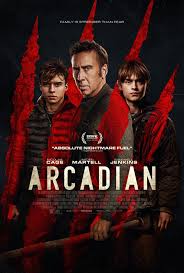
Told as a post-apocalyptic fairy tale, Arcadian stars Nicolas Cage as an anxious father of twins trying to navigate single parenthood while fighting off vicious monsters come nightfall.

Bummer. At least he doesn’t have to drive them to soccer practice.

For 15 years, Paul (Cage, in an extremely understated role) has forged a hardscrabble existence putting food on the table for his adopted sons Thomas (Maxwell Jenkins) and Joseph (Jaeden Martell), whom he rescued as infants during the initial collapse of civilization.

Holed up in a remote farmhouse, Paul teaches the lads everything they need to know about off-the-grid survival, most importantly, being home by sundown to secure their hacienda from nightly visits by protean creatures with sharp claws and turbo-charged choppers that show up like broke relatives at suppertime.

Joseph is a homeschooled DaVinci, intuitively figuring out how things work and devising ingenious inventions. His brother Thomas has the hots for Charlotte (Sadie Soverall), a lovely lass who lives on a farm some distance away, causing the crushed-out kid to test the limits of Paul’s strict curfew.

Arcadian director Benjamin Brewer and writer Mike Nilon tell a simple story as simply as possible. When Thomas visits Charlotte on her farm, they play a game in which they have to explain how the world ended in 10 seconds. Charlotte theorizes that alien insects infected humanity, and Thomas says that a purple haze turned people into werewolves.

After providing us with that handy exposition summary, Thomas realizes he’s been wooing Charlotte for too long, and is forced into a cross-country sprint to get his ass home before dark. He ends up unconscious at the bottom of a ravine, necessitating a rescue from Paul.

Poor old Dad barely survives an explosive confrontation with the burrowing alien wolf bugs, and now it’s up to the boys to adapt and survive on their own. Arcadian works best as a coming-of-age story, with the brothers painfully applying the lessons they’ve learned about their nocturnal enemies.

Jospeh is methodical, taking careful notes about the intensity and duration of the attacks. Thomas, ruled by his passions, favors direct action, but benefits from listening to his wiser sibling.

The action is occasionally marred by poor lighting and clumsy edits. Paul, finding Thomas at the bottom of a crevasse, suddenly appears at his son’s side after finding some alternate route down.

The ensuing battle with a suddenly subterranean foe is almost all quick cuts with a shaky camera in the darkness so we don’t really figure out what happened to Paul until the sun comes up.

The monsters are formidable, though vague, never holding still long enough to get a gander at. Their inexplicable hive-mind decision to assemble into a giant flaming attack wheel is certainly a head-scratcher.

Ultimately, the pros of a fast-moving story outweigh the clunky cons in Arcadian, and you will be sufficiently entertained.

The end.

Die Alone (2024)

Screen history repeats itself, as Carrie-Anne Moss is once again paired with an amnesia victim (Douglas Smith) searching for answers in Die Alone, a Canadian post-apocalypse drama crawling with a verdant variety of zombies that have gone to seed.

Writer-director Lowell Dean makes sensible use of Saskatchewan’s panoramic grasslands to anchor the action, following a few hardy survivors stumbling through a barren landscape largely stripped of humanity thanks to a plant-based virus that’s amped up the vegetation to lethal levels.

Ethan (Smith) and Emma (Kimberly Sue Miller) are a young couple on the run when the environmental shit hits the fan. Despite making a plan to meetup at a remote cabin in case they get separated, Ethan’s trauma-induced amnesia keeps getting in the way, and the two predictably lose track of each other.

Luckily clueless Ethan gets rescued by rugged survivalist May (Moss), who agrees to help him locate his lost love and provide reasonable room and board in exchange for farm labor.

Instead of gratitude, Ethan steals May’s truck and goes off to search for Emma on his own, but the absent-minded protagonist requires frequent rescuing. That means many scenes begin with Ethan regaining consciousness in different locations, usually covered in blood, sweat, and ears.

The zombie community is represented by hungry humanoids that have been reclaimed by the earth, each with its own distinctive look fusing foliage and fashion. The makeup department deserves the donuts for creating such intriguing new creatures.

Strangely, Dean mostly employs the undead as set dressing, rather than as a serious threat, limiting their fright potential to a precious few moments.

But it’s not a dealbreaker.

That Die Alone succeeds as a movie is largely due to the unbreakable strength of its central relationships and the filmmaker’s fully developed arsenal of appreciation for those that came before him.

Cinema nerds will eagerly recognize shots paying tribute to everyone from John Ford to Terrence Malick to Sam Raimi. Dean’s script, though maddeningly fractured and episodic, leads to a crushing finale that I’m still chewing on like old Milk Duds.

Be like the cows. Keep chewing. It’s making more sense all the time.

The Gorge (2025)

So many genres, so little time.

When the creative team in charge of a film project gets carried away trying to please each and every imagined audience member, the results are usually a load of crap.

The Gorge, written by Zach Dean and directed by Scott Derrickson, seemingly utilizes this kitchen-sink approach, tossing a zesty, messy melange of romance, action, horror, and conspiracy theory that’s a just a tad over two hours in length.

And somehow it works pretty damn well as a super-engaging popcorn flick!

Levi (Miles Teller) and Drasa (Anya Taylor-Joy) are two highly trained snipers from different countries assigned guard duty at opposite watch towers on either side of the enormous and mysterious titular gorge.

The mercenaries are armed to the hilt and instructed not to contact each other, but the need for company proves too much for Levi and Drasa, and soon they’re flirtatiously firing rounds, demonstrating their skill and accuracy, while a Ramones record plays.

“I guess this qualifies as a Meet Cute,” I whisper to Mrs. Sharky.

Though separated by a chasm that occasionally spits out monstrous hybrid humanoids called Hollow Men, the hired guns overcome logistical challenges and use a zip line to hook up and become not just a couple, but an elite and capable survival team.

This comes in handy when their military handler (Sigourney Weaver) decides they can no longer be trusted.

Once the protagonists figure out that this version of the future has no future, their decision to join forces is logical and inevitable. Besides, they’re a hot couple, and Drasa is clearly the aggressor, eventually rescuing Levi from an unexpected plummet into the abyss.

Through waves of decent monster attacks and fabulous fire fights, we actually grow fairly attached to Levi and especially the badass Drasa, which helps keep the viewer grounded during the mood shifts and infrequent talky interludes.

The Gorge is also a very impressive example of world-building, an important component to any successful popcorn operation. The mise-en scene has been carefully considered providing a foundation of future realism that looks like it was designed by the prison industrial complex.

No wonder no one want to hang around!

Warm Bodies (2013)

Mrs. Sharky wanted to watch a romantic comedy. Uh oh.

I said, “What’s in it for me?”

This is the type of give-and-take situation we domesticated adults must consider every single day, and believe me, it ain’t easy.

Fortunately, my painstaking research turned up Warm Bodies, a zesty Canadian zom-rom-com that actually checked all the boxes for both our discerning tastes.

What a find!

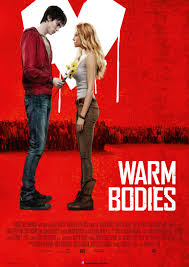
Written and directed by Jonathan Levine, and based on a novel by Seattle writer Isaac Marion, Warm Bodies is the story of R (Nicholas Hoult), an unusually thoughtful zombie who wanders around an airport with his fellow undead shufflers, after a plague or virus or something turns a majority of the population into brain-eating ghouls.

“What am I doing with my life?” he wonders in narration. “I’m so pale. I should get out more. I should eat better. My posture is terrible. I should stand up straighter. People would respect me more if I stood up straighter. What’s wrong with me? I just want to connect. Why can’t I connect with people? Oh, right, it’s because I’m dead.”

One fateful day, R impulsively rescues Julie (Teresa Palmer), an armed forager, from a pack of his hungry brethren and takes her to safety. This single act of compassion from a walking dead human changes everything we thought we knew about the entire zombie genre.

Indeed, it starts a movement of humanism among the dead, as long-deceased folks begin to feel—different. Something is stirring inside.

Warm Bodies could fit snugly inside AMC’s The Walking Dead universe as a diverting subplot. Julie, the daughter of General Grigio (John Malkovich), leader of the militaristic human resistance falls for R, the zombie who ate her boyfriend’s brain.

R and Julie? Try Romeo and Juliet. There’s even a balcony scene.

I’m as surprised as anyone that I dug Warm Bodies as much as I did. It’s funny, well-written, kinda scary, and uplifting as hell. That’s not just a difficult balancing act, it’s a rarely occurring cinematic event.

A horror movie that you can snuggle your honey through.

Prince of Darkness (1987)

Funny thing, I went to the theater and saw this when it came out. I remember liking it well enough, but Prince of Darkness is a relatively small-scale production for John Carpenter.

His previous run of films included Halloween, The Thing, The Fog, Escape From New York, and Big Trouble In Little China, so perhaps I was missing the star power typically provided by Kurt Russell and Jamie Lee Curtis.

The real reason, I now suspect, is that Prince of Darkness is more akin to Carpenter’s earlier, grittier Assault on Precinct 13, a no-name thriller about cops fighting off a crowd of vengeful gang members while trapped in a shuttered police station.

The cast of Prince of Darkness, including vintage TV stars Jameson Parker (Simon & Simon), Thom Bray (Riptide) and Dirk Blocker (son of Dan Blocker/Hoss), are similarly under siege, this time by a seemingly synchronized horde of hobo schizophrenics led by a menacing Alice Cooper.

Carpenter’s resident authority figure Donald Pleasence plays Father Loomis (Doctor Loomis’s twin brother?), a nervous priest who discovers an infernal device in the basement of an abandoned Los Angeles church.

The ancient artifact, which resembles a moldy lava lamp, appears to contain some kind of organic material that’s rapidly developing consciousness after lying dormant for untold centuries.

Loomis calls in Professor Birack (Victor Wong, Egg Shen from Big Trouble) and a group of his top physics students to study the strange canister and possibly decipher the accompanying doomsday grimoire also found on the premises.

How could they know they’d be hastening the return of the titular character, even providing a human vessel for its gestation period?

Nope, didn’t see that one coming.

I would expect college students to be dopey enough to take on this insane extra-credit assignment, but distinguished scientists?

All hell proceeds to break loose, as the assembled eggheads fall victim to having unholy water squirted in their faces from newly made zombies, or getting torn apart by the mute mob of street people that have surrounded the accursed church.

Professor Birack and the increasingly agitated Loomis deduce that the evil essence contained in the canister is now fully awake and influencing people on a subatomic level. Like ants working together toward a common goal.

You get it? Carpenter? Ants?

Carpenter is at his most diabolical depicting a wounded world, teeming with swarms of furious insects, that’s clearly reached end time, requiring an act of selfless sacrifice to save the day and keep the devil—and his creeping minions—away.

The dour final frame of Prince of Darkness indicates that he won’t be gone for long. A hell of a movie.

Choose Or Die (2022)

Video games are bad, ‘mkay?

Choose Or Die takes place in a slightly dystopian future that looks like the present, where our protagonist, Kayla (Iola Evans), ekes out a living cleaning clean offices every night, plus whatever she can scrounge by refurbishing obsolete technology.

During a visit with her friendly fence Isaac (Asa Butterfield), she discovers an old text-based video game from the 1980s called Curs>r that more than lives up to its name.

Isaac informs Kayla that there’s an unclaimed $100,000 prize that supposedly awaits the player worthy enough to win.

The bummer is that it’s a sentient game made with sorcerous runes that can take over reality, forcing the player to make impossible choices, usually having to decide which friend or family member gets maimed in grisly fashion.

Therein lies the tension in all its one-dimensional glory. Dig it, or don’t.

Choose Or Die gets a needed boost from actress Iola Evans, who invests Kayla with brains and bravery. Even with loved ones in constant peril, she keeps her focus while trying to hack the sinister system.

Writer-director Toby Meakins does an adequate job of creating a cold and confusing reality in which financially trapped citizens like Kayla engage in risky occult business in hopes of a prize that will rescue them from wretched poverty.

You know, like in The Hunger Games.

Though Kayla is a talented programmer, she can’t get her foot in the door anywhere, leaving her stuck with mindless labor as the only way to keep the drug-dealing landlord (Ryan Gage) from stringing out her junkie mom.

You should be entertained by the painful predicaments pondered in Choose Or Die, and you will definitely root for the plucky heroine. But it’s all pretty one-dimensional. Hopefully that’s enough.

The Happening (2008)

And back for a return visit to the director’s chair is our ol’ pal M. Night Shyamalan! Hope he brought snacks.

The Happening is one of those Shyamalan features that feels very insubstantial, with an ending bound to elicit cries of “That’s it?”

Nigel Floyd from Time Out, summed it up thusly: “At first, a great deal happens, then nothing much happens for quite some time, then something so underwhelming happens that one is left wondering, ‘Did that really just happen?'”

It doesn’t help that stars Mark Wahlberg and Zooey Deschanel have precious little chemistry as Elliott and Alma Moore, a couple on the run from an unspecified menace.

Shyamalan can take some of the blame. His dialogue is so wooden you could build a raft out of it.

It could be argued, however, that MNS movies are seldom character studies in the traditional sense, but rather about subjects adapting to extreme situations.

In this case, the Moores, along with most of the eastern seaboard are fleeing from a mysterious ill wind that upon contact motivates humans to destroy themselves in gruesome fashion.

Fortunately, Elliott is a science teacher so he hypothesizes his head off, and figures out the virus is being produced by sentient plant life. Needless to say, the shrubs are pretty damn unhappy with our stewardship of the planet, and their intent is to pull a few weeds out of the garden.

Timing is everything in show business. The Happening wasn’t a commercial or critical success upon its release, but it certainly has more impact on an audience today, having collectively experienced the Covid-19 crisis and an ongoing pandemic.

Not only that, my allergies are killing me. I think MNS deserves credit for anticipating floral warfare.

The Beach House (2020)

Turns out an extinction event is no day at the beach.

Two couples get acquainted over wine and weed edibles at a sweet shack by the seashore during an atmospheric catastrophe, after which everything changes for the worse.

Written and directed by Jeffrey A. Brown, The Beach House conjures scare scenarios along the same lines as The Block Island Sound and Color Out Of Space, a pair of recent cosmic horror entries that are also long on tension and short on answers.

College sweethearts in crisis, Randall (Noah Le Gros) and Emily (Liana Liberato), take a break from academia to spend the weekend at Randall’s family beach house.

It all looks promising until another pair of beachcombers arrive with a reservation for the same weekend. Awkward!

Mitch (Jake Weber) and Jane (Maryann Nagel), a distantly recognized, slightly older couple, are amiable and open to suggestions. The newly formed quartet agree to share quarters and a dinner party becomes the order of the day.

Like all civilized people, we welcome members into our tribe with barbecued meat, wine, and really potent edibles. Old records are played, dreams discussed, and for a short time these strangers relax in each other’s company in a beautiful home by the sea.

As a curiously glittered fog descends, Jane winds her way down to the beach.

It’s not a spoiler to say that everything falls apart, because it does so in such an artfully considered way. The Beach House depicts a low-key apocalypse that implodes an idyllic weekend getaway, and offers four stagnant souls an opportunity to embrace real change.

Writer-director Brown is an avowed fan of Invasion of the Body Snatchers (every iteration), and he creates perpetual nervousness by keeping the camera affixed to on-the-move Emily, who’s becomes the pivotal character forced to witness Jane’s uncanny transformation and Randall’s inability to adapt to a changing landscape.

It’s in the air. It’s in the water. It’s in you.

With the same respect for bourgeois leisure time as New Wave bosses like Luis Buñuel and Jean-Luc Godard, Brown pops his peeps into a pressure cooker beyond their control and reduces them to essential salts.

Speaking of waves, Mitch seems to have disappeared into them.

Characterizing some of the recurring elements here as “Lovecraftian,” isn’t misleading, but the term is becoming a convenient marketing junk drawer. It should remind us that the reclusive Rhode Islander doesn’t hold creative claim to the entire universe.

The nightmare evolution taking place in The Beach House could be accidental or inevitable; environmental or extra-terrestrial. In the end, it doesn’t matter. The scary thing is, it’s happening.

The Platform (2019)

Welcome to The Platform, a dystopian future where a prison sentence becomes a daily feeding frenzy or a grim kick in the guts, depending on what level of the prison you’re incarcerated.

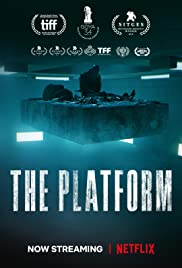
Somewhere in Europe there is an immense tower with hundreds of floors. Called a Vertical Self-Management Center (or simply “the hole”), the tower has two prisoners per floor.

Once a day a platform with the remains of a grand feast is lowered to each floor, and famished convicts shovel as much food as they can into their mouths, caring not one whit for the unfortunates beneath them.

Prisoners on the highest floor gorge themselves, while those below Level 50 or so, find less and less to eat.

And if you’re on Level 172? Improvise.

Lest we think this set-up perpetually favors the higher floors, there’s a catch. After one month, the prisoners are put to sleep and moved to another level. So one day, you might be fine dining on prime rib, the next, your cellmate.

If you guessed that this is a brutal allegory of class warfare, give yourself a star.

The protagonist, Goreng (Ivan Massague), awakens in the tower, with vicious little cellmate Trimagasi (Zorion Eguileor) as his only company. Gradually, he gets used to the ugly routine, watching as Trimagasi literally pisses on the prisoners housed below them.

As Goreng serves his time, whether starving or stuffed, he attempts to talk to those above and below about a means of cooperation to feed everyone in the prison. Though his efforts are routinely scorned, he sees a bigger picture in the small solidarity movement.

Director Galder Gaztelu-Urrutia (The Platform is in Spanish with subtitles) has created his own Stanford Prison Experiment, where guards are only necessary once a month. The inmates provide their own cruelty, happily spilling blood over a chicken leg or an extra mouthful of wine.

Goreng, a fundamentally decent fellow who only wants to help, is forced into several violent confrontations with fellow prisoners. Not to put too fine a point on it, but it’s all rather harsh sledding and not intended for the squeamish, especially if cannibalism is a trigger.

As concepts go, “Eat or Be Eaten” isn’t especially profound. Fortunately, Gaztelu-Urrutia is an ambitious, inventive visual stylist, painstakingly painting a nightmare society that is literally devouring itself.

The Platform isn’t the least bit subtle. Sometimes a sledgehammer is the best tool for the job.

The Blackout: Invasion Earth (2019)

No need to overthink it. The Blackout is a slam-bang, sci-fi, action blockbuster from Russia that’s certain to hold your attention long after the Milk Duds harden.

Borrowing from well-sourced material like Starship Troopers, Alien, and War of the Worlds, directors Egor Baranov and Nathalia Hencker have dropped a fairly epic slab of space spectacle on our heads, featuring a cast of brave comrades from the former Soviet Union battling an unearthly menace.

Nutshell: The Earth has gone dark except for one small circle of civilization in Eastern Europe. Russian troops are deployed, but prove mostly useless against an unseen enemy that sends wave after wave of brainwashed bears and people at their shrinking defenses.

All seems lost until the arrival of Id (Atryom Tkachenko), an alien with godlike powers (but no mouth), who offers the beleaguered survivors a possible solution to the impending invasion.

“But at what cost?” as the saying goes.

Seen mostly from the grunt’s-eye view of two soldiers, Oleg (Aleksey Chadov) and Grubov (Pyotr Fyodorov), The Blackout serves up balls-to-the-wall military gear excitement and plenty of narrow escapes, while bodies pile up to the heavens.

Having the aliens enslave millions of human subjects and making them fight against the Russian holdouts is a brilliant strategy that also saves tons of money on the special effects budget.

No need for Godzilla to stomp Tokyo when there’s plenty of domestic cannon fodder at hand.

Thankfully, even at 2-hours plus, there’s no lag time in The Blackout, and that’s worth plenty in my book, especially since it’s light on CGI.

Turns out there’s nothing wrong with old-fashioned blood and guts.