The Deeper You Dig (2019)

“Tell my mother what happened to me!”

“It was an accident!”

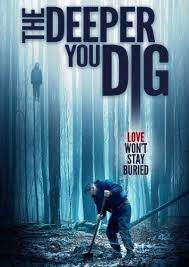
The admittedly tragic circumstance at the heart of The Deeper You Dig is indeed, an accident. What comes after is not. You would do well to pay attention.

Somewhere amidst the wintery rural recesses of upstate New York, Ivy Allen (Toby Poser) makes a living as a phony fortune teller, and apparently does well enough to support her 14-year-old daughter Echo (Zelda Adams), a sullen goth whose musical tastes include early 20th-century hit parade.

Just down the street, Kurt Miller (John Adams) is the new guy in town, fixing up a decrepit house in the hopes of a quick flip. This is all the setup we get before having to deal with a deadly event that traps all three characters into a single tense, tormented timeline.

Co-written and directed by Adams and Poser, and featuring their daughter, Zelda, The Deeper You Dig is a tight-as-a-drum domestic horror/occult revenge drama without an ounce of flab on it.

Kurt and Ivy’s parallel stories (him trying to escape a grim fate; her finding a missing daughter and rediscovering her gift), collide when Echo’s ghost comes a-haunting, effectively bedeviling Kurt by permanently fixing his radio to the Oldies Channel.

Meanwhile, Ivy interprets the signs left for her and finally makes direct contact with her daughter’s shade by mystical means.

The reunion scene in the forest, where Echo hovers above Ivy in the trees, is genuinely weird and otherworldly.

Major props to Toby Poser and John Adams (they even composed the screechy electronic score!) for concentrating not on their measly budget, but on inventing a dark and detailed world. Evildoers are not only punished here, they are recycled, reused, and renewed.

Fewer carbon footprints is a good thing.

Saint Maud (2019)

Maud (Morfydd Clark) says her prayers at night, and impatiently asks God for a task worthy of her devotion to him.

Careful what you wish for, Maud.

English writer-director Rose Glass unveils a disturbing, disintegrating portrait of a pious hospice nurse so anxious for meaning in her dismal life, that she creates her own.

Judging by the fiery final frame of Saint Maud, things don’t go as planned.

In a gloomy English town, Maud gets up each day to tend the terminally ill Amanda (Jennifer Ehle), a free-thinking extrovert whose bohemian behavior is a bucket of ice water on the nurse’s tightly held beliefs.

Her patient’s libidinous relationship with the seductive Carol (Lily Frazer) becomes unbearable to Maud’s ascetic sensibility, so she takes it upon herself to send the woman away—for Amanda’s own good.

This encourages Maud to step up her attempts to save Amanda’s damaged soul.

We patiently come to learn things about Maud, who comes from a long line of unreliable narrators. For one thing, that’s not her real name, and the devotional lifestyle is apparently a recent conversion, coming on the heels of a traumatic event.

There are ample clues to demonstrate her flimsy grasp on reality, as when Amanda ridicules her faith at a social gathering, and Maud slaps her face.

This rather unorthodox method doesn’t go over well, and it’s all downhill from there.

Without her mission to save Amanda, Maud hits the skids in a big way, seeking comfort at a pub where she gets wasted and sleeps with Joe Rando. She quickly realizes that secular pleasures don’t do anything for her higher self.

Just when all seems lost, Maud has a miraculous mystical episode in her dreary apartment that levitates her off the ground! And thus spiritually fortified, she returns to visit the dying Amanda one last time.

Recent fare like The Dark and the Wicked, Amulet, Antlers, and now Saint Maud, all seem to take place in the same pressurized godless vacuum, which can be challenging to absorb, especially if you’re allergic to hopelessness.

It can wear on you and leave a mark. But you won’t soon forget it, either. The talented Rose Glass has conjured powerful images here that are already filed away in your screaming subconscious.

Actress Morfydd Clark is a lightning bolt revelation in the title role, thoroughly committing herself to a difficult character. Maud is a well-intentioned soul, who, depending upon your interpretation of the final scene, stumbles over her pride and falls into darkness. Like Lucifer.

In this damned place, there are no other options.

Antlers (2021)

“It all makes sense, you see. I mean, our ancestral spirits never died. They were here long before we were, and they’ll be here long after we’re gone. But now, they’re angry.”

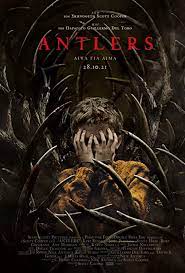
Dark times call for dark movies. Antlers is a coal mine at midnight.

The opening observation comes from Warren Stokes (Graham Greene), the former sheriff of Cispus Falls, a blighted Oregon town where mutilated citizens are appearing with alarming frequency.

The current sheriff, Paul Meadows (Jesse Plemons), is seeking counsel. He’s out of his depth and confused, hypothesizing a cougar or bear attack is responsible for the mayhem.

Meanwhile, Paul’s schoolmarm sister Julia (Keri Russell) is trying to figure out why her sullen student Lucas (Jeremy T. Thomas) is drawing pictures of demons and monsters.

In Antlers, all the dots connect to the decline of the planet’s structural integrity. Our systematic “pillaging of Mother Earth” has opened the door to indigenous spirits, most notably the Wendigo, a voracious cannibal that inhabits evil men.

Just below the narrative surface of this riveting supernatural thriller lurks mounting evidence of an infected society that has no access to spiritual vaccine.

Cispus Falls is a moribund mining town, an urban landscape littered with old machinery and empty storefronts, where the only thriving business is meth production.

Deep-rooted trauma is the norm. Julia, a recovering alcoholic with her own childhood of parental abuse, eyes liquor bottles at the store with palpable longing, searching for strength and comfort from any source.

In the background, the news drones on about the opioid epidemic, failing industries, and environmental collapse.

Kerri Russell owns her role as a damaged, unhappy woman who realizes her altruistic motives for helping Lucas are likely futile, but it’s marginally better than giving in to the despair that runs deep in these parts.

She recognizes the telltale signs of abuse in Lucas’s haunted face, a reflection of a home life that is literally hellish. He is a child doomed to maintaining the monstrous status quo at his house, while his younger brother Aidan (Sawyer Jones) is held captive by something that used to be their meth-cooking father (Scott Haze).

The thing Lucas calls “New Dad” is growing increasingly hungry and his grocery list requires fresh meat.

“Is God really dead?” Aidan asks Lucas. “Daddy said God is dead.”

Director Scott Cooper, working alongside executive producer/malevolent maestro Guillermo del Toro, has constructed a thoroughly ravaged world with precious little light—one that is bone-chillingly familiar.

Hey, isn’t that our civilization crumbling?

There are moments of brain-freezing terror in Antlers, including horned creature craft with genuine nightmare potential, a del Toro calling card.

Yet it’s the overall tone that proves the most unsettling factor, because it presents a terminally ill worldview, a pandemic of the soul that never ends.

There may be small victories to be had, individuals worth saving, but the inescapable conclusion is that humanity is fighting a losing battle with havoc we’ve wrought on ourselves.

In nearly every scene, Julia and Paul (the good guys) are stymied by inadequacy and failure. The coroner is apologetic because he can’t explain how the victims were killed. A doctor is unable to predict if a patient will recover. The harried school principal (Amy Madigan) tells Julia she isn’t allowed to intervene on a student’s behalf.

Even Paul admits he was reluctant to take the sheriff’s job, which mainly consists of evicting local homeowners.

“Everyone thinks these problems are just going to go away, and we know that they don’t,” Julia tells him. She could be referring to any number of societal symptoms depicted in Antlers.

The wound runs too deep, there’s no saving this patient. The downward spiral is well under way and no one’s getting off.

Hope you like it bleak.

Night Teeth (2021)

I wish they hadn’t called it Night Teeth. It’s not a very good title for such an entertaining and inventive film.

Broke student Benny Perez (Jorge Lendeborg, Jr.) just wants to earn a little extra cash driving for a car service. He borrows a sweet ride from his older brother Jay (Raul Castillo) and picks up mysterious beauties Zoe (Lucy Fry) and Blaire (Debby Ryan) for a night of club hopping around Los Angeles.

The ladies are able to read Benny like a book and quickly determine he’s a newbie at the chauffeur game, a source of much amusement. And as the night goes on, Benny becomes alternatingly aroused and alarmed by his odd passengers, particularly after one stop when they return with a satchel full of bloody cash.

Meanwhile, his brother Jay has to get his boys together because there are vampires in Boyle Heights, and that runs counter to a long-standing treaty.

There’s a full slate of subplots in Night Teeth, including sparks between young Benny and the somehow-still-kind-hearted Blaire. When they’re together the movie freely pivots into a star-crossed romance and the night seems full of new possibilities.

Mostly the story sticks close to the mob-style coup being staged by ambitious vampire Victor (Alfie Allen), who wants to go back to the old ways of old days, when humans were fair game, regardless of their address.

Night Teeth is also one of those vampire movies (like Near Dark) that doesn’t use the “V” word, which is why I found the title clumsy, like it was picked out of a hat.

Even so, there is all-you-can-eat action, laughs, guts, and unlikely romance to be feasted on in Night Teeth. Just as in Vampires Vs The Bronx, bloodsuckers are depicted as affluent white gangsters trying to gain wealth and power by displacing a hardworking minority, in this case, Latin Americans.

“Who still uses crossbows?” Benny wonders out loud while trying to stay alive during a gnarly fight between undead rebels and vampire hunters. Find out this and other exquisite tidbits in Night Teeth, winningly directed by Adam Randall, and sharply written by Brent Dillon.

These vampires definitely don’t suck.

They Remain (2018)

Two biologists working for an anonymous corporation are dispatched to the former site of a Manson-type cult compound to investigate strange animal behavior in the area.

Keith (William Jackson Harper) thoroughly explores the acreage, setting up camera feeds to monitor the fauna. Jessica (Rebecca Henderson) examines the data trying to find anomalies.

This goes on for the majority of the movie, as we observe the scientific method gradually give way to something far older and more primitive.

As so often happens, the more time they spend at the accursed locale, the more things break down. Keith hears voices. Jessica hears knocking at the door. Keith chases a wolf. Keith and Jessica drink whiskey.

They Remain is a subdued film, and it helps if you’re in the mood for subtlety. Writer-director Philip Gelatt adapted Laird Barron’s 30 for the screenplay, and it’s told largely from Keith’s perspective, which gets less reliable as time rolls on.

“I trust everybody, just not people,” he says to Jessica during one of their Happy Hours.

Keith dutifully collects his data, but the more he ventures out into the silent forest the less confident, and more unmoored he becomes.

Jessica, who is white, is the obsessive one, and Keith, a black man, worries that she’s not telling him the truth about their situation. Though he’s an experienced woodsman, he finds that his senses aren’t much help when faced with something that doesn’t track like an average specimen.

In fact, we’re never quite certain who is observing whom in They Remain. Whether it’s ghosts, hallucinations, cave dwellers, or just the effects of isolation, the feeling of someone watching is quite inescapable.

In scene after scene, Gelatt’s camera finds Keith hunkered down in the bush, but he doesn’t blend into his surroundings at all. He’s nervous because he isn’t safe, and he can’t hide in what is rapidly shaping up to be a hostile environment.

That’s a scary position to be in. They Remain is a profoundly unsettling movie and a very effective one.

Seance (2021)

When you’re the new kid in school, it helps to be adopted by the popular clique, even if they’re into necromancy. Go along to get along, you know?

Seance is set at Edelvine Academy for Girls, a prestigious private learning institution with a recent opening, thanks to a student hopping out the window during a paranormal prank.

Editor’s Note: When are we going to outlaw pranks? Nothing good ever comes from pranks and people get hurt, disfigured, and killed all the damn time.

New student Camille Meadows (Suki Waterhouse) moves into the recently vacated room and gets picked on by the same Mean Girls who drove the previous occupant to jump.

Camille and the Mean Girls all end up in detention together, where an alliance of sorts is formed, and a seance is convened to see if any ghosts want to communicate.

Surprise! They do!

Featuring both a ghost and masked psychos bearing cutlery, Seance is smartly written and full of gradually revealed plot twists that take sinister shape under the guidance of writer-director Simon Barrett (You’re Next, Dead Birds).

There aren’t buckets of blood, but there’s a body count and a few memorable kills, including Bethany’s (Madisen Beaty) fluorescent tube tracheotomy.

It’s also a movie about duty and the bonds of friendship that run deeper than the need for acceptance within a group of nasty bitches.

Recommended! Start the new year off right.

Head Count (2018)

The moral of the story: Don’t use the internet, it’s evil.

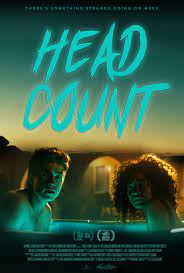
Evan (Isaac Jay) is a college kid on spring break looking for love and adventure. Careful what you wish for, my lad.

Instead of Lake Havasu, he heads for Joshua Tree to crash with his older brother Peyton (Cooper Rowe), and maybe bond over some hiking and camping.

Rather than pitch a tent, Evan ditches his brother at the first opportunity and falls in with a bunch of bohemian millennials renting a nearby house. Seeing attractive folks his own age that party all night is sufficient temptation for Evan, especially the beguiling Zoe (Ashleigh Morghan), a photographer currently without a boyfriend.

Scenes of low-key hedonism (weed, shrooms, booze) are followed by everyone gathered around the ol’ campfire for ghost stories. Since Evan doesn’t know one, he is directed to a website where he mistakenly recites a summoning spell for a shapeshifting demon.

Editor’s Note: Check and verify your sources, people! How dumb do you have to be to read an incantation that warns you not to say a certain name out loud? What hayseed community college do these nitwits attend?

None of them are going to have to worry about graduation requirements, if it’s any consolation.

The malevolent entity called a hsijie can appear to look like anyone and even these inebriated dorks begin to notice that various members of their group seem to have gained the ability to be in two places at once.

This is called a clue, and Evan is the only one present who picks up on it. The carefree weekend takes on a distinctly ominous tone after pretty Zoe walks off a cliff and injures her ankle.

Did she jump or was she pushed?

Other than Evan and Camille (Bevin Bru), the rest of the group can’t be bothered to examine the evidence that’s all around them, preferring beer pong and Never Have I Ever to thoughts of self-preservation.

Head Count succeeds as a low-budge (but not to its detriment) thriller with a nifty paranormal threat that remains largely out of sight. Even so, writer-director Elle Callahan (Witch Hunt) brings tensions to a boil with strategically placed pointers amidst all the scenes of collegiate cavorting that inevitably ensue when the parents are out of town.

I told you kids! No parties! You’re all grounded.

Six feet deep.

Monstrum (2016)

Directed and co-written by South Korean filmmaker Jong-ho Huh, Monstrum is an exquisitely crafted 16th century period piece about a legendary beast that is decimating the population of Mount Inwangsan.

It is also a very astute political thriller about a beleaguered king (Park Hee Soon) who is being undermined by his cabinet ministers. The powers behind the throne conspire to keep the peasants wary and fearful by fueling rumors of a horrible creature that not only kills its victims but spreads the plague throughout the countryside.

Naturally, the peasants would like to see something done to mitigate the mutilations, so the king summons a loyal general (Kim Myung-min) to lead a party of warriors and farmers to hunt down and destroy the thing known as Monstrum.

The plot bubbles with palace intrigue and betrayals as a persistent rumor turns flesh (fur) in the form of a monstrous black cat that’s grown to massive proportions thanks to a steady diet of disease-ridden corpses.

The Monstrum itself isn’t the best CGI critter ever, but it’s far from the worst. Thematically, it represents man-made corruption, dishing out death as an equal opportunity destroyer, feasting on peasant and noble alike.

The monster is generally on the money in Monstrum, but the movie’s also chockful of superb swordplay and martial arts choreography that dazzles the senses. It’s no Crouching Tiger, but it’s definitely a hidden gem.

It also boasts terrific cast chemistry and you’ll have no trouble rooting for the scrappy band of heroes that takes on the vicious monster and stands up to a cadre of treacherous politicians.

And like Masque of the Red Death or Brotherhood of the Wolf, Monstrum uses a deadly plague to illustrate the indifference of the aristocracy to the suffering of an impoverished working class.

Twas ever thus.

We Need To Do Something (2021)

There are moments in We Need To Do Something in which director Sean King O’Grady and writer Max Booth III manage to make us forget that the movie is mostly about an annoying family trapped in their bathroom.

There is a powerful storm. Dad, Mom, daughter Melissa, and son Bobby hole up in the master bath. A tree crashes through the roof imprisoning the bickering clan in the can.

The presence of a rattlesnake in the restroom livens things up a bit, and provides some semblance of actual danger.

Further, the subplot about Melissa (Sierra McCormick) and her girlfriend Amy (Lisette Alexis) casting a spell on a nosy classmate that apparently results in the Earth’s destruction is intriguing, and could have been developed.

However, there is just so much horror that can be plumbed from living in a loo. Robert (Pat Healy), the twitchy family patriarch proves to be utterly useless in a crisis, impotently raging around the room, making life miserable for everyone—including the viewer.

As the face of toxic masculinity, Healy is an angry, unstable child whose very presence makes any situation 100-times more unbearable.

This gets old real fast.

Diane (Vinessa Shaw), Robert’s wife, is preoccupied with buoying Bobby’s (John James Cronin) spirits, particularly after the latter’s encounter with the roving rattler.

Single-set monotony takes over, and the lack of legitimate threats beyond Robert’s rapid decline into lunacy (it was a short trip) do not inspire much in the way of suspense.

Will Melissa cop to the crime of crashing civilization? Will anyone survive the dangers lurking beyond the camera’s reach? Will someone please kill Dad?

In the final reckoning, We Need To Do Something falls short of achieving any sort of entertainment momentum, since it’s forced to rely on offscreen developments to move the story forward.

Rather than a movie, Max Booth’s script suggests the sort of exercise in stale irony that one endures in community college playwriting classes.

Feel free to skip this class. You won’t learn anything.

Spell (2020)

Thomas Wolfe was right. You can’t go home again.

Just ask Marquis Woods (Omari Hardwick), an affluent African-American who crashes his plane squarely in the distant past in director Mark Tonderai’s Spell.

Marquis has grown up from a dirt-poor Appalachian childhood into a powerhouse big city lawyer with a handsome family. Upon learning of the death of his estranged father back in the hills, he packs up the wife and kids and flies everyone down South.

Foul weather causes the single-engine plane to drop out of the sky, and when Marquis regains consciousness he is an injured house guest of Miss Eloise (Loretta Devine), a witchy woman who uses magic herbs and a hoodoo doll to keep him immobilized, awaiting a Blood Moon ritual to transfer her essence into a younger body, or something like that.

The lion’s share of Spell is about Marquis’s grueling quest to escape from Miss Eloise and her minions, that’s reminiscent of James Caan trying to vanquish Kathy Bates in Misery.

Eventually Marquis realizes he’s going to have to fight fire with fire and reaches back into his own distant memories for the incantations his father taught him. “You got to believe to make it work,” his father’s shade tells him.

Though he claims on numerous occasions not to believe any of his father’s magical madness, desperation and rage transform Marquis into a practitioner capable of battling Miss Eloise to a standstill.

There’s no shortage of horror movies about urbanites having to fight their way out of a backwoods hellhole, but Spell is the first one I’ve seen with an all-black cast.

It makes for a provocative and offbeat point of view in a film that I recommend taking for a spin.