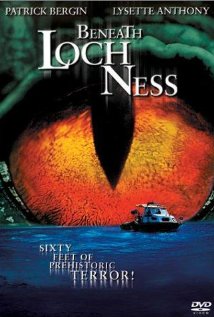
Beneath Loch Ness (2002)

MV5BMjAzNzc5NzMwM15BMl5BanBnXkFtZTcwNTgyMzIyMQ@@._V1_SY317_CR4,0,214,317_

I hate to repeat myself, but I’m going to say it again: If you don’t have a halfway decent onscreen monster, your monster movie is doomed. Doomed I tell you!

In the case of Beneath Loch Ness, the best that director and co-writer Chuck Comisky can manage for Nessie, the ill-tempered plesiosaur that occasionally wreaks havoc on local fishermen and scuba-diving scientists, is some dreadful animation that would shame a high school computer lab.

While seeking photographic evidence of prehistoric critters, a team of researchers in the employ of a cable TV adventure network loses its leader down a freshly opened trench at the bottom of the loch.

Enter the team’s former honcho, Case Howells (Brian Wimmer) who arrives fresh from the Middle East to wrangle the beast, soon followed by his ex-wife Elizabeth (Lysette Anthony) a pushy producer from the network.

The cartoon creature kills some more people so Howells teams up with Blay (Patrick Bergin—say whatever happened to him?) an obsessed local who lost his son to the monster several years before.

In his kilt, William Wallace makeup and Captain Ahab harpoon, Blay is easily the most compelling thing about Beneath Loch Ness. That, and some arresting footage of rural Scotland.

The animated Loch Ness Monster here is a thing of no scale or substance—so how could it frighten anyone? Even the guys sweating their asses off in rubber monster suits at Toho Studios understand this.

Look, if I want cartoon entertainment I’ll stick with The Venture Brothers or Metalocalypse, thanks.

Let this one return to the depths from whence it came.

Werewolf: The Beast Among Us (2012)

MV5BMjA0OTM0MzAyNV5BMl5BanBnXkFtZTcwOTUyNjQ1OA@@._V1_SY317_CR17,0,214,317_

If, like me, you viewed the Hugh Jackman vehicle Van Helsing as mere brain-dead spectacle, then be of good cheer. Werewolf: The Beast Among Us is an efficient example of how to perform genre gene splicing without relying on a bombardment of cheesy CGI to impress the yokels in the third row.

It’s sort of a rollicking Eastern European cowboy version of John Carpenter’s Vampires with a few wink-worthy nods to Jaws, steampunk fashion and the original Wolf Man—including a reprise of Maria Ouspenskia’s famous gypsy poem (“Even a man that’s pure of heart/And says his prayers by night…”).

Somewhere in the dark forests of Transylvania, in the latter part of the 19th century, a merry band of werewolf hunters rolls into a village currently under siege from members of the lycanthrope community. But, as several characters knowingly declare, “this is no ordinary werewolf!”

The hunters are led by taciturn gunslinger Charles (Ed Quinn) and the swashbuckling Stefan (Adam Croasdell), and aided in their quest by local lad Daniel (Guy Wilson), a medical student working for the town doctor (Stephen Rea). As the nimrods close in on an exceptionally wily werewolf, the townsfolk begin to realize that there is indeed, a “beast among us.”

Perhaps due to its obvious budget limitations (Hello, it’s filmed in Romania!), director Louis Morneau pumps up the fun factor and relies on a capable supporting cast (Rea, Stephen Bauer, Nia Peeples) to tell this ripping werewolf yarn.

The hunters are a posse of cool killers, especially Kazia (Ana Ularu), who fries her foes with a makeshift flamethrower and Fang (Florin Piersic) who takes a bite out of crime with his silver choppers. The werewolf CGI isn’t particularly inspired, but Morneau wisely lets a guy in a suit handle the closeup carnage when limbs are torn off and guts are gushing.

A genuinely pleasant surprise.

Jug Face (2013)

MV5BMjI2ODI0Nzg2Nl5BMl5BanBnXkFtZTcwNzM4MzU2OQ@@._V1_SY317_CR3,0,214,317_

“There’s some weird shit going on in the woods out there.”

I’m quite impressed with Jug Face, an absorbing and shockingly original jolt of indie-horror from writer-director Chad Crawford Kinkle.

I would almost venture to call it “magical realism” but that term fails to capture the profound depths of despair plumbed by teen protagonist Ada (Lauren Ashley Carter) as she tries to avoid getting tossed into a pit as a sacrificial offering to the nameless creature that serves as deity and protector to her ignorant hillbilly kinsfolk.

Jug Face is  mighty grim stuff. Somewhere in the Appalachians, a degenerate community of yokels lives off the grid, dependent on sales of white lightning and dutifully tending the thing in the pit to maintain their squalid existence.

Ada, who has an arranged marriage to a doughy village boy in her future, is in love with her sullen brother Jessaby (Daniel Manche) who knocks up the unlucky lass whilst they’re cavorting in the woods.

Meanwhile, the thing in the pit is unhappy and Dwai (Sean Bridgers), the village idiot savant/high priest can’t figure out what’s wrong. Normally, when the god is restless, Dwai is compelled to bake a jug that looks like one of the villagers, who is then thrown to the deity.

So not only is Ada facing a loveless marriage while carrying her brother’s baby, but it appears she’s next on the pit parade.

The filth and blind ignorance in this hick settlement is so thick you’d need a weed whacker to get through it. It’s the act of “committing a sin” in such a terrible, unforgiving environment that accounts for the real horror in Jug Face, more so than the angry Lovecraftian entity in their midst.

Poor Ada tries everything she can think of to avoid the pit, but the superstitious ties that bind (and strangle) these slack-jawed citizens are simply too strong.

Reminiscent of Winter’s Bone, another film about an isolated community with its own strict code of behavior, Jug Face is like an anthropological field trip—or a bad dream induced by leftover Indian food.

In either case, you’ll be very grateful to wake up safe and sound in your own bed.

Frankenstein and the Monster From Hell (1973)

220px-Frankmonsterfromhell

This oddball entry was the last movie in Hammer Films’ Frankenstein cycle that starred the incomparable Peter Cushing as the most infamous mad scientist of all. Judging by the sets and the sketchy monster makeup, it was certainly a low-budget affair, but for sheer audacity and inspired lunacy, Frankenstein and the Monster From Hell deserves a place alongside better-known examples of Hammer/Cushing greatness like Curse of Frankenstein and Evil of Frankenstein. Seriously, give it a chance.

Young surgeon Simon Helder (played by bored Sting lookalike Shane Briant—by far the most emotionally blasé mad scientist that I can recall) is sentenced to an insane asylum for experimenting on corpses and discovers that the man in charge is none other than his mentor in madness, Victor Frankenstein (Cushing). Together they make use of body parts donated by expired inmates and fashion a creature that resembles a simian drag queen version of George “The Animal” Steel. The pitiful “monster from hell” does very little to earn such a fearsome sobriquet, and it’s really up to Cushing in a foppish blond wig to carry the movie—which he does admirably.

Seldom has this dignified and methodical actor behaved in such a delightfully giddy, unhinged manner. When his plans for the monster—which include mating it with his beautiful mute assistant (Madeline Smith)—come to light, even the normally listless Helder is forced to acknowledge, “But surely you’re mad.” To which Cushing’s doctor replies without missing a beat, “Yes, perhaps. But I’ve never felt more elated.”

Despite the low horror quotient, veteran director Terrence Fisher doubles down on the atmosphere, including a fairly excruciating brain-transplant sequence that gives Frankenstein and the Monster From Hell some much-needed shock value. It’s no triumph, but for acolytes of Cushing and the Frankenstein oeuvre, it shouldn’t be missed.

Note: The monster is played by none other than David Prowse, who would ascend to immortality as the man in the Darth Vader suit in a series of films conceived by George Lucas.

Sector 7 (2011)

220px-Sector_7_film_poster

In the mood for a Korean homage to Alien set on an oil rig? I hope so, because Sector 7 makes for a dandy monster matinee—plenty of thrills, a kick-ass female lead (Ji-won Ha), and an imaginative creature that takes a pounding and keeps on hounding.

A small crew on an oil rig off the coast of South Korea is menaced by a bloodthirsty beast from below. Resembling a slimy hybrid of giant crocodile and a pit bull with tentacles, the monster grows, regenerates, and catches fire easily since its blood is flammable. But damn, if it ain’t resilient! Hottie heroine Cha Hae-joon (Ha) hits the thing with everything but the good china and it just…keeps…coming.

Sector 7‘s nods to Alien are numerous and easily spotted: the sweaty, gritty industrial sets; a monster that begins its life as a tiny specimen and quickly grows to er, monstrous proportions; a representative from the oil company (Seong-gi Ahn, the Korean Robert Forster) with a secret agenda; and finally, one of the two women crew members proves to be the toughest and most resourceful character in the movie.

The creature and gore effects are outstanding, and director Ji-hoon Kim is a gifted visual stylist, utilizing an arsenal of nimble camerawork, fast, tight frames, and even imparting a knowing sense of cosmic wonder and whimsy into the action, not unlike Guillermo del Toro. Between Sector 7 and 2006’s The Host, South Korea might slowly be revealing itself as a promising player in the import horror market.

The Mummy’s Hand (1940)

MV5BMTI2Mjk0MTM5NV5BMl5BanBnXkFtZTcwMTIwNTEyMQ@@._V1_SX214_

Haven’t sat down with a good ol’ Universal monster movie in quite a while, and that’s a shame since they were the primary catalyst for making me the horror fan I am today.

Imagine your humble narrator as a wide-eyed moppet in footy pajamas staring in wonder at another episode of some regional spook show like Creature Features or House of Fear, my shaky hand seeking the comfort of the popcorn bowl in a profound darkness lighted only by a small black-and-white TV set.

Or better yet, don’t.

Yes, the Mummy is a slow-moving, clumsy bugger usually manipulated by some dude in a fez to deliver him hot chicks in nightgowns, but not many monsters have such a formidable (and underutilized) mythology behind them. You know, Egypt, hieroglyphics, sarcophagi, curses, tombs, and the like?

It’s a wealth of sinister and exotic pageantry, and I for one will never tire of an ambulatory roll of bandages hunting down a bunch of foolhardy archaeologists.

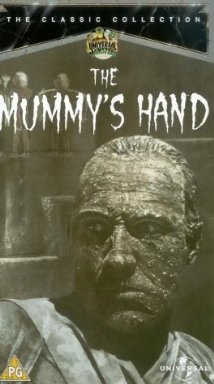
The Mummy’s Hand isn’t the first entry in the series (that would be 1932 version of The Mummy with Boris Karloff) but it’s a fine jumping-off point to get acquainted with the whole premise.

Brawny archaeologist Steve Banning (Dick Foran—not much of an actor, I’m afraid) and his comedy sidekick Babe Jensen (Wallace Ford) launch an expedition to find the tomb of Princess Ananka, and instead stumble upon Kharis (Tom Tyler) a 3,000-year-old living mummy who serves the latest in a long line of high priests (George Zucco, who would return to the role two more times in The Mummy’s Tomb and The Mummy’s Ghost).

Interlopers are strangled, a tasty dame (Peggy Moran) is carried away by the lovesick Kharis, and the high priest gets gunned down by the comedy sidekick. It’s a lot of movie packed into a short running time, and even with some unlikely set dressing decisions (I spied a dragon motif affixed to the temple of Amon-Ra. Were Egyptians into dragons?) and elastic mood swings (e.g., Babe Jensen sits around the campfire with his magician pal, the Great Solvani, trying to learn a corny parlor trick about 10 minutes after they discover a murdered comrade in the forbidden tomb), but it’s fast-paced entertainment with an eerie menace that stands the test of time.

Do yourself a favor. Visit your mummy more often.

Beast Beneath (2011)

MV5BMTcyMzQ5MzUyNF5BMl5BanBnXkFtZTcwMzc1NzQzNw@@._V1_SY317_CR5,0,214,317_

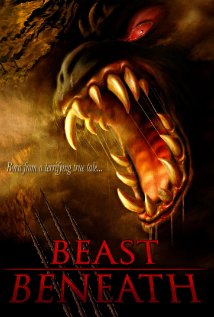
Another case of the cover art being scarier than the film.

If you’re in the mood for a low-budget, slow-paced monster matinee, I guess you could do worse than Beast Beneath. But you’d have to try pretty goddamn hard.

Seated beside a campfire, a father tells his bored teenage son the true (?) story of Griffith Park (their present location) in Los Angeles. Seems the family that once owned this prime piece of real estate was cheated out of it by a trio of unscrupulous douches.

The offenders and the land itself are cursed, and now the ghost of the family patriarch and his demonic dog haunt the premises. Sounds good on paper, but Beast Beneath never transcends the restraints imposed by its humble budget, and instead of inspired amateurism, we merely get amateurism.

Of note to followers of “Where Are They Now?” trivia. Jimmy Buffet-esque one-hit singer Bertie Higgins (“Key Largo,” 1982) cowrote and stars in Beast Beneath. His son Julian is the director. Hope they didn’t sink their own money into this project.

Killer Mountain (2011)

Unknown-1

Hey! Aaron Douglas from The Killing is the lead! He was the nicer of the two prison guards that watched over Death Row inmate Ray Seward. That’s about it for my list of recommendations as far as Killer Mountain goes, other than it’s another made-for-SyFy shoestring operation from writer-director Sheldon Wilson (Shallow Ground).

Douglas plays world-famous mountaineer Ward Donovan, a chunky bloke who gets coaxed out of retirement by a mysterious plutocrat (Andrew Airlie) in need of a rescue mission leader. The mogul’s first team, including Donovan’s partner (and presumed love interest) Kate Pratt (Emmanuelle Vauiger), disappeared on the face of forbidden Gangkhar Puensum (“Killer Mountain”) in Bhutan. It’s a sacred place to the locals, considered the gods’ mountain, and woe unto anyone that dares blah, blah, blah…

The gods turn out to be poorly constructed CGI critters that resemble unscary spider/iguana chimeras, and soon after, when you discover the idiotic reason everyone’s risking their lives climbing this stupid peak, you’ll know you’ve been played for a sucker. Spoiler alert: The plutocrat has cancer and has reason to believe Shambala or Shangri-La exists in this accursed location, offering the key to immortality or some shit.

Look, just don’t bother and you can thank me later.

Grim (1995)

MV5BODUzMDk5NjUyOF5BMl5BanBnXkFtZTcwMjkzODQyMQ@@._V1_SY317_CR5,0,214,317_

Since when does a movie made in the 90s look like a movie made in the 70s? When it’s made in England, pretending to be Virginia! It certainly helps explain the abundance of denim jackets in this thing, that’s for sure.

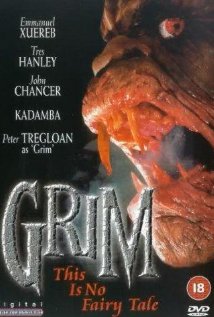
Nutshell: Rob (Emmanuel Xuereb—he’s good in anything!) is a mining expert inspecting a series of tunnels and caves under a housing in development in “Virginia” (actually, Coleford, Gloucestershire) where folks have been disappearing. He and a bunch of concerned homeowners go spelunking into the bowels of the earth and are set upon by a magic troll-like being who can walk through walls.

The creature (Peter Tregloan) is the best thing about this SPoS—a toothy brute who bites and kills some of his victims, while others are imprisoned, presumably to be scarfed at a future date. By the way, the monster is initially summoned by some bored New Age suburbanites playing with a homemade Ouija board.

Grim is an idiotic film, but it’s the right kind of idiotic, as writer-director Paul Matthews leaves plenty of lengthy silences in the script so viewers can hurl snarky comments with impunity (a perfect movie for MST3K-style riffing). The story also gets increasingly (and I would argue “winningly”) bizarre, contains a decent amount of bloodletting, and leads to a WTF finale, with a minor character helplessly snared in a completely FUBAR situation. Grim is an amusing time-waster with an OK monster—nothing more, nothing less.

The Frankenstein Theory (2013)

MV5BMTU3NzcwMjIyOF5BMl5BanBnXkFtZTcwOTk0MDQwOQ@@._V1_SY317_CR5,0,214,317_

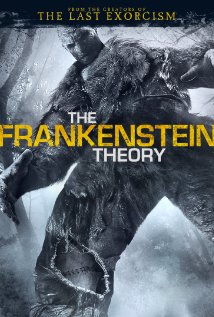
The Frankenstein Theory is a well-made addition to the monster’s cinematic pantheon.

It’s The Blair Witch Project set in the Yukon and the tension build is exquisite. Sure, there’s no monster and no killing for most of the movie’s 86-minute running time, but the slow changes that occur, the gathering darkness that descends on a hapless film crew in search of the legendary Frankenstein’s monster is expertly handled by writer-director Andrew Weiner.

Brainiac scientist Jonathan Venkenhein (Kris Lemche, who is excellent) enlists filmmaker Heather Stephens (Vicky Stephens) and her three-man documentary crew to follow him to the Arctic Circle in search of Frankenstein’s monster, a fictional construct that Venkenhein believes to be flesh and blood.

He produces letters, maps, drawings, and all sorts of theoretical evidence that gets laughed off by the film crew and the team’s hardboiled guide (Timothy V. Murphy), but as they move closer to the frozen heart of nowhere, they begin to realize that there might be something to this mad doctor’s hypothesis after all.

The Frankenstein Theory is a slow turn of the screw, but worth your patience. Action fans might be distressed by the lack of a towering body count, but in doling out the frights in small measures, Weiner makes the anticipation of a showdown worth savoring.

As with most mockumentary/found footage features, there are improbable scenes of “anonymous” camera work (i.e., “Hey, who’s supposed to be shooting this sequence?”) that stretch credulity to the breaking point, but I’m going to let it pass.

Hell, I would watch this again, and that’s something you don’t hear me say very often.