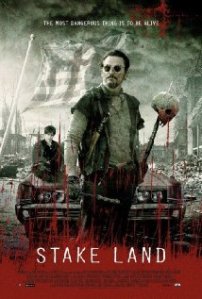
Stake Land (2010)

MV5BMTg4NTYwNDc0MF5BMl5BanBnXkFtZTcwNDg1NzM5NA@@._V1._SY317_CR0,0,214,317_

I noticed this title had popped up on a lot of “Best Of”  lists from two years ago so I was keen on seeing it. Saints be praised, I wasn’t disappointed. (Don’t you love it when that happens?) Lean, mean, and gritty, there’s not an ounce of fat on Stake Land; no extraneous drama, no clumsy attempts at comedy, and very little dialogue. It’s a rural, post-apocalypse road movie that’s long on action and intense situations. Admirers of The Walking Dead, The Omega Man, Road Warrior, and especially Justin Cronin’s novel The Passage will be in their happy place. The undead/post-apocalyptic genre is getting pretty crowded these days, but director and co-writer Jim Mickle manages to “stake” out a little fresh territory.

Martin (Connor Paolo) is a young survivor trying to keep his blood inside his body during the vampire infestation that’s swept the nation after the collapse of society. (Don’t you hate it when that happens?) His hard-boiled mentor Mister (Nick Damici) is a bad-ass vampire killer that drives a muscle car around the rural South, chasing bloodsuckers (and collecting their fangs) and steering clear of the crazy Christians known as the Brotherhood, who may well pose a greater threat than the undead. They stop and sleep where they can and barter with other refugees, all the while following a vague plan to head north for a safe settlement called New Eden, which may or may not exist. Martin and Mister are targeted for death by the head of the Brotherhood, Jebedia Loven (Michael Cerveris), a bald-headed fanatic who thinks the vampires are angels sent by God to rid the world of sinners.

The vampires in Stake Land are neither dudes in capes nor sparkly teenagers. In fact, they’re little more than zombies; grunting, snuffling ghouls on the hunt for a fresh cup of O-Positive. But they’re fast, strong, and seemingly all over the damn place. Because this is basically a road movie, things keep moving (duh!) and the action never bogs down. Martin and Mister fight, flee, make friends, lose friends, and gain enemies, and continue to chase a nebulous idea that somewhere else is probably better than here. Just like everybody, ever. It’s Martin’s determined belief that he can somehow find a normal (or at least livable) life that propels Stake Land, and keeps it from imploding in the face of hopelessness and chaos. Believe me, there’s plenty of hopelessness and chaos to go around; it’s almost as prevalent as the vampires and deranged bible-belters.

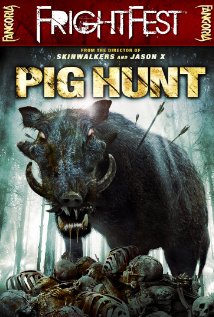
Pig Hunt (2008)

Now this is more like it! Plenty of weird shit as far as the eye can see.

Writers Zack Anderson and Robert Mailer Anderson and director James Isaac are obviously genre geeks—observant viewers will spot references to Alien, Road Warrior, even Apocalypse Now—who understand exactly what elements will best play in Peoria.

Blood sure, but even more, carnage. There’s enough carnage in Pig Hunt to fill Carnagie Hall. Yeah, I know.

Rugged leading man John (Travis Aaron Wade), his super-hot girlfriend Brooks (Tina Huang), and John’s three dopey bro buds drive out to the California equivalent of Appalachia, to go hunting for wild pigs on property owned by John’s uncle, who perished under mysterious circumstances.

But since the movie is named Pig Hunt, probably not all that mysterious. Look, just play along!

The gang goes through all the familiar check points (or plot points, if you prefer): They stop at a backwoods general store for directions—this one run by blues harmonica great Charlie Musselwhite, who gives them dire warnings—and encounter a hostile clan of indiginous rurals, a rattlesnake, and a van containing a muscular black gentlemen with a hippie-chick entourage, part of a nearby weed-growing commune.

Somewhere in here, we discover that John grew up around these parts, and that he’s actually a skilled hunter and woodsman, unlike his three hopelessly doomed friends.

Some hillbilly acquaintances of John come a-visiting, and they all decide to go hunting for “the Ripper”, a legendary 3,000 pound killer hog that most likely wasted John’s uncle—and the train goes off the rails, big time.

This sounds like it has all the makings of Troma Team farce, but somehow Pig Hunt avoids broad comedic pitfalls, and plays it somewhat straight.

The Andersons actually have the guts to develop the characters beyond stereotype to the point that I actually felt sorry for John’s friend Quincy (Trevor Bullock), a gentle chef who accompanies his more macho comrades. He and his beloved dog Wolfgang come to a bad end that they really didn’t deserve (though, to be fair, Quincy has no more business being outside the urban landscape than Ned Beatty does).

Collateral damage, as it turns out.

What the filmmakers demonstrate most effectively in Pig Hunt is that it’s the various human tribes (duh!) that wreak the most havoc, and that in order to survive, you have to become the biggest monster of all.

Hell, the giant pig is almost an afterthought until the one-hour point in the film. Bonus: The music is by Primus bassist Les Claypool, who also doubles as Preacher, one of the bloodthirsty hillbillies.

I love that shit.

The Tall Man (2012)

Is The Tall Man HINO (Horror in Name Only)?

Sure, it takes place in a brooding rural slum ala Winter’s Bone (except this one’s on the West Coast—Washington, to be exact), and it’s about a prolific bogeyman who abducts children in a dried-up mining town.

What ensues is a provocatively ambiguous thriller (and yes, it is thrilling) with a fairly blunt social agenda.

Cold Rock, Washington is a mildewed husk of a town decomposing in the overgrown backwoods of Washington. The local Chamber of Commerce undoubtedly has its hands full trying to lure tourists to a cheerless gray community where 18 children have disappeared over the past few years.

A focused and fascinating Jessica Biel plays Julia, a recently widowed nurse living in the area who tends to the medical needs of the hapless hillbillies in her sector. Shit gets personal when her beloved toddler gets snatched from her house by the legendary “Tall Man.”

Julia channels her inner Ellen Ripley and sets out to get her bambino back.

The tagline should have been: “Who’s The Monster Here?” The Tall Man is a brisk, well-crafted, and shifty film that never allows you to get comfortable from any perspective.

And while the supernatural elements are mostly of the red-herring variety, there is a very real horror at its heart—namely are we becoming a society that might require fantastically drastic social engineering in order to survive?

Echoes of P.D. James’ Children of Men and Dennis Lehane’s Gone Daddy Gone bubble to the murky surface.

You have been warned.

Creature (2011)

Lucky me! I was in the mood for a good ol’ monster matinee and I found one.

It ain’t exactly Ingmar Bergman, but it gets the job done; the horror movie equivalent of a shot and a beer. Creature more than meets the minimum daily requirement of gore and casual nudity, with just enough plot to complement, rather than complicate, the visual carnage.

A half-dozen camping buddies pitch their tents in a remote patch of the Louisiana bayou (“They’re dead already!” I shouted gleefully at the dogs) after being told the tale of Grimly, a local legend that haunts the vicinity searching for food—and a bride.

Note to Doomed Campers: Is your skepticism really more powerful than the possibility that a local legend has some basis in fact? Use your heads people!

Anyway, Grimly is a monstrous human-gator hybrid worshipped by the indiginous population (hillbillies swamp rats), who pass the time of day steering tourists toward the wonders of the bayou.

I’m not sure what the swamp rats get out of this arrangement, but Grimly has a well-stocked pantry and uh, lots of brides. Yes, I am fully aware that the suggestion of a gator-man impregnating some unfortunate lass is going to be a deal-breaker in most households, but the concept does goes back to Greek mythology.

Fortunately, there’s no onscreen miscegenation. And in the interest of full disclosure, I’ll also mention there’s a recurring subplot about incest. Taboos mean nothing when you live in a swamp, I suppose.

The campers are actually a better lot than the usual walking cliches, thankfully eschewing the typical Jock-Nerd-Stoner-Slut-Virgin hierarchy.

Instead, we get a pair of not-too-stupid veterans from Afghanistan, a weird brother and sister team (sshhh!), and the soldiers’ nubile girlfriends, who have no qualms about doffing their duds when the mood strikes them.

The swamp rats include name actors Sid Haig (Chopper) and Pruitt Taylor Vince (Grover) who both lend dependable gravitas to Fred Andrews’ often distracted direction. Speaking of Sid Haig, there’s even a Spider Baby reference!

As for the monster itself, after suffering through an endless parade of shitty CGI creatures that look like they were created on an old Amiga computer, a big guy in a halfway decent rubber suit works just fine for me—even though at times Grimly suspiciously resembles an off-duty Teenage Mutant Ninja Turtle sans shell.

I’d also like to give a shout-out to the Louisiana film industry, who seem to be doing a bang-up job of luring horror movie companies to bayou country, pumping needed money into local economies.

Strong work, one and all!

Eden Lake (2008)

Talk about grueling; Eden Lake makes Straw Dogs look like a Frankie and Annette double feature. Writer-director James Watkins (The Woman in Black) methodically stokes the fear furnace until the tension is nearly unbearable—but you don’t dare look away.

By firmly establishing his protagonists as something more than pale quaking stereotypes, Watkins succeeds where Eli Roth and James Wan fall short; namely giving the viewer a good reason to be shocked and horrified about the cruelties inflicted on them.

In search of a romantic weekend, Steve (Michael Fassbender) and his girlfriend Jenny (Kelly Reilly) drive way out to hell and gone in the English countryside to camp on a secluded beach that’s about to become the centerpiece of a condo development. The couple incurs the wrath of local juvenile delinquents on BMX bikes and things rapidly spin out of control. Sure, it’s all a big joke, till someone gets hurt—or in this case, killed.

While Steve and Jenny definitely do not deserve their eventual fates, it can be rightly said that the awful shit pit they land in is due mostly to Steve being a colossal asshole who should have just walked away before everything went to hell. He has several chances to do so, but his idiotic pride won’t let him.

Eden Lake should look familiar: the plot is nearly identical to The Strangers (or Deliverance, The Hills Have Eyes, The Texas Chainsaw Massacre, and Wrong Turn, for that matter). Above all else, never ever pitch your tent in an isolated rural area, especially after witnessing the casual cruelty of the locals.

But there is a critical difference. There’s no explanation for the amorality and astonishing lack of empathy on the part of the teens in The Strangers. Boredom maybe? Gangsta rap? Point and shoot video games? Guess we’ll never know.

In Watkins’ film, the young miscreants are squarely under the sway of Brett (Jack O’Connell), the group’s psychotic Alpha male, who, like any good tyrant, whittles away his subjects’ humanity with bullying and threats. (I kept thinking of African child soldiers, forced under impossible pressure into remorseless killers.)

Each nightmarish escalation of the action is presented as a transgression that could have been avoided, but also as a disturbingly believable development, considering the hellish circumstances the characters find themselves in. And that is why Eden Lake is so damn terrifying and transfixing.

Cabin in the Woods (2011)

Autobiographical side bar: I am old, old, old. I am not Li’l Sharky, Teen Sharky, or even Adult Contemporary Sharky. I’m Ol’ Sharky, an ancient relic from a cooler and weirder world. I carried Agamemnon’s sword; argued with Aristotle; and dogged Cleopatra like she was made of bacon. I shit the pyramids and danced with dinosaurs. I used to carpool to work with Gilgamesh, and even he called me “Gramps.” So when I tell you that I don’t go to the movies much anymore, you’ll begin to understand why. It’s too risky. I can’t be away from my climate-controlled condo for lengthy periods or my aorta will explode. I tried once, and the Visigoths that run the multiplex refused to let me pitch my oxygen tent in the theater. Bastards. All bastards.

Even so, I found myself in the vicinity of a theater with time to kill yesterday, so I purchased a ticket for the moving pictures and saw Cabin in the Woods. I’m very glad that I did. Joss Whedon is getting justifiably blown by critic and fanboy alike for hitting a box-office home run with The Avengers, but that’s no reason to overlook this marvelous muffin basket of a monster movie that he produced, co-wrote, and (second unit) directed. Sadly, the specifics of the story arc prevent a detailed critique, but let’s just say that this is a horror movie on a grand “meta” scale that dwarfs Wes Craven’s Scream series.

What Whedon does with Cabin in the Woods is place the late 20th century horror movie, and more specifically the subcategory known as Hack and Stack (a.k.a. Doomed Teenage Campers), into a miraculous context, one that weds the most dreadful aspects of Lovecraft and Phillip K. Dick. Whedon has created a horror movie mythos that dares to explain why its characters make such monumentally bad decisions, and why it’s imperative that the fools suffer before meeting their (mostly determined) gruesome fate. It’s a groovy concept, but really, just this once.

I don’t anticipate a rash of imitators, because this looks to be a genre only big enough for one. And Cabin in the Woods is it. At the same time, I can understand why some horror fans didn’t care for it. To them I would say, don’t think of this movie as an attempt to subvert the genre in a contrived or overly clever way—it’s more of an elegant novelty, an intricate lark that stands as a singular testament to outside-the-box thinking. In other words, Whedon’s laughing with us, and not at us.

Shark Night (2011)

The budget for Shark Night was reportedly somewhere in the neighborhood of $25 million. So where did the money go?

My guess is $24 million went to the 3D effects (which don’t magically appear on my TV—I even tried wearing an old pair of glasses, but all I got was a migraine) and the rest was divvied up between fake blood, a few hair metal songs, and (hopefully) a decent payday for one of the coolest character actors going, Donal Logue.

Judging by the results, Will Hayes and Jesse Studenberg probably got a case of beer and a couple frozen pizzas. For cryin’ out loud, this even had a theatrical release and it’s only marginally better than something from the Asylum crew, who would have at least had the decency to throw in a little nudity.

The story (such as it is) concerns a group of reasonably attractive Tulane college students who decide to drop the books and have a wild weekend at Sara’s (Sara Paxton) McMansion on the shores of Lake Pontchartrain—a body of water that’s allegedly got enough salt in it to sustain gangs of roving ravenous sharks.

In case you’re interested, the prevailing theory is that the sharks arrived as the result of a particularly tempestuous hurricane season, but this notion is quickly discarded when local rednecks Dennis and Red (Chris Carmack and Joshua Leonard) confess to stocking the pond with 45 varieties of shark (out of a possible 350!) in order to shoot footage of idiots getting eaten for “a cable channel.”

Really? That’s the best we can do?

There’s gallons of blood, but not much gore in Shark Night, and the effects (which include sharks leaping balletically out of the water to chomp people in trees and boats) are ludicrous and lame enough to be for Crockasaurus Meets Robo Squid (Hey, I have a script!), on SyFy Channel.

The previously mentioned Donal Logue is always worth watching (especially in his late, lamented FX series Terriers), and he manages to sneak off with a couple of scenes as a metalhead sheriff, but the rest of the cast is unremarkable.

And the sharks? Those fish should go back to school.

The Pack (2010)

Stop the Interwebs! In fact, just drop what you’re doing for the next 81 minutes, crack a cold one, and summon The Pack from your Netflix netherworld. Don’t think! Just watch, because it’s a gem, a Horrificflicks revelation.

The Pack, a French-dubbed rural nightmare, is quite simply the most finely rendered horror film I’ve seen in a long, long time, at least since Neil Marshall’s The Descent. It’s successful in every sense: Original yet referential; gory but restrained; funny but not goofy, and it’s not horror lite, either.

It’s chock-a-block with cringe-inducing scenes, but the delicious jolt of shock doesn’t get washed away in a tedious “pain for the sake of watching pain” tidal wave. It’s too artfully evocative (it’s a beautifully shot movie) and carefully orchestrated to be mere torture porn, but it is relentless—like a dream that keeps going from bad to worse.

Final (Only?) Girl Charlotte Massott (the gutsy and striking Émilie Dequenne), is driving through uncharacteristically blighted French countryside, cranking speed metal, and smoking. Some bikers have been on her ass, hassling her for a while, so she decides to pick up Max (Benjamin Biolay), a hitchhiker who is perhaps a touch less sinister than the bikers she’s trying to avoid. She pulls up and says, “If you pull out your dick, I’ll hammer you!” With a stone impassive face that he wears for the entire movie, Max replies, “It’s too cold anyway.” (Practically a Truffaut opening!)

Evidently Charlotte is a remarkably trusting soul, because she takes a catnap while Max (whom she’s known for about 6 minutes) drives. When she wakes up, they’ve stopped at a ramshackle backwoods saloon/gas station/arcade, run by massive Madame La Speck (Yolande Moreau, whose maternal, Kathy Bates-like performance is terrific). At this point, the wheels come off for Charlotte and everything gets real weird and bleak, real quick.

A true horrorphile will be happier than a puppy in puke spotting subtle and shady references to Psycho (“Oh, Mother!”), The Texas Chainsaw Massacre (horrible hillbillies); Night of the Living Dead (flesh-eating, blood-sucking stumbling humanoids); and Pumpkinhead (farm setting, hayseed occultism, genuinely frightening beastie[s], lots of shots of windmills), not too mention every variation of Why Strangers Passing Through Blighted Lonely Territory Should Never Pick Up Hitchhikers, Much Less Go To Their Lair.

Writer-director Franck Richard’s The Pack boasts so many well-chosen fiendish delights, that I could sit here all day singling out its virtues. Instead, I’ll just point out a couple:

It’s a real shock when the monsters arrive. They don’t look stock or schlocky. I would compare them favorably to something dreamed up by Guillermo Del Toro.

The acting is strong across the board, including Phillippe Nahon, a Charles Durning lookalike who plays a Columbo-ish cop, and wears a shirt that reads “I Fuck On The First Date” throughout the film.

The action gets progressively grimmer, but Richard doesn’t dwell overly long on the suffering. There is a “circle of life” at work here that’s hideous in its organic inevitability. Make no mistake, no one will be disappointed with their level of discomfort.

Even so, The Pack never panders; it’s never sensational and garish for its own sake. Rather it has a soupçon of Tim Burton’s fairy-tale-gone-horribly-wrong sensibility, combined with Sam Raimi’s quick, decisive cuts. And the gruesome proceedings are tastefully seasoned with odd, welcome interludes of humor.

If I really had to compare The Pack to another film, it would be Clint Eastwood’s The Unforgiven: It’s genre filmmaking utilized to its full potential. It’s a familiar template that Richard is working from, but he raises the bar on quality and originality to the ceiling. I kept thinking I knew what was going on, because I’ve seen these stranded-motorist scenarios in hundreds of movies. But I was always surprised by something far stranger than I was expecting.

I kept waiting for the other shoe to drop, but instead, Richard kicked my ass with it. To my fellow fans hungry for a quality horror experience, all I can add is, go and enjoy. Heck, I may watch it again. What’s 81 minutes on a Sunday?

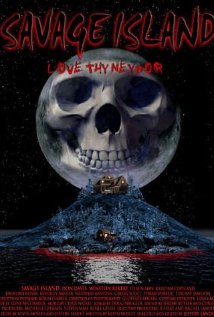
Savage Island (2005)

Here’s a drinking game you can play as the credits roll. Down a shot of whiskey whenever the name “Lando” appears. Between the efforts of writer/director/stunt driver/pianist/editor Jeffrey Lando and his brother (?) Peter, you’ll be shitfaced by the time the movie starts, and then again at the end. It will probably help.

Unlikeable yuppie pricks Steven (Steven Man) and Julia (Kristina Copeland), along with their squawling infant, take a trip to a remote island in British Columbia to visit Julia’s parents. After Julia’s idiot brother Peter (Brendan Beiser) runs over a child belonging to a family of grubby squatters, the yuppie pricks find themselves besieged by vengeful hillbillies (let’s just call them that) who demand their squawling infant as recompense. It goes downhill from there.

While the writing in Savage Island is nothing less than terrible, I have to drop a few props on Jeffrey Lando for his consistency of vision. He finishes what he starts, a third-rate, low-budget riff on Deliverance and Straw Dogs. The Savages (the appropriately named island hillbillies) are nicely fleshed out, and I appreciate that Pa (Winston Rekert) and Ma (Lindsay Jameson) look like Merle Haggard and Sarah Palin, respectively. For that matter, the yokel clan is far more interesting—and sympathetic— than their whiny bourgeois captives.

Bonus: The part of Julia’s stubborn father Keith is played by Don Davis, who was memorable in Twin Peaks as Major Briggs, the father of rebellious teen Bobby, one of Laura Palmer’s many swains.

Dying Breed (2008)

Another entry in the “isolated cannibal clan” genre, Dying Breed is way better than the earlier-reviewed Hillside Cannibals (but then, so is an average episode of Three’s Company), thanks in no small part to its being set in the deep, vibrant woodlands of Tasmania.

Zoologist Nina (Mirrah Foulkes) plunges into the harsh and unforgiving forests of Western Tasmania seeking evidence of the presumed-extinct Tasmanian tiger—the same mysterious beast that her zoologist sister Ruth was chasing several years earlier, before the latter turned up disfigured and drowned. (Dunno Nina, think I’d leave this one alone.)

Along with her boyfriend Matt (Aussie Leigh Whannell, who also wrote Insidious and a couple Saw movies), his obnoxious buddy Jack, and Jack’s cupcake, Rebecca, Nina wanders hither and yon before stumbling upon the rustic and remote township of Sarah.

As luck would have it, the town is populated by the descendants of Alexander Pearce (aka, “The Pieman”), an escaped convict who eluded the police in that area nearly 200 years earlier.

Pearce was later captured and hanged under a cloud of suspicion that he had resorted to chowing down on his chums while hunkered in the bush. Needless to say, the party soon finds itself firmly ensconced in the soup. (Or they end up in quite a pickle, your choice, but I like soup a little better.)

Instead of intrepid ineptitude (again, see Hillside Cannibals), Dying Breed is a grim, well-executed “don’t-go-in-the-woods” fable, directed, plotted, paced, and acted with unwavering efficiency.

The Tasmanian locale carries the same palpable sense of dread and foreboding as the back country of Pennsylvania in Deliverance (a movie that’s referenced here), and the local color is even more bloodthirsty.

Trigger Warning: There are some highly unpleasant implications vis-a-vis “women as breeding stock” here, which may not play in your particular domestic Peoria.