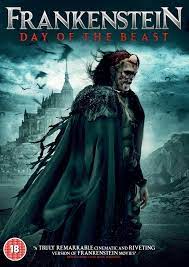
Frankenstein: Day Of The Beast is the low-budget shocker being watched by the doomed audience inThe Last Matinee when the maniac (played by Ricardo Islas, the writer-director of this film) goes on his cinematic killing rampage.
Truth be told, I was intrigued enough by the footage to give it a shot, and it turned out to be worth the effort.
In this version of the Frankenstein tale, Victor Frankenstein (Adam Stephenson) has fled to a remote island to wed his beloved Elizabeth (Michelle Shields).
Victor has employed a squad of mercenaries to keep her safe, but the monster (Tim Krueger, who’s quite good) has promised his creator that he would appear on his wedding night to take her.
Islas stays fairly faithful to Mary Shelley’s source material, but departs from the template in significant ways. This incarnation of the Frankenstein Monster is pure evil, with no grey area. He kills in extravagantly brutal fashion, bifuracting one unlucky guard with intestines on full display. Another gets his spine removed, and a blind man is forced to swallow his own cane.
The monster also eats human flesh, so there’s that. Apparently mangling his victims wasn’t sufficient to inspire terror. This guy bites faces off and rips throats out with his teeth.
How downright monstrous!
As the title implies, Frankenstein: Day Of The Beast is a more elemental take on a familiar story, one that doesn’t hold back on the blood and guts, and allows no sympathy for the monster, who doesn’t speak, but occasionally laughs cruelly.
The aforementioned budget limitations show up in various forms, from flimsy sets to terrible acting by supporting characters, but Islas clearly understands what makes Frankenstein’s creation so damned frightening. He is a relentless enemy who can’t be destroyed.
So what are you gonna do? As the vengeful Mohawk says to Max in The Road Warrior, “You can run, but you can’t hide.”
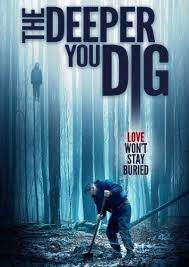
The admittedly tragic circumstance at the heart of The Deeper You Dig is indeed, an accident. What comes after is not. You would do well to pay attention.
Somewhere amidst the wintery rural recesses of upstate New York, Ivy Allen (Toby Poser) makes a living as a phony fortune teller, and apparently does well enough to support her 14-year-old daughter Echo (Zelda Adams), a sullen goth whose musical tastes include early 20th-century hit parade.
Just down the street, Kurt Miller (John Adams) is the new guy in town, fixing up a decrepit house in the hopes of a quick flip. This is all the setup we get before having to deal with a deadly event that traps all three characters into a single tense, tormented timeline.
Co-written and directed by Adams and Poser, and featuring their daughter, Zelda, The Deeper You Dig is a tight-as-a-drum domestic horror/occult revenge drama without an ounce of flab on it.
Kurt and Ivy’s parallel stories (him trying to escape a grim fate; her finding a missing daughter and rediscovering her gift), collide when Echo’s ghost comes a-haunting, effectively bedeviling Kurt by permanently fixing his radio to the Oldies Channel.
Meanwhile, Ivy interprets the signs left for her and finally makes direct contact with her daughter’s shade by mystical means.
The reunion scene in the forest, where Echo hovers above Ivy in the trees, is genuinely weird and otherworldly.
Major props to Toby Poser and John Adams (they even composed the screechy electronic score!) for concentrating not on their measly budget, but on inventing a dark and detailed world. Evildoers are not only punished here, they are recycled, reused, and renewed.
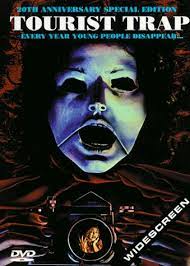
It’s always a trip to catch a TV icon in a weird little genre film. In the case of Tourist Trap, we’re fortunate to observe The Rifleman himself, Chuck Connors, chewing the scenery as the deranged proprietor of a roadside museum called Slauson’s Lost Oasis.
Written and directed by David Schmoeller (Puppet Master, Crawlspace), Tourist Trap begins with car trouble on a lonely road for five young adults (20? 30?) who are “rescued” from the elements by Slauson (Connors), an overall-clad rube who once ran a profitable frontier wax museum in the area.
Sadly, the new highway choked off the customer flow to Lost Oasis, so now it’s just Slauson and a house full of mannequins that occasionally come to life and scream their displeasure.
The victims, including future Charlie’s Angel Tonya Roberts, wisely decide to go explore the creepy manor house one at a time so they can be easily captured by Slauson (or his masked transvestite brother) and converted into shaking mannequins.
So lifelike! Such realistic skin.
In what may be a case of gilding the lily, Slauson also has telekinetic abilities that he uses to shake things up and kill people remotely when his presence is required elsewhere.
Now that’s multitasking!
To his credit, Connors is marvelous as a really kooky dude who misses his wife and his livelihood. He’s not quite as over-the-top batshit as Rory Calhoun in Motel Hell, but he constantly introduces new facets to Slauson’s madness, creating a more well-rounded maniac.
I believe Tourist Trap was remade in 2005 as House Of Wax, a vehicle for the thespian talents of Paris Hilton. There’s less blood in the original, but it’s way wackier.
We’re rolling down South America way for a truly international salute to Italian giallo cinema, that takes place inside a cinema.
In The Last Matinee, a handful of unlucky patrons and staff encounter a thoroughly disgusting maniac who eats the eyeballs of his victims!
Me? I prefer Junior Mints.
Writer-director Maxiliano Contenti hails from Montevideo, the capital city of Uruguay, where The Last Matinee unfolds on a furiously dark and rainy evening in 1993.
Industrious engineering student Ana (Luciana Grasso) is taking a shift in the projection booth, hoping to dodge the clumsy attention of Mauricio (Pedro Duarte) a boring usher with no game to speak of.
In the theater itself, a few parties settle in for a viewing of Frankenstein: Day of the Beast. There’s a couple on their first date, a little kid (Franco Duran), who hides in the aisle to see a grisly horror film, a trio of smart-ass teens sipping on a hooch bottle, and a grumpy old geezer who just wants to enjoy the movie.
While their collective gaze is locked on the onscreen atrocities, a beefy lunatic in a trench coat (Ricardo Islas) is stealthily carving up the “crowd” until the small audience gets noticeable smaller.
Editor’s note: Ricardo Islas, who plays the killer, also directed the gruesome Frankenstein feature being watched by the victims. How’s that for symmetry?
Contenti assembles a dreary little theater world peopled by very mundane citizens. When the action ramps up, the safe and predictable reality is shattered, heralded by blasts of dissonant synthesizer that generally indicates a crazed killer has entered the building.
Once the madman has announced his presence with a few preliminary cuts, the lurid elements of operatic horror (there is a poster of Dario Argento’s Opera on the wall) snap into place.
Doomed moviegoers are artfully slain and fall, like snack-bar sweets, to the cinema floor as seen through the eyes of poor little Tomas, the urchin who spends most of the film cowering in the darkness from authority and maniac alike.
A little parental discretion would have been a good idea. Tomas is going to need years of therapy.
Contenti isn’t the first filmmaker to draw a parallel line between screen violence and the behavior of deranged of individuals, but The Last Matinee is reverently rendered as a tribute to the giallo school, even if it lacks some of the top-drawer flair demonstrated by the masters of the craft.
The message comes through loud and clear, to those of us watching. We willingly put ourselves in the grip of horrifying stories. Buying a ticket is a contract that puts us is in the same line of fire as the characters.
And that’s the thrill of it all. Just ask Tomas, if you can find him.
To his credit, Contenti’s most vivid creation is the eyeball-chomping killer. Shortly before the conclusion, a few tattered survivors witness the fiend lustily chowing down on his favorite snack, just as they were minutes before with popcorn. This moment is such an over-the-top freakout, you could get whiplash.
It’s a surefire scream scenario that also folds in neatly with an earlier visual point of reference. Nicely done!
The Last Matinee is not the last we’ll be hearing from Maximiliano Contenti, that’s for certain.
Settle in and get comfortable, because there’s no walking out once the movie starts.
“It all makes sense, you see. I mean, our ancestral spirits never died. They were here long before we were, and they’ll be here long after we’re gone. But now, they’re angry.”
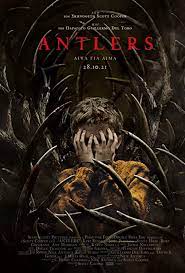
Dark times call for dark movies. Antlers is a coal mine at midnight.
The opening observation comes from Warren Stokes (Graham Greene), the former sheriff of Cispus Falls, a blighted Oregon town where mutilated citizens are appearing with alarming frequency.
The current sheriff, Paul Meadows (Jesse Plemons), is seeking counsel. He’s out of his depth and confused, hypothesizing a cougar or bear attack is responsible for the mayhem.
Meanwhile, Paul’s schoolmarm sister Julia (Keri Russell) is trying to figure out why her sullen student Lucas (Jeremy T. Thomas) is drawing pictures of demons and monsters.
In Antlers, all the dots connect to the decline of the planet’s structural integrity. Our systematic “pillaging of Mother Earth” has opened the door to indigenous spirits, most notably the Wendigo, a voracious cannibal that inhabits evil men.
Just below the narrative surface of this riveting supernatural thriller lurks mounting evidence of an infected society that has no access to spiritual vaccine.
Cispus Falls is a moribund mining town, an urban landscape littered with old machinery and empty storefronts, where the only thriving business is meth production.
Deep-rooted trauma is the norm. Julia, a recovering alcoholic with her own childhood of parental abuse, eyes liquor bottles at the store with palpable longing, searching for strength and comfort from any source.
In the background, the news drones on about the opioid epidemic, failing industries, and environmental collapse.
Kerri Russell owns her role as a damaged, unhappy woman who realizes her altruistic motives for helping Lucas are likely futile, but it’s marginally better than giving in to the despair that runs deep in these parts.
She recognizes the telltale signs of abuse in Lucas’s haunted face, a reflection of a home life that is literally hellish. He is a child doomed to maintaining the monstrous status quo at his house, while his younger brother Aidan (Sawyer Jones) is held captive by something that used to be their meth-cooking father (Scott Haze).
The thing Lucas calls “New Dad” is growing increasingly hungry and his grocery list requires fresh meat.
“Is God really dead?” Aidan asks Lucas. “Daddy said God is dead.”
Director Scott Cooper, working alongside executive producer/malevolent maestro Guillermo del Toro, has constructed a thoroughly ravaged world with precious little light—one that is bone-chillingly familiar.
Hey, isn’t that our civilization crumbling?
There are moments of brain-freezing terror in Antlers, including horned creature craft with genuine nightmare potential, a del Toro calling card.
Yet it’s the overall tone that proves the most unsettling factor, because it presents a terminally ill worldview, a pandemic of the soul that never ends.
There may be small victories to be had, individuals worth saving, but the inescapable conclusion is that humanity is fighting a losing battle with havoc we’ve wrought on ourselves.
In nearly every scene, Julia and Paul (the good guys) are stymied by inadequacy and failure. The coroner is apologetic because he can’t explain how the victims were killed. A doctor is unable to predict if a patient will recover. The harried school principal (Amy Madigan) tells Julia she isn’t allowed to intervene on a student’s behalf.
Even Paul admits he was reluctant to take the sheriff’s job, which mainly consists of evicting local homeowners.
“Everyone thinks these problems are just going to go away, and we know that they don’t,” Julia tells him. She could be referring to any number of societal symptoms depicted in Antlers.
The wound runs too deep, there’s no saving this patient. The downward spiral is well under way and no one’s getting off.
I wish they hadn’t called it Night Teeth. It’s not a very good title for such an entertaining and inventive film.
Broke student Benny Perez (Jorge Lendeborg, Jr.) just wants to earn a little extra cash driving for a car service. He borrows a sweet ride from his older brother Jay (Raul Castillo) and picks up mysterious beauties Zoe (Lucy Fry) and Blaire (Debby Ryan) for a night of club hopping around Los Angeles.
The ladies are able to read Benny like a book and quickly determine he’s a newbie at the chauffeur game, a source of much amusement. And as the night goes on, Benny becomes alternatingly aroused and alarmed by his odd passengers, particularly after one stop when they return with a satchel full of bloody cash.
Meanwhile, his brother Jay has to get his boys together because there are vampires in Boyle Heights, and that runs counter to a long-standing treaty.
There’s a full slate of subplots in Night Teeth, including sparks between young Benny and the somehow-still-kind-hearted Blaire. When they’re together the movie freely pivots into a star-crossed romance and the night seems full of new possibilities.
Mostly the story sticks close to the mob-style coup being staged by ambitious vampire Victor (Alfie Allen), who wants to go back to the old ways of old days, when humans were fair game, regardless of their address.
Night Teeth is also one of those vampire movies (like Near Dark) that doesn’t use the “V” word, which is why I found the title clumsy, like it was picked out of a hat.
Even so, there is all-you-can-eat action, laughs, guts, and unlikely romance to be feasted on in Night Teeth. Just as in Vampires Vs The Bronx, bloodsuckers are depicted as affluent white gangsters trying to gain wealth and power by displacing a hardworking minority, in this case, Latin Americans.
“Who still uses crossbows?” Benny wonders out loud while trying to stay alive during a gnarly fight between undead rebels and vampire hunters. Find out this and other exquisite tidbits in Night Teeth, winningly directed by Adam Randall, and sharply written by Brent Dillon.
When you’re the new kid in school, it helps to be adopted by the popular clique, even if they’re into necromancy. Go along to get along, you know?
Seance is set at Edelvine Academy for Girls, a prestigious private learning institution with a recent opening, thanks to a student hopping out the window during a paranormal prank.
Editor’s Note: When are we going to outlaw pranks? Nothing good ever comes from pranks and people get hurt, disfigured, and killed all the damn time.
New student Camille Meadows (Suki Waterhouse) moves into the recently vacated room and gets picked on by the same Mean Girls who drove the previous occupant to jump.
Camille and the Mean Girls all end up in detention together, where an alliance of sorts is formed, and a seance is convened to see if any ghosts want to communicate.
Surprise! They do!
Featuring both a ghost and masked psychos bearing cutlery, Seance is smartly written and full of gradually revealed plot twists that take sinister shape under the guidance of writer-director Simon Barrett (You’re Next, Dead Birds).
There aren’t buckets of blood, but there’s a body count and a few memorable kills, including Bethany’s (Madisen Beaty) fluorescent tube tracheotomy.
It’s also a movie about duty and the bonds of friendship that run deeper than the need for acceptance within a group of nasty bitches.
Directed and co-written by South Korean filmmaker Jong-ho Huh, Monstrum is an exquisitely crafted 16th century period piece about a legendary beast that is decimating the population of Mount Inwangsan.
It is also a very astute political thriller about a beleaguered king (Park Hee Soon) who is being undermined by his cabinet ministers. The powers behind the throne conspire to keep the peasants wary and fearful by fueling rumors of a horrible creature that not only kills its victims but spreads the plague throughout the countryside.
Naturally, the peasants would like to see something done to mitigate the mutilations, so the king summons a loyal general (Kim Myung-min) to lead a party of warriors and farmers to hunt down and destroy the thing known as Monstrum.
The plot bubbles with palace intrigue and betrayals as a persistent rumor turns flesh (fur) in the form of a monstrous black cat that’s grown to massive proportions thanks to a steady diet of disease-ridden corpses.
The Monstrum itself isn’t the best CGI critter ever, but it’s far from the worst. Thematically, it represents man-made corruption, dishing out death as an equal opportunity destroyer, feasting on peasant and noble alike.
The monster is generally on the money in Monstrum, but the movie’s also chockful of superb swordplay and martial arts choreography that dazzles the senses. It’s no Crouching Tiger, but it’s definitely a hidden gem.
It also boasts terrific cast chemistry and you’ll have no trouble rooting for the scrappy band of heroes that takes on the vicious monster and stands up to a cadre of treacherous politicians.
And like Masque of the Red Death or Brotherhood of the Wolf, Monstrum uses a deadly plague to illustrate the indifference of the aristocracy to the suffering of an impoverished working class.
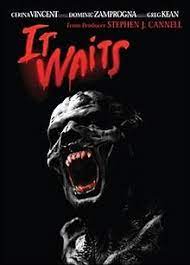
If your expectations are not currently residing in a lofty skyscraper, then It Waits should do the trick. The time passed and I was engaged, despite the teensy budget and a general lack of dramatic ability from the cast.
First and foremost, this is a story about redemption. Yes, there is a winged monster that dismembers campers, and plays cat-and-mouse with the lovely Danielle (Cerina Vincent), an alcoholic ranger stationed at a lonely tower in the forest primeval.
See, Danielle recently got shitfaced with her friend Julie, and was at the wheel of their jeep when it crashed, killing her bestie. Since then, she’s retreated to the solitude of her fire-watch perch to sulk and drink some more, with a wisecracking parrot as her primary companion.
If only there were some way for her to save the day, and earn back her self-respect!
Meanwhile, a bunch of stupid college students blast a hole in the side of a mountain, freeing a demon/gargoyle that’s resided there for ages and ages. After dispensing with the hors d’oeuvres, the monster plays the long game with Danielle, waging a gruesome terror campaign and reducing everyone around her to bloody mulch.
Director Steven Monroe recognizes that Danielle is the focus of the feature, so she’s never far from the camera, an aesthetic gamble that pays off. While her emotive capability seldom rises above school play levels, actress Cerina Vincent pumps the gas when action is called for and spends the majority of her screen-time looking absolutely ravishing.
The creature also gets a fair amount of camera time, and it’s a sturdily built costume that wreaks plenty of havoc, resembling Pumpkinhead with a wingspan. In fact, the diabolical monster seems rather too formidable for the plucky ranger.
Fortunately, dynamite is a great equalizer. Keep expectations on the ground floor and you will be reasonably pleased with It Waits.
To anyone who dares spread the rumor that horror movies are responsible for the moral decay of society, here is a provocative feature for your consideration.
Set against England’s Video Nasty outrage of the mid-’80s, Censor takes us inside the head of Enid Baines (Niamh Algar), an efficient and organized member of the government agency in charge of rating violent and disturbing films of the day, like Driller Killer and Deranged.
Enid is quite good at her job but her personal life hasn’t recovered from the childhood trauma of losing her sister Nina in the woods, and she continues to harbor hopes that she will turn up one day.
When she’s assigned a Nasty called Don’t Go in the Church, something shifts in Enid’s memories as the movie seems to be a re-creation of the day her sister disappeared, a haunting mystery that was never solved, and the details of which she can’t remember.
Her parents want her to move on with her life and meet a nice fellah, but Enid is determined to track down the cult filmmaker who could be the source of everything that’s gone wrong in her life.
Welsh writer-director Prano Bailey-Bond has fashioned a deeply drawn character in Enid, and the performance by Algar just keeps getting richer, even as her world gets darker, infected by the barrage of torture and cruelty she witnesses on a daily basis.
Bailey-Bond does a first-rate job of establishing time and place, when England was under a media-fueled frenzy of lurid details from “hardcore” horror films dubbed “Video Nasties.”
Enid’s office, with its dark little viewing rooms, becomes equally lurid, as screams and chopping sounds fill the halls.
Job pressures take their toll on Enid, a thoroughly professional woman with a complicated, compartmentalized life. Like Cassandra Thomas in Promising Young Woman, she has answered a calling and takes pride in her work.
Unfortunately, Enid, an otherwise intelligent and perceptive woman, ignores the warning issued by more than one character, that being, “Evil is contagious.”
In my estimation, Censor is one of the best horror films of the year.





 horrificflicks.com
You must be logged in to post a comment.