The Cursed (2021)

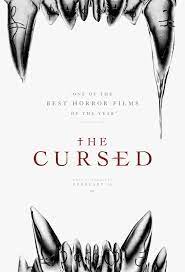
Lovely to look at but largely bereft of beast, The Cursed, written and directed by Sean Ellis, can’t decide if it’s a werewolf movie or a period piece homage to The Thing.

In true egalitarian fashion, we get a smattering of each, leaving both camps less than satisfied.

Seamus Laurent (Alistair Petrie) is a 19th-century French landowner with a passel of problems. While slaughtering a band of gypsies who’ve taken up residence on his property, Laurent gets a horrible hex placed on him by a dying witch, who doesn’t appreciate being buried alive.

The local children immediately start having bad dreams about an evil mouth of silver teeth, supposedly constructed from the 30 pieces of silver that Judas was paid to betray Jesus.

Kids being kids, they find the enchanted teeth, start horsing around with them, and Edward (Max Mackintosh), Laurent’s son, gets bitten. Soon after, mutilated bodies begin turning up, and a visiting pathologist (Boyd Holbrook) is called in to investigate.

The Cursed is sturdily constructed and painterly pretty, but Ellis uses such a muted color palette, his framing dexterity often gets overlooked. Each set is either engulfed in fog or we get buckets of brown mud and green turf, so as to appear especially dreary. Visual monotony ensues.

And then there’s his cavalier attitude toward lycanthropy. Surviving victims of Edward’s rampage transform with tendrils emerging from their backside. Tendrils? Where did they come from? Is this Lon Chaney or Lovecraft?

Furthermore, the werewolf CGI isn’t anything special when it finally appears. Rick Baker’s seven Oscars are not in danger of being eclipsed by this bunch.

Even so, The Cursed isn’t a terrible movie, but it’s slow, overly talky, and there are way too many scenes of people waking up from nightmares. Turns out the dreams are the scariest part, unfortunately.

Editor’s Note: This is the second disappointing werewolf movie I’ve seen with this title. The 2004 Wes Craven-Kevin Williamson feature with Christina Ricci is also a dud.

Barbarian (2022)

We’re seeing an upswing of Air B&B-based horror movies, and writer-director Zach Cregger’s Barbarian currently sits alone at the top of the heap. It’s a stylistic cousin of Tarantino’s Pulp Fiction, as mood and tone careen crazily between multiple storylines that converge in one really bad house.

Our heroine Tess (Georgina Campbell) is on her way to Detroit for a job interview with a documentary filmmaker. She arrives at her rental, the only livable dwelling in a blighted suburb that looks like World War II ended last week.

To complicate matters, it’s a dark and stormy night. To further complicate matters, she finds her house already occupied by Keith (Bill Skarsgard), a somewhat intense fellow who seems determined to put her at ease, offering to share the house with Tess for the evening.

Eventually, and against her better judgment, Tess accepts Keith’s hospitality and the two get better acquainted over a bottle of wine.

Meanwhile, in another part of the movie, TV sitcom star A.J. Gilbride (Justin Long), is having a rough time with the #MeToo movement, causing his career to crumble.

He’s advised to liquidate his holdings, including some rental property in his native Michigan, currently occupied by Tess, Keith, and something else entirely.

There is a fearsome creature at the heart of Barbarian, but like any good monster, she’s highly sympathetic, certainly more so than the two male leads, neither of whom can adapt in the unexpected survival situation they all stumble into.

AJ in particular is a loathsome example of masculinity; a whiny, raging, mama’s boy, who proves to be the biggest obstacle in Tess’s escape from a hell-house that rivals the Sawyer Farm in Texas.

Frank (Richard Brake), the owner of the house and its hell, gets his story told in a narrative hopping flashback, and we realize that the thing haunting this hacienda is not the real monster here. In fact, she’s a remarkably nurturing creature considering her grim origin.

There’s a hell of a lot happening in Barbarian, and it understandably leaves the viewer a bit rung out. It’s shocking, periodically funny, and superbly realized by Zach Cregger, formerly of The Whitest Kids You Know.

Cregger’s commitment to creeping (and grossing) us out is impressive as layers of awfulness just continue stack up like mildewed laundry.

It’s also a film that’s not afraid to sound off on a laundry list of anxiety topics, including motherhood, property values, Cancel Culture, incest, hospitality industry paranoia, and awkward first dates.

Barbarian is a wild ride and there are no seat belts in this buggy.

The Rental (2020)

Not recommended.

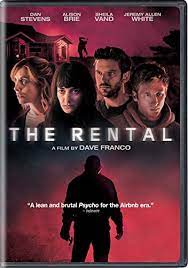
Dave Franco (younger brother of James) is the fledgling auteur responsible for The Rental, and unlike most coattail grabbing siblings, he demonstrates legitimate ability in the cinematic arts.

Of course, vacationers in peril isn’t the most original concept, but we’ve seen filmmakers do more with less.

Charlie (Dan Stevens, who seems to be making a career in genre films), a big-shot tech dude on the verge of a major career spike, makes arrangements for a celebratory weekend getaway at a well-appointed beach house on the Oregon Coast.

His wife Michelle (Alison Brie), and underachieving kid brother Josh (Jeremy Allen White) are part of the party, as is Josh’s Iranian girlfriend Mina (Sheila Vand)—who also happens to be Charlie’s coworker.

Problems predictably boil to the surface in short order: Mina suspects that Taylor (Toby Huss), the beach-house caretaker, is a racist and makes an issue of it. Michelle doesn’t want any Molly, so the other three party without her. Mina and Josh bring an adorable French bulldog with them, despite a No Dogs clause in the rental agreement.

As the drugs take effect, Charlie puts the moves on Mina, even though she’s in a committed relationship with his hot-headed younger brother, currently crashed on the couch. While Charlie’s wife sleeps peacefully in the next room, the horny workmates knock boots in the shower.

Classy.

Shortly thereafter, Mina discovers micro cameras installed in the shower head and things take a very paranoid turn. Charlie and Mina immediately seize on the idea that Taylor, a man they’ve never met before, is going to blackmail them with illicit footage of their midnight hanky-panky.

If that wasn’t enough, the dog disappears. (He does not die.)

Franco succeeds in sparking tension and earning our interest, as it’s obvious from the assortment of perspectives we’re presented with, inside and outside the house, that someone is watching these frisky beachcombers screw around and catching it all on camera.

Sadly, The Rental builds shakily to a half-baked massacre that clarifies zilch. I honestly pictured a nation of viewers looking quizzically at one another while shrugging their shoulders.

My complaint is simply this: We spend 95 percent of the running time of the movie putting up with a philandering tech bro and his flawed posse, only to have a deux ex machina come in and wipe them all out?

Who’s the guy in the mask?

Hey Little Franco, if we’re forced to go online for an explanation of your movie’s ending, you’ve failed your obligation as a storyteller.

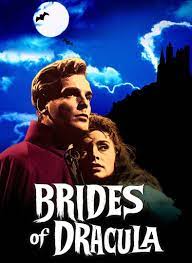
Brides of Dracula (1960)

“Count Dracula, monarch of all vampires, is dead, but his disciples live on, to spread the cult and corrupt the world.”

Like the gloomy narrator indicates in his ominous introduction to Brides of Dracula, the marquee bloodsucker, played by Christopher Lee, managed to get himself skewered in a previous Hammer Films production, so this time around we get Baron Meinster (the dashing David Peel), certainly one of the first examples of vampire as pop star.

When Meinster materializes at the Transylvania Academy of Proper Young Ladies to visit Marianne (Yvonne Monlaur), the pretty new French teacher, the gathered gals go gaga over the dapper blonde Baron.

Check out the image above used to promote the film. It looks Heathcliff and Catherine off to a make-out sesh on the moors.

But I’m getting ahead of myself.

By this point in the movie, Marianne has already freed Meinster from captivity by his daffy dowager mother the Baroness Meinster (Martita Hunt), who for years has kept vigil over her evil offspring, aided by Greta (Freda Jackson), her equally loony servant.

Earlier, the Baroness discovers Marianne stuck at the local pub, abandoned by her cowardly coachman (Michael Ripper). Lonely for educated company, the increasingly unstable noblewoman invites Marianne up to her castle, to sleep in one of her many guest bedrooms.

From her window, Marianne spies the young Baron wandering on his own balcony below. Throwing common sense to the wind, she instantly believes the beautiful man has been wrongfully incarcerated and helps him to escape.

Nice going, Marianne!

The newly liberated nosferatu is soon feasting on the hottest peasant woman in the village (Marie Deveraux), as well as Marianne’s jealous roommate Gina (Andree Melly).

Greta, once his captor, has decided to help out Meinster by digging up the dead girls and making them more presentable for their master.

Now that’s what I call Goth!

True, there is no Dracula on hand, but we do get Doctor Van Helsing (Peter Cushing) the Hall of Fame vampire slayer, operating at the top of his game. Cushing is typically excellent and erudite as the dedicated undead destroyer, who has a couple gnarly brawls with the new count on the block.

After getting a bite from Meinster, Van Helsing demonstrates uncanny resourcefulness, by treating his unholy hickey with a hot branding iron and some H20 blessed by the local priest.

Despite the absence of the iconic Christopher Lee, Brides of Dracula gallops along at a brisk clip, with impending danger reliably signaled by Malcolm Williamson’s anxious orchestration, that during moments of high drama seems on the verge of complete nervous collapse.

The veteran supporting cast is spot on. Freda Jackson is a howling mad domestic that nonetheless adapts to new duties with surprising confidence. And the enchanting Andree Melly glowingly epitomizes the movie’s tagline: “He turned innocent beauty into unspeakable horror!”

Even minor characters, like Dr. Tobler (Miles Malleson), the dipsomaniac local sawbones, are given sufficient space by director Terence Fisher to have small comic interludes that prove successful more often than not.

Speaking of comic interludes, there is some lame-ass bat puppetry happening here that might also inspire a few laughs. That should not deter anyone in the slightest.

Brides of Dracula is Hammer horror at its hottest, featuring a plethora of glaring bloodshot eyes, heaving bosoms, and a fair amount of fang action.

Required viewing in my estimation. See what all the fuss is about.

Horror in the High Desert (2021)

Social influencers are horror movie gold!

I alluded to this situation in my review of The Deep House, as the answer to the burning question, “Why would otherwise intelligent people put on scuba gear to explore a haunted house at the bottom of a lake?”

The protagonists are compelled to take on insanely dangerous missions in order to attract (and maintain) followers! Building that brand is indeed hazardous to your health.

Horror in the High Desert is an 82-minute found-footage shocker about Gary Hinge (Eric Mencis), a popular outdoor adventure blogger who disappears under (you guessed it!) “mysterious circumstances,” while exploring a remote area of Nevada’s high desert.

Possibly based on the real-life case of Kenny Veach (Google that shit), writer-director Dutch Marich dutifully assembles realistic interviews with family, friends, and investigators, all of whom are trying to figure out what happened to someone who was, by all accounts, an expert at wilderness survival.

Spoiler alert: It ain’t good, and eventually the talking heads give way to Gary Hinge’s final creepy posts, from a location he clearly didn’t want to revisit.

The fearless blogger admits to increasing anxiety, and with good reason. All his instincts warn Hinge away from the nasty little shack in the middle of Nowhere, Nevada.

But his core followers have demanded video evidence, so he has no choice but to return to a cursed location. Film, or it didn’t happen.

As a blogger myself, I can only hope my dozen or so regular readers don’t start clamoring for personal peril on my part—unless you’d enjoy footage of me collecting dog poop in the backyard.

The ending leaves open the possibility of a sequel (or three), as it’s reported during the credits that no less than 17 teams of danger bloggers went out to find Hinge.

Horror in the High Desert is a more than ample warning to the foolhardy. Don’t let obnoxious fans push you over the brink and into the arms of … someone you do not ever want to meet.

Wer (2013)

I’m reasonably sure that this movie would have more of a following if it wasn’t saddled with such a clunker of a title.

Wer? Really, that’s the best we can do?

It’s a shame because Wer is top-shelf lycanthrope mayhem all day, every day.

Co-writer and director William Brent Bell wisely saved his nickels and dimes by filming in Romania and calling it France, where American lawyer Kate Moore (A.J. Cook from Criminal Minds) is defending a hulking peasant (Brian Scott O’Connor) accused of tearing up a family of tourists. Limb from limb.

And taking huge bites out of them.

The makeup and prosthetic work by Almost Human Inc. is worth the price of the ticket. The scene when Kate examines the shredded remains of the victims is startlingly savage. Seldom has bodily harm been rendered in such vicious detail.

A shaking hand-held camera gives Wer the appearance of a found footage police procedural, with lengthy talking sequences that flare into bloody chaos without warning.

Now that’s what I’m talking about. Modest movies that turn out to be way better than I expect are the coin of my realm. They’re my jam.

Now if you’ll excuse me, I’m going to make some toast.

Editor’s Note: Come and have a hang at our new Facebook site!

Day Shift (2022)

“This is like the third movie we’ve seen where vampires are also realtors,” Kaja observes.

“It’s an easy metaphor,” I admit.

Day Shift is set in sunny Los Angeles, as hard-working vampire hunter Bud Jablonski (Jamie Foxx) tries to earn a living snuffing out the undead and selling their teeth to oily pawnshop owner Troy (Peter Stormare).

There is a vampire hunter union, and Bud could make more money if he was a member. Alas, he’s been kicked out for not following the rules.

And wouldn’t you know it? He’s got a week to put together $10,000 for his daughter’s school tuition and braces, and his soon-to-be ex-wife wants to sell their house.

This situation provides the comic fulcrum and prompts Bud’s return to the union, where he is assigned a by-the-book partner named Seth, played by Dave Franco as a Rick Moranis-style retro nerd.

The villain in Day Shift is Audrey San Fernando (Karla Souza), an ambitious land baron who’s trying to buy up the valley she’s named after. She’s got a score to settle with Bud, who recently beheaded Audrey’s daughter during a house call.

Heck, let’s throw in Snoop Dogg dressed in full-on cowboy gear as Big John Elliott, a legendary slayer with a Clint Eastwood vibe.

Day Shift, directed by J.J. Perry and written by Tyler Tice and Shane Hatten, provides zippy spectacle with state-of-the-art vampire slaying methods (garlic grenades, silver beheading wire, wooden bullets), and the action is tightly choreographed and brutally executed.

The scene in which Bud teams up with the Nazarian Brothers, a pair of Eastern European tough boys, to clean out a nest of vampires is a real adrenaline popper. Martial arts, flying body parts, and tech toys make for successful stimulation.

Unfortunately, when the rumbles subside, we’re not left with much to occupy our attention.

It’s a minor complaint, but Bud’s family is about as one-dimensional as it gets. The sassy daughter (Zion Broadnax) and endlessly complaining wife (Meagan Goode) are standard plug and play characters.

There are loose ends left dangling all over the place, including a sunscreen that allows vampires to run around in the daylight for a short time. A significant discovery in Nosferatu society, but here it barely rates a mention.

And what’s up with Jamie Foxx’s name? When was the last time you met an African-American dude named Bud Jablonski?

If you’re inclined to forgive a few half-assed details, Day Shift delivers decent bang for the buck, but you’re not missing anything special.

Prey (2022)

About 20 minutes into Prey, I made an offhand comment to my wife.

“This seems more like a Disney movie than a horror movie.”

A few momnets later, Barb replied, “Good call. It’s from 20th Century Studios, owned by Disney.”

Therein lies the rub.

Co-writer and director Dan Trachtenberg (10 Cloverfield Lane) has assembled a violent, R-rated action movie that nonetheless features a headstrong and resourceful heroine who isn’t satisfied with her gender-defined role in life.

Prey also provides new management for the Predator series, which has been floundering since Schwarzenegger flew the coop. Here, an interstellar big-game hunter makes a landing in early 18th century America, amongst a tribe of sturdy Comanches.

Naru (Amber Midthunder), is a bad-ass hunter and tracker who wants to be a warrior. Unfortunately, she lives in the shadow of her older brother Taabe (Dakota Beavers), the tribe Alpha Male.

In a refreshing turn, Taabe is actually supportive of his sister, speaking highly of her skills to his fellow hunters.

His encouragement pays off, as Naru is the only one with the smarts to figure out that whatever is killing nearby wildlife is not a bear or a mountain lion.

Eventually, Naru gets her most fervent wish: to hunt something that is simultaneously hunting her.

Prey is visually stimulating and full of arboreal wonder as the tale and the landscape itself unfold without the presence of Western man—except for some dastardly French trappers who get in the way of the Predator’s safari.

As for the main monster itself, we don’t get any major developments other than their hunting technology is more rudimentary than that one time with Arnold.

Overall, it seems a less formidable opponent, which takes some of the steam out of the narrative.

Equally bothersome, there’s CGI work involving some of the animal fight scenes (Predator versus Bear, Naru versus Mountain Lion) that seems crudely rendered and rather clunky. It makes you think, for a second or two, that the whole picture must be a bloody animated feature, rather than live action.

Yet the Disney thematic parachute is unmistakably present in Prey, and the result is an uneasy alliance between dueling Market Powers (Action Fans versus Disney Moral Authority).

My wife liked it more than I did.

Note: Naru has a brave dog sidekick that doesn’t get killed.

Lantern’s Lane (2021)

True Confession. Role Playing Games once represented a huge part of my social life. Many’s the night we cast our dice to the wind playing Dungeons & Dragons, rolling up characters for some catastrophic quest or other, fortified by cheap beer and weak weed (and vice versa).

On the not-too-rare occasions when nobody really had their shit together enough to have an original adventure prepared, we relied on modules, or ready-made dungeons, that any half-bright game master could purchase at the local Nerd Boutique.

Lantern’s Lane, written and directed by Southern California filmmaker Justin LaReau, is a horror movie module. It’s a bare-bones slasher that hovers around the minimum requirement level in every department.

Nutshell: Homecoming Queen and all-around It Girl, Layla (Brooke Butler), returns to her hick hometown after graduating from college. She drops by the seedy saloon and reconnects with high-school chums Missy (Ashley Doris), a hottie waitress, Shana (Sydney Carvill), a former fat girl, and Jason (Andy Cohen, think Xander from Buffy The Vampire Slayer), the eunuch comic relief.

After a few shots of White Lightning, the onetime classmates drive out to Lantern’s Lane, a local hotspot for Urban Legends and paranormal activity, hoping to get a glimpse of the Old Lady with the Lantern, a tragic spook eternally searching for her dead hubby.

Instead, Layla and her mates end up stranded in an unfinished house, penned in by a knife-wielding psycho wearing a bug-eyed sack.

How basic can you get?

Sadly, most of the running time is devoted to devising escape plans that don’t work, and discussing how Layla is a bad friend for leaving their Podunk town and making a life for herself in the Big City.

By the time the maniac shows up, the characters have rehashed their petty grievances to the point that we’re hoping they get carved up like Christmas hams. No such luck, the body count is dismal and we get only trace amounts of viscera.

On top of all that, LaReau can’t write dialogue to save his life, seldom rising above “Let’s get out of here,” “I can’t do it,” and other throwaway panic phrases that come with the game setup.

The recurring problem with Lantern’s Lane is its lack of any distinctive characteristics. It isn’t scary, funny, bloody, sexy, or even atmospheric.

More like Lantern’s Lame, if you ask me.

Editor’s Note: Find additional content at facebook.com/horrificflicks

A Lonely Place To Die (2011)

It’s really more of a thriller than a horror movie, but there’s no mistaking the blinding terror faced by the principals in A Lonely Place To Die, written and directed by British filmmaker Julian Gilbey.

Five friends meet up for a weekend of rock climbing in the Scottish Highlands. While negotiating some tricky cliff business, they stumble upon Anna (Holly Boyd), a kidnapped Serbian girl who’s been buried alive in a small chamber.

Rob (Alec Newman) and Alison (Melissa George), the group’s best climbers, take off to fetch help, leaving Ed (Ed Speelers), Alex (Garry Sweeney), and Jenny (Kate Magowan) to mind the child.

Nearby, Mr. Kidd (Sean Harris) and Mr. McRae (Stephen McCole), the ruthless criminals responsible for the abduction, start killing everyone they meet, working their way through a couple of hapless poachers before cutting Rob’s rope as he dangles off a precipice known as “Devil’s Drop.”

Then they break out rifles and set their sites on the rest of the party.

Julian Gilbey does an excellent job of distributing his threats in A Lonely Place To Die. We get vertiginous mountain-climbing spectacle, causing characters to stop and muse how long it would take them to reach the ground after falling.

Anna’s burial in such a remote area is an indication that the villains are cold and cruel, not even bothering to check on the little girl’s scant water supply while she’s in the ground.

Indeed, this turns out to be the case, as Kidd plays the quiet sociopath to McRae’s raging and reckless killer.

The finale takes place in a small Scottish village during a riotous Beltane festival, the perfect cover for a violent skirmish between desperate foes. Gilbey deftly orchestrates the havoc, switching point of view from hunters to hunted, to different hunters hunting the hunters.

Sorry, there’s nothing supernatural going on in A Lonely Place To Die, but the pace, pursuit, and payoff are so far up our alley, we’re going to make room.