A beleaguered Georgia landowner summons a husband-wife team of investigators to document possible paranormal parties driving away his customers at a remote hunting lodge.
The hunters are scared of ghosts that noisily walk around at night, and whose presence is felt by virtually everyone who stays there.
Filmmakers Kendall and Vera Whelpton set up shop in the antler-festooned farmhouse, promptly noting atmospheric changes on their EMF readers, and seemingly making contact with an entity that flashes lights in response to questions.
Eventually the Whelptons bring in a rather theatrical psychic, Jill Morris, who makes her own connections into the spirit realm that causes a minor metaphysical ruckus.
Keep in mind, The Haunting Lodge is a DOCumentary and not a MOCKumentary.
The Whelptons maintain that what we are watching is a genuine event, a legitimately filmed paranormal happening.
Therefore, the doors opening and closing by themselves, accompanied by the sounds of booted feet marching down the hallway, are real ghosts.
And there are a few glimpses of beings (?) that appear and move digitally through the darkness.
With plenty of “Did you see that?” moments, the footage allows disbelief to be temporarily and precariously suspended.
Actually, it doesn’t matter if you believe what you see here. It’s the storytelling equivalent of saying, “I swear! It’s true! It happened to my Mom’s cousin’s sister!”
In any case, The Haunting Lodge clocks in at a lean 67 minutes, so it’s not much of a time investment.
Welcome to a dark night of the soul. Even bad people have them.
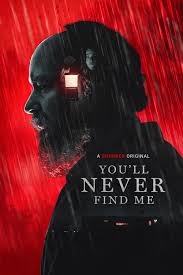
In some nameless Australian trailer park, Patrick (Brendan Rock) sits in his living room drinking whiskey. Outside, there is thunder and lightning, just like the night Frankenstein’s creature woke up.
Patrick is alone, but not for long.
A wayward woman (Jordan Cowan), lost in the storm and soaked to the skin, pounds on his door seeking a telephone.
“You’ve knocked on the wrong door,” Patrick tells the shoeless visitor.
Of course, things are not that simple. The wrong door depends on who’s standing where.
You’ll Never Find Me, written and co-directed by Australian newcomer Indianna Bell, is an intricately constructed two-person play, featuring unexpected shifts in the power dynamic taking place over the course of a dark and stormy evening.
It’s Patrick’s house, and he’s obviously a formidable man who prefers solitude. A drenched woman with no shoes can’t possibly be a threat.
So why is he uneasy?
Patrick explains to her that feral kids living in the park routinely beat on his door and run away. Even at two in the morning during a violent storm?
That’s enough to drive anyone mad.
Gradually, Patrick warms up to his guest and promises to help her, but he’s also clearly suspicious about her point of origin. She claims she fells asleep at the beach.
“The beach?” Patrick wonders aloud, as if he’d never heard the word.
Viewers are left to puzzle and ponder the scant information provided by these mysterious players, as both sides continue to distract and interrogate the other while passing the time with a few hands of cards.
We can tell from the outset that Patrick is a (deservedly) haunted man, and as the tension in the trailer escalates, a very big decision about his future—the same one faced by Hamlet—becomes an unbearable burden.
With its single set, minimal action, and tiny, terrific cast, You’ll Never Find Me is a harrowing and claustrophobic watch, with revolving doors of trust and deception leading to the ultimate question: To be or not to be.
Original, highly rewarding, and vigorously recommended.
George C. Scott in an understated role as a classical composer bedeviled by spooks in Seattle? It’s true!
I reviewed The Changeling upon its release for my high school newspaper, wherein I declared it “really scary.”
More than 40 years later, I am revising my opinion. Sometimes “scary” doesn’t age well. But then, neither do I.
Ivory tickler John Russell (GCS) is a recent widower, having lost wife and daughter in a wintery road accident. He takes a teaching job at a small college in Washington state to hopefully get his head together and start composing again.
Instead, the massive mansion generously rented to him by Claire Norman (Trish Van Devere, his real-life wife) from the local historical society, comes with a ghost in the attic that wastes no time banging around upstairs, depriving the maestro of much-needed rest.
A seance arranged by Claire with a psychic couple confirms the presence of a restless child murdered in the house, and it becomes Russell’s mission to bring metaphysical justice to the situation.
Director Peter Hyams (The Relic, Time Cop), a thoroughly capable and professional filmmaker, does a thoroughly capable and professional job on The Changeling.
The problem isn’t him, it’s me.
I suppose a scene in which a possessed antique wheelchair chases Claire around the upper floors of the mansion was sufficient to make teenaged me go, “eek!”
Since then, I’ve logged thousands of hours of community service watching ghosts, ghouls, creatures, cruel killers, and assorted hell-spawn ravaging their way through humanity.
The Changeling, even with its star cast and engaging mystery, comes off as quaint and dated. Weak tea and dry toast.
It’s not simply an age thing. A masterpiece of atmosphere such as Robert Wise’s The Haunting (1963) requires nothing more than sound and camera movement to convince us that the supernatural world is all around us.
The Great Scott, who does not bellow, growl, or bloviate, is convincing as Russell, a (literally) haunted man vulnerable/receptive to unseen forces, due to the fresh tragedy in his life.
Though Hyams, Scott, et al, give it the old college try, their collective efforts fail to generate any genuine shock wattage in the 21st century.
Three years after John Carpenter set the night on fire with Halloween, The Fog, his return to the horror genre, earned lukewarm reviews and is generally considered one of his lesser efforts.
People forget that Carpenter came up helming made-for-TV movies with micro budgets, like Someone’s Watching Me, and Elvis, a surprisingly good Presley biopic from 1979 starring a young Kurt Russell, who was nominated for an Emmy.
Carpenter’s theatrical movies, which tend to feature desperate characters trapped together against unearthly enemies, are similarly economical affairs with superior practical effects by master technicians.
The Fog once again forces his cast indoors as vengeful spirits from a doomed sailing ship descend on a coastal California town on the night of its 100th anniversary.
Speaking of master technicians, makeup and effects whiz Rob Bottin even gets to step in front of the camera as Blake, the leader of the ghostly mariners.
Antonio Bay, California is the setting, as citizens excitedly prepare for the upcoming centennial celebration. Sad-sack sermonizer Father Malone (Hal Holbrook) discovers a diary written by his grandfather, detailing a treacherous deal offered by town founders a century earlier.
It seems that Blake, a well-to-do leper and his flaky followers, were determined to settle near the still-undeveloped Antonio Bay, even sealing the deal with a generous amount of gold.
Instead of welcoming their new neighbors with casseroles, locals lured the leprous crew’s ship onto the rocks with a false campfire, sending the scabrous sailors to a watery grave.
Once the founders lifted the lepers’ loot from the wreck, they had sufficient capital to incorporate and become an actual spot on the map.
To no one’s surprise, this original sin results in sword-wielding spooks rolling into town via a glowing fog bank on founders’ day to slay six unlucky souls to match the number of drowned crew.
The Fog isn’t exactly scary, but it’s got a ton of atmosphere, the 44-year-old effects are decent, and Carpenter keeps the action—and heads—rolling while notching the tension with minimal dialogue and unforeseen events, such as dissonant symphonies of car horns going off at night.
Carpenter’s cast is filled with reliable talent, including, Holbrook as the guilt-ridden Father Malone, Adrienne Barbeau (his wife at the time) as sexy DJ Stevie Wayne, Jamie Lee Curtis as a free-spirit hitchhiker, and her mom, Janet “Psycho” Leigh as the town mayor.
As is par for the course, Carpenter crams everyone into a church in the final scene to keep the spectral swabs at bay, but they only leave after Father Malone returns most of their gold and gets beheaded for his trouble.
And so, order is restored, because you can’t make an omelet without breaking some eggs.
This is definitely a case that calls for an enhanced re-release with better picture quality, because The Fog is a very dark movie, and I don’t mean thematically.
Note to auteurs: If you plan on a lengthy career don’t use cheap film stock. It can can dim the enthusiasm of the newly curious.
I’ve been a fan of Edgar Wright from his earliest work on Spaced, the hilarious BBC sit-com from the tail-end of the previous century.
This foundational series teamed director Wright with writer/actor Simon Pegg, a partnership that flourished with ace collaborations like Shaun of the Dead (2004) and Hot Fuzz (2007).
Pegg is certainly the more visible of the two, appearing in high-profile film franchises based on TV shows from the 1960s, Star Trek and Mission Impossible.
In Last Night In Soho, Wright’s musically minded, bloody Valentine to swinging London, he affirms his true love (and understanding) of those riotous times through masterful manipulation of color, sound, and movement in telling the story of two girls from different eras whose lives overlap in Dreamland.
We open with Eloise (Thomasin McKenzie), a spirited lass from Cornwall with dreams of being a 60s-inspired fashion designer in London.
Upon landing in the big city, Eloise is treated rudely by her designing classmates to the point that she’s forced to abandon the dorms in favor of lodging with Mrs. Collins (Diana Rigg) a lovely old-lady landlord who doesn’t allow male guests after 8pm.
Soon after acquiring the new digs, Eloise begins a dream odyssey about the adventures of Sandy (Anya Taylor-Joy), a live-wire hip chick who captures the attention of everyone she meets during her meteoric ascent in London’s nightclub scene, circa 1965.
Coincidentally, it’s the very same historical period that Eloise obsesses about through her clothes and music. Cilla Black, Kinks, Chad & Jeremy, and Petula Clark can be heard plugging away on the phonograph, while her attempts at creating swing silhouettes and bubble dresses are clearly influenced by Mary Quant and other Carnaby Street regulars.
Eloise and Sandy overlap in these subconscious interludes: Sandy is portrayed by Taylor-Joy, but whenever an opportunity for a reflection appears, it’s McKenzie looking back at the action.
A lesser director would milk this device as a gimmick. Wright uses it to set the story to a fevered rhythm, as Sandy, a beautiful rising star, sees her ambition smashed to bits by horrible old men.
When not living her dream, Eloise styles herself as the beguiling Sandy, until the viewer loses her sense of identity in both the sleeping and waking worlds.
Last Night in Soho is a rise-and-fall fable that kicks off with a dazzling bang, and shifts gears into a sordid nightmare spiral that’s grim going indeed.
Wright’s poise and whirlwind finesse with the camera is thoroughly transportive, evoking both delirious highs and utter misery in strikingly composed scene after scene.
This is a bumpy ride, but Last Night In Soho is more than worth it. Instead of grousing about getting the rug yanked out from under, we should be thankful that an artist of Wright’s ability has fully materialized in our present day.
While The Thing (1982) remains one of my absolute favorite horrors, Big Trouble In Little China finds John Carpenter at the top of his game. I’d be hard-pressed to think of a film that can match it for sheer volume of fun, fights, and full-tilt frenetic action.
It’s the ideal midnight movie.
We must remember that Kurt Russell has been a leading man in Hollywood since The Computer Wore Tennis Shoes. Big Trouble is essentially a live-action comic book, and Russell plays hero Jack Burton as a bumbling John Wayne caricature who’s routinely saved by his buddy Wang Chi (Dennis Dun).
Indeed, Burton’s capacity to stupidly screw up and still save the day is unmatched in my cinematic memory.
Trucker Jack Burton (Russell) gets his rig stolen after an all-night game of cards in SF’s Chinatown. The culprits are connected to David Lo Pan (James Hong) a sinister sorcerer/crime boss who has also arranged for the kidnapping of Wang’s girlfriend Miao Yin (Suzee Pai), a beautiful woman with green eyes.
From here, the plot thickens into a dark, delicious pudding of ghosts, monsters, sorcery, aerial martial arts, and a flying blade ceremony designed to make Lo Pan flesh and blood so he can wed Miao Yin after centuries of living as a formless ghost.
Unless he chooses Gracie Law (Kim Cattrall), another beautiful woman with green eyes.
Like a good paella, Big Trouble is a feast for the senses as Carpenter’s cameras fly alongside supernatural warriors locked in thunderous conflict. When you combine the movie’s breathless pace with acrobatic cinematography and those distinctively quotable tough-guy cracks from Burton, the results are pure gold.
But don’t take my word for it. Let the man speak for himself.
“Just remember what ol’ Jack Burton does when the earth quakes, and the poison arrows fall from the sky, and the pillars of Heaven shake.
“Yeah, Jack Burton just looks that big ol’ storm right square in the eye and he says, ‘Give me your best shot, pal. I can take it.'”
Indeed, you really can’t go wrong with the team of John Carpenter and Kurt Russell.
I am a restless channel surfer, something that my lovely wife won’t tolerate. So, I have to sneak around like a burglar and surf on the down low when and where possible.
H is for horror. H is also for home.
This is the category I relentlessly peruse. After skimming through the same titles over and over again, I have come to the conclusion that there may be in excess of 5,000 movies about folks trying to rebound from tragedy (kid dies, kid goes missing, kid joins cult, kid kills other kid) by moving somewhere for a “fresh start.”
And it never works.
Our gradual awareness of the significant wounds we acquire (and inflict), while going about the business of our lives, is fertile turf for purveyors of contemporary horror.
We are in a weakened state, and the oceans of emotions used to somehow transform sorrow into a way of “living with it” are often identified as symptoms of madness.
The Invitation, director Karyn Kusama’s dinner-from-hell, is a wolf in sheep’s clothing, by seemingly offering its cast the chance to not only overcome grief and guilt, but to live in a serene present.
Will (Logan Marshall-Green) and his girlfriend Kira (Emayatzy Corinealdi) reluctantly agree to attend a dinner party in Laurel Canyon thrown by Will’s ex-wife Eden (Tammy Blanchard) and her new husband David (Michael Huisman).
Also present are several old friends whom Will hasn’t seen since a tragedy two years before, that resulted in the accidental death of Will and Eden’s son, Ty (Aiden Lovekamp).
Throughout a long evening of reminiscing over excellent wine, David and Eden reveal their true agenda for this jolly reunion, recruiting the guests to accept The Invitation, a growing metaphysical movement that seeks to rehabilitate poor souls suffering from overwhelming guilt.
Like Will.
“Grief, anger, depression, abuse… It’s all just chemical reactions,” Eden explains.
The soiree hits rough waters on several occasions, due to suspicion and eventually open hostility from Will, who pushes back at David’s spiritual salesmanship by storming out of the room every five minutes or so.
“I don’t pretend to know what you went through, and you don’t know me. You can’t!” he growls at David.
His friends are rightfully worried, as Will demonstrates classic post-traumatic paranoia, especially when David locks the doors, explaining that there was a recent home invasion nearby.
But what are Eden and her rather intense new hubby up to?
“Something dangerous is going on, and we’re all just ignoring it because David brought some good wine!” Will barks at the other guests.
The action is a delicately paced slow-burn, as Kusama (Girlfight, Jennifer’s Body, and TV’s Yellowjackets) and husband-screenwriter Phil Hay manifest the most nightmarish episode of dinner and drinks since Who’s Afraid of Virginia Woolf?
I urge you to accept The Invitation (at your own risk) and you will be rewarded with a sharp, uncompromising thriller that also serves as a fevered meditation on the various paths we take to process tragic events.
Amazon Prime temptingly offers the opportunity to pig-out on obscure and overlooked horror television from every port of call imaginable. After a bit of grazing. I’d highly recommend From, a series filmed in Nova Scotia that’s captured the imagination of myself and Mrs. Sharky.
It should ring several bells if you’re a fan of Lost, The Walking Dead, and Wayward Pines, as a four-pack family unit drives its RV into one of those cursed communities that you can never leave.
To make matters worse, everybody has to be inside and locked down before darkness falls, because monsters (kind of like vampires, kind of like zombies) come out of the woods at night seeking to gain entry into the town’s various residences to murder and mutilate the town’s various residents.
The pale whispering ghouls surround a home, endlessly cajoling and compelling its occupants to throw open their doors so they can be properly displayed as part of a gruesome tableaux come the morning.
On the upside, houses are free, but you might have to clean up the viscera from the most recent undead onslaught.
Still a good deal, if you ask me. I bet it’s cheaper than Salem’s Lot.
Vehicles arrive from a disparate assortment of starting points, and after an interval of freaking out, travelers must decide whether they want to reside in the town itself, under the severe protection of Sheriff Boyd Stevens (Harold Perrineau), or find some floor space with the free-loving bohemians of Colony House, where the Sheriff’s brooding, model-handsome son Ellis (Corteon Moore) holds court.
The two camps represent humanity as ludicrously polarized despite a shared goal of not wanting to end up as chew toys for a mob of malevolent entities.
Series creator John Griffin does a stellar job of knitting hard horror elements into a character-driven show. The creatures that stalk the populace of this nameless community aren’t driven by a biological need to feed.
They’re just evil and cruel!
The cast of “castaways” on From range from complaining assholes to compassionate caretakers, including a tech bro, an amusement park engineer and his traumatized family, an unstable clergyman, a spooky waitress with voices in her head, and a crayon-coloring man child who’s been exiled in this particular limbo the longest.
As for the bigger picture, Boyd and company must solve the mystery of how they all got there and devise methods of escape from a location that isn’t on any map.
But as one character says bitterly, “We’re not on Gilligan’s Island. We can’t fix the radio with coconuts.”
From keeps enough intriguing subplots at play (e.g., where is the electricity coming from?) to reel in even the casual viewer. At present, there are only two seasons available.
I’ve seen the first one and I’m completely hooked.
The inevitable comparisons to Lost are well warranted. Executive producers Jack Bender and Jeff Pinkner both worked on that genre-defying show.
Perhaps they belong to the same universe? I’ll know more after my next season session.
Editor’s Note: The addictive theme song to From is a minor-key, dirge arrangement of “Que Sera Sera,” performed by the Pixies, that sounds like Lee Hazlewood.
Hey, we’ve got a package on the porch! Were you expecting scary shit from South Korea?
Gonjiam: Haunted Asylum is an international entry in the found-footage genre, directed by Jung Bum-shik, and it follows a team of horror vloggers live-streaming from an abandoned insane asylum with a sinister reputation.
Based on a real location that CNN Travel dubbed “One of the 7 Freakiest Places on the Planet,” it’s rumored that the former director of Gonjiam Asylum killed all of her patients and then hung herself.
Team captain Ha-joon (Wi Ha-joon) sets up a video control room outside the asylum while his camera-toting crew of three men and three women explore the premises, agreeing to meet up outside the mysterious Room 402, that has never been opened.
Ha-joon hopes that by securing one million views, he and his team will receive a ton of advertising revenue and enjoy the fame and fortune of being paranormal VIPs.
Needless to say, there is no happy ending in the offing. Gonjiam is gorged with ghosts apparently still in thrall to the former director, an evil woman who loves nothing more than a friendly game of ping pong.
Director Jung Bum-shik nurtures tension like a mad nanny and reveals plot twists with precision timing for maximum impact. The imperiled explorers manage to be distinctive without being a bunch of cliches, and the chaotic camera work is handled with extreme dexterity.
The breakdown of the group dynamic is inevitable in Gonjiam: Haunted Asylum. No state-of-the-art gadgetry or high-tech surveillance gear can protect the mind from fear once it’s taken hold.
And if you happen to be in one of CNN’s Freakiest Places on the Planet, it can be a lethal combination. Recommended!
Welcome to another edition of I Should Have Stayed In the City.
In Leaving D.C., a surprisingly anxiety inducing found-footage thriller, writer-director Josh Criss stars as Mark Klein, a 20-year veteran of working like a donkey as a technical writer in our nation’s capitol.
After achieving some measure of financial independence, Mark buys his “dream house” that comes with 17 acres of land—smack dab in the middle of Nowhere, West Virginia.
To chart his return to nature, Mark sends video updates to the members of his OCD support group back in Washington. These start out in relatively benign fashion, but it soon becomes apparent that our humble narrator is obsessed with the idea that he’s not alone in this remote wilderness.
Every night at a little after three in the morning, some form of disturbance takes place that causes the already anxious Mark Klein to devolve into a nervous wreck, despite the fact that he’s installed a state-of-the-art security system and even bought a handgun.
As an OCD sufferer myself, I found Mark’s slippery slope into extreme agitation a comically familiar one, as rational thinking is replaced with desperation and poor decision making.
The weirdest manifestation Mark has to deal with is flute playing right outside his window. In the middle of the woods. Miles from his nearest neighbor.
That would be enough for me to abandon ship, but Mark digs in his heels.
I don’t think I’m spoiling anything when I reveal that our man Mark is not up to the task of solving this mystery.
Instead, it solves him.
We are enthusiastically recommending Leaving D.C., and let it be a lesson to you.




 horrificflicks.com
You must be logged in to post a comment.