The Invitation (2015)

I am a restless channel surfer, something that my lovely wife won’t tolerate. So, I have to sneak around like a burglar and surf on the down low when and where possible.

H is for horror. H is also for home.

This is the category I relentlessly peruse. After skimming through the same titles over and over again, I have come to the conclusion that there may be in excess of 5,000 movies about folks trying to rebound from tragedy (kid dies, kid goes missing, kid joins cult, kid kills other kid) by moving somewhere for a “fresh start.”

And it never works.

Our gradual awareness of the significant wounds we acquire (and inflict), while going about the business of our lives, is fertile turf for purveyors of contemporary horror.

We are in a weakened state, and the oceans of emotions used to somehow transform sorrow into a way of “living with it” are often identified as symptoms of madness.

The Invitation, director Karyn Kusama’s dinner-from-hell, is a wolf in sheep’s clothing, by seemingly offering its cast the chance to not only overcome grief and guilt, but to live in a serene present.

Will (Logan Marshall-Green) and his girlfriend Kira (Emayatzy Corinealdi) reluctantly agree to attend a dinner party in Laurel Canyon thrown by Will’s ex-wife Eden (Tammy Blanchard) and her new husband David (Michael Huisman).

Also present are several old friends whom Will hasn’t seen since a tragedy two years before, that resulted in the accidental death of Will and Eden’s son, Ty (Aiden Lovekamp).

Throughout a long evening of reminiscing over excellent wine, David and Eden reveal their true agenda for this jolly reunion, recruiting the guests to accept The Invitation, a growing metaphysical movement that seeks to rehabilitate poor souls suffering from overwhelming guilt.

Like Will.

“Grief, anger, depression, abuse… It’s all just chemical reactions,” Eden explains.

The soiree hits rough waters on several occasions, due to suspicion and eventually open hostility from Will, who pushes back at David’s spiritual salesmanship by storming out of the room every five minutes or so.

“I don’t pretend to know what you went through, and you don’t know me. You can’t!” he growls at David.

His friends are rightfully worried, as Will demonstrates classic post-traumatic paranoia, especially when David locks the doors, explaining that there was a recent home invasion nearby.

But what are Eden and her rather intense new hubby up to?

“Something dangerous is going on, and we’re all just ignoring it because David brought some good wine!” Will barks at the other guests.

The action is a delicately paced slow-burn, as Kusama (Girlfight, Jennifer’s Body, and TV’s Yellowjackets) and husband-screenwriter Phil Hay manifest the most nightmarish episode of dinner and drinks since Who’s Afraid of Virginia Woolf?

I urge you to accept The Invitation (at your own risk) and you will be rewarded with a sharp, uncompromising thriller that also serves as a fevered meditation on the various paths we take to process tragic events.

Apparently there is a right way and a wrong way.

From (2022-23)

Back to the small screen for a moment, if I may.

Amazon Prime temptingly offers the opportunity to pig-out on obscure and overlooked horror television from every port of call imaginable. After a bit of grazing. I’d highly recommend From, a series filmed in Nova Scotia that’s captured the imagination of myself and Mrs. Sharky.

It should ring several bells if you’re a fan of Lost, The Walking Dead, and Wayward Pines, as a four-pack family unit drives its RV into one of those cursed communities that you can never leave.

To make matters worse, everybody has to be inside and locked down before darkness falls, because monsters (kind of like vampires, kind of like zombies) come out of the woods at night seeking to gain entry into the town’s various residences to murder and mutilate the town’s various residents.

The pale whispering ghouls surround a home, endlessly cajoling and compelling its occupants to throw open their doors so they can be properly displayed as part of a gruesome tableaux come the morning.

On the upside, houses are free, but you might have to clean up the viscera from the most recent undead onslaught.

Still a good deal, if you ask me. I bet it’s cheaper than Salem’s Lot.

Vehicles arrive from a disparate assortment of starting points, and after an interval of freaking out, travelers must decide whether they want to reside in the town itself, under the severe protection of Sheriff Boyd Stevens (Harold Perrineau), or find some floor space with the free-loving bohemians of Colony House, where the Sheriff’s brooding, model-handsome son Ellis (Corteon Moore) holds court.

The two camps represent humanity as ludicrously polarized despite a shared goal of not wanting to end up as chew toys for a mob of malevolent entities.

Series creator John Griffin does a stellar job of knitting hard horror elements into a character-driven show. The creatures that stalk the populace of this nameless community aren’t driven by a biological need to feed.

They’re just evil and cruel!

The cast of “castaways” on From range from complaining assholes to compassionate caretakers, including a tech bro, an amusement park engineer and his traumatized family, an unstable clergyman, a spooky waitress with voices in her head, and a crayon-coloring man child who’s been exiled in this particular limbo the longest.

As for the bigger picture, Boyd and company must solve the mystery of how they all got there and devise methods of escape from a location that isn’t on any map.

But as one character says bitterly, “We’re not on Gilligan’s Island. We can’t fix the radio with coconuts.”

From keeps enough intriguing subplots at play (e.g., where is the electricity coming from?) to reel in even the casual viewer. At present, there are only two seasons available.

I’ve seen the first one and I’m completely hooked.

The inevitable comparisons to Lost are well warranted. Executive producers Jack Bender and Jeff Pinkner both worked on that genre-defying show.

Perhaps they belong to the same universe? I’ll know more after my next season session.

Editor’s Note: The addictive theme song to From is a minor-key, dirge arrangement of “Que Sera Sera,” performed by the Pixies, that sounds like Lee Hazlewood.

One more reason to tune in.

Gonjiam: Haunted Asylum (2018)

Hey, we’ve got a package on the porch! Were you expecting scary shit from South Korea?

Gonjiam: Haunted Asylum is an international entry in the found-footage genre, directed by Jung Bum-shik, and it follows a team of horror vloggers live-streaming from an abandoned insane asylum with a sinister reputation.

Based on a real location that CNN Travel dubbed “One of the 7 Freakiest Places on the Planet,” it’s rumored that the former director of Gonjiam Asylum killed all of her patients and then hung herself.

Team captain Ha-joon (Wi Ha-joon) sets up a video control room outside the asylum while his camera-toting crew of three men and three women explore the premises, agreeing to meet up outside the mysterious Room 402, that has never been opened.

Ha-joon hopes that by securing one million views, he and his team will receive a ton of advertising revenue and enjoy the fame and fortune of being paranormal VIPs.

Needless to say, there is no happy ending in the offing. Gonjiam is gorged with ghosts apparently still in thrall to the former director, an evil woman who loves nothing more than a friendly game of ping pong.

Director Jung Bum-shik nurtures tension like a mad nanny and reveals plot twists with precision timing for maximum impact. The imperiled explorers manage to be distinctive without being a bunch of cliches, and the chaotic camera work is handled with extreme dexterity.

The breakdown of the group dynamic is inevitable in Gonjiam: Haunted Asylum. No state-of-the-art gadgetry or high-tech surveillance gear can protect the mind from fear once it’s taken hold.

And if you happen to be in one of CNN’s Freakiest Places on the Planet, it can be a lethal combination. Recommended!

Why aren’t you watching it already?

Leaving D.C. (2012)

Welcome to another edition of I Should Have Stayed In the City.

In Leaving D.C., a surprisingly anxiety inducing found-footage thriller, writer-director Josh Criss stars as Mark Klein, a 20-year veteran of working like a donkey as a technical writer in our nation’s capitol.

After achieving some measure of financial independence, Mark buys his “dream house” that comes with 17 acres of land—smack dab in the middle of Nowhere, West Virginia.

To chart his return to nature, Mark sends video updates to the members of his OCD support group back in Washington. These start out in relatively benign fashion, but it soon becomes apparent that our humble narrator is obsessed with the idea that he’s not alone in this remote wilderness.

Every night at a little after three in the morning, some form of disturbance takes place that causes the already anxious Mark Klein to devolve into a nervous wreck, despite the fact that he’s installed a state-of-the-art security system and even bought a handgun.

As an OCD sufferer myself, I found Mark’s slippery slope into extreme agitation a comically familiar one, as rational thinking is replaced with desperation and poor decision making.

The weirdest manifestation Mark has to deal with is flute playing right outside his window. In the middle of the woods. Miles from his nearest neighbor.

That would be enough for me to abandon ship, but Mark digs in his heels.

I don’t think I’m spoiling anything when I reveal that our man Mark is not up to the task of solving this mystery.

Instead, it solves him.

We are enthusiastically recommending Leaving D.C., and let it be a lesson to you.

Scary Stories to Tell in the Dark (2019)

“Stories hurt. Stories heal.”

Folklorist Alvin Schwartz is the author of the source material for Scary Stories to Tell in the Dark, but in the fertile hands of director Andre Ovredal (Trollhunter) and producer Guillermo del Toro, these words not only spring to life, they chase us down a long dark hallway.

With the 1968 presidential election of Richard Nixon serving as an ominous backdrop, we are invited into the picturesque community of Mill Valley, Pennsylvania, where Halloween is in full swing.

Stella (Zoe Margaret Colletti), a fan of horror movies and a burgeoning writer, is putting the finishing touches on her witch costume in preparation for an evening out with Auggie (Gabriel Rush), and Chuck (Austin Zajur), her two doofus friends.

In short order, they manage to piss off Tommy Milner (Austin Abrams), the town bully, and he and his goon buddies chase the luckless teens into a drive-in showing Night of the Living Dead. There, they take refuge in a car belonging to Ramon (Michael Garza), a stranger in town, who coincidentally is also on the run.

With Ramon in tow, Stella and her friends decide to explore the Bellows Mansion, the local haunted house of mystery, and in doing so, release the spirit of Sarah Bellows, a raging ghost bent on revenge.

While the connecting narrative of Scary Stories to Tell in the Dark is an increasingly familiar page torn from Ray Bradbury, Stephen King, Stranger Things, etc, the monsters conceived by del Toro and Ovredal bring the zing to this production.

The Fat Lady, Harold the Scarecrow, the Jangly Man, and the Big Toe Zombie are the stuff of newer, fresher nightmares, elbowing aside worn-out boogeyman templates that neither frighten nor satisfy.

Scary Stories to Tell in the Dark also ends in such a way that a second film is practically required so Stella can rescue Auggie and Chuck. I only hope that the sequel is likewise handled by del Toro and Overdal, who are perfectly suited to the task.

In case my review is too ambiguous, I heartily recommend Scary Stories to Tell in the Dark, now and in the future.

Off Season (2021)

Old School creepy goes a long way in my book. I’m always in the mood for an immersive plunge into nightmare waters.

Off Season is Old School creepy, a diabolical downward spiral with definite shades of Carnival of Souls and Dead and Buried tellingly layered into a Lovecraftian landscape.

Writer-director Mickey Keating, a former Blumhouse intern, has manifested another one of those damned tourist trap towns that visitors find impossible to leave behind.

Marie (Jocelin Donahue) is the daughter of reclusive actress Ava Aldrich (Melora Walters), who recently passed away and was laid to rest on the small coastal island where she grew up.

Funny thing, before she died, Ava told her daughter specifically to not allow her body to be buried there.

Funnier thing: Two lawyers she’s never met inform Marie that her mother changed her will, and that she wanted to be buried on the island.

Shortly thereafter, Marie receives a mysterious letter from the caretaker of the cemetery instructing her to come at once to address the recent vandalism of Ava’s grave.

Once she and her whiny husband George (Joe Swanberg) arrive on the island, the trap springs shut and the real nightmare can begin. Marie discovers the community is a hotbed of pagan idolatry and that many years before the villagers made a deal with “a man who came from the sea.”

Off Season comes foggily shrouded in a fatalistic sense of inevitability that dwarfs our petty terrestrial concerns, offering us a glimpse of life everlasting.

And we all lived happily ever after in thrall to Cthulhu, or someone like him. Well, maybe not so happily. Let’s say creepily.

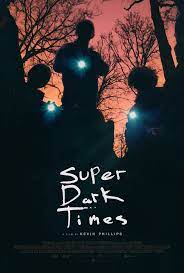
Super Dark Times (2017)

I’d heard Super Dark Times compared to Stand By Me, but it reminds me more of a much grimmer movie that came out the same year (1986), Tim Hunter’s River’s Edge.

Known primarily as a launching pad for a young Keanu Reeves, it also came with barking mad performances from Dennis Hopper and Crispin Glover.

All three movies speak volumes about adolescent friendships put under stress by the presence of a dead body.

The resemblance to Stand By Me seems deliberate. At first glance, Super Dark Times appears to take place in one of those Stephen King-like clouds of sunny nostalgia based some time in the 1990s.

Boys on their bicycles, clunky portable phones with Walkie Talkie antennas, and a TV appearance by Bill Clinton anchor us firmly in the appropriate decade, much like Donnie Darko’s sister declaring her intent to vote for Michael Dukakis.

Zach (Owen Campbell) and Josh (Charlie Tahan) are high school best buds whiling away their virgin years in a small rural town that looks Norman Rockwell on the surface, with a noticeable David Lynch underbelly.

Their lives are mostly innocent fun punctuated with declarations of impending boy horniness until a terrible mishap claims the life of Daryl (Max Talisman), a pain-in-the-ass acquaintance whom no one wanted to hang out with in the first place.

Everyone agrees it was an accident that led to Daryl’s bleeding to death, and the decision is quickly made to bury his stupid body and play dumb.

Indeed, it’s the day-to-day mundanity of the average teen that director Ken Phillips and writers Luke Piotrowski and Ben Collins, get exactly right, to the point where we actually care about Zach’s budding relationship with dream girl Allison (Elizabeth Cappucino).

However, this isn’t a John Hughes film, either. Zach cannot be redeemed by love and Josh loses his way entirely.

Once the closest of friends, Zach and Josh now view each other with increasing suspicion, that builds fiendishly low and slow.

Josh becomes angry and distant while Zach can’t sleep due to vivid nightmares about their dark deed.

The inability of friends to trust each other with a hideous secret dooms the relationship and leads to an unexpectedly bloody finale, one that slays any notion of Super Dark Times taking place in a benign Stephen King universe.

More like Dateline with Keith Morrison.

SDT is a superb, riveting thriller as well as a brutally harsh coming-of-age story, with young protagonists that have yet to develop a moral center.

Enthusiastic recommendation from this corner. I ate it up like Junior Mints.

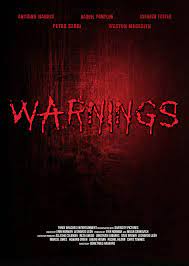
Warnings (2019)

Real estate is always a solid investment—unless you’re in a state where realtors needn’t disclose past tragic events, such as occupation by a sinister cult and lots of subsequent disappearances.

Like I said, a crap shoot.

Such is the case with Marcus (Antoine Harris) and Grace (Shannon Foster), who think they’ve found a perfect parcel of land near Ojai, California to set up a commercial cannabis operation.

To celebrate their new future as ganja growers, the couple invite friends Phillip (Peter Sabri), Dominic (Weston Meredith), and Patricia (Erlinda Navarro), down for a weekend of drinking games and exploring the property.

At first, guest and host alike have trouble sleeping. Patricia in particular is gripped by nightmares of bloodletting and dismemberment.

Meanwhile Phil and Dominic get into a lover’s quarrel, and Dominic storms off to find a signal for his phone. Never to be seen again.

Thanks to a gabby security officer, the group finds out that at least one ex-cult member (with cannibal tendencies) is still running around terrorizing the community.

Unfortunately, this is the kind of red flag that will cause most investors to bail out.

The maniac is a brawny dude, marginally scary, but nothing really paranormal happens until his victims rise from the grave seeking revenge.

Filmed on a micro budget by director Demetrius Navarro, Warnings isn’t a good movie, but it’s good enough if gruesome events taking place in a scenic location float your boat.

Let’s give it a C+.

Deadstream (2022)

Now that’s what I’m talking about!

As if to put an exclamation point on my earlier observation that internet adventurers are the new Red Shirts, along comes Deadstream, the Apocalypse Now of found footage horror.

Sean Ruddy (Joseph Winter) is an internet personality who stages dangerous stunts that also manage to be offensive, such as getting smuggled across the Mexican border in the trunk of a car.

After his latest spectacle goes horribly wrong, Ruddy hopes to apologize and move on, but his fans are deserting him in droves, peppering his inbox with destructive criticism.

Comments pop up throughout the movie acting as a sort of Greek chorus to the action, which is plentiful. Even as Sean battles all manner of paranormal entity, the comment string keeps up a barrage of fan posts that are funny, annoying, and even surprisingly useful.

Among my favorite comments: “Glad I’m not you,” “Better start praying,” and “Please sign this petition at Move.org so Sean will stop being be such a pussy.”

In order to atone for a bad call, Ruddy comes clean to his public about the one fear he’s never tackled—ghosts.

So, strapped with all the latest gear thanks to a sponsorship from an energy drink company, the repentant daredevil vows to spend a night in the most haunted house in America—that he can successfully break into without getting arrested.

The lion’s share of Deadstream originates from one of Sean’s cameras that are spread throughout Death House, the site of his viral vigil, or mounted on his person.

Admittedly, this is a long time to be looking up Sean’s nose, but writer-directors Joseph and Vanessa Winter reward our patience by throwing everything but the yeti at our fearful protagonist.

Sean spends an enchanted evening fending off angry spirits, misshapen freaks, and a hot girl named Chrissy (Melanie Stone) who wanders into the chaos.

Like the legendary Don Knotts in The Ghost and Mister Chicken, Joseph Winter delivers an unhinged scaredy-cat performance, that comes garnished with the best girlie shriek of man-terror I’ve heard in a minute.

As Sean Ruddy, a man who will do anything to please the ever-present and increasingly fickle comment string, Winter willfully throws himself into a thankless part, that of sacrificial lamb to his voracious followers.

Ruddy makes himself vulnerable to the dark forces of the house and to his followers. Will the truth set him free?

His unwavering commitment to see the project through drives Deadstream to thoughtful new frontiers that bear examining. For instance, shouldn’t everyone come equipped with a Stupid Things To Do spin board?

Simply in terms of pound-for-pound raw energy, and entertainment bang for the buck, Deadstream is a hot ticket.

I was a wee bit disappointed that the Winters decided to pay homage to Sam Raimi about three-fourths of the way through the film, precisely because they had managed to avoid doing so up to that point.

The Deadites must have a strong union.

Jamie Marks is Dead (2014)

“Adam, you don’t want a dead boy lurking around outside your house, trust me.”

Writer-director Carter Smith distinguishes himself mightily with Jamie Marks Is Dead, a ghost story about friendship and duty from beyond the grave.

Adam McCormick (Cameron Monaghan) is a high school cross country star who becomes curiously attached to the ghost of a murdered classmate, Jamie “Moonie” Marks (Noah Silver).

Marks’ body is found at the riverside by weird goth girl Grace Highsmith (Morgan Saylor), with whom Adam quickly becomes romantically involved. This development leads to the discovery of Marks’ ghost, still shivering and dressed in skivvies, skulking around Grace’s backyard.

“We all have a choice, Adam,” Grace tells him. “I choose not to see him.”

Driven by pity for Marks, a friendless boy routinely tormented by his fellow jocks, Adam vows to help the wayward spirit, giving him clothes and a place to live in his own closet.

Adam reaches out because he’s lonely, too. His own brother Aaron (Ryan Munzert) is a macho douchebag, while his trailer park mama (Liv Tyler) has chosen to share their home with Lucy, the drunk driver (Judy Greer) that put her in a wheelchair.

Adam affectionately nicknames her “the Paralyzer.”

At this point in the narrative, the viewer will surely make assumptions about Adam eventually being forced to disentangle himself from an increasingly needy spook. Smith, who adapted the novel One For Sorrow by Daniel Barzak, avoids the obvious track.

Instead, Adam atones for his callous indifference to the suffering of a fellow soul, by pledging emotional support to someone he never cared for in life.

The action takes place in another one of those blighted, boarded-up little towns that appear bereft of anything resembling empathy or compassion.

But sometimes humanity rises to the occasion.

Jamie Marks is Dead, is a fascinating, somber movie that will surprise a few people, thanks to an unexpectedly hopeful final act. One that allows for a smidgen of light into a 99 percent dreary reality.

My thanks to friend of the blog, Andre Hagestedt, for recommending it. You may want to thank him, too.