Animal Among Us (2019)

A very weird and cheap little film.

Animal Among Us kept me marginally enthralled through its entirety, and really, the best I can offer is that it’s weird and cheap, occasionally endearingly so, but mostly it’s a rolling mess.

Somewhere in the California wilderness lies Camp Merrymaker, a blighted spot that’s been closed for 15 years due to a couple kids getting mauled to death by a mysterious creature.

Anita Bishop (Larisa Oleynik) and her sister Poppy (Christine Donlon) are the cute caretakers of this forsaken forest community. They hope to reopen the ill-reputed summer camp with the help of Roland Baumgarner (Christian Oliver), the best-selling author who originally wrote about The Merrymaker Murderer case.

Editor’s Note: After the whole Friday The 13th debacle, why in God’s name would anyone with a grain of sense want to open a summer camp? Were they ever profitable? Just asking.

There’s a junk drawer of subplots spilling all over the place, and what starts out as Cat & Mouse with a monster in the woods, evolves into a revenge plot against the arrogant and faithless Baumgarner.

By no means is Animal Among Us compelling drama, but director John Woodruff and writer Jonathan Murphy pull a few rudimentary surprises out of an old, battered hat.

Their neatest cinematic trick is enlisting the talents of Christine Donlon as a sex-pot forest ranger, who seems to have wandered in from a steamy Cinemax thriller.

Donlon’s libidinous, unhinged performance works as an effective snare to the unaware, hopeful of bonus porn tableaux. (Cue saxophones)

And so the time passes.

Indeed, there is such a palpable sensation of delayed sexy time throughout, that the existence of a spicy director’s cut would surprise absolutely no one of this Earth.

With barely any gore and no actual nudity in the offing, Animal Among Us plays out like community theater Campground Gothic, as an evil, but determined family hangs on against all odds to preserve their vanishing way of life.

To be grudgingly honest, there is a smidgen of entertainment to be derived from witnessing this unstable combination of ludicrous script, wooden acting, and Craft Night special effects.

Keep your expectations as low as the budget and you’ll be fine.

Boar (2017)

Boar is an Aussie animal-attack flick about a small outback community of ranchers threatened by a gigantic, bloodthirsty pig.

Yes, I know it sounds like Razorback (1979). When the star of the movie is a massive swine, comparisons are inevitable.

For my money, writer-director Chris Sun accomplishes exactly what he sets out to do, namely, make an old-fashioned thriller about a giant critter on a rampage that racks up a hella high body count.

It helps greatly that cinematography and practical creature effects were areas of focus for Sun. He dexterously shuffles hog-o-vision POV stalking camera with flying tracking shots of victims trying to escape the oncoming Pork Chop Express in ways that maximize impending terror.

When poor Blue (Roger Ward) has to make a stand against the monstrous boar, the buildup is dizzying, with cameras swooping and circling around him like vultures.

The cast of familiar faces include John Jarratt (Wolf Creek) and Bill Moseley (The Devil’s Rejects) in non-maniac roles.

In fact, Jarratt, who played one of the most cruel and violent killers ever in Wolf Creek, is borderline heroic here. He risks his life, unarmed, to rescue some old-looking teenage campers who’ve pitched their tents in the pig’s path of destruction.

It’s a refreshingly uncharacteristic touch, in a movie that’s full of them. Another example is heroic hulk Bernie (Nathan Jones, think Jason Statham Down Under) launching into a gleeful rap-a-long of “Ice Ice Baby” that reminds me of Quint’s crew enjoying a song in Jaws—a timely comic moment shortly before the shit hits the fan.

There are a number of such moments in Boar, particularly in the beery banter between drinking buddies Ken (Jarratt) and Blue, who are forced to put down their Fosters and run for their lives.

Blue yells at Ken for not loading his rifle before they drunkenly embark on a midnight run to track the creature.

“Well, I never reckoned I’d run into a pig the size of a rhino out here!” Ken retorts.

The “out here” Ken refers to is the beautiful Mary Valley in Queensland, Australia, whose bucolic splendors are never less than gorgeous. Even while characters plan, plot, and panic over their porky predicament, the scenery remains a sparkling gem.

Taken as a whole, Boar isn’t a bore; there are too many good things going on to complain about the uneven pace or a few CGI pig shots that don’t cut it.

Your time invested will be paid off in quality entertainment. You’re welcome.

Choose Or Die (2022)

Video games are bad, ‘mkay?

Choose Or Die takes place in a slightly dystopian future that looks like the present, where our protagonist, Kayla (Iola Evans), ekes out a living cleaning clean offices every night, plus whatever she can scrounge by refurbishing obsolete technology.

During a visit with her friendly fence Isaac (Asa Butterfield), she discovers an old text-based video game from the 1980s called Curs>r that more than lives up to its name.

Isaac informs Kayla that there’s an unclaimed $100,000 prize that supposedly awaits the player worthy enough to win.

The bummer is that it’s a sentient game made with sorcerous runes that can take over reality, forcing the player to make impossible choices, usually having to decide which friend or family member gets maimed in grisly fashion.

Therein lies the tension in all its one-dimensional glory. Dig it, or don’t.

Choose Or Die gets a needed boost from actress Iola Evans, who invests Kayla with brains and bravery. Even with loved ones in constant peril, she keeps her focus while trying to hack the sinister system.

Writer-director Toby Meakins does an adequate job of creating a cold and confusing reality in which financially trapped citizens like Kayla engage in risky occult business in hopes of a prize that will rescue them from wretched poverty.

You know, like in The Hunger Games.

Though Kayla is a talented programmer, she can’t get her foot in the door anywhere, leaving her stuck with mindless labor as the only way to keep the drug-dealing landlord (Ryan Gage) from stringing out her junkie mom.

You should be entertained by the painful predicaments pondered in Choose Or Die, and you will definitely root for the plucky heroine. But it’s all pretty one-dimensional. Hopefully that’s enough.

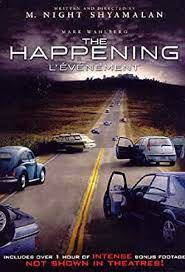
The Happening (2008)

And back for a return visit to the director’s chair is our ol’ pal M. Night Shyamalan! Hope he brought snacks.

The Happening is one of those Shyamalan features that feels very insubstantial, with an ending bound to elicit cries of “That’s it?”

Nigel Floyd from Time Out, summed it up thusly: “At first, a great deal happens, then nothing much happens for quite some time, then something so underwhelming happens that one is left wondering, ‘Did that really just happen?'”

It doesn’t help that stars Mark Wahlberg and Zooey Deschanel have precious little chemistry as Elliott and Alma Moore, a couple on the run from an unspecified menace.

Shyamalan can take some of the blame. His dialogue is so wooden you could build a raft out of it.

It could be argued, however, that MNS movies are seldom character studies in the traditional sense, but rather about subjects adapting to extreme situations.

In this case, the Moores, along with most of the eastern seaboard are fleeing from a mysterious ill wind that upon contact motivates humans to destroy themselves in gruesome fashion.

Fortunately, Elliott is a science teacher so he hypothesizes his head off, and figures out the virus is being produced by sentient plant life. Needless to say, the shrubs are pretty damn unhappy with our stewardship of the planet, and their intent is to pull a few weeds out of the garden.

Timing is everything in show business. The Happening wasn’t a commercial or critical success upon its release, but it certainly has more impact on an audience today, having collectively experienced the Covid-19 crisis and an ongoing pandemic.

Not only that, my allergies are killing me. I think MNS deserves credit for anticipating floral warfare.

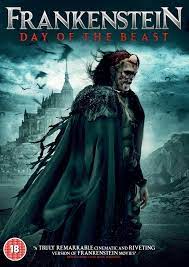
Frankenstein: Day Of The Beast (2011)

Frankenstein: Day Of The Beast is the low-budget shocker being watched by the doomed audience in The Last Matinee when the maniac (played by Ricardo Islas, the writer-director of this film) goes on his cinematic killing rampage.

Truth be told, I was intrigued enough by the footage to give it a shot, and it turned out to be worth the effort.

In this version of the Frankenstein tale, Victor Frankenstein (Adam Stephenson) has fled to a remote island to wed his beloved Elizabeth (Michelle Shields).

Victor has employed a squad of mercenaries to keep her safe, but the monster (Tim Krueger, who’s quite good) has promised his creator that he would appear on his wedding night to take her.

Islas stays fairly faithful to Mary Shelley’s source material, but departs from the template in significant ways. This incarnation of the Frankenstein Monster is pure evil, with no grey area. He kills in extravagantly brutal fashion, bifuracting one unlucky guard with intestines on full display. Another gets his spine removed, and a blind man is forced to swallow his own cane.

The monster also eats human flesh, so there’s that. Apparently mangling his victims wasn’t sufficient to inspire terror. This guy bites faces off and rips throats out with his teeth.

How downright monstrous!

As the title implies, Frankenstein: Day Of The Beast is a more elemental take on a familiar story, one that doesn’t hold back on the blood and guts, and allows no sympathy for the monster, who doesn’t speak, but occasionally laughs cruelly.

The aforementioned budget limitations show up in various forms, from flimsy sets to terrible acting by supporting characters, but Islas clearly understands what makes Frankenstein’s creation so damned frightening. He is a relentless enemy who can’t be destroyed.

So what are you gonna do? As the vengeful Mohawk says to Max in The Road Warrior, “You can run, but you can’t hide.”

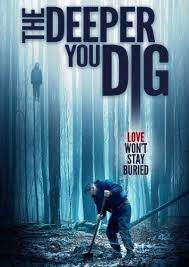
The Deeper You Dig (2019)

“Tell my mother what happened to me!”

“It was an accident!”

The admittedly tragic circumstance at the heart of The Deeper You Dig is indeed, an accident. What comes after is not. You would do well to pay attention.

Somewhere amidst the wintery rural recesses of upstate New York, Ivy Allen (Toby Poser) makes a living as a phony fortune teller, and apparently does well enough to support her 14-year-old daughter Echo (Zelda Adams), a sullen goth whose musical tastes include early 20th-century hit parade.

Just down the street, Kurt Miller (John Adams) is the new guy in town, fixing up a decrepit house in the hopes of a quick flip. This is all the setup we get before having to deal with a deadly event that traps all three characters into a single tense, tormented timeline.

Co-written and directed by Adams and Poser, and featuring their daughter, Zelda, The Deeper You Dig is a tight-as-a-drum domestic horror/occult revenge drama without an ounce of flab on it.

Kurt and Ivy’s parallel stories (him trying to escape a grim fate; her finding a missing daughter and rediscovering her gift), collide when Echo’s ghost comes a-haunting, effectively bedeviling Kurt by permanently fixing his radio to the Oldies Channel.

Meanwhile, Ivy interprets the signs left for her and finally makes direct contact with her daughter’s shade by mystical means.

The reunion scene in the forest, where Echo hovers above Ivy in the trees, is genuinely weird and otherworldly.

Major props to Toby Poser and John Adams (they even composed the screechy electronic score!) for concentrating not on their measly budget, but on inventing a dark and detailed world. Evildoers are not only punished here, they are recycled, reused, and renewed.

Fewer carbon footprints is a good thing.

Till Death (2021)

We’ve all had one of those nights. Maybe not quite as bad as the one in Till Death, but you know what I mean.

After an evening of sweet lovemaking at their secluded lake house, Emma (Megan Fox) awakens handcuffed to her very dead, attorney husband Mark (Eoin Macken).

As if this wasn’t enough of a predicament, the same thug (Callan Mulvey) that stabbed her during a robbery years before, is apparently dropping by to finish the job.

The vast majority of Till Death‘s running time tracks Emma’s excruciating adventures as she slides awkwardly into survival mode, with her late hubby serving as a constant ball and chain.

Director SK Dale and writer Jason Carvey make things rough on poor Emma, who proves to be more resilient than a powerful man’s trophy wife should be.

Tellingly, of all the items she has at her disposal, it’s Emma’s wedding dress that serves her best, both as bandage material, and as a travois for hauling a stiffening corpse around the frozen countryside.

Till Death works as a teeth-grinding thriller and as a visceral metaphor for the honeymoon being over in a big way. It’s in darkly comic top form when all the desperate parties are present and the cards are on the table—the same one Emma attempts to turn on her would-be assailants.

She was not a good wife. But Emma refuses to go down with the sinking matrimonial ship.

Lucky for her, she got custody of the survival instincts.

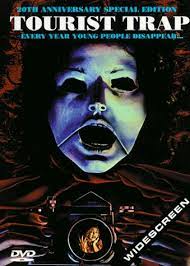
Tourist Trap (1979)

It’s always a trip to catch a TV icon in a weird little genre film. In the case of Tourist Trap, we’re fortunate to observe The Rifleman himself, Chuck Connors, chewing the scenery as the deranged proprietor of a roadside museum called Slauson’s Lost Oasis.

Written and directed by David Schmoeller (Puppet Master, Crawlspace), Tourist Trap begins with car trouble on a lonely road for five young adults (20? 30?) who are “rescued” from the elements by Slauson (Connors), an overall-clad rube who once ran a profitable frontier wax museum in the area.

Sadly, the new highway choked off the customer flow to Lost Oasis, so now it’s just Slauson and a house full of mannequins that occasionally come to life and scream their displeasure.

The victims, including future Charlie’s Angel Tonya Roberts, wisely decide to go explore the creepy manor house one at a time so they can be easily captured by Slauson (or his masked transvestite brother) and converted into shaking mannequins.

So lifelike! Such realistic skin.

In what may be a case of gilding the lily, Slauson also has telekinetic abilities that he uses to shake things up and kill people remotely when his presence is required elsewhere.

Now that’s multitasking!

To his credit, Connors is marvelous as a really kooky dude who misses his wife and his livelihood. He’s not quite as over-the-top batshit as Rory Calhoun in Motel Hell, but he constantly introduces new facets to Slauson’s madness, creating a more well-rounded maniac.

I believe Tourist Trap was remade in 2005 as House Of Wax, a vehicle for the thespian talents of Paris Hilton. There’s less blood in the original, but it’s way wackier.

Vintage weird that’s worth the search.

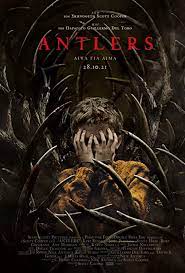
Antlers (2021)

“It all makes sense, you see. I mean, our ancestral spirits never died. They were here long before we were, and they’ll be here long after we’re gone. But now, they’re angry.”

Dark times call for dark movies. Antlers is a coal mine at midnight.

The opening observation comes from Warren Stokes (Graham Greene), the former sheriff of Cispus Falls, a blighted Oregon town where mutilated citizens are appearing with alarming frequency.

The current sheriff, Paul Meadows (Jesse Plemons), is seeking counsel. He’s out of his depth and confused, hypothesizing a cougar or bear attack is responsible for the mayhem.

Meanwhile, Paul’s schoolmarm sister Julia (Keri Russell) is trying to figure out why her sullen student Lucas (Jeremy T. Thomas) is drawing pictures of demons and monsters.

In Antlers, all the dots connect to the decline of the planet’s structural integrity. Our systematic “pillaging of Mother Earth” has opened the door to indigenous spirits, most notably the Wendigo, a voracious cannibal that inhabits evil men.

Just below the narrative surface of this riveting supernatural thriller lurks mounting evidence of an infected society that has no access to spiritual vaccine.

Cispus Falls is a moribund mining town, an urban landscape littered with old machinery and empty storefronts, where the only thriving business is meth production.

Deep-rooted trauma is the norm. Julia, a recovering alcoholic with her own childhood of parental abuse, eyes liquor bottles at the store with palpable longing, searching for strength and comfort from any source.

In the background, the news drones on about the opioid epidemic, failing industries, and environmental collapse.

Kerri Russell owns her role as a damaged, unhappy woman who realizes her altruistic motives for helping Lucas are likely futile, but it’s marginally better than giving in to the despair that runs deep in these parts.

She recognizes the telltale signs of abuse in Lucas’s haunted face, a reflection of a home life that is literally hellish. He is a child doomed to maintaining the monstrous status quo at his house, while his younger brother Aidan (Sawyer Jones) is held captive by something that used to be their meth-cooking father (Scott Haze).

The thing Lucas calls “New Dad” is growing increasingly hungry and his grocery list requires fresh meat.

“Is God really dead?” Aidan asks Lucas. “Daddy said God is dead.”

Director Scott Cooper, working alongside executive producer/malevolent maestro Guillermo del Toro, has constructed a thoroughly ravaged world with precious little light—one that is bone-chillingly familiar.

Hey, isn’t that our civilization crumbling?

There are moments of brain-freezing terror in Antlers, including horned creature craft with genuine nightmare potential, a del Toro calling card.

Yet it’s the overall tone that proves the most unsettling factor, because it presents a terminally ill worldview, a pandemic of the soul that never ends.

There may be small victories to be had, individuals worth saving, but the inescapable conclusion is that humanity is fighting a losing battle with havoc we’ve wrought on ourselves.

In nearly every scene, Julia and Paul (the good guys) are stymied by inadequacy and failure. The coroner is apologetic because he can’t explain how the victims were killed. A doctor is unable to predict if a patient will recover. The harried school principal (Amy Madigan) tells Julia she isn’t allowed to intervene on a student’s behalf.

Even Paul admits he was reluctant to take the sheriff’s job, which mainly consists of evicting local homeowners.

“Everyone thinks these problems are just going to go away, and we know that they don’t,” Julia tells him. She could be referring to any number of societal symptoms depicted in Antlers.

The wound runs too deep, there’s no saving this patient. The downward spiral is well under way and no one’s getting off.

Hope you like it bleak.

Old (2021)

We’ve discussed M. Night Shyamalan’s work here before, and true to form, his new feature, Old has elicited sharply mixed reviews. Rotten Tomatoes has them squarely at 50 percent favorable.

Siting precarious fantasies such as The Village, The Happening, and Lady in the Water, fanboys and critics alike have pummeled the acclaimed genre director with charges of proffering half-baked, preposterous plots that don’t pay off. MNS routinely gets written up for Twilight Zone endings more befitting the small screen rather than a theatrical feature.

Stylistic quibbles aside, MNS is and always has been an artful storyteller, and in Old he delivers another dark fable, this time about a family’s vacation to a tropical resort that turns tourists into unwilling test subjects.

Having adapted the French graphic novel Sandcastle, Shyamalan fades in on a European household on holiday, comprised of Guy (Gael Garcia Bernal), wife Prisca (Vicky Krieps), daughter Maddox (Alexa Swinton), and son Trent (Nolan River).

Along with a few other hotel guests, Guy’s group is bundled off to enjoy an afternoon of food and frolic at a secluded beach of postcard quality. Everything seems serene and wondrous, but time gets away from these blissful beachcombers, and they start aging in fast-forward.

The lion’s share of Old is spent with the unfortunate tourists as they try every method at their disposal to leave the beach, with very little success. Kids grow up. Young adults get old. Old adults get older and die.

Trent, a curious and open-minded lad, is soon replaced by successively older actors, but continues to try and puzzle out their predicament. He takes a quick time out to father a child with another guest on a similar biological clock, yet he remains committed to the task of liberating his loved ones.

Shyamalan gets credit for covering a lot of ground here, gracefully transitioning from drama, to horror, to deep questions about the ethics of scientific research.

Of course, we also get plenty of sentimental Mom and Pop moments to remind us that time slips away quickly so be sure to tell everyone you love that, blah, blah, blah.

In this fashion, MNS has always been able to have his cake and eat it, too. By combining humanity’s plight with forces at work beyond our comprehension, we are forced to consider perspectives other than our own.

Visually, Shyamalan continually disorients the viewer by having characters wake up in a daze and seeing familiar looking, but different people standing around them. Who are they?

A sunny, postcard beach isn’t supposed to this sinister, right?

This ambiguity provides the dark current that will keep you watching. It’s just like in real life, but in Old, we can feel the time passing. And it hurts like hell.