
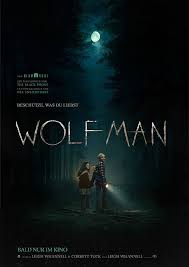
The most impressive thing about Leigh Whannell’s Wolf Man is that it got made.
Whannell, the Australian horror maestro who introduced us to the Saw and Insidious franchises, clearly has serious show biz clout to get this turkey green-lighted.
This was obviously a “troubled” production.
Blake (Christopher Abbott) is a stay-at-home dad married to busy magazine writer Charlotte (Julia Garner). While Charlotte earns bucks, Blake looks after their daughter Ginger (Matilda Firth), until he’s notified that his father Grady (Sam Jaeger) has been declared officially dead, after being reported missing for several years.
Now the owner of the family farm, Blake drags his dubious brood out to the Middle of Nowhere, and in real time they are attacked by a strange creature (see the film’s title), and spend the evening running and hiding from same.
Meanwhile, Blake, the dutiful husband and father, begins to change into something remarkably similar to the beast that’s stalking them.
Wow. Didn’t see that one coming.
There is little dialogue, which lends itself to Mystery Science Theater ad-libbing during the howlingly bad action sequences, such as Blake gnawing on his own arm, and two guys in simian rubber masks wrestling on a dark floor.
What are we watching?
Wolf Man is simply godawful, and since Whannell directed and cowrote this mess, he gets the lion’s share of the blame.
It’s a complete waste of Julia Garner’s talents, and hopefully won’t interfere with her trajectory as one of Hollywood’s best young actresses. She’s given very little to do besides wander through the night with a flashlight.
I’ve said this before when reviewing werewolf movies and it certainly applies to Wolf Man: If you can’t come up with better transformation effects than The Howling or American Werewolf In London—both of which were made 43 years ago!—then don’t bother.

 horrificflicks.com
You must be logged in to post a comment.