The Angry Black Girl and Her Monster (2023)

This creature has life! But what kind?

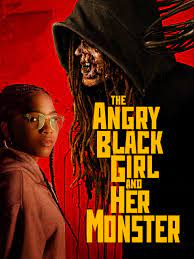
The Angry Black Girl and Her Monster is a powerhouse debut written and directed by USC film school grad, Bomani J. Story.

In another cross-stitching of Mary Shelley’s well-seasoned source material, we fade in on Vicaria (Laya DeLeon Hayes), a budding teen scientist from the ‘hood who’s just lost her older brother Chris (Edem Atsu-Swanzy) in a gang shooting.

Rather than grieve and move on, Vicaria decides to take matters into her own hands and bring him back from beyond. From her jerry-rigged laboratory in a condemned building she summons sufficient wattage to jolt Chris back to consciousness.

Oddly enough, her creation largely disappears into the woodwork, because Vicaria has plenty of other shit to deal with, namely working off a debt to Kango (Denzel Whittaker), the local drug lord that keeps her poor father (Chad C. Coleman) strung out.

The monster’s presence is often felt, particularly by Jada (Amani Summer), a chatty, precocious neighbor kid who seems quite up-to-date on its whereabouts.

Writer-director Story has fashioned a curious creature, the likes of which we haven’t seen before. While some plot developments don’t make much sense (e.g., Vicaria seems awfully into Kango, the guy who deals to her daddy), the look and feel of The Angry Black Girl and Her Monster pulses with an otherworldly glow and a fresh current of rage, not to mention a towering title character prowling the night in designer streetwear seeking revenge.

Or maybe he’s just looking for his home. In any event, he kills people.

Vicaria is the electricity that animates this action, and actress Laya DeLeon Hayes delivers high drama with a cool head. Here is a young woman that’s seen enough death for one lifetime—and does something about it, despite the endless obstacles placed in her path by institutional racism, classism, and sexism.

And if at first you don’t succeed in defeating death, try, try again, because hope springs eternal and shit.

The Tank (2023)

Tanks for nothing.

The Tank fails to capitalize on a perfectly serviceable premise reminiscent of H.P. Lovecraft’s The Shuttered Room, in which a financially strapped family inherits a long-abandoned property on the Oregon coast. (Actually filmed in New Zealand!)

Conveniently set in the 1970s (no cellphones, duh), The Tank dutifully introduces us to Ben (Matt Whelan) and his wife Jules (Luciane Buchanan), a young couple eking out a living as co-owners of a pet shop.

One day a lawyer arrives with a mysterious deed to a mysterious house that Ben’s mysterious mother (a madwoman) had in her possession, and without further prompting, Ben and Jules pack up their daughter Reia (Zara Nausbaum) and the family dog (who doesn’t die) and split for the new beach house.

Writer-director Scott Walker does an okay job of placing his protagonists in a suitably eerie environment, but there isn’t much going on for the first hour of the film, and frankly it’s not worth the time investment spent waiting for a little action.

What follows are approximately 46 scenes of Ben and Jules wandering about their property in the dark with only lanterns to the light the way, and they mostly add up to zilch. All manner of growls, grunts, and groans are investigated but nothing turns up and everyone goes back to sleep.

Finally, some flesh-eating salamanders materialize in the water tank beneath the house and make their presence known by mauling a couple of secondary characters.

The salamanders have no eyes, so that’s a bit creepy.

Where did they come from? Are they monsters? Did they kill Ben’s father and sister? Most of these mysterious queries remain unanswered, so be prepared for the bitter taste of disappointment upon conclusion of The Tank, because it will not inspire much joy—other than the dog’s survival.

Alligator 2: The Mutation (1991)

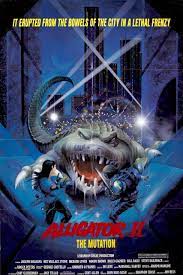
Eleven years after Joe Dante and John Sayles delivered one of the best giant critter movies ever, the not-as-good (but not bad!) sequel, Alligator 2: The Mutation shows up.

It lacks the satirical bite of its predecessor, but the plot is a carbon copy of Alligator, with a smattering of Jaws, once again pitting a wise-cracking cop against a reptilian nightmare lurking in the city sewer system.

Speaking of cities, A2 is filmed in Echo Park dressed up to look like a small town where everyone knows each other. Here, local Latino families are threatened by an evil developer (Steve Railsback) with a lot of toxic waste to unload.

David Hodges (Joseph Bologna) is the detective in charge of the mutilated bodies that start piling up, and he’s beset on all sides by difficult choices, not made any easier by the fact that his scientist wife Christine (Dee Wallace Stone) wants him to quit smoking for his birthday.

Taking another page from the original movie, Vinnie Brown (Railsback), the black-hearted villain of our story, hires comic-relief hunters, led by Hawk Hawkins (Richard Lynch, in a scene-chewing special) as a Cajun gator-getter flanked by a brood of gun-toting rednecks.

Good old Major Healy, Bill Daily, is on hand as the spineless mayor, and veteran faces like Wallace, Brock Peters, and Kane Hodder add some seasoning to the soup.

It’s a fun flick, but Alligator 2: The Mutation can’t duplicate the depth and daring of the first film, which is what happens when you replace director Joe Dante with Jon Hess, and screenwriter John Sayles with Curt Allen.

The practical effects depicting gore and gator mayhem aren’t nearly as good as the first movie, released a decade earlier. Fluctuating gator size doesn’t help. Come on people! Keep up with technology!

In the final reckoning, it checks a bunch of boxes, and you’ll have a decent time chuckling at all the ridiculous hair-dos and don’ts, and occasional cheese-metal anthems.

Gonjiam: Haunted Asylum (2018)

Hey, we’ve got a package on the porch! Were you expecting scary shit from South Korea?

Gonjiam: Haunted Asylum is an international entry in the found-footage genre, directed by Jung Bum-shik, and it follows a team of horror vloggers live-streaming from an abandoned insane asylum with a sinister reputation.

Based on a real location that CNN Travel dubbed “One of the 7 Freakiest Places on the Planet,” it’s rumored that the former director of Gonjiam Asylum killed all of her patients and then hung herself.

Team captain Ha-joon (Wi Ha-joon) sets up a video control room outside the asylum while his camera-toting crew of three men and three women explore the premises, agreeing to meet up outside the mysterious Room 402, that has never been opened.

Ha-joon hopes that by securing one million views, he and his team will receive a ton of advertising revenue and enjoy the fame and fortune of being paranormal VIPs.

Needless to say, there is no happy ending in the offing. Gonjiam is gorged with ghosts apparently still in thrall to the former director, an evil woman who loves nothing more than a friendly game of ping pong.

Director Jung Bum-shik nurtures tension like a mad nanny and reveals plot twists with precision timing for maximum impact. The imperiled explorers manage to be distinctive without being a bunch of cliches, and the chaotic camera work is handled with extreme dexterity.

The breakdown of the group dynamic is inevitable in Gonjiam: Haunted Asylum. No state-of-the-art gadgetry or high-tech surveillance gear can protect the mind from fear once it’s taken hold.

And if you happen to be in one of CNN’s Freakiest Places on the Planet, it can be a lethal combination. Recommended!

Why aren’t you watching it already?

Leaving D.C. (2012)

Welcome to another edition of I Should Have Stayed In the City.

In Leaving D.C., a surprisingly anxiety inducing found-footage thriller, writer-director Josh Criss stars as Mark Klein, a 20-year veteran of working like a donkey as a technical writer in our nation’s capitol.

After achieving some measure of financial independence, Mark buys his “dream house” that comes with 17 acres of land—smack dab in the middle of Nowhere, West Virginia.

To chart his return to nature, Mark sends video updates to the members of his OCD support group back in Washington. These start out in relatively benign fashion, but it soon becomes apparent that our humble narrator is obsessed with the idea that he’s not alone in this remote wilderness.

Every night at a little after three in the morning, some form of disturbance takes place that causes the already anxious Mark Klein to devolve into a nervous wreck, despite the fact that he’s installed a state-of-the-art security system and even bought a handgun.

As an OCD sufferer myself, I found Mark’s slippery slope into extreme agitation a comically familiar one, as rational thinking is replaced with desperation and poor decision making.

The weirdest manifestation Mark has to deal with is flute playing right outside his window. In the middle of the woods. Miles from his nearest neighbor.

That would be enough for me to abandon ship, but Mark digs in his heels.

I don’t think I’m spoiling anything when I reveal that our man Mark is not up to the task of solving this mystery.

Instead, it solves him.

We are enthusiastically recommending Leaving D.C., and let it be a lesson to you.

Bodies, Bodies, Bodies (2022)

You think you know who your friends are? Would you bet your life on it?

Certainly the most frightening aspect of director Halina Reijn’s Bodies, Bodies, Bodies is that every relationship in a movie about lifelong friends under pressure is so damn fragile.

Or in some cases, nonexistent.

Sophie (Amandla Stenberg) is bringing her new girlfriend Bee (Maria Bakalova) to a magnificent mansion owned by the family of her best friend, Dave (Pete Davidson).

So there’s a hurricane brewing and a bunch of Richie Rich kids have the run of a big house. What could go wrong?

Everything!

While playing a game of Bodies, Bodies, Bodies, in which someone “kills” people in the dark, and the remaining players have to figure out whodunnit, Dave the host turns up with his throat cut.

There are seven remaining party guests—including one who isn’t present for most of the movie—and all it takes is one grisly corpse and abundant cocaine for a bunch of 20-somethings to turn on each other like rabid rats.

Outside a storm is raging. Inside, there are accusations, confessions, and pleas for mercy, followed by the thunk of more bodies hitting the floor.

The zeal with which these “friends” tear into each other could be blamed on the nose candy, but inevitably comes back around to the most obvious conclusion. Nobody knows anybody. Not that well.

If you’re just too ADD for Agatha Christie, Bodies, Bodies, Bodies should keep you guessing to the end, or at least till something shinier comes along.

Influencer (2022)

Oh, what a web she weaves.

With Influencer, writer-director Kurtis David Harder (Spiral) successfully binds dazzling visual elements with an intricately plotted story that just keeps twisting.

Madison (Emily Tennant), a beautiful travel blogger and media influencer, is unhappily flying solo on a backpacking trip through Thailand, when she meets CW (Cassandra Naud), a free-spirited adventurer who offers to show her around.

The mysterious CW is the polar opposite of pale blonde Madison, most notably due to a prominent birthmark on her face, though she too is unmistakably attractive.

The new-found friends explore the intoxicatingly exotic landscape until CW shockingly abandons Madison on an island with no food or water, and assumes her identity.

We learn that CW’s diabolical modus operandi has been used before, and spend the majority of Influencer riding shotgun with an extremely complicated woman with an apparent ax to grind against alluring travel bloggers.

The tone throughout reminded me of Patricia Highsmith, the author of Strangers on a Train and The Talented Mr. Ripley, novels about unlikely and conflicted villains marching to their own drummers.

Cassandra Naud, an actress with an actual facial birthmark, absolutely owns Influencer as an often inscrutable psychopath with ninja Photoshop skills. We might even discover a wee sliver of empathy for CW, a testament to the multiple layers of nuance that Naud brings to every scene.

Quick-thinking and resourcefulness are usually attributes we admire in a leading character. Is it unthinkable that it’s a Bad Guy (Gal)?

Recommended with no reservations.

Forest of Death (2023)

I have to admire the moxie of writer-director Brendan Rudnicki—aka, President and CEO of DBS Films—who doesn’t let little things like money get in the way of quick-hitting horror films like Forest of Death.

Weighing in at a lean 75 minutes, Rudnicki wastes no time with story arc, motivation, or any of that other fancy pants nonsense. It’s two basic-cable couples playing drinking games in the woods with a skinwalker/shapeshifter haunting the vicinity.

Despite a predictable premise and a shortage of dramatic talent, there are moments in Forest of Death where the total is greater than the sum of its cheapo parts, and Rudnicki makes his crude puppet show dance and caper.

Make no mistake, this movie doesn’t dawdle, placing the protagonists in danger within 10 minutes of the opening credits. Even so, Rudnicki feels confident enough to include two cheerful, upbeat musical interludes of his nondescript characters enjoying a few rousing rounds of gin rummy.

There is very little creature action, since the evil spirit can assume any form, which is another handy budget-saving device employed by the resourceful Rudnicki.

Once the skinwalker has infiltrated the cabin, it’s only a matter of time before the dominos start falling, and friends turn on each other. The question each viewer must answer for themselves is how much nutritional value can be derived from such a thoroughly chewed bone?

When there’s no meat, you make soup. Forest of Death is strictly warmed-over leftovers.

I was passably entertained, but no one will be blown away by loads of fresh ideas. As a resumé builder for Brendan Rudnicki, though, it’s a statement of purpose.

Ariel Phenomenon (2022)

Forgive me for straying somewhat far afield from my usual cadre of killers and creatures, on behalf of Ariel Phenomenon, a riveting BBC documentary by Randall Nickerson. To be honest, I feel I’d be forsaking my curatorial responsibilities if I were to ignore what might be the most important film of all time.

If you believe the testimony from the dozens of Zimbabwean schoolchildren, who reported contact with an alien craft and its strange crew, then you have no choice but to accept the idea that we definitely aren’t alone in the universe.

Shouldn’t be difficult if you grew up with Star Trek.

The incident took place in 1994, at a parochial learning center in rural Zimbabwe called Ariel School. As many as 60 students on recess witnessed the appearance of a large silver saucer in the jungle brush near their playground.

The vessel was guarded by small men, with large almond-shaped eyes, dressed in skintight black material. Though the encounter couldn’t have taken more than 15 minutes, some of the schoolchildren claim to have communicated telepathically with one of the aliens.

The kids, mostly between the ages of six and twelve, were asked to draw pictures of what they saw, with the resultant artwork revealing an unnerving consistency.

All this might have gone unnoticed, but a BBC reporter named Tim Leach got wind of the story, leading to the arrival in Zimbabwe of Dr. John Mack, a Pulitzer Prize winning psychiatrist from Harvard, who agreed to interview several of the children.

His findings? These children are telling the truth.

Consider those implications, why dontcha?

Through an abundance of documentation connected to the incident and investigation, director Nickerson presents a provocative picture of a society (just 20-odd years ago) that isn’t ready to consider the possibility of extraterrestrial contact.

Dr. Mack became a punchline for media pundits, portraying the noted scientist as a crackpot who believes in little green men. As a result of the controversy stirred up by Mack’s conclusions, Harvard publicly withdrew its support for his research.

Mack authored a book on the subject in 1999, Passport to the Cosmos: Human Transformation and Alien Encounters.

As for the students themselves, we see them interviewed in historical footage with Dr. Mack and then again later as adults, still unshaken in their conviction that something unique and wonderful happened to them.

In the end, Ariel Phenomenon makes a compelling case for visitors from outer space. And just like Star Trek, where the Vulcans come to Earth and wisely advise us not to annihilate each other, these travelers bear a message about human devotion to technology.

With Artificial Intelligence knocking on our door, we’d best pay attention.

Scary Stories to Tell in the Dark (2019)

“Stories hurt. Stories heal.”

Folklorist Alvin Schwartz is the author of the source material for Scary Stories to Tell in the Dark, but in the fertile hands of director Andre Ovredal (Trollhunter) and producer Guillermo del Toro, these words not only spring to life, they chase us down a long dark hallway.

With the 1968 presidential election of Richard Nixon serving as an ominous backdrop, we are invited into the picturesque community of Mill Valley, Pennsylvania, where Halloween is in full swing.

Stella (Zoe Margaret Colletti), a fan of horror movies and a burgeoning writer, is putting the finishing touches on her witch costume in preparation for an evening out with Auggie (Gabriel Rush), and Chuck (Austin Zajur), her two doofus friends.

In short order, they manage to piss off Tommy Milner (Austin Abrams), the town bully, and he and his goon buddies chase the luckless teens into a drive-in showing Night of the Living Dead. There, they take refuge in a car belonging to Ramon (Michael Garza), a stranger in town, who coincidentally is also on the run.

With Ramon in tow, Stella and her friends decide to explore the Bellows Mansion, the local haunted house of mystery, and in doing so, release the spirit of Sarah Bellows, a raging ghost bent on revenge.

While the connecting narrative of Scary Stories to Tell in the Dark is an increasingly familiar page torn from Ray Bradbury, Stephen King, Stranger Things, etc, the monsters conceived by del Toro and Ovredal bring the zing to this production.

The Fat Lady, Harold the Scarecrow, the Jangly Man, and the Big Toe Zombie are the stuff of newer, fresher nightmares, elbowing aside worn-out boogeyman templates that neither frighten nor satisfy.

Scary Stories to Tell in the Dark also ends in such a way that a second film is practically required so Stella can rescue Auggie and Chuck. I only hope that the sequel is likewise handled by del Toro and Overdal, who are perfectly suited to the task.

In case my review is too ambiguous, I heartily recommend Scary Stories to Tell in the Dark, now and in the future.