Shining Vale (2022-23)

When I was a wee sprout, and the family hive mind turned to televisual entertainment options, I invariably lobbied for something “scary” or something “funny.”

My conservative-leaning, middle-class family would not have tolerated a moment of Shining Vale, and, truth be told, most of the adult humor would have been lost on me.

Shining Vale ran for two seasons on Starz, and was created by Jeff Astrof (The New Adventures of Old Christine, S#!* My Dad Says) and Sharon Horgan (Catastrophe, Bad Sisters). Over the course of 16 half-hour episodes, we get cozy with the Phelps family, possibly the most dysfunctional brood since the Bundys showed up on Fox in 1987.

Pat Phelps (Courteney Cox) is in a dark place. She wrote a tawdry, best-selling lady porn novel 14 years before, but the follow-up hasn’t been forthcoming, and her agent Kam (Merrin Dungey) is giving her an ultimatum: deliver the book or return the advance money.

When Pat has a torrid affair with a handyman, her stubbornly optimistic husband Terry (Greg Kinnear) packs the whole family off to a huge haunted house in rural Connecticut for a fresh start, much to the dismay of teenaged daughter Gaynor (Gus Birney).

“Mom boned some rando and now we have to move,” she grumbles. Though a freewheeling sexpot herself, Gaynor becomes the unwilling head of the household, after Mom and Dad lose their marbles.

Her younger brother Jake, a plus-sized introvert, is mostly concerned with gaining levels in his Virtual Reality game, and is slow to realize that change is afoot.

“Why did we move to a hotel?” he asks, upon arrival at the dilapidated Victorian mansion they will now call home.

Jake is also the butt of (fairly benign) fat kid jokes, but gets comic revenge by farting most foul at the worst possible moments. Seemingly an innocent, he gets his own demon adversary courtesy of VR.

Once the family is settled, Pat makes instant contact with the spirit of Rosemary (Mira Sorvino), the former owner of the house who went mad and hacked up her own family with an axe.

Rosemary does a little ghost-writing on Pat’s unfinished manuscript, and an uneasy partnership is formed when Kam digs the new, darker direction the book is taking.

This is all just tip of the iceberg stuff, as Pat, Terry, and the kids go through individual transformations of various magnitudes, while dealing with ghosts, cults, demonic possession, hereditary mental illness, and infidelity in a weird little town that features homegrown businesses like The Lucky Wiccan.

As for the title of the series, yes, there are many references to The Shining. For crying out loud, it’s about a writer trying her best not to chop everyone up with an axe.

For my money, Shining Vale is the funniest and finest-written domestic horror series since The Addams Family. The cast is flawless. You’re welcome.

But what happened to Season 3?
The Fields (2011)

Image

Cloris Leachman (April 30, 1926–January 27, 2021) is beyond awesome.

Maybe you remember her Academy Award-winning turn as the neglected wife of a high school football coach in The Last Picture Show. Or the time she won an Emmy for her portrayal of Mary Tyler Moore’s nosy neighbor, Phyllis.

How about the two Emmys she took home as the weirdest granny of all time in Malcolm in the Middle?

Hell, she was Frau Blucher (*horse whinnies*) in Young Frankenstein! In her twilight years guested on American Gods and Dancing with the Stars! Let’s see you do that.

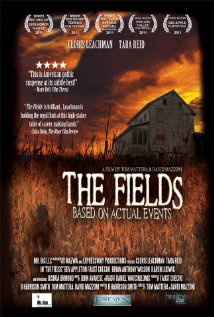
At age 85, she’s the best thing about The Fields, an eerie slow-burner co-directed by Tom Mattera and Dave Mazzoni.

Based on an actual occurrence from writer Harrison Smith’s childhood, the movie is set in 1973, and follows Steven (Joshua Ormond)—an angelic kid with hair like Robert Plant—who gets shipped off to live with his grandparents in rural Pennsylvania, after he witnesses Dad (Faust Checho) pointing a rifle at Mom’s (Tara Reid in a wig) noggin.

Enter Grandma Gladys (Leachmen) and Grandpa Hiney (Bev Appleton), who welcome the lad to their decrepit farm, surrounded on three sides by enormous (and dead) cornfields. Gladys tells young Steven to avoid the fields.

“We’ll never find ya in there, at least not till you’re all black and swollen,” she warns. Kids never listen.

On the other side of the cornfields is an abandoned amusement park currently occupied by a cult of evil hippie girls. Next door there’s a milk farm where Eugene (Louis Morabito), a dead ringer for Manson, works as a hired hand. Slowly, and with the inevitability of a bad dream, Little Steven finds himself surrounded on all sides by sinister forces.

If The Fields had just a smidgen more action or more beefy scares, I would be shouting my praises from the rooftops. As it stands, it’s a very watchable feature with an assortment of haunting touches.

Directors Mattera and Mazzoni capture the dread of being a child in an unfamiliar environment and without parents to explain life’s little mysteries: For instance, why is there a dead girl in the cornfield, and how come my cousins are all deformed lunatics?

And through it all, there’s Steven’s protector, Cloris Leachman, as a foul-mouthed, chain-smoking matriarch who likes to watch horror movies. The Fields is planted on her firm foundation.

Rubber (2010)

MV5BMTU2Nzg2NDQ2Nl5BMl5BanBnXkFtZTcwMDk5MjMzNA@@._V1_SX214_

Oh, France! What a nation of jolly, irreverent provocateurs you are! Why did writer/director Quentin Dupieux make a “horror” movie about a sentient car tire with terrifying telekinetic powers? As Lieutenant Chad (Steve Spinella) says many times during the film’s introduction, “No reason.”

In the middle of desert nowhere, a tire comes to life and uses its psychic ability to make heads explode. Nearby, an audience of nitwits watches the action through binoculars. The tire becomes obsessed with a beautiful woman (Roxane Mezquida) in a Volkswagen and trails her to a decrepit motel.

To his credit, Dupieux has made a marvelously intricate and witty movie that poses a passel of burning questions to its audience. (That would be you and me. The audience with the binoculars has been poisoned with bad turkey—except for the guy in the wheelchair played  by Wings Hauser.) It would be easy to dismiss Rubber as absurdist twaddle with a side of pretension, but it’s filmed so cunningly through low-angle cameras that roll us right along with the murderous tire, that it becomes a brutally hypnotic experience. And by then, it’s too late.

Unlike similar exercises in reflexive filmmaking by Dupieux’s highbrow cinematic forebears (Godard and Wenders come to mind), Rubber maintains a much-needed sense of its own playfulness that keeps the whole business from sinking under the weight of its concept.

Even while some of the characters ponder the reality of the situation as if they were in a staged reading of Rosencrantz and Guildenstern Are Dead, Dupieux seems to be more interested in why we’re still watching this nonsense. You see, Monsieur Director, as nonsense goes, Rubber is hard to ignore. Will there be a sequel with the tricycle?