Hush (2016)

Tonight! The War Between the Sexes! Right here on Pay Per View! Let’s give it up for Hush!

Writer-director Mike Flanagan (Haunting of Hill House, Fall of the House of Usher, Midnight Mass, Oculus) and his wife, writer-actress Kate Siegel constructed this lean, mean thriller about a deaf-mute author fighting for her life against a sadistic killer.

Hush also makes sense as an anxiety inducing metaphor about unwanted male attention, as Maddie Young (Siegel), a best-selling author, can’t even have a reasonable expectation of privacy IN THE MIDDLE OF A FRIGGIN’ FOREST!

Maddie lives in a nice house (with lots of doors and windows) somewhere in the deep woods. A bout with meningitis at age 13 has left her without speech and hearing, but she has a crafty writer’s brain that never stops ticking, as we squeamishly witness her reviewing potential escape options that never materialize.

The plucky scribe finds herself trapped in her bucolic hacienda by a masked madman (John Gallagher Jr) with a crossbow, who just recently finished an evisceration job on Maddie’s neighbor (Samantha Sloyan).

Who? Why? Not important. Perhaps Cupid’s in a real bad mood today. Flanagan and Siegel play the cat-mouse game to the hilt, which usually ends up plunging into someone’s neck or torso.

Nosey neighbors don’t fare well in Hush, but the timely arrival of a cat named Bitch provides Maddie with enough of a diversion to go on the offensive against toxic masculinity. The killer reminds Maddie that he’s enjoying himself, and that he can take her whenever he wants.

The maniac clearly derives grim pleasure in cutting off her limited means of communication (he also collects cell phones) and watching Maddie react to the mounting stressors he places upon her.

The entire movie is gaze-oriented. Maddie is either keeping track of her assailant roaming around in her yard (he makes no effort at stealth or concealing his identity, which makes the situation even more dire)—or the killer is feverishly observing Maddie as she tries to hide and barricade herself inside a house with too many access points.

As I mentioned, Hush is all killer, no filler. No competing storylines, no comedy relief, no shaky camera tomfoolery. Just two people (one of whom can’t call for help) airing their differences. To the death.

This is what happens when you don’t respect boundaries.

The Substance (2024)

Your attention horror shoppers!

The Substance should be seen, full stop.

Nominated for five Oscars including best actress for Demi Moore? As it should be.

French writer-director Coralie Fargeat (Revenge) turns up the rage to Nova, and opens the taps at the blood bank in a body horror spectacle that will likely leave a bruise on your soul. It’s definitely worth the uncomfortable moments.

Fargeat gives us the impression that The Substance is another tale of dashed dreams in the Hollywood meat grinder, and it certainly is. In fact, the meat grinding has never been portrayed in such glaring and grotesque detail.

Elizabeth Sparkle (Demi Moore) is a beloved fitness guru who has gotten too long in the tooth to pump up sponsor sales. She is unceremoniously dumped by the venal head of the network (Dennis Quaid), who announces his plan to find a younger model, while angrily taking a pee.

Fearing for her fading career, Sparkle takes a chance on a miracle rejuvenation drug called The Substance, which promises a “a younger, better version” of yourself.

Her decision to join the program, which includes a grumpy operator, a squalid post office box, hellish injection regimen, and the gradual draining of her own vitality, is the trap springing shut.

It’s only proper that a trouper like Demi Moore has enough presence and pathos to make her vainglorious plight extremely moving, as she’s forced to grapple with her younger, better self (Margaret Qualley) for limited consciousness.

Of course, things get worse, and by the time the finale rolls around, with a mutated star trying to host a live New Year’s Eve special, it’s a straight-up Frankenstein heartbreaker, with an angry mob in pursuit.

Each time Coralie Fargeat reaches a narrative turning point in The Substance, she amps up the gore to the point of anguish, and I admire that audaciousness in the telling of this particular story.

Fargeat never delivers half measures or wimps out in any way, and in Demi Moore she has the perfect vehicle to bring home a brutal point.

“Women are bloody,” my wife reminds me. “Birth, menstruation, it’s gross.”

I get the picture, and so will you.

Heretic (2024)

This is a different Hugh Grant, though there is a passing resemblance to the rom-com Don Juan with the aw-shucks manner.

Written and directed by Scott Beck and Bryan Woods, Heretic is another film set during a storm that makes the most of its few sets and small cast. Sister Paxton (Chloe East) and Sister Barnes (Sophie Thatcher) are young Mormon missionaries on bicycles visiting the home of Mr. Reed (Grant), a seemingly absent-minded scholar with an interest in religion and spiritual knowledge.

An approaching deluge induces the girls to accept Mr. Reed’s hospitality and enter his surprisingly roomy cottage. He mentions that his wife is in the kitchen making blueberry pie!

The front door closes and the camera backtracks down the foot path that approaches the house. It seems like a long way from the road.

Trap sprung.

Mr. Reed proves to be a highly intelligent and extremely well-read individual, who goes from asking questions about Mormonism to lecturing the girls on his own personal quest for the “one true religion.”

At times, he is a professor impressively expounding on several subjects at once to a class of freshmen, and Barnes and Paxton soon find themselves in over their heads as the subject matter becomes increasingly uncomfortable.

The time passes in conversation and the smell of blueberry pie fills a cozy sitting room that begins to look suspiciously normal.

Beck and Woods do a masterful job of gradually goosing up the tension without turning Mr. Reed into Dracula. Can this old duffer even be considered a physical threat?

Reed mostly remains reasonable, but the red flags are starting to pile up. Cell phones don’t work and the front door is on a time lock that won’t open till morning (!), so if the girls want to leave (and they’re always welcome to), they’ll have to exit through the back of the house.

Credit must be given to Chloe West and Sophie Thatcher for instilling their characters with brains and backbones, the ability to think and reason even when their situation hits nightmare territory.

As for Grant, the charmingly awkward Brit with the hots for Andie McDowell is a faded lobby poster, but he can still badger and beguile a captive audience. The ingratiating tendencies and ability to spin complex thoughts into amusing, provocative word bubbles remains intact in Heretic, and Grant digs deep to reach a rich vein of menace.

Dr. Giggles (1992)

“Laughter is the best medicine.”

As played by a thoroughly committed Larry Drake (Benny Stowitz from L.A. Law!), this titular sawbones could have been a contender, worth at least two sequels, minimum.

Dr. Giggles is an early release from Dark Horse Comics, so no reason for there not to be a franchise.

As a child, Evan Rendell Jr. (Drake) watched the angry citizens of Moorehigh haul his father, the town doctor, out of his home office and stone him to death. Apparently, the locals were none-to-pleased with Rendell Senior’s research methods, which included killing seven patients in search of a healthy heart to transplant into his own dying wife.

Hey! You can’t make an omelet without breaking a few eggs.

Young Rendell is institutionalized and grows up into an adult lunatic with a fixation on physicians. He escapes after dissecting his captors, and heads back to Moorehigh tittering like a freshly sprung Michael Myers.

Final Girl Jennifer Campbell (Holly Marie Combs, Piper from Charmed!) is an anxious high school student with heart valve problems set on a collision course with the hysterical healer, while a bunch of her friends and neighbors fall victim to Rendell’s house calls, dying horribly under the madman’s medical ministrations.

A hearty round of applause to Drake, who giggles and puns his way through the slaughter with verve and panache, a maniacal glint in his bulging eyes.

“Wait till you see my bill,” he crows after skewering another unlucky chump with his antique surgical implements.

Like any good doctor, Rendell is torn between his duty to the community (killing them), and carrying on his father’s quest to find a heart, in this case to “save” Jennifer.

The fact that he’s a self-taught surgeon doesn’t inspire much confidence, though. That’s why the patient needs to be strapped to the table—for her own good.

Dr. Giggles is premium slasher carnage punctuated with corny jokes. If it’s wrong, I don’t wanna be right.

The doctor will slay you now.

In A Violent Nature (2024)

There’s quite a bit more here than meets the eye.

In A Violent Nature is not, as I had been told, a slasher movie told from the killer’s point of view.

Instead, writer-director Chris Nash dials up a multitude of perspectives, as if the doomed campers were being chased through a high-tech forest equipped with dozens of surveillance angles to choose from.

Stupid, soon-to-be-deceased college students rent a cabin in the woods. While hiking they disturb a memorial to Johnny, a mentally challenged boy who got bullied to death 70 years before.

Straight away we witness a now monstrous Johnny rise from the grave to seek revenge, and we spend considerable time riding shotgun alongside this unstoppable fiend as he makes an inspired mess out of the clueless kids.

Sometimes the murders are super gory, (the girl doing yoga gets some major stretching bodywork done) and some happen at a distance in the blink of an eye, as when a comely swimmer disappears below the waterline with a yelp from across the lake.

Nash keeps refreshing the views. He employs a static wilderness cam that dispassionately records long shots of the killer walking from one side of the frame to another. Next thing you know, we’re sitting on his shoulder, then a bird’s eye view, then a worm’s eye view.

With a string of cameras at his disposal, Nash asks us to consider the single-minded plight of a creative mutilator, in this case one that wears an old-time fireman’s mask, giving him the appearance of a predatory insect.

When Johnny occasionally pauses in his gruesome quest, we can get inside his horrible head and watch the wheels turn as he considers how best to maximize his menace, though he does remove his mask to play with a toy car at one point, a tragic reminder that this thing was once a happy child.

The undead death dealer featured in In A Violent Nature isn’t a killing machine, however. He wordlessly seems to enjoy the hunt and clearly takes pride in his victim-stalking and construction of murderous tableaux.

Johnny is obviously an artist, inviting us along to spy on his process. Now there’s a view you won’t see every day.

The Resident (2011)

It’s Hammer Time!

A release from the revived (and revered) Hammer Films imprint, The Resident traces its ancestry from gothic mysteries, slasher cinema, erotic thrillers, and Hitchcock’s Psycho.

It’s even got Christopher Lee in a supporting role! Doesn’t get more Hammer than that.

Oscar winner Hilary Swank portrays Juliet, a frazzled ER doctor on the fly from a failed relationship. In search of new lodgings, she chances upon an old building with a spectacular view of the Brooklyn Bridge, owned by Max (Jeffrey Dean Morgan), a charming landlord who resides on the premises with his ailing grandfather August (Christopher Lee).

When Juliet flirts with and kisses Max, it seems perfectly natural. He and Juliet are both attractive and successful people, their mutual interest is a given. She’s also lonely and drinks too much wine.

Finnish writer-director Antti Jokinen infuses the standard melodrama in The Resident, with a willingness to get uncomfortably close to his characters. Juliet isn’t sleeping well and can’t shake the feeling that someone is invading her space.

It’s not much of a mystery, as we learn that Max, the guy who owns the building, is indeed a highly disturbed individual, but perhaps not unreasonably so. It could be argued that Juliet’s reckless behavior with the heart of an unstable suitor is the cause of all the misery.

“You kissed me first,” he reminds her. And when Juliet has the nerve to get back together with her asshole ex, the wheels really come off.

Jokinen’s use of floating and flying camerawork is absorbing, making a mostly single-set apartment appear to be filled with more passages and secret doors than the Vatican.

The Resident is better than it has a right to be, largely thanks to Jeffrey Dean Morgan’s impressively layered performance as Max, a tortured soul who maybe just wanted to meet a nice girl. And a doctor to boot!

Morgan isn’t shy about delving the creepier depths of Max’s obsession, whether it’s licking Juliet’s hand from beneath her bed while she sleeps, or having a little cuddle party with her clothes, he’s clearly an actor unafraid of committing to a role.

Anyone expecting an arrogant and antagonistic villain in the vein of The Walking Dead’s Negan will, I thnk, be surprised by Morgan’s ability to generate menace, revulsion, and sympathy—right up until the bloody nail-gun finale.

Fresh (2022)

Ask anyone. The dating scene can be murder, especially if the relationship consumes you.

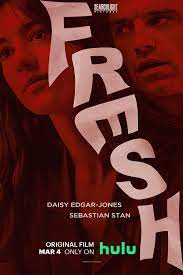
In director Mimi Cave’s black-comic thriller Fresh, Noa (Daisy Edgar-Jones) is a smart, witty, modern girl just looking for a meaningful nibble in her stagnant dating pool when she meets Steve (Sebastian Stan), a super-attractive doctor at her local produce market.

After a quick roll in the sack, Noa is whisked off for a magical weekend trip with the too-good-to-be-true Steve, despite warnings from her lesbian BFF Mollie (Jonica T. Gibbs) that there are some definite red flags in this picture.

Next thing Noa knows is waking up chained to a floor. This is never a good sign.

Turns out Steve has a thriving black market business that needs new blood occasionally.

“What the fuck is happening?” Noa screams at Steve.

“I’ll tell you, but you’re going to freak out,” Steve replies.

Noa is in a very bad place, but she shows grit and determination by convincing her captor that she shares his unusual tastes for the very finest cuts of meat.

Yes, it’s every bit as gruesome as you think, and then some, but Cave also sneaks in stress-relieving laughs when we need them most, particularly after one of the director’s many rapid-fire meat-cutting-and-eating montages designed to make the viewer queasy with self-loathing.

“I don’t eat animals,” Steve tells Daisy in the early days of their courtship. Not ones with four legs, anyway.

Fresh doesn’t pull any punches in its portrayal of toxic masculinity, embodied by the charmingly evil Steve, a respectable man with a home and family who just can’t resist a tempting morsel.

Unfortunately, as any upset stomach commercial ably demonstrates, sometimes your food will fight back.

Berberian Sound Studio (2012)

If you’ve ever remarked aloud words to the effect of “this job is killing me,” then perhaps you can understand the kind of hell that protagonist Gilderoy (Toby Jones) faces in Berberian Sound Studio, a meticulously unnerving film by Peter Strickland.

Gilderoy is a sound editor for movies, recognized internationally as a true artisan in a mostly vulgar industry. He takes an assignment in Italy that turns out to be a lurid horror movie about the Inquisition, and finds himself at odds with everyone around him, including the raging director (Cosimo Fusco), a playboy producer (Antonio Mancino), and various unhappy actresses who complain that they haven’t been paid.

Time is measured fitfully. Gilderoy, feeling more trapped every day, is unable to get reimbursed for his airfare by a sneering secretary (Tonia Sotiropoulo), forcing him into a captivity spent devising gruesome sound effects for a movie about (mainly) torture and screaming women.

We are witness to countless taping sessions of chopping, stabbing, boiling, and mutilating many pounds of fruits and vegetables, which never seem to get cleaned up, giving us a behind-the-scenes look at a studio full of moldy produce.

And it appears the mold is growing in direct proportion to the increasing torment depicted in the film being made, which the viewer never sees.

Meanwhile, actresses continue to scream in the sound booth. The director isn’t remotely satisfied with anyone’s terror level, and bullies the hapless audio supervisor into turning things up a bit.

Not surprisingly, the mild-mannered and repressed Gilderoy begins to lose his grip on reality, cheered only by an occasional letter from his mother. Even these become sinister as the days roll by, as if the carnage he helps create in this cursed Italian production has infected every branch in his life.

Writer-director Peter Strickland has cunningly fabricated a stinging slow-burner about the frailty of the creative spirit and how the battle between art and crass commercialism can cost you your very soul—not unlike say, Barton Fink.

Berberian Sound Studio plays out as a hypnotic and haunting collage of rolling tapes, clipping VU meters, and the turning of knobs, all of which contribute to a very soft man’s ruin, brilliantly realized by veteran stage actor Toby Jones (also sublime in The Detectorists), with whom we sympathize every awful step.

It’s also a “way homer” and worth the time it takes to puzzle over. I’m still thinking on it.

Stoker Hills (2020)

Funny, I thought with a title like Stoker Hills, that there might be vampires in the vicinity.

Nope, not even a nibble, though blood is drained if you pay attention. I’m not advising you to do so.

Three students enrolled in Professor Tony Todd’s community college film class get themselves kidnapped while working on a zombie movie, and must escape the clutches of a fiendish killer in an underground labyrinth.

Ryan (David Gridley), Jake (William Bedford-Hill), and Erica (Steffani Brass) set out with the noblest intentions to create a cinematic hybrid of “The Walking Dead and Pretty Woman.”

Shooting B-roll of a trolling Erica decked out in hooker garb goes south when she gets snatched by a goon in a creepy car. The dufus bros take off in hot pursuit, eventually leading to a secret trailer in the woods, where they too are set upon and abducted.

The camera is found by a fireman and turned over to the cops.

What looks to be a promising setup is soon squandered, as director Benjamin Louis and scenarist Jonah Kuehner unwisely shift gears into the police investigation that follows their disappearance.

We are summarily introduced to a pair of plodding detectives (Eric Etabari and William Lee Scott, the former inexplicably garbed like he’s auditioning for Guys & Dolls) who manage to grind narrative momentum to a screeching halt.

We’re handed scene after scene of these two dull dicks mulling over the found footage for clues, occasionally cutting back to the tied-up victims trying laboriously to escape their shackles, as if to remind us that there’s still a plot that needs resolving here.

The storyline twists and rebounds with their ponderous investigative revelations, including a serial killer with a pig heart (Jason Sweat) in need of fresh blood. The outré details don’t add up to much of anything, until the very last scene.

At that point, you will have the privilege of deciding if Stoker Hills is a clever little film with a “Gotcha” ending, or a low-budget time-waster with the lamest finale since, “Gosh, what a crazy dream!”

It’s an awesome responsibility when you think about it.

The Menu (2022)

Chef’s kiss for The Menu, a daily special filled with dark delights.

Directed and dressed with considerable panache by Mark Mylod, from a script by Will Tracy and Seth Reiss, The Menu is pitch-black comedy, skewering pretentious food snobs like so much shish kabob.

Twelve affluent diners are picked up by ferry and transported to Hawthorn Island, a self-contained culinary colony dedicated to growing, raising, and cooking food that’s showcased at its exclusive Hawthorn restaurant.

Here, Chef Julian Slowik (Ralph Fiennes) prepares mind-boggling tasting menus for $1200 a head. But this particular evening’s service is special. There will be no coming back for seconds.

In fact, there will be no coming back at all! Class warfare has seldom been served up with so many diabolical surprises.

Among the doomed diners are the Queen Bee food critic (Janet McTeer); a has-been Hollywood star (John Leguizamo); a multi-cultural trio of blowhard bros (Mark St. Cyr, Arturo Castro, Rob Yang), and fawning foodie fanboy Tyler (Nicholas Hoult), accompanied by his dazzling date, Margot (Anya Taylor-Joy).

Like a master showman in the guise of a humble cook, Chef Slowik meticulously describes each course. While doing so, he drops not-so-cryptic hints about the various axes he has to grind with each guest.

And when Slowik announces that there will be no bread served with the evening meal, because of its necessity to a working-class diet, the assembled eaters become even more uneasy.

Many timely topics are trotted out in The Menu—celebrity worship, commitment to ideals, pitiful power plays—and they all get seared by the heat of righteous service industry anger.

The quieter scenes of Slowik and Margot, slowly revealing themselves to each other, give us a breather between the mayhem of each successive course, until the feast’s fiery finale unfolds.

Margot wisely orders a cheeseburger to go. No surprise, it’s delicious!

You’ve gotta try this.