Trim Season (2023)

Though it has a few decent moments, Trim Season is mostly a harsh toke.

Director Ariel Vida definitely has a gift for visual flair but largely ignores storytelling in favor of making sure that the color red is fully represented in as many shots as possible.

A group of broke stoner girls and one trans man get a good paying gig trimming bud at a pot farm in Northern California.

Nothing wrong with that, I’ve done it myself. The isolation, drugs, little sleep, and sketchy authority figures make it a ripe scenario for any number of horror options.

The trimmers are introduced to Mona (Jane Badler), the mysterious and commanding owner of the operation, and quickly find her to be a firm enforcer of rules as well as their provider of weed and employment.

Emma (Beth Million) is our chief protagonist among the reefer recruits, but like most of the cast, she does little to distinguish herself, leaving Badler to dominate the action, as a sort of hippie Elizabeth Bathory, smoking her own strain of crimson cannabis.

I appreciated Vida’s gender tweaking throughout, as the girls are clearly protective of Dusty (Bex Taylor-Klaus), a vulnerable trans man, who would rather not talk about his past, but has an instant connection with Mona’s shy son, Christopher (Corey Hart).

Trim Season squanders much of its potential, however, thanks to stock characters, a wayward script, and careless plot developments: Why make a point of having Lex (Juliette Kenn De Balinthazy) being impervious to pain if it doesn’t come into play in any meaningful way?

It doesn’t help that when Mistress Mona flexes her witchy powers, she waves her hands in the air, remotely guiding her victims to off themselves like awkward, staggering marionettes. Instead of the intended dread, the results are comical, at best.

Also, note to the art department. The scenes featuring the girls trimming buds around the table are marred by the presence of weird, bulbous styrofoam cannabis. Is that the best we can do?

As I mentioned, this particular plot could have yielded some top-shelf terror. Sadly, Trim Season wouldn’t get a fly high.

In A Violent Nature (2024)

There’s quite a bit more here than meets the eye.

In A Violent Nature is not, as I had been told, a slasher movie told from the killer’s point of view.

Instead, writer-director Chris Nash dials up a multitude of perspectives, as if the doomed campers were being chased through a high-tech forest equipped with dozens of surveillance angles to choose from.

Stupid, soon-to-be-deceased college students rent a cabin in the woods. While hiking they disturb a memorial to Johnny, a mentally challenged boy who got bullied to death 70 years before.

Straight away we witness a now monstrous Johnny rise from the grave to seek revenge, and we spend considerable time riding shotgun alongside this unstoppable fiend as he makes an inspired mess out of the clueless kids.

Sometimes the murders are super gory, (the girl doing yoga gets some major stretching bodywork done) and some happen at a distance in the blink of an eye, as when a comely swimmer disappears below the waterline with a yelp from across the lake.

Nash keeps refreshing the views. He employs a static wilderness cam that dispassionately records long shots of the killer walking from one side of the frame to another. Next thing you know, we’re sitting on his shoulder, then a bird’s eye view, then a worm’s eye view.

With a string of cameras at his disposal, Nash asks us to consider the single-minded plight of a creative mutilator, in this case one that wears an old-time fireman’s mask, giving him the appearance of a predatory insect.

When Johnny occasionally pauses in his gruesome quest, we can get inside his horrible head and watch the wheels turn as he considers how best to maximize his menace, though he does remove his mask to play with a toy car at one point, a tragic reminder that this thing was once a happy child.

The undead death dealer featured in In A Violent Nature isn’t a killing machine, however. He wordlessly seems to enjoy the hunt and clearly takes pride in his victim-stalking and construction of murderous tableaux.

Johnny is obviously an artist, inviting us along to spy on his process. Now there’s a view you won’t see every day.

The Resident (2011)

It’s Hammer Time!

A release from the revived (and revered) Hammer Films imprint, The Resident traces its ancestry from gothic mysteries, slasher cinema, erotic thrillers, and Hitchcock’s Psycho.

It’s even got Christopher Lee in a supporting role! Doesn’t get more Hammer than that.

Oscar winner Hilary Swank portrays Juliet, a frazzled ER doctor on the fly from a failed relationship. In search of new lodgings, she chances upon an old building with a spectacular view of the Brooklyn Bridge, owned by Max (Jeffrey Dean Morgan), a charming landlord who resides on the premises with his ailing grandfather August (Christopher Lee).

When Juliet flirts with and kisses Max, it seems perfectly natural. He and Juliet are both attractive and successful people, their mutual interest is a given. She’s also lonely and drinks too much wine.

Finnish writer-director Antti Jokinen infuses the standard melodrama in The Resident, with a willingness to get uncomfortably close to his characters. Juliet isn’t sleeping well and can’t shake the feeling that someone is invading her space.

It’s not much of a mystery, as we learn that Max, the guy who owns the building, is indeed a highly disturbed individual, but perhaps not unreasonably so. It could be argued that Juliet’s reckless behavior with the heart of an unstable suitor is the cause of all the misery.

“You kissed me first,” he reminds her. And when Juliet has the nerve to get back together with her asshole ex, the wheels really come off.

Jokinen’s use of floating and flying camerawork is absorbing, making a mostly single-set apartment appear to be filled with more passages and secret doors than the Vatican.

The Resident is better than it has a right to be, largely thanks to Jeffrey Dean Morgan’s impressively layered performance as Max, a tortured soul who maybe just wanted to meet a nice girl. And a doctor to boot!

Morgan isn’t shy about delving the creepier depths of Max’s obsession, whether it’s licking Juliet’s hand from beneath her bed while she sleeps, or having a little cuddle party with her clothes, he’s clearly an actor unafraid of committing to a role.

Anyone expecting an arrogant and antagonistic villain in the vein of The Walking Dead’s Negan will, I thnk, be surprised by Morgan’s ability to generate menace, revulsion, and sympathy—right up until the bloody nail-gun finale.

The Hunt (2020)

Rich people hunting poor people for sport. Yeah, so what?

Richard Connell’s short story, The Most Dangerous Game, featuring a Russian nobleman tracking an American captive on a private island, is the source material for this concept, and it was published just over 100 years ago!

A familiar premise, but in The Hunt, it’s all about where you stand politically that determines your fate. Always room for innovation.

The setup is pure boilerplate, as a dozen seemingly random folks are kidnapped and transferred to a private hunting reserve called The Manor, where they’re given weapons to defend themselves against their affluent captors.

But something’s just a little off. The victims are not what they seem, and neither are the hunters.

Writers Damon Lindelof (Lost) and Nick Cuse drop little hints throughout the film about who exactly is hunting who, and the reveal is both unexpected and fertile ground for hilarity, as liberals, who aren’t all that competent with guns, try to exterminate right-wing pundits, podcasters, and NRA supporters.

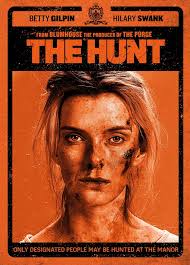
The Hunt leaves no room for good guys and bad guys, but Crystal (Betty Gilpin), an ex-military badass who was captured by mistake, takes the entire operation down, culminating in vicious hand-to-hand combat with Hilary Swank, the mastermind of the whole scenario.

The action sequences are tightly and efficiently orchestrated, particularly during a deadly shootout in a Mom & Pop grocery store, where in between salvos of bullets, a shopkeeper (Amy Madigan) wonders why one of the gunmen (Ike Barenholtz) feels the need to own so many guns?

Director Craig Zobel maintains a whippingly brisk level of excitement peppered with acidic observations from everyone involved, which should lead to repeat viewings in order to extract hidden gems.

Need to mend some fences after the election? The Hunt should satisfy both ends of the American politcial spectrum, and most points in between, as long as we haven’t lost the ability to laugh at our foolish selves.

The Final Girls (2015)

It started with Back to the Future, of course, the idea that a troubled teen could fix the present by kicking ass in the past.

The Happy Death Day series introduces horror into the equation, and recent stabs at the genre include Totally Killer, a film reviewed here.

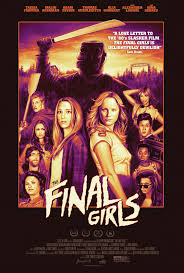
The Final Girls adds even more spice to the stew, as Max (Taissa Farmiga), grieving the death of her Scream Queen mother, Amanda Cartwright (Malin Ackerman), gets dumped into the early 1980s after a catastrophe at a screening of Mom’s most famous feature, Camp Bloodbath.

Director Todd Strauss-Schulson and writers Joshua John Miller and M.A. Fortin have a ball with a group of contemporary adolescents spun 40-plus years into the past to be fodder for a Jason Voorhees-style killing machine at a doomed summer camp.

Like the Scream franchise, the ability to adapt and survive by figuring out the “rules” of a slasher movie is the name of the game in The Final Girls, but the action also affords Max the chance to not only reconnect with her mother, but to act as a sort of spiritual advisor to a character carelessly described as “the shy girl with a guitar and a clipboard.”

Max and her friends travel even further back in time to witness the origin of the camp killer in the 1950s, and they all notice when the world around them is in black and white. One of them reckons she’s having a stroke because she’s suddenly colorblind!

The cinematography by Elle Smolkin also grabs our attention with a bevy of unbelievable shots, such as the killer, set ablaze, chasing the kids in slow motion. Or the apocalyptic purple sky during Max’s final battle.

There’s frightening fun in abundance, but there’s also inside jokes about lame movie stereotypes such as the airhead slut Tina (Angela Trimbur), who must be tied up to keep her from stripping off her clothes and summoning the killer.

Adam Devine from Workaholics delivers boffo laughs as Kurt, a one-dimensional stud from Hollywood’s disposable character drawer, who somehow makes his quest for endless nooky a righteous cause.

The Final Girls is an excellent example of a teen time-travel traumatic adventure. Maybe one of the best.

The Skeleton Key (2005)

Yes, the ending of The Skeleton Key is kind of a bummer. Think of it as social justice from beyond the grave.

The luminous Kate Hudson headlines as Caroline, a big-hearted hospice care worker hired to look after catatonic Ben Devereaux (John Hurt), a senior citizen sucking his last few breaths in a decaying plantation house somewhere in the Louisiana bayou.

Caroline’s routine is not made any easier by the presence of Ben’s overbearing wife Grace (Gena Rowlands), who rules the swampy mansion with an iron will in service to an arcane agenda.

Director Iain Softley (Hackers, Backbeat) and writer Ehren Kruger (The Ring, Scream 3) successfully stitch-up a scary Southern gothic, placing the very curious Caroline smack-dab in the middle of a mystery that will test her to the limits, and then some.

Softley deftly guides his camera through keyholes and tumbling tumblers as Caroline unlocks the secrets of a blighted house, mostly kept in the attic. It could be argued that she makes a few too many discoveries for her own good.

John Hurt has no dialogue, yet his face is required to reveal multiple layers of unexpressed anguish, as a man who literally hasn’t a clue how he got here. Gena Rowlands, who recently passed away, is highly animated as a mad matriarch wielding sorcerous formulas to prolong her already very long life.

As previously noted, the finale of The Skeleton Key is decidedly downbeat—until we consider the context of the tragic events that caused the curse. Then, maybe, it’s not so bad.

While you sort out your feelings, please enjoy this crackerjack feature.

Ghostwatch (1992)

I watched Late Night with the Devil, but it didn’t bring me any joy. A far more effective version of hell breaking loose on the telly can be found in Ghostwatch a BBC mockumentary that originally aired on Halloween night, 1992.

Apparently Ghostwatch was so realistic that many citizens were fooled into thinking something truly paranormal was unfolding before their astonished eyes, and network censors vowed never to rerun it on the BBC, accusing the creators of “a deliberate attempt to cultivate a sense of dread.”

Cool beans! Sign me up!

The made-for-TV movie was written by Steven Volk and directed by Lesley Manning, and it follows a large team of 1990s-style BBC reporters and crew onsite at a very normal looking home in Foxhill, that’s been the scene of serious poltergeist activity.

We meet the unfortunate inhabitants of the house, Pamela Early (Brid Brennan), and her two traumatized daughters, Suzanne (Michelle Wesson) and Kimmy (Cherise Wesson).

From the studio, the veteran presenter (Michael Parkinson), a stodgy old skeptic, coordinates the various segments, including live reports from the haunted house, interviews with the beleaguered family, and assorted talking heads adding their two cents worth to the proceedings.

What elevates Ghostwatch is its organic flow from spooky fun to impending danger to an unearthly tele-event, as a very compelling guest crashes the “live broadcast” for a few announcements and a guest editorial.

The pacing is superbly handled and the characters behave as real humans probably would in the presence of a particularly evil entity.

That’s a heavy compliment. You should watch.

Monolith (2022)

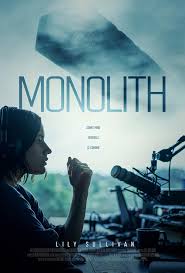
An investigative journalist (Lily Sullivan) has suffered a career setback. Hoping to salvage her reputation with a new podcast about unexplained phenomenon, she retreats to her parents’ posh pad in the Australian wilderness to brainstorm some ideas.

“I need a story,” she tells her boss on the phone. To paraphrase Apocalypse Now, for her sins, they gave her one.

Monolith, written by Lucy Campbell and directed by Matt Vesely, is confined to one location, with a single actress interacting with other characters online and over the telephone.

The journalist, at first reluctantly, and then with single-minded vigor, pursues a juicy conspiracy story revolving around the mysterious distribution of “black bricks” that exert a kind of power over those who receive them.

As she assembles and submits episodes of her podcast, her listeners begin to take notice, and soon her inbox is full of testimony from people who’ve had experiences with these bricks, the effects of which include visions, loss of appetite, cognitive decline, and occasionally a fatal illness.

As often happens with conspiracy cases, the reporter gets swept up and goes down a very deep, dark rabbit hole, that originates surprisingly close to home.

Lily Sullivan dramatically carries Monolith and she’s quite up to the task, as her increasingly odd situation requires a fully stocked arsenal of emotional firepower. She threatens, cajoles, pleads, and does a remarkable job inhabiting what appears to be a nervous breakdown of some sort, that also could be a fight for her very soul.

Sullivan’s transformation from a sulky ego-driven internet personality to an obsessed participant in her own developing story, is astonishing and completely believable.

Well worth the watch, in my opinion.

Night Swim (2024)

“I’ve always wanted a pool.”

Kurt Russell’s kid, Wyatt Russell, stars as an ailing baseball player who lucks into a house with a magic swimming pool.

Unfortunately, his family may not survive a comeback.

I went into Night Swim under the impression that it was a goofy monster-in-the-drain romp, accompanied by a heavy body count, but writer-director Bryce McGuire threw me a curveball.

Instead, it’s a movie about hope and how misplaced faith in miracles can be a dangerous thing. It also does a very credible job of capturing the joy and terror of owning a backyard pool.

A swimming pool used to be a mighty source of entertainment for the entire family, with a few short breaks for potato chips and kool-aid. Got a jar of change? Kids will dive after dimes all goddamn day.

A child’s introduction to liquid immersion is a unique feeling that goes back to the womb. Weightless, wet, wonderful, intoxicating, and frightening—it’s a different dimension that can play tricks on our senses.

McGuire makes fertile use of those familiar sensations, shooting every scrap of action from multiple angles for an extra slow and scary fun slide into the dark tank.

The title taps into the curious dread that comes with nocturnal aquatics, the feeling of not knowing how deep the deep end goes, and the uncertain possibility that you’re not alone in the pool.

Of course, it wouldn’t be a Hollywood film about a swimming pool without the ancient game of Marco Polo being involved. Do they really play this antique pastime in the 21st century?

I’m skeptical.

Night Swim also includes the obligatory Camel Fight sequence, and sure enough, people escape death by a hair’s breadth. Having once been pinned to the bottom of a pool during a losing Camel Fight, I can confirm that this is the sort of horseplay that can ruin everyone’s good time.

No one wants to see your stupid lungs explode.

Abigail (2024)

“What are we talking about, like an Anne Rice or a True Blood? You know, Twilight? Very different kinds of vampires.”

So wonders Sammy (Kathryn Newton), one of a crew of professional criminals hired to kidnap the 12-year-old daughter (Alisha Weir) of a powerful crime boss.

This isn’t one of those vampire movies where the characters behave like they’ve never seen a vampire movie.

Quite the opposite, and directors Matt Bettinelli-Olpin and Tyler Gillett use the opportunity to remind us that maybe we don’t know shit about Nosferatu Nation.

“The thing about being a vampire is, it takes a long time to learn how to do the cool shit,” explains Abigail, the ballerina from hell at the center of the horror-thriller-comedy that bears her name.

Abigail is a blast, and way too freaking much fun not to earn my humble endorsement.

A group of Usual Suspects are promised $50 million to snatch the fancy dancing Abigail and bring her to a safe house to await a ransom payment from her father, Kristof Lazaar, a legendary criminal mastermind spoken of with Keyser Sozé reverence.

There’s Frank (Dan Stevens), the leader, a paranoid ex-undercover cop; Joey (Melissa Barrera), the empathetic army doctor trying to kick a drug habit. Peter (Kevin Durand), is a massive mob leg-breaker, Rickles (Will Catlett), a Marine sharpshooter, Sammy, the cute punky hacker chick, and Dean (Angus Cloud), a loose-cannon getaway driver.

The crooks, forced to hole up, quickly get on each others’ nerves with well-written, zesty crook dialogue leading us to believe we’re watching a hard-boiled caper flick, like, The Usual Suspects.

The similarities don’t end there.

As the captors settle in for a 24-hour babysitting gig, the frightened little girl reveals herself to be a vicious, sadistic bloodsucker who wants to “play with her food.”

We’re swept along as the tiny dancer turns the tables, easily terrorizing and dominating the band of seasoned professionals, usually accompanied by the thunderous strains of Tchaikovsky’s Swan Lake.

It is at this point that Abigail reaches its comedic zenith, and it’s a dilly.

Joey: Why didn’t she kill you?

Frank: She is fucking with us!

Joey: I’m guessing none of the weapons worked.

Frank: Well, the stake worked on my fucking leg, and she used the crucifix on Peter like a fucking pincushion and the garlic did fuck all!

Amidst the copious blood-letting , savage sucking, and decapitation, bargains are made and broken as further scheming by henchmen complicates the caper considerably.

And then her father shows up, and we get some tips on the finer points of parenting. Abigail moves at a breathless pace, only slowing occasionally for a tactical pause before further mutilation occurs.

I’m clapping. Really!