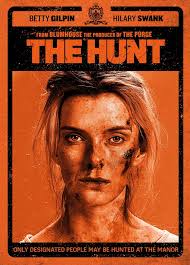
The Hunt (2020)

Rich people hunting poor people for sport. Yeah, so what?

Richard Connell’s short story, The Most Dangerous Game, featuring a Russian nobleman tracking an American captive on a private island, is the source material for this concept, and it was published just over 100 years ago!

A familiar premise, but in The Hunt, it’s all about where you stand politically that determines your fate. Always room for innovation.

The setup is pure boilerplate, as a dozen seemingly random folks are kidnapped and transferred to a private hunting reserve called The Manor, where they’re given weapons to defend themselves against their affluent captors.

But something’s just a little off. The victims are not what they seem, and neither are the hunters.

Writers Damon Lindelof (Lost) and Nick Cuse drop little hints throughout the film about who exactly is hunting who, and the reveal is both unexpected and fertile ground for hilarity, as liberals, who aren’t all that competent with guns, try to exterminate right-wing pundits, podcasters, and NRA supporters.

The Hunt leaves no room for good guys and bad guys, but Crystal (Betty Gilpin), an ex-military badass who was captured by mistake, takes the entire operation down, culminating in vicious hand-to-hand combat with Hilary Swank, the mastermind of the whole scenario.

The action sequences are tightly and efficiently orchestrated, particularly during a deadly shootout in a Mom & Pop grocery store, where in between salvos of bullets, a shopkeeper (Amy Madigan) wonders why one of the gunmen (Ike Barenholtz) feels the need to own so many guns?

Director Craig Zobel maintains a whippingly brisk level of excitement peppered with acidic observations from everyone involved, which should lead to repeat viewings in order to extract hidden gems.

Need to mend some fences after the election? The Hunt should satisfy both ends of the American politcial spectrum, and most points in between, as long as we haven’t lost the ability to laugh at our foolish selves.

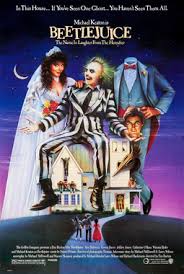
Beetlejuice (1988)

I found it inconceivable that Mrs. Sharky hadn’t seen Beetlejuice! I mean, if we go to the sequel, she’ll be lost!

The original Beetlejuice holds up extremely well, and it’s a shiny example of filmmaker Tim Burton at his most creatively unfettered, before the weight of pleasing soulless studio executives damaged his goods.

The man who gave the world Pee Wee’s Big Adventure, Edward Scissorhands, and Sleepy Hollow was firing on all cylinders, as yet unburdened with hallucinatory tasks like unsuccessfully updating Alice in Wonderland and Charley and the Chocolate Factory for new generations.

Burton casts a wild net in Beetlejuice, introducing us to Barbara Maitland (Geena Davis) and her husband Adam (Alec Baldwin), a recently deceased “normal” couple, who end up trying to haunt their own house to scare away the obnoxious family that moves in after their funeral.

The incoming Deetz family is fronted by brash, no-talent artist Deelia (Catherine O’Hara, who is wonderful),along with her fretful yuppie husband Charles (Jeffrey Jones), and darkling daughter Lydia (Winona Ryder), who has the ability to see the Maitlands and sympathizes with their plight.

The fledgling ghosts, after failing to frighten away the interlopers, summon the titular evil spirit (Michael Keaton) to handle the eviction process. Keaton is the the straw that stirs the drink, a Pu-Pu platter of perversion and patter, rightfully stealing every scene in sight.

In a movie about the importance of family—chosen and blood—we get three levels of domestic possibilities. The Maitlands, though dead, represent the most nurturing option for Lydia, while her parents are usually too distracted with their own devices to pay any attention.

But even the Deetz clan is preferable to Beetlejuice and his quest to take Lydia for his child bride so he can return to the land of the living. Yikes!

Burton earns an advanced degree in visual arts with his depiction of the afterlife, an impenetrable bureaucracy with frazzled, overworked caseworkers like Juno (Sylvia Sydney), in charge of crowded offices filled with confused corpses in various stages of dumbfounded decay.

The contrast between an increasingly bizarre real world, brought on by the arrival of the Deetz family and their awful Boho sensibilities, with a limbo full of mud-colored, take-a-number waiting rooms, helped to establish Burton’s outré credentials.

He also shows an uncanny eye for fashion, giving Lydia striking looks in both black and red. Burton definitely had a hand in Ryder’s ascent as a teen icon that learned to act and stayed forever.

The Vincent Price-loving Burton has honed a visual aesthetic of fascinating grotesquerie much like spiritual forefathers Edward Gorey and Charles Addams. And Beetlejuice is his master’s thesis, a riotous dark comedy that’s still cherished five decades later.

OK, bring on the sequel.

Oddity (2024)

Irish filmmaker Damian McCarthy made a bit of a splash with his debut, Caveat (2020), an indie-horror shocker that more than recouped the measly 250,000 pounds spent on its production.

Oddity is McCarthy’s second film, and the raw talent revealed in Caveat gains both power and polish, anchored by an incendiary performance by Carolyn Bracken, as twin sisters Dani and Darcy Timmins—the former a murder victim, the latter a blind collector of cursed objects.

Darcy decides that her sister’s murder at the hands of an escaped mental patient (Tadhg Murphy) is just a little too coincidental, considering her sister’s husband Ted (Gwilym Lee) is a psychiatrist at the nearby asylum from whence the killer came!

As if that weren’t enough to put a bee in her bonnet, Darcy discovers that Ted has a new girlfriend (Caroline Menton) less than a year after her sister’s brutal death by bludgeoning.

Through a magic ritual involving the glass eye of the alleged killer, Darcy figures out who the real culprits are and rebrands herself as an instrument of vengeance.

The obvious care and attention to detail provided by writer-director McCarthy is a pleasure to behold—the atmosphere of the mostly single set of a remote country house successfully develops layers of menace with each scene.

The narrative is bone simple, as Darcy arranges a sinister fate for the conspirators responsible for her twin’s demise, disguised as a bizarre housewarming gift: a life-sized wooden man that appears to be distressingly ambulatory.

The actual business of the revenge plot isn’t terribly intricate, but McCarthy consistently avoids the obvious choices, and the viewer is all the better for it.

Oddity is a first-rate horror experience that belies the lack of a body count, and indicates that Damian McCarthy is emerging as a confident comer in modern genre filmmaking.

Don’t believe me? See for yourself!

Ghostwatch (1992)

I watched Late Night with the Devil, but it didn’t bring me any joy. A far more effective version of hell breaking loose on the telly can be found in Ghostwatch a BBC mockumentary that originally aired on Halloween night, 1992.

Apparently Ghostwatch was so realistic that many citizens were fooled into thinking something truly paranormal was unfolding before their astonished eyes, and network censors vowed never to rerun it on the BBC, accusing the creators of “a deliberate attempt to cultivate a sense of dread.”

Cool beans! Sign me up!

The made-for-TV movie was written by Steven Volk and directed by Lesley Manning, and it follows a large team of 1990s-style BBC reporters and crew onsite at a very normal looking home in Foxhill, that’s been the scene of serious poltergeist activity.

We meet the unfortunate inhabitants of the house, Pamela Early (Brid Brennan), and her two traumatized daughters, Suzanne (Michelle Wesson) and Kimmy (Cherise Wesson).

From the studio, the veteran presenter (Michael Parkinson), a stodgy old skeptic, coordinates the various segments, including live reports from the haunted house, interviews with the beleaguered family, and assorted talking heads adding their two cents worth to the proceedings.

What elevates Ghostwatch is its organic flow from spooky fun to impending danger to an unearthly tele-event, as a very compelling guest crashes the “live broadcast” for a few announcements and a guest editorial.

The pacing is superbly handled and the characters behave as real humans probably would in the presence of a particularly evil entity.

That’s a heavy compliment. You should watch.

Monolith (2022)

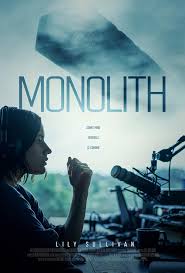
An investigative journalist (Lily Sullivan) has suffered a career setback. Hoping to salvage her reputation with a new podcast about unexplained phenomenon, she retreats to her parents’ posh pad in the Australian wilderness to brainstorm some ideas.

“I need a story,” she tells her boss on the phone. To paraphrase Apocalypse Now, for her sins, they gave her one.

Monolith, written by Lucy Campbell and directed by Matt Vesely, is confined to one location, with a single actress interacting with other characters online and over the telephone.

The journalist, at first reluctantly, and then with single-minded vigor, pursues a juicy conspiracy story revolving around the mysterious distribution of “black bricks” that exert a kind of power over those who receive them.

As she assembles and submits episodes of her podcast, her listeners begin to take notice, and soon her inbox is full of testimony from people who’ve had experiences with these bricks, the effects of which include visions, loss of appetite, cognitive decline, and occasionally a fatal illness.

As often happens with conspiracy cases, the reporter gets swept up and goes down a very deep, dark rabbit hole, that originates surprisingly close to home.

Lily Sullivan dramatically carries Monolith and she’s quite up to the task, as her increasingly odd situation requires a fully stocked arsenal of emotional firepower. She threatens, cajoles, pleads, and does a remarkable job inhabiting what appears to be a nervous breakdown of some sort, that also could be a fight for her very soul.

Sullivan’s transformation from a sulky ego-driven internet personality to an obsessed participant in her own developing story, is astonishing and completely believable.

Well worth the watch, in my opinion.

Night Swim (2024)

“I’ve always wanted a pool.”

Kurt Russell’s kid, Wyatt Russell, stars as an ailing baseball player who lucks into a house with a magic swimming pool.

Unfortunately, his family may not survive a comeback.

I went into Night Swim under the impression that it was a goofy monster-in-the-drain romp, accompanied by a heavy body count, but writer-director Bryce McGuire threw me a curveball.

Instead, it’s a movie about hope and how misplaced faith in miracles can be a dangerous thing. It also does a very credible job of capturing the joy and terror of owning a backyard pool.

A swimming pool used to be a mighty source of entertainment for the entire family, with a few short breaks for potato chips and kool-aid. Got a jar of change? Kids will dive after dimes all goddamn day.

A child’s introduction to liquid immersion is a unique feeling that goes back to the womb. Weightless, wet, wonderful, intoxicating, and frightening—it’s a different dimension that can play tricks on our senses.

McGuire makes fertile use of those familiar sensations, shooting every scrap of action from multiple angles for an extra slow and scary fun slide into the dark tank.

The title taps into the curious dread that comes with nocturnal aquatics, the feeling of not knowing how deep the deep end goes, and the uncertain possibility that you’re not alone in the pool.

Of course, it wouldn’t be a Hollywood film about a swimming pool without the ancient game of Marco Polo being involved. Do they really play this antique pastime in the 21st century?

I’m skeptical.

Night Swim also includes the obligatory Camel Fight sequence, and sure enough, people escape death by a hair’s breadth. Having once been pinned to the bottom of a pool during a losing Camel Fight, I can confirm that this is the sort of horseplay that can ruin everyone’s good time.

No one wants to see your stupid lungs explode.

You’ll Never Find Me (2023)

Welcome to a dark night of the soul. Even bad people have them.

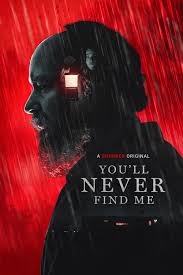
In some nameless Australian trailer park, Patrick (Brendan Rock) sits in his living room drinking whiskey. Outside, there is thunder and lightning, just like the night Frankenstein’s creature woke up.

Patrick is alone, but not for long.

A wayward woman (Jordan Cowan), lost in the storm and soaked to the skin, pounds on his door seeking a telephone.

“You’ve knocked on the wrong door,” Patrick tells the shoeless visitor.

Of course, things are not that simple. The wrong door depends on who’s standing where.

You’ll Never Find Me, written and co-directed by Australian newcomer Indianna Bell, is an intricately constructed two-person play, featuring unexpected shifts in the power dynamic taking place over the course of a dark and stormy evening.

It’s Patrick’s house, and he’s obviously a formidable man who prefers solitude. A drenched woman with no shoes can’t possibly be a threat.

So why is he uneasy?

Patrick explains to her that feral kids living in the park routinely beat on his door and run away. Even at two in the morning during a violent storm?

That’s enough to drive anyone mad.

Gradually, Patrick warms up to his guest and promises to help her, but he’s also clearly suspicious about her point of origin. She claims she fells asleep at the beach.

“The beach?” Patrick wonders aloud, as if he’d never heard the word.

Viewers are left to puzzle and ponder the scant information provided by these mysterious players, as both sides continue to distract and interrogate the other while passing the time with a few hands of cards.

We can tell from the outset that Patrick is a (deservedly) haunted man, and as the tension in the trailer escalates, a very big decision about his future—the same one faced by Hamlet—becomes an unbearable burden.

With its single set, minimal action, and tiny, terrific cast, You’ll Never Find Me is a harrowing and claustrophobic watch, with revolving doors of trust and deception leading to the ultimate question: To be or not to be.

Original, highly rewarding, and vigorously recommended.

Alone (2020)

“That’s one of the most stressful movies I’ve ever seen!”

This quote comes from Mrs. Sharky, who perhaps unwisely left the selection of this evening’s entertainment to me.

She says that Alone is like death by a thousand cuts and accurately represents the kind of micro-aggression that women traveling by themselves encounter far too often.

Sometimes it’s just assholes, sometimes it’s Ted Bundy.

Jessica (Jules Willcox) decides to pack up her troubles in a U-Haul and head for greener pastures after her husband commits suicide—a similar premise to Alex Garland’s recent film Men.

Instead of rest and recuperation, her healing mission gets derailed by a menacing motorist (Mark Menchaca) who proves harder to get rid of than a mosquito in your tent.

As previously mentioned, sometimes extreme tragedy and trauma are considered action items in the universe we live in, as the landscape shifts from indifferent to malign and the real character development gets started.

Alone director Johm Hyams (Black Summer) and writer Mattias Olsson devise a brutal (and stressful!) battlefield in the rainy tall timber of the Pacific Northwest.

There is very little dialogue and our protagonist spends much of her screen time hiding in the bush from a diabolical serial killer who knows the area well. Jessica’s propensity to make noise (heavy breathing, mewling whimpers) during these anxious interludes drove my wife nuts.

“Shut up, already!” she shouted more than once. “It’s easy to hide in the woods! Just shut the hell up!”

Pursuit, capture, escape, more pursuit, and murder are the forces at work here, and the tension levels go “pop” on several occasions, such as when Jessica agonizingly overhears her stalker talking jovially with his wife and child on the phone, telling them he’ll be home in a few days.

Take a break if you need to, but stick with it. Alone delivers a satisfyingly savage finale that will make your blood pressure dance the meringue.

Who says cinema should be relaxing? Take up yoga, or something.

Last Night In Soho (2021)

I’ve been a fan of Edgar Wright from his earliest work on Spaced, the hilarious BBC sit-com from the tail-end of the previous century.

This foundational series teamed director Wright with writer/actor Simon Pegg, a partnership that flourished with ace collaborations like Shaun of the Dead (2004) and Hot Fuzz (2007).

Pegg is certainly the more visible of the two, appearing in high-profile film franchises based on TV shows from the 1960s, Star Trek and Mission Impossible.

In Last Night In Soho, Wright’s musically minded, bloody Valentine to swinging London, he affirms his true love (and understanding) of those riotous times through masterful manipulation of color, sound, and movement in telling the story of two girls from different eras whose lives overlap in Dreamland.

We open with Eloise (Thomasin McKenzie), a spirited lass from Cornwall with dreams of being a 60s-inspired fashion designer in London.

Upon landing in the big city, Eloise is treated rudely by her designing classmates to the point that she’s forced to abandon the dorms in favor of lodging with Mrs. Collins (Diana Rigg) a lovely old-lady landlord who doesn’t allow male guests after 8pm.

Soon after acquiring the new digs, Eloise begins a dream odyssey about the adventures of Sandy (Anya Taylor-Joy), a live-wire hip chick who captures the attention of everyone she meets during her meteoric ascent in London’s nightclub scene, circa 1965.

Coincidentally, it’s the very same historical period that Eloise obsesses about through her clothes and music. Cilla Black, Kinks, Chad & Jeremy, and Petula Clark can be heard plugging away on the phonograph, while her attempts at creating swing silhouettes and bubble dresses are clearly influenced by Mary Quant and other Carnaby Street regulars.

Eloise and Sandy overlap in these subconscious interludes: Sandy is portrayed by Taylor-Joy, but whenever an opportunity for a reflection appears, it’s McKenzie looking back at the action.

A lesser director would milk this device as a gimmick. Wright uses it to set the story to a fevered rhythm, as Sandy, a beautiful rising star, sees her ambition smashed to bits by horrible old men.

When not living her dream, Eloise styles herself as the beguiling Sandy, until the viewer loses her sense of identity in both the sleeping and waking worlds.

Last Night in Soho is a rise-and-fall fable that kicks off with a dazzling bang, and shifts gears into a sordid nightmare spiral that’s grim going indeed.

Wright’s poise and whirlwind finesse with the camera is thoroughly transportive, evoking both delirious highs and utter misery in strikingly composed scene after scene.

This is a bumpy ride, but Last Night In Soho is more than worth it. Instead of grousing about getting the rug yanked out from under, we should be thankful that an artist of Wright’s ability has fully materialized in our present day.

The Invitation (2015)

I am a restless channel surfer, something that my lovely wife won’t tolerate. So, I have to sneak around like a burglar and surf on the down low when and where possible.

H is for horror. H is also for home.

This is the category I relentlessly peruse. After skimming through the same titles over and over again, I have come to the conclusion that there may be in excess of 5,000 movies about folks trying to rebound from tragedy (kid dies, kid goes missing, kid joins cult, kid kills other kid) by moving somewhere for a “fresh start.”

And it never works.

Our gradual awareness of the significant wounds we acquire (and inflict), while going about the business of our lives, is fertile turf for purveyors of contemporary horror.

We are in a weakened state, and the oceans of emotions used to somehow transform sorrow into a way of “living with it” are often identified as symptoms of madness.

The Invitation, director Karyn Kusama’s dinner-from-hell, is a wolf in sheep’s clothing, by seemingly offering its cast the chance to not only overcome grief and guilt, but to live in a serene present.

Will (Logan Marshall-Green) and his girlfriend Kira (Emayatzy Corinealdi) reluctantly agree to attend a dinner party in Laurel Canyon thrown by Will’s ex-wife Eden (Tammy Blanchard) and her new husband David (Michael Huisman).

Also present are several old friends whom Will hasn’t seen since a tragedy two years before, that resulted in the accidental death of Will and Eden’s son, Ty (Aiden Lovekamp).

Throughout a long evening of reminiscing over excellent wine, David and Eden reveal their true agenda for this jolly reunion, recruiting the guests to accept The Invitation, a growing metaphysical movement that seeks to rehabilitate poor souls suffering from overwhelming guilt.

Like Will.

“Grief, anger, depression, abuse… It’s all just chemical reactions,” Eden explains.

The soiree hits rough waters on several occasions, due to suspicion and eventually open hostility from Will, who pushes back at David’s spiritual salesmanship by storming out of the room every five minutes or so.

“I don’t pretend to know what you went through, and you don’t know me. You can’t!” he growls at David.

His friends are rightfully worried, as Will demonstrates classic post-traumatic paranoia, especially when David locks the doors, explaining that there was a recent home invasion nearby.

But what are Eden and her rather intense new hubby up to?

“Something dangerous is going on, and we’re all just ignoring it because David brought some good wine!” Will barks at the other guests.

The action is a delicately paced slow-burn, as Kusama (Girlfight, Jennifer’s Body, and TV’s Yellowjackets) and husband-screenwriter Phil Hay manifest the most nightmarish episode of dinner and drinks since Who’s Afraid of Virginia Woolf?

I urge you to accept The Invitation (at your own risk) and you will be rewarded with a sharp, uncompromising thriller that also serves as a fevered meditation on the various paths we take to process tragic events.

Apparently there is a right way and a wrong way.