Dark Skies (2013)

You can’t run, you can’t hide.

There is an air of grim inevitability that permeates Dark Skies, the feeling that any precautions taken are futile, because the extraterrestrial enemy faced by the Barrett family is simply beyond their comprehension.

“People think of aliens as these beings invading our planet in some great cataclysm, destroying monuments, stealing our natural resources,” states UFO expert Edwin Pollard (J.K. Simmons).

“But it’s not like that at all. The invasion already happened.”

The Barretts are a normal, run-of-the-mill family just trying to make ends meet. Mom Lacy (Keri Russell) is a real estate agent in a slump; Dad Daniel (Josh Hamilton) is an unemployed architect working on his anger issues. Older son Jesse (Dakota Goyo) has a crush on a neighborhood girl, while younger son Sammy (Kadan Rockett) is more of a sensitive introvert.

Without warning, weird shit starts happening. Food and garbage gets strewn around the kitchen. Household items are stacked in geometric configurations. Photographs disappear. Swarms of starlings hit the house.

Even more disturbing, episodes of sleepwalking plague various Barretts, resulting in a tightening noose of paranoia and distrust between Lacy and Daniel, who despite their dire financial circumstances, continue to invest in pricey home security measures that prove fruitless.

After enduring a series of inexplicable events, Lacey reaches out via the internet to Pollard, a man who has been visited by aliens known as “the Grays” since he was a youngster.

“I don’t even fight them anymore,” he tells Lacey and Daniel, and further informs them that one of their children is being groomed for abduction, sooner rather than later,

Instead of providing the parents with hope, all Pollard can suggest is to fight back and hope the extraterrestrials get frustrated and move on to other specimens.

Writer-director Scott Stewart dispenses with the usual CGI wonder parade, and keeps things low-tech, naturalistic, and increasingly tense. The absence of special effects adds a mundane realism to Dark Skies, that sharply contrasts with the utterly unknowable nature of the Grays.

“What answer would a lab rat understand from a scientist in a white coat putting electrodes in its brain, giving it cancer?” Pollard asks.

Best of all, Dark Skies is a riveting example of story craft that shows, rather than tells us what we need to know. Even so, answers are few and far between.

Heavily recommended.

Weapons (2025)

And now, the rest of the story.

If we examine Weapons alongside Zach Cregger’s previous oddball odyssey, Barbarian, what we’re seeing is the emergence of a different school of narrative filmmaking, in which a mystery morphs into a profound horror.

Both movies feature people disappearing under outré circumstances, and the subsequent investigation, told Pulp Fiction-like in chapters from assorted points of view, reveals the “monster” lurking at the center.

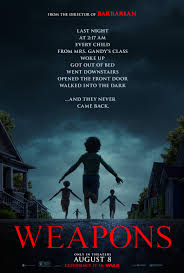
In Weapons, an entire classroom of children awaken in their beds at 2:17 am, leave their homes, and go missing. Only their teacher, Justine Gandy (Julia Garner), and a single student, Alex (Cary Christopher), were unaffected by this strange occurrence.

Justine bears the brunt of her community’s rage, but the real story unfolds quietly around Alex, and the coincidental arrival of his eccentric Aunt Gladys (Amy Madigan) into the family home.

Recounting plot details diminishes the wonderful WTF factor at work in Weapons. Letting the story open up and swallow you is the correct path forward, as the interested parties play their parts in nonlinear fashion, leading to another shit-crazy finale full of strange shots and unhinged images you aren’t likely to forget, such as a pack of possessed children pursuing Aunt Gladys through an entire neighborhood of homes and their stunned denizens.

As for Madigan’s very specific portrayal of the uniquely wicked Aunt Gladys, it’s the stuff of nightmares, a thermometer-shattering motherlode of malevolence. Small wonder that Creggar is busy working on a prequel based on Gladys’ origin story.

The horror that lives beneath the surface in Weapons, has to do with influence, and the impossibility of truly knowing one’s neighbors and what they’re up to. Anyone can wake up weaponized.

So basically, no one is safe, not even in their own home with Mom and Dad.

Creggar’s roundabout approach to the genre trumps traditional terror tropes at every turn. And that’s reason enough to to see Weapons, post-haste.

Parasite (2019)

When was the last time a horror movie won a Best Picture Oscar?

How about a horror movie from South Korea?

Wait! Is this even actually horror?

Bong Joon Ho’s Parasite was recently named the best movie of the 21st century by the New York Times, as well as in a poll of more than 500 actors, writers, and assorted Hollywood riff raff.

The accolades were enough to prompt a rewatch, so the wife and I buckled in with a tasty spread from Hawaiian Bros Grill, and let the good times roll.

We open on the Kim clan, a quartet of creative and industrious con artists living in a smelly basement apartment in Seoul. Bong’s set design standards are incredibly detailed, with the Kims’ ridiculous elevated toilet serving as a mocking throne over their scheming degradation.

From the squalid floor of their stinking dungeon, the Kims watch as a parade of drunks pee on their window to the outside world.

Fortunately, son Ki-woo (Lee Sun-kyun) lands a gig as a tutor to a bored rich high school girl (Jo Yeo-jeong) and soon, through Machiavellian machinations and good old teamwork, the enterprising Kims have securely attached themselves to the wealthy, but blandly oblivious Park family, serving comically in a number of unlikely household occupations.

As the title implies, the Kims dig deep into their new situation, even taking on airs of pretension themselves, while pillaging the fancy foods in the bourgeois pantry.

Speaking of pantries, the Parks’ fabulous modern house is itself a metaphor for a society that could do a better job of feeding and housing its less-prosperous citizens.

Consider the plight of Oh Geun-sae, (Park Myung-hoon) the hider in the house with nowhere else to go. The husband of the Parks’ former housekeeper has gone insane living on food scraps in a hidden underground bunker. It’s his terror at the prospect of being homeless that’s responsible for the blood that eventually flows all over a beautifully manicured backyard.

Parasite is a marvelous creature, neither fish nor foul, bursting with darkly comic observations about the pathetic need to feel superior—to anyone. The Kims want that smug insulation of their own, but they don’t pass the smell test.

The American Dream, at least in South Korea, involves fastening yourself to a fat host. While waiting for the trickle down to take effect, you must keep others away from the living meal ticket.

Bong’s masterpiece makes for a wondrously uncomfortable safari through a human ecosystem. Parasite is mind-growing artistry containing an ocean of insights on the class struggle, all awaiting your repeated viewing.

That’s called time well spent. Ask the New York Times.

MadS (2024)

Kids! Don’t do drugs!

Unless you want to slowly transform into a cackling, bloodthirsty Deadite.

Writer-director David Moreau and his camera crew of French daredevils have assembled MadS, a micro-zombie tale that maintains a breathless pace, thanks to it being filmed in one exhausting take!

For 89 minutes nonstop minutes, we tag along with Romain (Milton Riche), a swinging teen (?) on his 18th (?) birthday, as he visits his dealer driving a classic Mustang convertible.

After snorting several lines of a dark red powder, Romain scores a few bindles of the stuff and blasts off through the French countryside in his sweet ride, soon to be tripping balls.

At this early stage, we almost envy the lad. It’s his dad’s car but Romain cuts a dashing figure behind the wheel, like Jean-Paul Belmondo or something.

As the powerful drugs take hold of his system his special birthday night rapidly degenerates into hell. He inadvertently gives a ride to a feral madwoman who seems to be on the run from nefarious forces.

Romain, who is expected to be at a blowout rager for his birthday, instead brings the nonverbal, unstable refugee to his father’s fancy house—and loses track of her.

The constant motion of the narrative gives MadS a major advantage in holding our attention. I realized while watching it, that I was standing up for much of the time. That’s called tension and it just keeps coming.

There’s a particular scene with a woman riding a scooter, trying to outrace an infected friend who is madly pursuing on foot and calling out to her that burns like a fuse.

The visual excitement is top drawer throughout. Moreau’s sensibility is slick, sleek, and sleazy, and MadS rates highly as finely-crafted, Old World, Eurotrash with a pedal that’s always on the metal.

The movie dovetailed nicely with my reading a trilogy of post-apocalyptic books by English author Rich Hawkins (The Last Plague, The Last Outpost, and The Last Soldier; recommended!) that are really grim.

And so is this. But it kicks major ass.

Die Alone (2024)

Screen history repeats itself, as Carrie-Anne Moss is once again paired with an amnesia victim (Douglas Smith) searching for answers in Die Alone, a Canadian post-apocalypse drama crawling with a verdant variety of zombies that have gone to seed.

Writer-director Lowell Dean makes sensible use of Saskatchewan’s panoramic grasslands to anchor the action, following a few hardy survivors stumbling through a barren landscape largely stripped of humanity thanks to a plant-based virus that’s amped up the vegetation to lethal levels.

Ethan (Smith) and Emma (Kimberly Sue Miller) are a young couple on the run when the environmental shit hits the fan. Despite making a plan to meetup at a remote cabin in case they get separated, Ethan’s trauma-induced amnesia keeps getting in the way, and the two predictably lose track of each other.

Luckily clueless Ethan gets rescued by rugged survivalist May (Moss), who agrees to help him locate his lost love and provide reasonable room and board in exchange for farm labor.

Instead of gratitude, Ethan steals May’s truck and goes off to search for Emma on his own, but the absent-minded protagonist requires frequent rescuing. That means many scenes begin with Ethan regaining consciousness in different locations, usually covered in blood, sweat, and ears.

The zombie community is represented by hungry humanoids that have been reclaimed by the earth, each with its own distinctive look fusing foliage and fashion. The makeup department deserves the donuts for creating such intriguing new creatures.

Strangely, Dean mostly employs the undead as set dressing, rather than as a serious threat, limiting their fright potential to a precious few moments.

But it’s not a dealbreaker.

That Die Alone succeeds as a movie is largely due to the unbreakable strength of its central relationships and the filmmaker’s fully developed arsenal of appreciation for those that came before him.

Cinema nerds will eagerly recognize shots paying tribute to everyone from John Ford to Terrence Malick to Sam Raimi. Dean’s script, though maddeningly fractured and episodic, leads to a crushing finale that I’m still chewing on like old Milk Duds.

Be like the cows. Keep chewing. It’s making more sense all the time.

Frailty (2001)

The late Bill Paxton (1955–2017) will always be remembered for his distinguished genre credentials. As the not-so-brave Private Hudson in Aliens (1986), he got all the best lines, including “Game over, man!”

A year later he was part of a kick-ass vampire gang in the criminally underrated Near Dark, reunited with his Aliens costars, Lance Henriksen and Jenette Goldstein.

Still not impressed? How about this action? Paxton is the only actor to play a character killed by a Predator (Predator 2, 1990), a Xenomorph (Aliens) and a Terminator (The Terminator, 1984).

Serious respect!

In Frailty, Paxton directs and stars as a mild-mannered mechanic who becomes a divinely inspired killer after a visitation from an angel.

Rather than keep this to himself, he awakens his two young sons Fenton (Matt O’Leary) and Adam (Jeremy Sumpter), informing them that they will be helping Dad destroy demons in human form.

Adam, the younger son, is gung-ho to please his avenging father, while older brother Fenton doesn’t like the idea one bit.

Too bad the Lord’s will must be served.

The brothers’ upbringing is recounted years later by a grown-up Fenton (Matthew McConnaughy) to incredulous FBI agent Wesley Doyle (Powers Boothe), who reluctantly gets reeled into a twisted tale of a family under the dominion of a terribly unbalanced man.

As a director, Paxton imbues Frailty with a naturalistic, small-town feel that makes the episodic violence particularly jarring. As an actor, he delivers a nuanced, but emotionally reserved performance that evokes a little sympathy and a whole lot of terror.

Anyone expecting the unhinged Hudson, or perhaps the belligerent bully Chet from Weird Science will see nothing of the sort here.

By the time he locks Fenton in the basement for a week (no food, one glass of water per day) in an effort to drive out any demonic influences, the horror has gotten uncomfortably real, as Paxton dons the face of unblinking fundamental fanaticism, reminiscent in tone of Kevin Smith’s Red State.

Bill Paxton’s ability to goose the tension as a filmmaker in Frailty, is more than matched by his extraordinary performance as an ordinary man called upon to serve God by fighting evil.

But it’s not easy. Just ask Abraham.

The Gorge (2025)

So many genres, so little time.

When the creative team in charge of a film project gets carried away trying to please each and every imagined audience member, the results are usually a load of crap.

The Gorge, written by Zach Dean and directed by Scott Derrickson, seemingly utilizes this kitchen-sink approach, tossing a zesty, messy melange of romance, action, horror, and conspiracy theory that’s a just a tad over two hours in length.

And somehow it works pretty damn well as a super-engaging popcorn flick!

Levi (Miles Teller) and Drasa (Anya Taylor-Joy) are two highly trained snipers from different countries assigned guard duty at opposite watch towers on either side of the enormous and mysterious titular gorge.

The mercenaries are armed to the hilt and instructed not to contact each other, but the need for company proves too much for Levi and Drasa, and soon they’re flirtatiously firing rounds, demonstrating their skill and accuracy, while a Ramones record plays.

“I guess this qualifies as a Meet Cute,” I whisper to Mrs. Sharky.

Though separated by a chasm that occasionally spits out monstrous hybrid humanoids called Hollow Men, the hired guns overcome logistical challenges and use a zip line to hook up and become not just a couple, but an elite and capable survival team.

This comes in handy when their military handler (Sigourney Weaver) decides they can no longer be trusted.

Once the protagonists figure out that this version of the future has no future, their decision to join forces is logical and inevitable. Besides, they’re a hot couple, and Drasa is clearly the aggressor, eventually rescuing Levi from an unexpected plummet into the abyss.

Through waves of decent monster attacks and fabulous fire fights, we actually grow fairly attached to Levi and especially the badass Drasa, which helps keep the viewer grounded during the mood shifts and infrequent talky interludes.

The Gorge is also a very impressive example of world-building, an important component to any successful popcorn operation. The mise-en scene has been carefully considered providing a foundation of future realism that looks like it was designed by the prison industrial complex.

No wonder no one want to hang around!

Ouija: Origin Of Evil (2016)

Prolific genre dynamo Mike Flanagan (Haunting of Hill House, Oculus, Dr. Sleep) created this prequel to Ouija (2014), and consensus opinion holds that Ouija: Origin of Evil, is far superior to its predecessor, though that may have more to do with the “meh” quality of the original material, rather than an auteur’s magic wand.

We travel back to the year 1967, where widowed mother Alice (Elizabeth Reaser) makes a modest living as a phony fortune teller, aided in her deceptive practices by daughters Lina (Annalise Basso) and Doris (Lulu Wilson).

Alice and eldest daughter Lina consider adding a Ouija board to their seance shtick, but all too quickly this occult stepping stone gets a grip on Doris, the youngest, resulting in a once-innocent child playing host to a number of spiritual entities, good and bad, including her late father (good) and a fiendish Nazi doctor (bad).

Flanagan and cowriter Jeff Howard weave together enough plot points for seven sweaters, but don’t sweat the details. Ouija: Origin of Evil is trademark Flanagan territory, as a fractured family faces a perilous paranormal presence coming from inside the house.

The technicians Flanagan puts to work on his projects are first-rate, intuitively establishing the tone, time, and terroir in which his particular domestic terror can take hold of hearts and spines.

Here, art director Alberto Gonzalez-Reyna and cinematographer Michael Fimognari mute the sunny ’60s California scenery in dark shades of green and gold, so wardrobe colors appear especially vivid and blooming—a keen counterpoint to the carnage being carried on behind closed doors at the local fortune teller’s house!

Despite being a minor entry in Mike Flanagan’s filmography, Ouija: Origin of Evil is a compelling and highly watchable film in its own right, and needn’t be seen in the company of any other Ouija entries in the hopes of additional illumination.

Abandoned (2022)

I’ve spent enough hours surfing for movie options that I can read a plot summary in about three seconds flat.

Thanks to several years of immersive research, I can now safely testify that approximately 70 percent of ALL horror entertainment must include a struggling couple with kids (living or recently deceased) relocating to a house of questionable repute in search of a fresh start.

Usually for such an egregious error in judgment, the hopefully healing family gets placed in a potentially paranormal hot seat, somehow stemming from one of the parent’s festering trauma.

Abandoned, which benefits from a thoroughly committed Emma Roberts as a new mom with a vicious case of postpartum depression, is another such film. Director Spencer Squire digs deep into the tortured psyche of Sara (Roberts), but doesn’t find anything new or interesting to report.

Sara and husband Alex (John Gallagher Jr) get a sweet deal on some rural acreage that comes with a bonus room that the previous owner only used for murder and suicide.

Their infant son Liam spends most of his screen (scream?) time lustily crying his lungs out, so we definitely sympathize with the rapidly disintegrating Sara.

The fragile lass gets saddled with a wailing infant all damn day, and has nothing better to do than figure out the dark history of the house while suffering a nervous breakdown.

Meanwhile, her veterinarian hubby is facing his own challenges putting down a pen of infected pigs, necessitating many hours spent out of the house, leaving Sara and little Liam to deal with a creepy neighbor (Michael Shannon), voices in the walls, and a bunch of missing toys (resulting in even more loud lamentations).

Alex euthanizing sickly swine is supposed to provide some kind of narrative parallel to Sara’s mentally unstable parenting style, but in the end, she accepts her crybaby and bravely snatches the little nipper back from a pair of feral kids.

Or maybe they’re ghosts, I dunno.

Even with Roberts giving it her deranged best, Abandoned never rises above the level of reheated leftovers, sadly lacking in flavor and originality. But if you’re not in a hurry it might inspire memories of better meals. I mean, movies.

Preferably ones not ruined by the presence of shrieking children.

The Visit (2015)

As someone rapidly approaching senior citizen status, I get why old people are perceived as weird and scary.

The aging mind is undependable, and at times downright incomprehensible. With life expectancy continuing to rise, the question becomes: What do we do with all these crazy old coots?

It’s clearly something that occupies the mind of speculative filmmaker M. Night Shyamalan, as he addresses the issue in The Visit, as well as in Old (2021). Let’s call it Golden Age Anxiety.

Becca (Olivia DeJonge) and her rap-happy kid brother Tyler (Ed Oxenbould) are spending a week with their grandparents on the family farm.

So far, so good.

Mom (Katherine Hahn) has been estranged from her conservative parents for many years, so the teen travelers have never actually met Nana (Deanna Dunagan) and Pop Pop (Peter McRobbie), and have no idea what’s in store for them.

An aspiring documentarian, Becca brings along a couple of cameras to commemorate the reconciliation of a fractured family, and provide the found footage foundation of Shyamalan’s feature.

Suffice to say that The Visit doesn’t go as planned. As Becca and Tyler try their best to get better acquainted with the kinfolk, the latter just keep turning up the freaky to a point that becomes impossible to ignore.

They are given a 9:30 curfew, and instructed to stay in their rooms, lest they witness Nana screaming and vomiting in the nude, or Pop Pop taking another trip out to his locked shed.

Being inquisitive kids, Becca and Tyler investigate further, discussing their discoveries with Mom over Skype, rightfully concluding that something is strangely amiss.

As the cuckoo grandparents, Peter McRobbie and Deanna Dunagan are captivating, both in terms of their gamut of lunacy, and increasingly failing attempts to conceal the craziness.

Often funny, a little sweet, and madly unpredictable, The Visit culminates in a 100 percent slasher movie ending, that should feed those hungry for mayhem after numerous attempts at domestic bonding.

Not the most creative solution, but a satisfying one.

Shyamalan doesn’t always hit what he’s aiming for, but he capitalizes on the singular terror experienced by kids upon meeting batshit relations for the first time—and realizing that they’re trapped with them.

Recommended.