Dark Skies (2013)

You can’t run, you can’t hide.

There is an air of grim inevitability that permeates Dark Skies, the feeling that any precautions taken are futile, because the extraterrestrial enemy faced by the Barrett family is simply beyond their comprehension.

“People think of aliens as these beings invading our planet in some great cataclysm, destroying monuments, stealing our natural resources,” states UFO expert Edwin Pollard (J.K. Simmons).

“But it’s not like that at all. The invasion already happened.”

The Barretts are a normal, run-of-the-mill family just trying to make ends meet. Mom Lacy (Keri Russell) is a real estate agent in a slump; Dad Daniel (Josh Hamilton) is an unemployed architect working on his anger issues. Older son Jesse (Dakota Goyo) has a crush on a neighborhood girl, while younger son Sammy (Kadan Rockett) is more of a sensitive introvert.

Without warning, weird shit starts happening. Food and garbage gets strewn around the kitchen. Household items are stacked in geometric configurations. Photographs disappear. Swarms of starlings hit the house.

Even more disturbing, episodes of sleepwalking plague various Barretts, resulting in a tightening noose of paranoia and distrust between Lacy and Daniel, who despite their dire financial circumstances, continue to invest in pricey home security measures that prove fruitless.

After enduring a series of inexplicable events, Lacey reaches out via the internet to Pollard, a man who has been visited by aliens known as “the Grays” since he was a youngster.

“I don’t even fight them anymore,” he tells Lacey and Daniel, and further informs them that one of their children is being groomed for abduction, sooner rather than later,

Instead of providing the parents with hope, all Pollard can suggest is to fight back and hope the extraterrestrials get frustrated and move on to other specimens.

Writer-director Scott Stewart dispenses with the usual CGI wonder parade, and keeps things low-tech, naturalistic, and increasingly tense. The absence of special effects adds a mundane realism to Dark Skies, that sharply contrasts with the utterly unknowable nature of the Grays.

“What answer would a lab rat understand from a scientist in a white coat putting electrodes in its brain, giving it cancer?” Pollard asks.

Best of all, Dark Skies is a riveting example of story craft that shows, rather than tells us what we need to know. Even so, answers are few and far between.

Heavily recommended.

Weapons (2025)

And now, the rest of the story.

If we examine Weapons alongside Zach Cregger’s previous oddball odyssey, Barbarian, what we’re seeing is the emergence of a different school of narrative filmmaking, in which a mystery morphs into a profound horror.

Both movies feature people disappearing under outré circumstances, and the subsequent investigation, told Pulp Fiction-like in chapters from assorted points of view, reveals the “monster” lurking at the center.

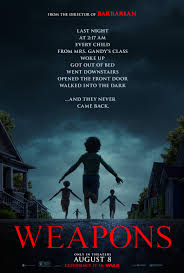
In Weapons, an entire classroom of children awaken in their beds at 2:17 am, leave their homes, and go missing. Only their teacher, Justine Gandy (Julia Garner), and a single student, Alex (Cary Christopher), were unaffected by this strange occurrence.

Justine bears the brunt of her community’s rage, but the real story unfolds quietly around Alex, and the coincidental arrival of his eccentric Aunt Gladys (Amy Madigan) into the family home.

Recounting plot details diminishes the wonderful WTF factor at work in Weapons. Letting the story open up and swallow you is the correct path forward, as the interested parties play their parts in nonlinear fashion, leading to another shit-crazy finale full of strange shots and unhinged images you aren’t likely to forget, such as a pack of possessed children pursuing Aunt Gladys through an entire neighborhood of homes and their stunned denizens.

As for Madigan’s very specific portrayal of the uniquely wicked Aunt Gladys, it’s the stuff of nightmares, a thermometer-shattering motherlode of malevolence. Small wonder that Creggar is busy working on a prequel based on Gladys’ origin story.

The horror that lives beneath the surface in Weapons, has to do with influence, and the impossibility of truly knowing one’s neighbors and what they’re up to. Anyone can wake up weaponized.

So basically, no one is safe, not even in their own home with Mom and Dad.

Creggar’s roundabout approach to the genre trumps traditional terror tropes at every turn. And that’s reason enough to to see Weapons, post-haste.

Found Footage: The Making of the Patterson Project (2025)

Layers upon layers upon layers.

Writer-director Max Tzannes opens Pandora’s Box in Found Footage: The Making of the Patterson Project, and what emerges is a very entertaining hot mess.

As we’ll see, there are no other outcomes possible.

See if you can follow this. Chase Bradner (Brennan Keel Cook), a low-budget filmmaker, makes commercials for used furniture salesman Frank (Dean Cameron).

Chase and Frank decide to make a found footage horror film about Bigfoot that somehow attracts the attention of a French documentary crew that tags along for the ride.

Funding for the movie comes from a $20,000 loan from Frank’s dotty client Betsey (Suzanne Ford), under the condition that her favorite actor, Alan Rickman, will play the lead. This becomes especially difficult when they figure out the actor passed away eight years before.

Chase and Frank are under the impression that they have secured the talents of Daniel Radcliffe to act in their feature, but he turns out to be a chick named Danielle (Rachel Alig).

The location, a remote time-share cabin belonging to the parents of Chase’s girlfriend and producer Natalie (Erika Vetter) appears to be inhabited by a demon from Sam Raimi’s Evil Dead universe.

Add to that a conundrum straight out of Waiting For Guffman, when it proves too dangerous to have anyone running about in the meticulously made Bigfoot costume after the first actor is shot by a hunter.

It’s to his credit that Tzannes manages to keep most of his subplot balls in the air. We actually care about Natalie’s growing frustration with Chase and her budding romance with his best friend Mitchell (Chen Tang), despite the silly chaos erupting all over the place.

Natalie gets respect points by being the only adult on the set capable of seeing the big picture, but her boyfriend is too preoccupied with his vanity project to pay attention.

And it all builds to what is called the Grand Jubilee, a surprisingly downbeat WTF ending, that explains why no bodies were ever found.

Yep. You should watch it.

There’s Something Wrong with the Children (2023)

Camping and looking after someone else’s kids? There’s a pair of concepts I find extremely disturbing!

Director Roxanne Benjamin and writers T.J. Cimfel and David White definitely know how to create the potential for a scary experience as they put two couples into a paranormal powder keg and hand a book of matches to some thoroughly corrupted moppets .

In There’s Something Wrong with the Children, Ben (Zach Guilford) and Margaret (Alisha Wainwright) are cabin camping with longtime friends Ellie (Amanda Crew) and Thomas (Carlos Santos), and their two kids Lucy (Briella Guiza) and Spencer (David Mattle).

While exploring some industrial ruins nearby, Lucy and Spencer become fascinated with a mysterious well found on the abandoned property. And by fascinated, I mean hypnotized and enslaved by a malevolent entity, who soon has the little rug rats doing the devil’s business, which primarily consists of driving Ben loony.

Not that they had to drive very far.

The most rightfully horrifying element at play here, are the malicious kids. Lucy gads about in a red devil hoody, evil-eyeing everyone in sight, and her younger brother shows genuine promise as a budding psycho killer.

There is much subtext given over to the topic of Breeding versus Not Breeding, and the latter wins by a country mile. As evidenced here by a reasonable body count, expanding your brood beyond the number two is like inviting Evil to share your campfire and sharpening them up a weenie stick.

Margaret becomes the de facto Final Girl and she’s not a very good one. But by the end of the movie it’s apparent that she has finally resolved any conflicts she may have had about family planning.

It’s a middling effort, let’s give it a C (see).

Ouija: Origin Of Evil (2016)

Prolific genre dynamo Mike Flanagan (Haunting of Hill House, Oculus, Dr. Sleep) created this prequel to Ouija (2014), and consensus opinion holds that Ouija: Origin of Evil, is far superior to its predecessor, though that may have more to do with the “meh” quality of the original material, rather than an auteur’s magic wand.

We travel back to the year 1967, where widowed mother Alice (Elizabeth Reaser) makes a modest living as a phony fortune teller, aided in her deceptive practices by daughters Lina (Annalise Basso) and Doris (Lulu Wilson).

Alice and eldest daughter Lina consider adding a Ouija board to their seance shtick, but all too quickly this occult stepping stone gets a grip on Doris, the youngest, resulting in a once-innocent child playing host to a number of spiritual entities, good and bad, including her late father (good) and a fiendish Nazi doctor (bad).

Flanagan and cowriter Jeff Howard weave together enough plot points for seven sweaters, but don’t sweat the details. Ouija: Origin of Evil is trademark Flanagan territory, as a fractured family faces a perilous paranormal presence coming from inside the house.

The technicians Flanagan puts to work on his projects are first-rate, intuitively establishing the tone, time, and terroir in which his particular domestic terror can take hold of hearts and spines.

Here, art director Alberto Gonzalez-Reyna and cinematographer Michael Fimognari mute the sunny ’60s California scenery in dark shades of green and gold, so wardrobe colors appear especially vivid and blooming—a keen counterpoint to the carnage being carried on behind closed doors at the local fortune teller’s house!

Despite being a minor entry in Mike Flanagan’s filmography, Ouija: Origin of Evil is a compelling and highly watchable film in its own right, and needn’t be seen in the company of any other Ouija entries in the hopes of additional illumination.

Abandoned (2022)

I’ve spent enough hours surfing for movie options that I can read a plot summary in about three seconds flat.

Thanks to several years of immersive research, I can now safely testify that approximately 70 percent of ALL horror entertainment must include a struggling couple with kids (living or recently deceased) relocating to a house of questionable repute in search of a fresh start.

Usually for such an egregious error in judgment, the hopefully healing family gets placed in a potentially paranormal hot seat, somehow stemming from one of the parent’s festering trauma.

Abandoned, which benefits from a thoroughly committed Emma Roberts as a new mom with a vicious case of postpartum depression, is another such film. Director Spencer Squire digs deep into the tortured psyche of Sara (Roberts), but doesn’t find anything new or interesting to report.

Sara and husband Alex (John Gallagher Jr) get a sweet deal on some rural acreage that comes with a bonus room that the previous owner only used for murder and suicide.

Their infant son Liam spends most of his screen (scream?) time lustily crying his lungs out, so we definitely sympathize with the rapidly disintegrating Sara.

The fragile lass gets saddled with a wailing infant all damn day, and has nothing better to do than figure out the dark history of the house while suffering a nervous breakdown.

Meanwhile, her veterinarian hubby is facing his own challenges putting down a pen of infected pigs, necessitating many hours spent out of the house, leaving Sara and little Liam to deal with a creepy neighbor (Michael Shannon), voices in the walls, and a bunch of missing toys (resulting in even more loud lamentations).

Alex euthanizing sickly swine is supposed to provide some kind of narrative parallel to Sara’s mentally unstable parenting style, but in the end, she accepts her crybaby and bravely snatches the little nipper back from a pair of feral kids.

Or maybe they’re ghosts, I dunno.

Even with Roberts giving it her deranged best, Abandoned never rises above the level of reheated leftovers, sadly lacking in flavor and originality. But if you’re not in a hurry it might inspire memories of better meals. I mean, movies.

Preferably ones not ruined by the presence of shrieking children.

Shining Vale (2022-23)

When I was a wee sprout, and the family hive mind turned to televisual entertainment options, I invariably lobbied for something “scary” or something “funny.”

My conservative-leaning, middle-class family would not have tolerated a moment of Shining Vale, and, truth be told, most of the adult humor would have been lost on me.

Shining Vale ran for two seasons on Starz, and was created by Jeff Astrof (The New Adventures of Old Christine, S#!* My Dad Says) and Sharon Horgan (Catastrophe, Bad Sisters). Over the course of 16 half-hour episodes, we get cozy with the Phelps family, possibly the most dysfunctional brood since the Bundys showed up on Fox in 1987.

Pat Phelps (Courteney Cox) is in a dark place. She wrote a tawdry, best-selling lady porn novel 14 years before, but the follow-up hasn’t been forthcoming, and her agent Kam (Merrin Dungey) is giving her an ultimatum: deliver the book or return the advance money.

When Pat has a torrid affair with a handyman, her stubbornly optimistic husband Terry (Greg Kinnear) packs the whole family off to a huge haunted house in rural Connecticut for a fresh start, much to the dismay of teenaged daughter Gaynor (Gus Birney).

“Mom boned some rando and now we have to move,” she grumbles. Though a freewheeling sexpot herself, Gaynor becomes the unwilling head of the household, after Mom and Dad lose their marbles.

Her younger brother Jake, a plus-sized introvert, is mostly concerned with gaining levels in his Virtual Reality game, and is slow to realize that change is afoot.

“Why did we move to a hotel?” he asks, upon arrival at the dilapidated Victorian mansion they will now call home.

Jake is also the butt of (fairly benign) fat kid jokes, but gets comic revenge by farting most foul at the worst possible moments. Seemingly an innocent, he gets his own demon adversary courtesy of VR.

Once the family is settled, Pat makes instant contact with the spirit of Rosemary (Mira Sorvino), the former owner of the house who went mad and hacked up her own family with an axe.

Rosemary does a little ghost-writing on Pat’s unfinished manuscript, and an uneasy partnership is formed when Kam digs the new, darker direction the book is taking.

This is all just tip of the iceberg stuff, as Pat, Terry, and the kids go through individual transformations of various magnitudes, while dealing with ghosts, cults, demonic possession, hereditary mental illness, and infidelity in a weird little town that features homegrown businesses like The Lucky Wiccan.

As for the title of the series, yes, there are many references to The Shining. For crying out loud, it’s about a writer trying her best not to chop everyone up with an axe.

For my money, Shining Vale is the funniest and finest-written domestic horror series since The Addams Family. The cast is flawless. You’re welcome.

But what happened to Season 3?

The Secret Of Crickley Hall (2012)

Sounds like a Hardy Boys Mystery that never made it to the editing stage, but The Secret Of Crickley Hall is a cracking good BBC miniseries (three one-hour episodes) based on the book by James Herbert.

Written and directed by Dr. Who alum Joe Ahearne, the story straddles past/present timelines, spilling the dramatic details of the Caleigh family, who are hoping for a fresh start in the North of England after the disappearance of their son.

The idea of turning the page on tragedy seems highly unlikely at this location, as Crickley Hall turns out to be a former orphanage that was overseen by seriously damaged WW I veteran Augustus Cribben (Douglas Henshall) and his seething sister Magda (Sarah Smart).

In keeping with the popular paranormal theory that those who’ve experienced loss are more sensitive to the plight of the deceased (The Changeling, et al), motivated mom Eve Caleigh (Suranne Jones), intuits that her still-missing child is somehow connected with the orphans who died in a flood at Crickley Hall during WW II.

This leads to a parallel narrative from the past about Nancy Linnet (Olivia Cooke), a determined young teacher hired to educate the wayward waifs of Crickley Hall. Instead, she uncovers terrible abuses visited upon the children by the cruel Cribben siblings, who unfortunately remain above suspicion in their community.

With a few splashes of redemption, revenge, and romance, and featuring a realistically frightening ghost, The Secret Of Crickley Hall is well-above-average haunted house hoopla handled by a cast of top drawer talent that includes David Warner and Donald Sumpter in crucial character roles.

Ghosts may or may not be scarier in the English countryside, but their tales fit this bleak territory like a black glove.

Recommended!

The Damned (2024)

Cinema doesn’t get more international than The Damned, a UK-Belgium-France-Iceland coproduction, filmed in the furthest reaches of Iceland’s Westfjord’s region, as convincing a frozen hellscape as you’re likely to find this side of Ice Station Zebra.

The Damned takes place in the latter part of the 19th century in a remote arctic fishing camp, where a small but determined band of anglers grind out a meager existence wrangling fish from the unforgiving sea.

The recently widowed Eva (Odessa Young), the owner of the fishing boat (and possible Vermeer model), calls the shots around the camp, though she often appears lost and childlike in the presence of her crusty crew.

One particular day, they spy a ship foundering on the rocks, and after some debate, decide that they can’t rescue survivors due to their own lack of food and supplies.

It’s this weighty decision that places the crew in metaphysical danger, as superstitions about vengeful drowned sailors take root in the hearts and minds of the simple fisher folk.

Devotees of the winter horror sub-genre will be right at home amongst the wind, snow, and angry tides, as reason gives way to fear and guilt in the face of powerful elemental forces, all captured by Eli Arenson’s breathtaking cinematography. Skating effortlessly between warm firelight intimacy and the brutal splendor of the Icelandic tundra, the camerawork underscores nature’s icy indifference to human ambition.

Director Thordur Palsson allows the chilly isolation to exacerbate the dread that haunts the crew until something has to give—in this case, sanity. The Damned delivers demons that we didn’t expect, in a winter wonderland of lost souls on thin ice.

Stoke the fire and get another blanket in case of the shivers.

Heretic (2024)

This is a different Hugh Grant, though there is a passing resemblance to the rom-com Don Juan with the aw-shucks manner.

Written and directed by Scott Beck and Bryan Woods, Heretic is another film set during a storm that makes the most of its few sets and small cast. Sister Paxton (Chloe East) and Sister Barnes (Sophie Thatcher) are young Mormon missionaries on bicycles visiting the home of Mr. Reed (Grant), a seemingly absent-minded scholar with an interest in religion and spiritual knowledge.

An approaching deluge induces the girls to accept Mr. Reed’s hospitality and enter his surprisingly roomy cottage. He mentions that his wife is in the kitchen making blueberry pie!

The front door closes and the camera backtracks down the foot path that approaches the house. It seems like a long way from the road.

Trap sprung.

Mr. Reed proves to be a highly intelligent and extremely well-read individual, who goes from asking questions about Mormonism to lecturing the girls on his own personal quest for the “one true religion.”

At times, he is a professor impressively expounding on several subjects at once to a class of freshmen, and Barnes and Paxton soon find themselves in over their heads as the subject matter becomes increasingly uncomfortable.

The time passes in conversation and the smell of blueberry pie fills a cozy sitting room that begins to look suspiciously normal.

Beck and Woods do a masterful job of gradually goosing up the tension without turning Mr. Reed into Dracula. Can this old duffer even be considered a physical threat?

Reed mostly remains reasonable, but the red flags are starting to pile up. Cell phones don’t work and the front door is on a time lock that won’t open till morning (!), so if the girls want to leave (and they’re always welcome to), they’ll have to exit through the back of the house.

Credit must be given to Chloe West and Sophie Thatcher for instilling their characters with brains and backbones, the ability to think and reason even when their situation hits nightmare territory.

As for Grant, the charmingly awkward Brit with the hots for Andie McDowell is a faded lobby poster, but he can still badger and beguile a captive audience. The ingratiating tendencies and ability to spin complex thoughts into amusing, provocative word bubbles remains intact in Heretic, and Grant digs deep to reach a rich vein of menace.