Dark Skies (2013)

You can’t run, you can’t hide.

There is an air of grim inevitability that permeates Dark Skies, the feeling that any precautions taken are futile, because the extraterrestrial enemy faced by the Barrett family is simply beyond their comprehension.

“People think of aliens as these beings invading our planet in some great cataclysm, destroying monuments, stealing our natural resources,” states UFO expert Edwin Pollard (J.K. Simmons).

“But it’s not like that at all. The invasion already happened.”

The Barretts are a normal, run-of-the-mill family just trying to make ends meet. Mom Lacy (Keri Russell) is a real estate agent in a slump; Dad Daniel (Josh Hamilton) is an unemployed architect working on his anger issues. Older son Jesse (Dakota Goyo) has a crush on a neighborhood girl, while younger son Sammy (Kadan Rockett) is more of a sensitive introvert.

Without warning, weird shit starts happening. Food and garbage gets strewn around the kitchen. Household items are stacked in geometric configurations. Photographs disappear. Swarms of starlings hit the house.

Even more disturbing, episodes of sleepwalking plague various Barretts, resulting in a tightening noose of paranoia and distrust between Lacy and Daniel, who despite their dire financial circumstances, continue to invest in pricey home security measures that prove fruitless.

After enduring a series of inexplicable events, Lacey reaches out via the internet to Pollard, a man who has been visited by aliens known as “the Grays” since he was a youngster.

“I don’t even fight them anymore,” he tells Lacey and Daniel, and further informs them that one of their children is being groomed for abduction, sooner rather than later,

Instead of providing the parents with hope, all Pollard can suggest is to fight back and hope the extraterrestrials get frustrated and move on to other specimens.

Writer-director Scott Stewart dispenses with the usual CGI wonder parade, and keeps things low-tech, naturalistic, and increasingly tense. The absence of special effects adds a mundane realism to Dark Skies, that sharply contrasts with the utterly unknowable nature of the Grays.

“What answer would a lab rat understand from a scientist in a white coat putting electrodes in its brain, giving it cancer?” Pollard asks.

Best of all, Dark Skies is a riveting example of story craft that shows, rather than tells us what we need to know. Even so, answers are few and far between.

Heavily recommended.

Arcadian (2024)

Once upon a time…

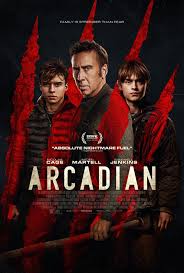
Told as a post-apocalyptic fairy tale, Arcadian stars Nicolas Cage as an anxious father of twins trying to navigate single parenthood while fighting off vicious monsters come nightfall.

Bummer. At least he doesn’t have to drive them to soccer practice.

For 15 years, Paul (Cage, in an extremely understated role) has forged a hardscrabble existence putting food on the table for his adopted sons Thomas (Maxwell Jenkins) and Joseph (Jaeden Martell), whom he rescued as infants during the initial collapse of civilization.

Holed up in a remote farmhouse, Paul teaches the lads everything they need to know about off-the-grid survival, most importantly, being home by sundown to secure their hacienda from nightly visits by protean creatures with sharp claws and turbo-charged choppers that show up like broke relatives at suppertime.

Joseph is a homeschooled DaVinci, intuitively figuring out how things work and devising ingenious inventions. His brother Thomas has the hots for Charlotte (Sadie Soverall), a lovely lass who lives on a farm some distance away, causing the crushed-out kid to test the limits of Paul’s strict curfew.

Arcadian director Benjamin Brewer and writer Mike Nilon tell a simple story as simply as possible. When Thomas visits Charlotte on her farm, they play a game in which they have to explain how the world ended in 10 seconds. Charlotte theorizes that alien insects infected humanity, and Thomas says that a purple haze turned people into werewolves.

After providing us with that handy exposition summary, Thomas realizes he’s been wooing Charlotte for too long, and is forced into a cross-country sprint to get his ass home before dark. He ends up unconscious at the bottom of a ravine, necessitating a rescue from Paul.

Poor old Dad barely survives an explosive confrontation with the burrowing alien wolf bugs, and now it’s up to the boys to adapt and survive on their own. Arcadian works best as a coming-of-age story, with the brothers painfully applying the lessons they’ve learned about their nocturnal enemies.

Jospeh is methodical, taking careful notes about the intensity and duration of the attacks. Thomas, ruled by his passions, favors direct action, but benefits from listening to his wiser sibling.

The action is occasionally marred by poor lighting and clumsy edits. Paul, finding Thomas at the bottom of a crevasse, suddenly appears at his son’s side after finding some alternate route down.

The ensuing battle with a suddenly subterranean foe is almost all quick cuts with a shaky camera in the darkness so we don’t really figure out what happened to Paul until the sun comes up.

The monsters are formidable, though vague, never holding still long enough to get a gander at. Their inexplicable hive-mind decision to assemble into a giant flaming attack wheel is certainly a head-scratcher.

Ultimately, the pros of a fast-moving story outweigh the clunky cons in Arcadian, and you will be sufficiently entertained.

The end.

Monolith (2022)

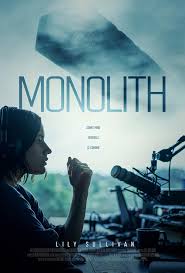
An investigative journalist (Lily Sullivan) has suffered a career setback. Hoping to salvage her reputation with a new podcast about unexplained phenomenon, she retreats to her parents’ posh pad in the Australian wilderness to brainstorm some ideas.

“I need a story,” she tells her boss on the phone. To paraphrase Apocalypse Now, for her sins, they gave her one.

Monolith, written by Lucy Campbell and directed by Matt Vesely, is confined to one location, with a single actress interacting with other characters online and over the telephone.

The journalist, at first reluctantly, and then with single-minded vigor, pursues a juicy conspiracy story revolving around the mysterious distribution of “black bricks” that exert a kind of power over those who receive them.

As she assembles and submits episodes of her podcast, her listeners begin to take notice, and soon her inbox is full of testimony from people who’ve had experiences with these bricks, the effects of which include visions, loss of appetite, cognitive decline, and occasionally a fatal illness.

As often happens with conspiracy cases, the reporter gets swept up and goes down a very deep, dark rabbit hole, that originates surprisingly close to home.

Lily Sullivan dramatically carries Monolith and she’s quite up to the task, as her increasingly odd situation requires a fully stocked arsenal of emotional firepower. She threatens, cajoles, pleads, and does a remarkable job inhabiting what appears to be a nervous breakdown of some sort, that also could be a fight for her very soul.

Sullivan’s transformation from a sulky ego-driven internet personality to an obsessed participant in her own developing story, is astonishing and completely believable.

Well worth the watch, in my opinion.

Alien: Covenant (2017)

Yech!

Even with Ridley Scott directing, Alien: Covenant is another flop from a franchise that needs fresh blood more than Dracula.

Maybe we should blame Michael Fassbinder who gets to chew twice as much scenery in the dual role of Walter (the helpful, supportive android) and David (the amoral narcissist android).

Ten years after the events of Prometheus, which was also terrible, a new crew of explorers and sleeping deep-space colonists get a fragmented distress signal from a nearby habitable planet.

Surprise! It’s a trap! Didn’t see that one coming, did you?

Though there is space allotted for character development, nobody in the crew stands out from the usual trope type, except perhaps for Tennessee (Danny McBride), a good ol’ boy pilot in a beat-up cowboy hat.

See also: Lisa Standing (Kimberly Scott) in James Cameron’s The Abyss (1989).

There’s Captain Oram (Billy Crudup), a nervous newbie destined for failure; his second-in-command, Daniels (Katherine Waterston), still grieving her recently deceased husband, and Walter (Fassbinder), the android science officer who does most of the work.

We also get a bunch of Shemps, including Callie Hernandez, with very little to do other than perish.

Alien: Covenant attempts to re-create that ol’ black magic, but writers John Logan and Dante Harper spend too much time constructing familiar-looking scenes that hopefully resonate with long-suffering fans of the series. Consequently, there isn’t much of a story to hang your hat on, other than David’s mad ambitions.

There are elements aplenty wrangled from the first two (best) Alien films, including face huggers, gory birth sequences, automatic weapons, and renegade robots, but these never coalesce into anything able to stand on its own.

There’s the crew. The ship. The planet. The androids. Once again, the xenomorphs become an afterthought. In the final analysis, there is too much android angst and not nearly enough creature chaos, though it is a better-looking film than Prometheus.

The Alien series is stuck in a deep-space rut and could definitely use a change of scenery. I’ll let you know if there’s any intelligent life onboard after Alien: Romulus.

Nope (2022)

Maybe the world isn’t ready for a sci-fi/horror Western starring a nonwhite cast, but I sure as hell am.

Writer-director Jordan Peele muses on a number of subjects in Nope, some in subtle fashion, others with blunt force trauma.

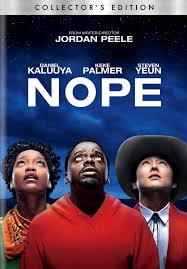
Otis Junior (OJ, played by Daniel Kaluuya) is a hard-working fella who runs the Haywood family horse training business somewhere in the California desert, following the recent passing of his father (Keith David) under mysterious circumstances.

His wayward sister Emerald (Keke Palmer) is trying to help out, but the fast-talking urbanite hype gal and the plainspoken cowboy are clearly not on the same page when it comes to getting work, resulting in a blown TV audition for one of their horses.

Not too far away, Ricky “Jupe” Park (Steven Yeun), a former child actor, runs an amusement park-frontier theme town. Park, a frequent customer of Haywood’s Hollywood Horses, lets OJ know that he would be interested in buying his entire operation.

These are the dramatic bones that make up the story, and Peele does his utmost to flesh out the situation by sensibly introducing creatures from another world on safari for exotic culinary specimens.

Time to cowboy up!

Peele delivers a ton of thematic groceries to the table, and it’s good eating. The pursuit of fame regardless of personal danger, appears to be his thesis statement, as both OJ and Ricky Park want to exploit the alien menace that hovers nearby for their own gain.

Fortunately, OJ comes to his senses. Others aren’t so lucky.

Nope stretches over two hours but Peele keeps everything smelling fresh. He definitely flexes a fondness for John Ford and Steven Spielberg, with bright, postcard vistas from the mysterious desert contrasted with tight indoor framing that clearly defines two different worlds—tamed and untamed.

Peele’s stinging observations about the invisibility of blacks and other minorities in the history of the motion picture industry are squarely on topic, and he remedies this historical omission with a brave black cowboy hero for us to root for.

When was the last time we saw one of those outside of Blazing Saddles?

Monsters (2010)

British filmmaker Gareth Edwards is nominated for two academy awards this year for The Creator, a provocative and timely sci-fi tale about Artificial Intelligence.

In addition to directing a well-received installment of the Star Wars saga (Rogue One, 2016), Edwards made an auspicious debut with Monsters, a bit of speculative fiction that imagines a not-too-distant future where humanity has lost a chunk of Central America to alien life forms brought to Earth from a deep-space NASA probe six years previous.

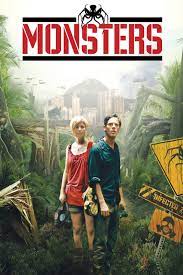
Andrew Kaulder (Scoot McNairy) is a freelance photojournalist trying to get photos of the mysterious creatures that have “infected” Costa Rica and Guatemala, and thus making travel in the region dicey and expensive.

He is sidetracked from his quest for fame and fortune with an offer from a media mogul to escort the latter’s runaway daughter Sam (Whitney Able) through the Infected Zone and back to the United States.

What follows is a gritty survival film with a credible romantic subplot about two strangers who must learn to trust each other under fire if they’re to make it out of an embattled landscape, as soldiers try to contain a mounting threat from tentacled terrors from beyond the stars.

Though the alien menace appears infrequently, its presence is felt constantly, reinforced by scenes of people in small villages watching news reports of monstrous destruction.

“You leave them alone, they’ll leave you alone,” comments one local.

We’ve seen this movie . Most of the time the danger is posed from warring nations or an impending natural disaster.

Writer-director-editor-FX guy Edwards juxtaposes gigantic octopoids wreaking havoc into the background, but this dark journey of discovery seen through the eyes of two stunned civilians could be about any set of fleeing refugees.

Kaulder and Sam must negotiate with locals for risky transportation options that are rapidly shrinking in the face of alien aggression. Eventually they are forced to go on foot, bearing mute witness to eerie tableaux of fallen creatures and aircraft alike, that are staged for maximum shock and awe.

Before Gareth Edwards takes a turn at the Oscars, Monsters offers an opportunity to see noteworthy work from an emerging artist. I would advise you to do so.

No One Will Save You (2023)

If you’re a fan of witty, acerbic dialogue, this won’t be your cup of tea.

Instead, No One Will Save You is a master class in visual storytelling from writer-director Brian Duffield (Underwater, The Babysitter, Love and Monsters) who puts his leading lady Kaitlyn Dever through one helluva wringer, all without a single word of exposition.

Through views both intimate and isolating, we meet Brynn Adams (Dever) a young woman with promising artistic talent who lives a solitary existence on the outskirts of town.

On the occasion when she ventures into her small community, it is quite apparent that Brynn is not a popular citizen, as her appearance invokes scorn and derision, all conveyed by a floating camera that hovers nearby like a curious housefly.

So who does Brynn turn to when she discovers that someone has broken into her house? What measures will the nervous girl with the bad reputation take when it appears her intruder is not of this world?

There’s barely a soundtrack to serve up emotional cues—mostly a few ominous Bernard Hermann orchestral swells—so we’re as surprised as Brynn when aliens shows up prowling her pad.

No One Will Save You sucks in the viewer like a Texas Twister from the opening frame. Brynn is a friendless, reluctant heroine with a tragic past who nonetheless steps up when her home is threatened by ambitious extraterrestrials.

For the majority of the running time, it appears that the thing to do is cheer for Brynn, and remain hopeful. This course of action gets increasingly difficult when Duffield zooms out from her personal combat to reveal the state of the rest of society.

Soon, the question becomes, why fight it? Maybe subjugation isn’t such a bad deal. It could even be an effective way to work through crippling anxiety and childhood trauma.

Filmmaker Duffield has fashioned something rather remarkable with No One Will Save You. It’s a silent, sci-fi, home invasion thriller with heavy implications for us to consider, that still manages to be big-ticket entertainment.

Are we the bad guys here? If we weren’t so freaked out about defending our castles, maybe we’d learn something.

Big-time recommendation from this terrestrial citizen.

Ariel Phenomenon (2022)

Forgive me for straying somewhat far afield from my usual cadre of killers and creatures, on behalf of Ariel Phenomenon, a riveting BBC documentary by Randall Nickerson. To be honest, I feel I’d be forsaking my curatorial responsibilities if I were to ignore what might be the most important film of all time.

If you believe the testimony from the dozens of Zimbabwean schoolchildren, who reported contact with an alien craft and its strange crew, then you have no choice but to accept the idea that we definitely aren’t alone in the universe.

Shouldn’t be difficult if you grew up with Star Trek.

The incident took place in 1994, at a parochial learning center in rural Zimbabwe called Ariel School. As many as 60 students on recess witnessed the appearance of a large silver saucer in the jungle brush near their playground.

The vessel was guarded by small men, with large almond-shaped eyes, dressed in skintight black material. Though the encounter couldn’t have taken more than 15 minutes, some of the schoolchildren claim to have communicated telepathically with one of the aliens.

The kids, mostly between the ages of six and twelve, were asked to draw pictures of what they saw, with the resultant artwork revealing an unnerving consistency.

All this might have gone unnoticed, but a BBC reporter named Tim Leach got wind of the story, leading to the arrival in Zimbabwe of Dr. John Mack, a Pulitzer Prize winning psychiatrist from Harvard, who agreed to interview several of the children.

His findings? These children are telling the truth.

Consider those implications, why dontcha?

Through an abundance of documentation connected to the incident and investigation, director Nickerson presents a provocative picture of a society (just 20-odd years ago) that isn’t ready to consider the possibility of extraterrestrial contact.

Dr. Mack became a punchline for media pundits, portraying the noted scientist as a crackpot who believes in little green men. As a result of the controversy stirred up by Mack’s conclusions, Harvard publicly withdrew its support for his research.

Mack authored a book on the subject in 1999, Passport to the Cosmos: Human Transformation and Alien Encounters.

As for the students themselves, we see them interviewed in historical footage with Dr. Mack and then again later as adults, still unshaken in their conviction that something unique and wonderful happened to them.

In the end, Ariel Phenomenon makes a compelling case for visitors from outer space. And just like Star Trek, where the Vulcans come to Earth and wisely advise us not to annihilate each other, these travelers bear a message about human devotion to technology.

With Artificial Intelligence knocking on our door, we’d best pay attention.

Significant Other (2022)

Camping makes everything worse. Debate me.

If you’re a real horror fan, you know it’s true. Significant Other is just another case study in the facts of life.

Written and directed by Dan Berk and Robert Olson, the movie also offers relationship advice on how not to upset your boyfriend when he’s been body snatched by an alien scout checking out Earth as a possible invasion site.

Harry (Jake Lacy) convinces his anxiety ridden girlfriend Ruth (Maika Monroe) to go on a camping and hiking weekend. The communication between Harry, a hearty, upbeat outdoorsman, and his dour partner is not good.

For the first quarter of the movie, Harry ignores and dismisses every word from Ruth, which leads to a really awkward marriage proposal that puts a damper on the campers.

Ruth storms off to be alone. Harry goes for a walk to clear his head. Both make discoveries of the Third Kind, and when they meet up again, they’re not the same people.

Harry plays host to an alien consciousness, and is as surprised as anyone that his feelings for Ruth are complicating his mission.

Significant Other almost ventures into romantic comedy territory, because this relationship turns toxic in a big way, leading to a modest blood bath. Harry falls off a cliff, gets eaten by a shark, and has his head smashed into pudding, but he’s harder to kill than a cockroach.

Finally, Ruth ends up in Harry’s shoes and seemingly outwits the cosmic conqueror, making her getaway. It’s a small victory, as it turns out, because like shitty boyfriends, there are always plenty of invaders to go around.

Recommended? You betcha.

Prey (2022)

About 20 minutes into Prey, I made an offhand comment to my wife.

“This seems more like a Disney movie than a horror movie.”

A few momnets later, Barb replied, “Good call. It’s from 20th Century Studios, owned by Disney.”

Therein lies the rub.

Co-writer and director Dan Trachtenberg (10 Cloverfield Lane) has assembled a violent, R-rated action movie that nonetheless features a headstrong and resourceful heroine who isn’t satisfied with her gender-defined role in life.

Prey also provides new management for the Predator series, which has been floundering since Schwarzenegger flew the coop. Here, an interstellar big-game hunter makes a landing in early 18th century America, amongst a tribe of sturdy Comanches.

Naru (Amber Midthunder), is a bad-ass hunter and tracker who wants to be a warrior. Unfortunately, she lives in the shadow of her older brother Taabe (Dakota Beavers), the tribe Alpha Male.

In a refreshing turn, Taabe is actually supportive of his sister, speaking highly of her skills to his fellow hunters.

His encouragement pays off, as Naru is the only one with the smarts to figure out that whatever is killing nearby wildlife is not a bear or a mountain lion.

Eventually, Naru gets her most fervent wish: to hunt something that is simultaneously hunting her.

Prey is visually stimulating and full of arboreal wonder as the tale and the landscape itself unfold without the presence of Western man—except for some dastardly French trappers who get in the way of the Predator’s safari.

As for the main monster itself, we don’t get any major developments other than their hunting technology is more rudimentary than that one time with Arnold.

Overall, it seems a less formidable opponent, which takes some of the steam out of the narrative.

Equally bothersome, there’s CGI work involving some of the animal fight scenes (Predator versus Bear, Naru versus Mountain Lion) that seems crudely rendered and rather clunky. It makes you think, for a second or two, that the whole picture must be a bloody animated feature, rather than live action.

Yet the Disney thematic parachute is unmistakably present in Prey, and the result is an uneasy alliance between dueling Market Powers (Action Fans versus Disney Moral Authority).

My wife liked it more than I did.

Note: Naru has a brave dog sidekick that doesn’t get killed.