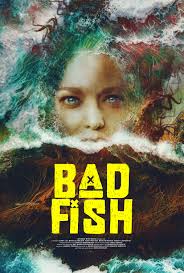
If Shadow Over Innsmouth was adapted as a Grade-Z horror film, it might play out something like Bad Fish, written and directed by West Coast indie filmmaker Brad Douglas.
Filmed for measly money over a two-year period in locations near Brookings, Oregon and Crescent City, California, Bad Fish follows alcoholic marine biologist John Burton (Jonny Lee) on a quest for clues in a remote coastal community where fishermen’s body parts keep washing ashore.
After confabbing with Sheriff Porter (Mark Schneider), Burton examines a mangled torso and concludes that this was no boating accident. But it wasn’t a shark either, he decides.
Giant squid? Not known to inhabit these water. And what’s driving away all the salmon?
Turns out it’s all the work of Abby (Abby Wathen), the beguiling bartender at the local boozer, who comes with a whopper of a backstory. Seems when she isn’t mixing martinis, Abby is the leader of a nasty deep-water cult in search of fresh blood (and other fluids).
Despite a few too many talky scenes enacted by amateur thespians, Bad Fish is an admirable, atmospheric, small-town mystery that concludes with Burton getting left without a leg to stand on in a very bad domestic situation.
Not to worry, Douglas has Bad Fish II in the works, so maybe someone will throw the poor sap a lifeline.
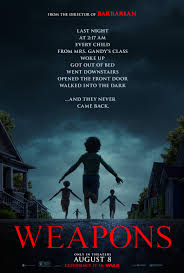
If we examine Weapons alongside Zach Cregger’s previous oddball odyssey, Barbarian, what we’re seeing is the emergence of a different school of narrative filmmaking, in which a mystery morphs into a profound horror.
Both movies feature people disappearing under outré circumstances, and the subsequent investigation, told Pulp Fiction-like in chapters from assorted points of view, reveals the “monster” lurking at the center.
In Weapons, an entire classroom of children awaken in their beds at 2:17 am, leave their homes, and go missing. Only their teacher, Justine Gandy (Julia Garner), and a single student, Alex (Cary Christopher), were unaffected by this strange occurrence.
Justine bears the brunt of her community’s rage, but the real story unfolds quietly around Alex, and the coincidental arrival of his eccentric Aunt Gladys (Amy Madigan) into the family home.
Recounting plot details diminishes the wonderful WTF factor at work in Weapons. Letting the story open up and swallow you is the correct path forward, as the interested parties play their parts in nonlinear fashion, leading to another shit-crazy finale full of strange shots and unhinged images you aren’t likely to forget, such as a pack of possessed children pursuing Aunt Gladys through an entire neighborhood of homes and their stunned denizens.
As for Madigan’s very specific portrayal of the uniquely wicked Aunt Gladys, it’s the stuff of nightmares, a thermometer-shattering motherlode of malevolence. Small wonder that Creggar is busy working on a prequel based on Gladys’ origin story.
The horror that lives beneath the surface in Weapons, has to do with influence, and the impossibility of truly knowing one’s neighbors and what they’re up to. Anyone can wake up weaponized.
So basically, no one is safe, not even in their own home with Mom and Dad.
Creggar’s roundabout approach to the genre trumps traditional terror tropes at every turn. And that’s reason enough to to see Weapons, post-haste.
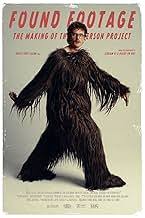
Writer-director Max Tzannes opens Pandora’s Box in Found Footage: The Making of the Patterson Project, and what emerges is a very entertaining hot mess.
As we’ll see, there are no other outcomes possible.
See if you can follow this. Chase Bradner (Brennan Keel Cook), a low-budget filmmaker, makes commercials for used furniture salesman Frank (Dean Cameron).
Chase and Frank decide to make a found footage horror film about Bigfoot that somehow attracts the attention of a French documentary crew that tags along for the ride.
Funding for the movie comes from a $20,000 loan from Frank’s dotty client Betsey (Suzanne Ford), under the condition that her favorite actor, Alan Rickman, will play the lead. This becomes especially difficult when they figure out the actor passed away eight years before.
Chase and Frank are under the impression that they have secured the talents of Daniel Radcliffe to act in their feature, but he turns out to be a chick named Danielle (Rachel Alig).
The location, a remote time-share cabin belonging to the parents of Chase’s girlfriend and producer Natalie (Erika Vetter) appears to be inhabited by a demon from Sam Raimi’s Evil Dead universe.
Add to that a conundrum straight out of Waiting For Guffman, when it proves too dangerous to have anyone running about in the meticulously made Bigfoot costume after the first actor is shot by a hunter.
It’s to his credit that Tzannes manages to keep most of his subplot balls in the air. We actually care about Natalie’s growing frustration with Chase and her budding romance with his best friend Mitchell (Chen Tang), despite the silly chaos erupting all over the place.
Natalie gets respect points by being the only adult on the set capable of seeing the big picture, but her boyfriend is too preoccupied with his vanity project to pay attention.
And it all builds to what is called the Grand Jubilee, a surprisingly downbeat WTF ending, that explains why no bodies were ever found.
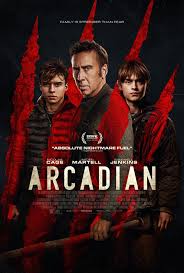
Told as a post-apocalyptic fairy tale, Arcadian stars Nicolas Cage as an anxious father of twins trying to navigate single parenthood while fighting off vicious monsters come nightfall.
Bummer. At least he doesn’t have to drive them to soccer practice.
For 15 years, Paul (Cage, in an extremely understated role) has forged a hardscrabble existence putting food on the table for his adopted sons Thomas (Maxwell Jenkins) and Joseph (Jaeden Martell), whom he rescued as infants during the initial collapse of civilization.
Holed up in a remote farmhouse, Paul teaches the lads everything they need to know about off-the-grid survival, most importantly, being home by sundown to secure their hacienda from nightly visits by protean creatures with sharp claws and turbo-charged choppers that show up like broke relatives at suppertime.
Joseph is a homeschooled DaVinci, intuitively figuring out how things work and devising ingenious inventions. His brother Thomas has the hots for Charlotte (Sadie Soverall), a lovely lass who lives on a farm some distance away, causing the crushed-out kid to test the limits of Paul’s strict curfew.
Arcadian director Benjamin Brewer and writer Mike Nilon tell a simple story as simply as possible. When Thomas visits Charlotte on her farm, they play a game in which they have to explain how the world ended in 10 seconds. Charlotte theorizes that alien insects infected humanity, and Thomas says that a purple haze turned people into werewolves.
After providing us with that handy exposition summary, Thomas realizes he’s been wooing Charlotte for too long, and is forced into a cross-country sprint to get his ass home before dark. He ends up unconscious at the bottom of a ravine, necessitating a rescue from Paul.
Poor old Dad barely survives an explosive confrontation with the burrowing alien wolf bugs, and now it’s up to the boys to adapt and survive on their own. Arcadian works best as a coming-of-age story, with the brothers painfully applying the lessons they’ve learned about their nocturnal enemies.
Jospeh is methodical, taking careful notes about the intensity and duration of the attacks. Thomas, ruled by his passions, favors direct action, but benefits from listening to his wiser sibling.
The action is occasionally marred by poor lighting and clumsy edits. Paul, finding Thomas at the bottom of a crevasse, suddenly appears at his son’s side after finding some alternate route down.
The ensuing battle with a suddenly subterranean foe is almost all quick cuts with a shaky camera in the darkness so we don’t really figure out what happened to Paul until the sun comes up.
The monsters are formidable, though vague, never holding still long enough to get a gander at. Their inexplicable hive-mind decision to assemble into a giant flaming attack wheel is certainly a head-scratcher.
Ultimately, the pros of a fast-moving story outweigh the clunky cons in Arcadian, and you will be sufficiently entertained.
When the creative team in charge of a film project gets carried away trying to please each and every imagined audience member, the results are usually a load of crap.
The Gorge, written by Zach Dean and directed by Scott Derrickson, seemingly utilizes this kitchen-sink approach, tossing a zesty, messy melange of romance, action, horror, and conspiracy theory that’s a just a tad over two hours in length.
And somehow it works pretty damn well as a super-engaging popcorn flick!
Levi (Miles Teller) and Drasa (Anya Taylor-Joy) are two highly trained snipers from different countries assigned guard duty at opposite watch towers on either side of the enormous and mysterious titular gorge.
The mercenaries are armed to the hilt and instructed not to contact each other, but the need for company proves too much for Levi and Drasa, and soon they’re flirtatiously firing rounds, demonstrating their skill and accuracy, while a Ramones record plays.
“I guess this qualifies as a Meet Cute,” I whisper to Mrs. Sharky.
Though separated by a chasm that occasionally spits out monstrous hybrid humanoids called Hollow Men, the hired guns overcome logistical challenges and use a zip line to hook up and become not just a couple, but an elite and capable survival team.
This comes in handy when their military handler (Sigourney Weaver) decides they can no longer be trusted.
Once the protagonists figure out that this version of the future has no future, their decision to join forces is logical and inevitable. Besides, they’re a hot couple, and Drasa is clearly the aggressor, eventually rescuing Levi from an unexpected plummet into the abyss.
Through waves of decent monster attacks and fabulous fire fights, we actually grow fairly attached to Levi and especially the badass Drasa, which helps keep the viewer grounded during the mood shifts and infrequent talky interludes.
The Gorge is also a very impressive example of world-building, an important component to any successful popcorn operation. The mise-en scene has been carefully considered providing a foundation of future realism that looks like it was designed by the prison industrial complex.
Prolific genre dynamo Mike Flanagan (Haunting of Hill House, Oculus, Dr. Sleep) created this prequel to Ouija (2014), and consensus opinion holds that Ouija: Origin of Evil, is far superior to its predecessor, though that may have more to do with the “meh” quality of the original material, rather than an auteur’s magic wand.
We travel back to the year 1967, where widowed mother Alice (Elizabeth Reaser) makes a modest living as a phony fortune teller, aided in her deceptive practices by daughters Lina (Annalise Basso) and Doris (Lulu Wilson).
Alice and eldest daughter Lina consider adding a Ouija board to their seance shtick, but all too quickly this occult stepping stone gets a grip on Doris, the youngest, resulting in a once-innocent child playing host to a number of spiritual entities, good and bad, including her late father (good) and a fiendish Nazi doctor (bad).
Flanagan and cowriter Jeff Howard weave together enough plot points for seven sweaters, but don’t sweat the details. Ouija: Origin of Evil is trademark Flanagan territory, as a fractured family faces a perilous paranormal presence coming from inside the house.
The technicians Flanagan puts to work on his projects are first-rate, intuitively establishing the tone, time, and terroir in which his particular domestic terror can take hold of hearts and spines.
Here, art director Alberto Gonzalez-Reyna and cinematographer Michael Fimognari mute the sunny ’60s California scenery in dark shades of green and gold, so wardrobe colors appear especially vivid and blooming—a keen counterpoint to the carnage being carried on behind closed doors at the local fortune teller’s house!
Despite being a minor entry in Mike Flanagan’s filmography, Ouija: Origin of Evil is a compelling and highly watchable film in its own right, and needn’t be seen in the company of any other Ouija entries in the hopes of additional illumination.
I’ve spent enough hours surfing for movie options that I can read a plot summary in about three seconds flat.
Thanks to several years of immersive research, I can now safely testify that approximately 70 percent of ALL horror entertainment must include a struggling couple with kids (living or recently deceased) relocating to a house of questionable repute in search of a fresh start.
Usually for such an egregious error in judgment, the hopefully healing family gets placed in a potentially paranormal hot seat, somehow stemming from one of the parent’s festering trauma.
Abandoned, which benefits from a thoroughly committed Emma Roberts as a new mom with a vicious case of postpartum depression, is another such film. Director Spencer Squire digs deep into the tortured psyche of Sara (Roberts), but doesn’t find anything new or interesting to report.
Sara and husband Alex (John Gallagher Jr) get a sweet deal on some rural acreage that comes with a bonus room that the previous owner only used for murder and suicide.
Their infant son Liam spends most of his screen (scream?) time lustily crying his lungs out, so we definitely sympathize with the rapidly disintegrating Sara.
The fragile lass gets saddled with a wailing infant all damn day, and has nothing better to do than figure out the dark history of the house while suffering a nervous breakdown.
Meanwhile, her veterinarian hubby is facing his own challenges putting down a pen of infected pigs, necessitating many hours spent out of the house, leaving Sara and little Liam to deal with a creepy neighbor (Michael Shannon), voices in the walls, and a bunch of missing toys (resulting in even more loud lamentations).
Alex euthanizing sickly swine is supposed to provide some kind of narrative parallel to Sara’s mentally unstable parenting style, but in the end, she accepts her crybaby and bravely snatches the little nipper back from a pair of feral kids.
Or maybe they’re ghosts, I dunno.
Even with Roberts giving it her deranged best, Abandoned never rises above the level of reheated leftovers, sadly lacking in flavor and originality. But if you’re not in a hurry it might inspire memories of better meals. I mean, movies.
Preferably ones not ruined by the presence of shrieking children.
An investigative reporter and a film crew descend into the darkness looking for a story—and find a doozy.
The Tunnel is a supremely creepy Australian found footage/creature feature that takes place in a vast network of subway tunnels beneath the streets of Sydney. Natasha Wagner (Bel Delía) is an ambitious journalist with water on the brain.
Specifically, Natasha wants to know why the city government abandoned a plan to recycle millions of gallons of water located in an old underground reservoir, so she picks up a map and convinces her trusty team of techs to have a look around down there and roll cameras.
Instead of civic corruption, Natasha, cameraman Steve Miller (Steve Davis), sound guy Jim “Tangles” Williams (Luke Arnold), and unit producer Pete Ferguson (Andy Rodoreda) uncover evidence of homeless folks living in the tunnels, as well as a fearsome predator that’s decimating their numbers.
Director Carlo Ledesma keeps the pace breathless and chaotic, dumping the cast in a very dark place. Fading sources of illumination prove particularly vexing to the trapped investigators, who have deduced that whatever manner of beast is stalking them, it’s frightened of light.
As is the case with media outlets these days, the whole case gets shut down at the behest of powerful interests, despite a few pesky survivors with some questionable footage.
As someone rapidly approaching senior citizen status, I get why old people are perceived as weird and scary.
The aging mind is undependable, and at times downright incomprehensible. With life expectancy continuing to rise, the question becomes: What do we do with all these crazy old coots?
It’s clearly something that occupies the mind of speculative filmmaker M. Night Shyamalan, as he addresses the issue in The Visit, as well as in Old (2021). Let’s call it Golden Age Anxiety.
Becca (Olivia DeJonge) and her rap-happy kid brother Tyler (Ed Oxenbould) are spending a week with their grandparents on the family farm.
So far, so good.
Mom (Katherine Hahn) has been estranged from her conservative parents for many years, so the teen travelers have never actually met Nana (Deanna Dunagan) and Pop Pop (Peter McRobbie), and have no idea what’s in store for them.
An aspiring documentarian, Becca brings along a couple of cameras to commemorate the reconciliation of a fractured family, and provide the found footage foundation of Shyamalan’s feature.
Suffice to say that The Visit doesn’t go as planned. As Becca and Tyler try their best to get better acquainted with the kinfolk, the latter just keep turning up the freaky to a point that becomes impossible to ignore.
They are given a 9:30 curfew, and instructed to stay in their rooms, lest they witness Nana screaming and vomiting in the nude, or Pop Pop taking another trip out to his locked shed.
Being inquisitive kids, Becca and Tyler investigate further, discussing their discoveries with Mom over Skype, rightfully concluding that something is strangely amiss.
As the cuckoo grandparents, Peter McRobbie and Deanna Dunagan are captivating, both in terms of their gamut of lunacy, and increasingly failing attempts to conceal the craziness.
Often funny, a little sweet, and madly unpredictable, The Visit culminates in a 100 percent slasher movie ending, that should feed those hungry for mayhem after numerous attempts at domestic bonding.
Not the most creative solution, but a satisfying one.
Shyamalan doesn’t always hit what he’s aiming for, but he capitalizes on the singular terror experienced by kids upon meeting batshit relations for the first time—and realizing that they’re trapped with them.
The most impressive thing about Leigh Whannell’s Wolf Man is that it got made.
Whannell, the Australian horror maestro who introduced us to the Saw and Insidious franchises, clearly has serious show biz clout to get this turkey green-lighted.
This was obviously a “troubled” production.
Blake (Christopher Abbott) is a stay-at-home dad married to busy magazine writer Charlotte (Julia Garner). While Charlotte earns bucks, Blake looks after their daughter Ginger (Matilda Firth), until he’s notified that his father Grady (Sam Jaeger) has been declared officially dead, after being reported missing for several years.
Now the owner of the family farm, Blake drags his dubious brood out to the Middle of Nowhere, and in real time they are attacked by a strange creature (see the film’s title), and spend the evening running and hiding from same.
Meanwhile, Blake, the dutiful husband and father, begins to change into something remarkably similar to the beast that’s stalking them.
Wow. Didn’t see that one coming.
There is little dialogue, which lends itself to Mystery Science Theater ad-libbing during the howlingly bad action sequences, such as Blake gnawing on his own arm, and two guys in simian rubber masks wrestling on a dark floor.
What are we watching?
Wolf Man is simply godawful, and since Whannell directed and cowrote this mess, he gets the lion’s share of the blame.
It’s a complete waste of Julia Garner’s talents, and hopefully won’t interfere with her trajectory as one of Hollywood’s best young actresses. She’s given very little to do besides wander through the night with a flashlight.
I’ve said this before when reviewing werewolf movies and it certainly applies to Wolf Man: If you can’t come up with better transformation effects than The Howling or American Werewolf In London—both of which were made 43 years ago!—then don’t bother.
You must be logged in to post a comment.