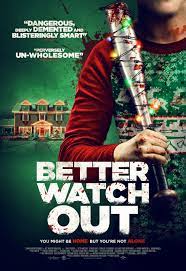
Once again, the poor babysitter is left to deal with the devil while bourgeois Mom and Pop drink the night away. And right before Christmas! After watching Better Watch Out, I know of one kid who’s getting a load of coal dumped in his yard.
On the verge of leaving town for college, Ashley (Olivia de Jonge) takes one last babysitting gig for the Lerners (Patrick Warburton and Virginia Madsen), keeping an eye on their son Luke (Levi Miller).
Unbeknownst to Ashley, Luke and his flunky friend Garrett (Ed Oxenbould) have contrived a “home invasion” to frighten her, in the hopes that a heroic-looking Luke will win her heart.
Yep, 12-year-old Luke has the hots for his sitter and his worst instincts take over. What starts out as Home Alone-inspired high jinks gets real dark, real fast, as Luke continually ups the stakes revealing him to be a vicious and clever sociopath.
“One-hundred one uses for duct tape,” he says merrily, as he binds Ashley to a chair.
The angel-faced kid is all bad, but when it comes to creating murder and mayhem he’s definitely a prodigy. They should probably consider moving him up a couple grades so he can torment older kids.
Miller is truly disturbing as Luke, imbuing him with a fiendishly high I.Q. His improvisational methods for dealing with a situation rapidly spinning out of his control are impressive, to say the least.
De Jonge, for her part, is formidable as the object of Luke’s grotesque affection who goes to extreme lengths to thwart his sinister scheme.
With Better Watch Out, director and co-writer Chris Peckover has left a distinctive mark on the Babysitter Horror subgenre, where the evil is always coming from inside the house.
I haven’t followed professional rasslin’ for the last decade or two, so I’ve missed out on the rise of CM Punk, a straight-edge, comic book-loving, butt-kicking atheist who’s managed to win several championship belts in the early part of the 21st century.
In Girl on the Third Floor he tries on a tool belt to restore an old Victorian mansion with a bad reputation as a peace offering to his pregnant wife, Liz (Trieste Kelly Dunn).
Don Koch (Punk), is a financial con artist who’s cut a deal with the feds to stay out of prison, despite draining several pension funds. Having proven himself to be a liar, a drunk, and a womanizer, Don has vowed to turn over a new leaf, and “make everything right” by fixing up a former brothel into a dream home for his burgeoning family.
Unfortunately, a leopard can’t change his spots and you can’t build a dream home on a rotten foundation. The man formerly known as King Don, immediately starts drinking beer and lying to his wife on their daily phone calls, which doesn’t say much about his commitment to the project or to his marriage.
While fumbling through basic carpentry and getting loads of gross fluids dumped on him in at every turn, Don entertains Ellie Mueller (Karen Wooditsch) a gabby nun from the church next door and Sarah Yates (Sarah Brooks) a simmering sexpot who seems to come and go at will.
Don gets characteristically drunk, smokes weed, and knocks boots with Sarah. Like Michael Douglas in Fatal Attraction, he soon regrets giving in to his toxic masculine desires when his one-night stand turns out to be a vengeful spirit.
It’s a morality play, duh.
The house itself consumes the protagonist, serving as a warning to faithless spouses seeking redemption for their misdeeds.
Punk is up to the task, and acquits himself as an able, agile leading man, losing his marbles in entertaining fashion and getting tossed around like a pumped-up Bruce Campbell in EvilDead II.
Watching the misadventures of the angry, bumbling, and ultimately remorseful Don Koch, writer-director Travis Stevens gives us a virtual Power Point illustration of the terrible fate that befalls an ethical weakling.
Maybe try couples counseling, instead.
Warning: The dog dies. Steel yourself emotionally.
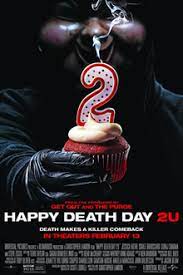
In this decidedly Back To The Future II sequel, Tree (Jessica Rothe), Carter (Israel Broussard), and his genius/nerd roommate Ryan (Phi Vu) are once again stuck in a campus vortex that culminates in murder.
It turns out all the time-loop business has been caused by Ryan’s thesis project Sissy, a super powerful time-shredding device that only works sporadically with unpredictable results.
It was a test-run of Sissy that caused Tree to relive her own murder in perpetuity, and this time around she gets bounced to another timeline where things are slightly different.
For one thing, Carter is now the caring boyfriend of Tree’s insufferable sorority queen bee Danielle (Rachel Matthews). For another, her late mother Julie (Missy Yager) is miraculously still alive!
This leads Tree to a cataclysmic decision with an unforeseen butterfly effect that could leave Carter as another victim of the Babyface Killer (Rob Mello).
Perhaps the best line in the film is when Ryan, who’s being stalked by the murderous mascot, quips something to the effect of “What kind of a stupid college has a baby for a mascot?
Beware the Bayfield Babies.
Writer-director Christopher Landon (several of the Paranormal Activity movies and director of Happy Death Day) expands on the theoretical possibilities hinted at in the first film and smartly beefs up the supporting cast, particularly Ryan, who grows from comedy relief to a crucial character in the new timeline.
And the long-suffering Tree is played to comedic and dramatic perfection by Jessica Rothe.
Happy Death Day 2U is the rarest thing in Hollywood—a truly worthy sequel to an excellent film, one that succeeds on its own merits and generates fresh inspiration instead of rehashed mayhem.
One should also admire the discipline of the principle actors and set design team for re-creating seamless continuity from a two-year-old shoot.
If the rumors are true, there’s going to be a third chapter in the series, which will require the key characters to remain ageless in suspended animation until filming begins.
I can’t wait for Happy Death Day 3 Cheers For Babyface.
A detective (Frank Grillo) and a police psychiatrist (Maria Bello) try to piece together what happened after a team of amateur ghostbusters bungle a seance in a haunted house, in Demonic.
Probably happens all the time.
The cops grill John (Dustin Milligan), the only survivor, in an attempt to locate his missing girlfriend Michelle (Cody Horn) and ghost team leader Bryan (Scott Mechlowicz).
The rest of Bryan’s crew are spread out around the house in various stages of decomposition after persons unknown went on a chopping spree.
The story unfolds via John’s remembrances and footage recovered by forensic specialists, so the narrative bounces from the current crime scene to the week before, when the paranormal investigators set up shop in a rambling manor house somewhere in Louisiana swampland.
There are jump scares aplenty and a decent amount of escalating tension, but not much in the way of blood and guts. Gaping plot holes abound (Really? The detective has no other recourse but to shoot his only suspect while the latter is holed up in a grocery store?) and no one associated with the film will win any acting awards.
Even so, director-cowriter Will Canon keeps his spooks flying and manages to perpetrate a few decent plot twists to keep our attention from wandering too far.
Demonic is not required viewing, but you could do a lot worse. I should know.
Jules (Brittany Allen) and Jackie (Hannah Anderson) are a married gay couple who go off for a romantic weekend to a well-appointed house in rural Canada that belongs to Jackie’s family.
In horror movies, romantic weekends are second only to make-out pot parties as an invitation to trauma. What Keeps You Alive is no exception.
What’s different here is the source of the threat. Soon after their arrival, the couple is visited by Sarah (Martha MacIsaac), a local who recognizes Jackie, but calls her by the name “Megan.”
The next morning Jackie tries to murder Jules by pushing her off a cliff. This unexpected development caused my friend Kaja to remark, “I guess she fell for the wrong girl.”
Jules does not die in the fall, so Jackie begins tracking her, shouting conciliatory messages about how sorry she is, and that she wants to take Jules home.
The single scariest moment in What Keeps You Alive is when Jules, hiding behind a tree from Jackie, sees her wife’s flat emotionless face while she’s yelling endearments.
Presently, Jackie gets tired of playing the concerned mate and informs the unseen Jules that she knows the woods like the back of her hand and escape is impossible.
The sexual dynamic between the two lovers hovers over the carnage, occasionally referenced in flashback, as writer-director Colin Minihan explores the depths of betrayal that Jackie has orchestrated.
There’s plenty of nail-biting action, including a riveting rowboat chase across the lake, that will keep your hand close to the panic button.
Minihan alternates between closeups of injured and frightened Jules running through the house, and long establishing shots of the unforgiving terrain, effectively adding weight to the already considerable tension.
There are enough twists and reversals to keep even the most astute thriller fan off balance, and both Allen and Anderson bring everything they have to their respective roles.
We’re predisposed to root for Jules, who proves tougher than she looks, but Jackie’s unfolding madness is spellbinding. She shifts and sheds personalities seemingly at will to keep Jules on the defensive. Whether she’s cajoling, cursing, or crying it’s impossible to get an accurate read on Jackie.
Mercenary? Maniac? Misunderstood?
At one point, Jules demands an answer. “What happened to you? Was it your father? Did he do something to you?” she asks.
“It was nature, not nurture,” Jackie answers deadpan.
And they’d have gotten away with it too, if it weren’t for those meddling kids. It’s a long-standing tradition that the biggest threat to imminent world domination is nosy teenagers.
Writer-director and Saturday Night Live alum Oz Rodriguez has a blast with villainous bloodsuckers disguised as real estate developers in Vampires vs The Bronx, a fast-paced, family fang feature from Netflix.
All over The Bronx businesses are closing down or getting bought out by Murnau Properties, a real estate firm with a logo depicting Vlad The Impaler. Gotta say one thing for those vampires, they’re a subtle bunch.
The nerds that save the day are a charismatic crew. Miguel, better known as Lil Mayor (Jaden Michael) is the golden boy, a community organizer/hustler who wants nothing more than to save his beloved Bodega from the wrecking ball.
Along with his friends Luis (Gregory Diaz) and Tommy (Gerald Jones), Miguel stumbles onto a vampire-driven plot to gentrify the neighborhood, but finds that it’s hard to get people to believe your story when the newcomers are affluent white folks throwing money around.
Besides, who’s going to listen to some stupid kids?
Jordan Peele correctly identified Class War Horror as a hot topic, and Rodriguez makes the most of his turn at bat. Cleverly setting the threat of Caucasian expansion in a comic-horror milieu, Rodriguez leaves us with no hard ethical decisions to make. Real estate developers bad. Neighborhood scalawags good.
Now let’s all forget our differences and drive out the suckheads!
The cast is 100 percent delightful (including Method Man as a priest!), the action is frequent and not too messy. Naturally, there will be valuable lessons for everyone. It’s not every day we get a vampire adventure fit for all ages, so get it while it’s hot.
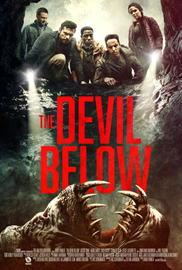
It’s always the right time for comfort-food horror, and in The Devil Below we are served up another doomed expedition searching for answers in a subterranean hellhole.
We’ll have a double helping of monsters, and don’t spare the giblets, please!
How can you screw up such a basic recipe? Director Bradley Parker and writers Eric Scherbarth and Stefan Jaworski manage to do so almost immediately and never really gain their balance.
The Devil Below is a rote, budget-strapped feature, which wouldn’t be so bad, except it also fails to register any decent gore or creature shocks, quite an unforgiveable sin in my book.
A ragtag team (is there any other kind?) of geologists guided by Alpha Gal Arianne (Maria Sanz) is tasked with investigating an Appalachian coal mine that’s been burning for decades.
They soon discover that the real cause for alarm is a race of tunneling trogs who can’t decide if they’re Lovecraftian (starfish face) or just mole people in baggy clothes.
It’s really hard to say, since we never get a proper look, but they do brandish a poison claw that immobilizes the victim. Shawn (Chinaza Uche), a soon-to-be late geologist hypothesizes that they’re a new species that colonizes, like insects, but that’s as far as the analysis goes.
Veteran character actor Will Patton is onboard as a grizzled mine owner trying to avenge his dead son, but despite everyone’s best intentions, we end up with a pale and bloodless version of The Descent, a movie that remains the undisputed high watermark in the Underground Horror genre.
With its modest body count and some of the vaguest monsters on the block, The Devil Below is below average viewing, and I’m stuck for a compelling reason to sit through it.
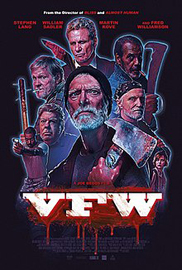
At first glance, VFW plays out like an ol’ time blood bath, somewhere along the lines of John Carpenter’s Assault On Precinct 13, as waves of drug addicts storm a little bar defended by a determined band of geezers.
Carpenter-esque synthesizer stabs punctuate the carnage and gang members are decked-out in faux-leather bodywear, as if they’d just returned from a Spandau Ballet video shoot.
The uber-violent skirmish gets rolling when street urchin Lizard (Sierra McCormick) rips off Boz (Travis Hammer), a theatrical drug-dealing psychopath, and seeks shelter at a local watering hole inhabited by combat veteran ass-kickers itching for a little action.
Boz and his ruthless bodyguard Gutter (Dora Madison) inflict some damage, but ultimately they underestimate the tenacity and loyalty of these ancient warriors, resulting in an explosive comeuppance.
The action is nonstop, the blood is plentiful and stylishly rendered. You need further recommendation? VFW is a Fangoria production, so don’t expect a whole lot of dialogue.
Even so, somewhere during the third act, Fred the bartender (Stephen Lang) yells “Come on, you lazy bastard!” at his old foxhole buddy Walter (William Sadler), who responds, “I’m coming, dammit!”
Not a super noticeable moment unless you’re a fan of Sam Peckinpah’s The Wild Bunch, but it demonstrates that director Joe Begos (Almost Human) and writers Max Brallios and Matthew McArdle know and respect their antecedents when it comes to movies about hopelessly outnumbered men fighting for a cause.
In addition to Lang and Sadler, the pedigreed supporting cast includes Martin Kove (The Karate Kid), Fred “The Hammer” Williamson (From Dusk Till Dawn), George Wendt (Cheers), and David Patrick Kelly (Twin Peaks, Commando), all of whom have swell screentime dismembering, impaling, and perforating platoons of savage tweakers.
Kelly, who distinguished himself as the evilest gang member ever in Walter Hill’s classic The Warriors, is particularly poignant as an old stoner on his last legs who chooses to die with his boots on.
Peckinpah would be proud of this bunch. Carpenter too, probably.
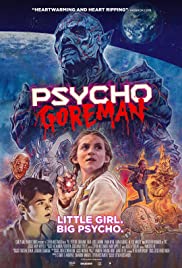
Surely there is a universe where Psycho Goreman would be considered family friendly entertainment.
You know, like E.T.? Maybe? Sorta?
The latest spectacle by Canadian makeup artist-turned-filmmaker Steven Kostanski, (see also 2016’s cosmic-horror blood bath The Void), Psycho Goreman is indeed the story of a family, but they’re not very friendly.
More like a Dysfunctional Family Circus, as conceived by Spielberg in a rare subversive mood.
Let’s start with Dad. Greg (Adam Brooks) is one of the worst fathers ever committed to celluloid. A lazy, resentful nitwit, he’s married to Susan (Alexis Kara Hancey), the primary breadwinner, who does her best to keep the clan operational.
Daughter Mimi (Nita-Josee Hanna) is a hotheaded Narcissist, and calls all the shots in this house. Her long-suffering brother Luke (Owen Myre) is an occasional co-conspirator, but more often than not, an easily bullied opponent.
The balance of power is further tipped in Mimi’s favor when Luke finds an ancient amulet that contains a monstrous alien warlord (Matthew Ninaber), imprisoned several millennia beforehand for trying to conquer the galaxy.
Luke discovers the artifact while digging his own grave. Mimi reminds him that he lost their most recent game of Crazy Ball, so he gets buried alive.
Side Note: Crazy Ball is an unfathomable form of dodge ball that is the most sacred game in Mimi and Luke’s world, as well as their primary activity. And rules are rules.
Since she won at Crazy Ball (she always does), Mimi takes ownership of the talisman and thus controls the most powerful being in existence.
“Do you have a name, monster man?” Mimi asks the towering gargoyle.
“My enemies sometimes refer to me as the archduke of nightmares,” the giant says, in a basso profundo arch-villain voice.
“Well, that sucks.” Mia replies unfazed. “Never mind, we can workshop this.” The kids subsequently dub him Psycho Goreman (or PG), after watching him dismember a street gang.
Psycho Goreman writer-director Kostanski artfully creates hilarious rubberized havoc in the style of Japan’s Tokosatsumovement—better known as Campy Superhero Versus Monster TV Shows (e.g., Ultraman, Mighty Morphin Power Rangers)—that dates all the way back to the middle 20th century.
And much like the juvenile delinquents over at Troma Entertainment (Toxic Avenger etc.), Kostanski loves blood, guts, and sick monster suits. Yet somehow the action here never degenerates into mere schlock, and we find ourselves rooting for a vicious villain against the forces that come his way.
As PG faces off against a barrage of interstellar assassins and vengeful demigods that want him out of the picture, we see an evil soulless creature learn just a little bit about love and human compassion. This observation applies principally to Mimi, but also to PG, who comes to appreciate terrestrial pleasures like magazines, hunky boys, and television from his prepubescent captors.
Slick fight choreography, brilliant character designs, and outrageous dialogue keep our higher senses engaged, while our lizard brains wallow in vivid onscreen pandemonium.
Sprinkled into all the frenetic mayhem is a sneaky anti-moralist message, one that’s the exact opposite of heroic, as Mimi decides that all the responsibility and power is kind of a pain.
Eventually, she gives PG his freedom so he can continue his mission to destroy the universe.
Except for the part Mimi and her family live in. So heartwarming. So wrong.
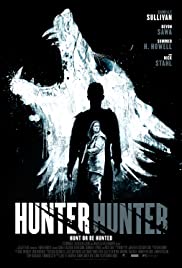
A backwoods survivalist pursues a rogue wolf that threatens his family—and finds something infinitely worse, in Shawn Linden’s Hunter Hunter.
Somewhere in the wilds of Manitoba, Joseph Mersault (Devon Sawa), his wife Anne (Camille Sullivan), and daughter Renee (Summer Howell), grind out a primitive existence by trapping critters and selling their pelts.
While this lifestyle is ideal for Joseph, a laconic hunter and woodsman, Anne is tired of hauling furs to the store to bargain for food, and communicating with her husband via Walkie Talkie. Most of all, she wants Renee to go to school and have real friends.
Joseph has been arduously training his daughter to be self-reliant in nature, so Anne’s pitch for a return to civilization doesn’t mesh with his mission.
“We don’t run from our problems,” he reminds her.
“You’re scared of people,” she counters.
“This is our home,” Joseph declares. “And nothing pushes us out of our home.”
Future plans are put on hold when Joseph finds carcass evidence of a vicious wolf stealing from their trap lines. As expected, Joseph, the seasoned hunter, disappears into the forest primeval to track the animal and kill it. A solid plan except for one detail: He doesn’t return.
“Joseph, are you there?” Anne despondently asks her Walkie Talkie, as hours turn into days.
In his absence, Anne nervously tries to put food on the table, relying on Renee’s advice on skinning a fawn for their evening meal. Eventually, Anne hears someone calling for help in the darkness. Instead of the long-missing Joseph, she comes upon Lou (Nick Stahl), a badly injured stranger. Anne loads Lou onto her sled, brings him back to the cabin, and nurses his wounds.
Renee doesn’t see the point. “He’s a stranger. Dad says we’re not supposed to trust strangers.”
“We’re helping him because that’s what you do when you find someone who needs help,” her mother explains.
But where’s Joseph? And who is Lou?
Writer-director Shawn Linden brings the great outdoors down around the viewer like a shroud. He employs his camera as a stealthy tracker shadowing Joseph, Anne, and Renee through the woods blurring the line between stalker and quarry.
Linden is unsentimental and straight forward in his depiction of frontier living, which includes knowing the correct way to skin and dress prey, so that it won’t ruin the food that’s necessary for survival.
Anne is not as skilled as her husband and daughter, but she understands necessity.
Hunter Hunter maintains a heady tension for the duration of the film, which builds to a shockingly bloody conclusion. Anne’s final confrontation with the dangerous predator is not as a hunter, but a terrible avenger, and it will leave a mark on your psyche.





 horrificflicks.com
You must be logged in to post a comment.