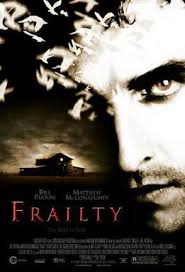
Frailty (2001)

The late Bill Paxton (1955–2017) will always be remembered for his distinguished genre credentials. As the not-so-brave Private Hudson in Aliens (1986), he got all the best lines, including “Game over, man!”

A year later he was part of a kick-ass vampire gang in the criminally underrated Near Dark, reunited with his Aliens costars, Lance Henriksen and Jenette Goldstein.

Still not impressed? How about this action? Paxton is the only actor to play a character killed by a Predator (Predator 2, 1990), a Xenomorph (Aliens) and a Terminator (The Terminator, 1984).

Serious respect!

In Frailty, Paxton directs and stars as a mild-mannered mechanic who becomes a divinely inspired killer after a visitation from an angel.

Rather than keep this to himself, he awakens his two young sons Fenton (Matt O’Leary) and Adam (Jeremy Sumpter), informing them that they will be helping Dad destroy demons in human form.

Adam, the younger son, is gung-ho to please his avenging father, while older brother Fenton doesn’t like the idea one bit.

Too bad the Lord’s will must be served.

The brothers’ upbringing is recounted years later by a grown-up Fenton (Matthew McConnaughy) to incredulous FBI agent Wesley Doyle (Powers Boothe), who reluctantly gets reeled into a twisted tale of a family under the dominion of a terribly unbalanced man.

As a director, Paxton imbues Frailty with a naturalistic, small-town feel that makes the episodic violence particularly jarring. As an actor, he delivers a nuanced, but emotionally reserved performance that evokes a little sympathy and a whole lot of terror.

Anyone expecting the unhinged Hudson, or perhaps the belligerent bully Chet from Weird Science will see nothing of the sort here.

By the time he locks Fenton in the basement for a week (no food, one glass of water per day) in an effort to drive out any demonic influences, the horror has gotten uncomfortably real, as Paxton dons the face of unblinking fundamental fanaticism, reminiscent in tone of Kevin Smith’s Red State.

Bill Paxton’s ability to goose the tension as a filmmaker in Frailty, is more than matched by his extraordinary performance as an ordinary man called upon to serve God by fighting evil.

But it’s not easy. Just ask Abraham.

Sinners (2025)

Enthusiastically recommended and watch out at awards time!

Sinners is the fifth collaboration between writer-director Ryan Coogler (Creed, Black Panther, Fruitvale Station) and star Michael B. Jordan, and it’s an epic whopper of a movie with a blistering blues soundtrack and a depth of soul not typically found in an era of easily disgested entertainment options.

Twin brothers Smoke and Stack (both played by Jordan) return to Clarksdale, Mississippi—after working for Al Capone’s mob in Chicago for seven years—determined to open a juke joint, a place where hard-working sharecroppers and field hands can be free to eat, drink, and dance the night away.

The brothers have contrasting demeanors, but their ambition, to own something free and clear that’s designed to serve the black community, is helped greatly by the large amounts of cash they’ve brought back from the Windy City.

Smoke recruits his former lover Annie (Wunmi Mosaku), a New Orleans hoodoo practitioner, to cook catfish for the crowd, while Stack hustles hooch and henchmen in an effort to keep the peace in their new joint.

On opening night, the club is jammed with folks stomping away to spirited music provided by guitar prodigy Sammy Moore (Miles Caton) and blues elder statesmen Delta Slim (Delroy Lindo).

Coogler is in absolute artistic control of the frenetic proceedings, and the verve and excitement he is able to capture during the dance sequences is unreal. We’re talking mesmeric scenes flowing so organically they’re worthy of repeated watches on their own.

While patrons shake and shimmy, Coogler enlarges the cultural lens to include a heartfelt vision of artists—past and future—caught in the dervish rhythms of the juke joint, and the effect is breathtaking.

“Blues weren’t forced on us like that religion,” Slim tells Sammy. “We brought this with us from home.”

Just when we’re having a peak cultural moment, a trio of vampires disguised as itinerant Irish folk musicians, crash the party and a bloodbath ensues.

There is no reason to believe, as some grumpy critics have implied, that Sinners unexpectedly goes off the rails at this point. Coogler doesn’t bring in the undead as a deux machina or as a concession to a larger, edgier demographic.

The taking of blood and the quick assimilation (exploitation) of blacks into a “protective” white society is a historical hot-button issue at play in Sinners, but it’s far from the only one.

There’s subtext and pointed references worth investigating everywhere, including a mysterious connection between the Choctaw Tribe and Irish immigrants. It’s all intentional on Coogler’s part, as he dares us to consider alternative histories to the ones we’ve been spoon fed.

Visually, musically, and dramatically, Sinners kicks more ass than a 1000 superhero flicks. Add yours to the queue.

The Visit (2015)

As someone rapidly approaching senior citizen status, I get why old people are perceived as weird and scary.

The aging mind is undependable, and at times downright incomprehensible. With life expectancy continuing to rise, the question becomes: What do we do with all these crazy old coots?

It’s clearly something that occupies the mind of speculative filmmaker M. Night Shyamalan, as he addresses the issue in The Visit, as well as in Old (2021). Let’s call it Golden Age Anxiety.

Becca (Olivia DeJonge) and her rap-happy kid brother Tyler (Ed Oxenbould) are spending a week with their grandparents on the family farm.

So far, so good.

Mom (Katherine Hahn) has been estranged from her conservative parents for many years, so the teen travelers have never actually met Nana (Deanna Dunagan) and Pop Pop (Peter McRobbie), and have no idea what’s in store for them.

An aspiring documentarian, Becca brings along a couple of cameras to commemorate the reconciliation of a fractured family, and provide the found footage foundation of Shyamalan’s feature.

Suffice to say that The Visit doesn’t go as planned. As Becca and Tyler try their best to get better acquainted with the kinfolk, the latter just keep turning up the freaky to a point that becomes impossible to ignore.

They are given a 9:30 curfew, and instructed to stay in their rooms, lest they witness Nana screaming and vomiting in the nude, or Pop Pop taking another trip out to his locked shed.

Being inquisitive kids, Becca and Tyler investigate further, discussing their discoveries with Mom over Skype, rightfully concluding that something is strangely amiss.

As the cuckoo grandparents, Peter McRobbie and Deanna Dunagan are captivating, both in terms of their gamut of lunacy, and increasingly failing attempts to conceal the craziness.

Often funny, a little sweet, and madly unpredictable, The Visit culminates in a 100 percent slasher movie ending, that should feed those hungry for mayhem after numerous attempts at domestic bonding.

Not the most creative solution, but a satisfying one.

Shyamalan doesn’t always hit what he’s aiming for, but he capitalizes on the singular terror experienced by kids upon meeting batshit relations for the first time—and realizing that they’re trapped with them.

Recommended.

Shining Vale (2022-23)

When I was a wee sprout, and the family hive mind turned to televisual entertainment options, I invariably lobbied for something “scary” or something “funny.”

My conservative-leaning, middle-class family would not have tolerated a moment of Shining Vale, and, truth be told, most of the adult humor would have been lost on me.

Shining Vale ran for two seasons on Starz, and was created by Jeff Astrof (The New Adventures of Old Christine, S#!* My Dad Says) and Sharon Horgan (Catastrophe, Bad Sisters). Over the course of 16 half-hour episodes, we get cozy with the Phelps family, possibly the most dysfunctional brood since the Bundys showed up on Fox in 1987.

Pat Phelps (Courteney Cox) is in a dark place. She wrote a tawdry, best-selling lady porn novel 14 years before, but the follow-up hasn’t been forthcoming, and her agent Kam (Merrin Dungey) is giving her an ultimatum: deliver the book or return the advance money.

When Pat has a torrid affair with a handyman, her stubbornly optimistic husband Terry (Greg Kinnear) packs the whole family off to a huge haunted house in rural Connecticut for a fresh start, much to the dismay of teenaged daughter Gaynor (Gus Birney).

“Mom boned some rando and now we have to move,” she grumbles. Though a freewheeling sexpot herself, Gaynor becomes the unwilling head of the household, after Mom and Dad lose their marbles.

Her younger brother Jake, a plus-sized introvert, is mostly concerned with gaining levels in his Virtual Reality game, and is slow to realize that change is afoot.

“Why did we move to a hotel?” he asks, upon arrival at the dilapidated Victorian mansion they will now call home.

Jake is also the butt of (fairly benign) fat kid jokes, but gets comic revenge by farting most foul at the worst possible moments. Seemingly an innocent, he gets his own demon adversary courtesy of VR.

Once the family is settled, Pat makes instant contact with the spirit of Rosemary (Mira Sorvino), the former owner of the house who went mad and hacked up her own family with an axe.

Rosemary does a little ghost-writing on Pat’s unfinished manuscript, and an uneasy partnership is formed when Kam digs the new, darker direction the book is taking.

This is all just tip of the iceberg stuff, as Pat, Terry, and the kids go through individual transformations of various magnitudes, while dealing with ghosts, cults, demonic possession, hereditary mental illness, and infidelity in a weird little town that features homegrown businesses like The Lucky Wiccan.

As for the title of the series, yes, there are many references to The Shining. For crying out loud, it’s about a writer trying her best not to chop everyone up with an axe.

For my money, Shining Vale is the funniest and finest-written domestic horror series since The Addams Family. The cast is flawless. You’re welcome.

But what happened to Season 3?

Hush (2016)

Tonight! The War Between the Sexes! Right here on Pay Per View! Let’s give it up for Hush!

Writer-director Mike Flanagan (Haunting of Hill House, Fall of the House of Usher, Midnight Mass, Oculus) and his wife, writer-actress Kate Siegel constructed this lean, mean thriller about a deaf-mute author fighting for her life against a sadistic killer.

Hush also makes sense as an anxiety inducing metaphor about unwanted male attention, as Maddie Young (Siegel), a best-selling author, can’t even have a reasonable expectation of privacy IN THE MIDDLE OF A FRIGGIN’ FOREST!

Maddie lives in a nice house (with lots of doors and windows) somewhere in the deep woods. A bout with meningitis at age 13 has left her without speech and hearing, but she has a crafty writer’s brain that never stops ticking, as we squeamishly witness her reviewing potential escape options that never materialize.

The plucky scribe finds herself trapped in her bucolic hacienda by a masked madman (John Gallagher Jr) with a crossbow, who just recently finished an evisceration job on Maddie’s neighbor (Samantha Sloyan).

Who? Why? Not important. Perhaps Cupid’s in a real bad mood today. Flanagan and Siegel play the cat-mouse game to the hilt, which usually ends up plunging into someone’s neck or torso.

Nosey neighbors don’t fare well in Hush, but the timely arrival of a cat named Bitch provides Maddie with enough of a diversion to go on the offensive against toxic masculinity. The killer reminds Maddie that he’s enjoying himself, and that he can take her whenever he wants.

The maniac clearly derives grim pleasure in cutting off her limited means of communication (he also collects cell phones) and watching Maddie react to the mounting stressors he places upon her.

The entire movie is gaze-oriented. Maddie is either keeping track of her assailant roaming around in her yard (he makes no effort at stealth or concealing his identity, which makes the situation even more dire)—or the killer is feverishly observing Maddie as she tries to hide and barricade herself inside a house with too many access points.

As I mentioned, Hush is all killer, no filler. No competing storylines, no comedy relief, no shaky camera tomfoolery. Just two people (one of whom can’t call for help) airing their differences. To the death.

This is what happens when you don’t respect boundaries.

The Substance (2024)

Your attention horror shoppers!

The Substance should be seen, full stop.

Nominated for five Oscars including best actress for Demi Moore? As it should be.

French writer-director Coralie Fargeat (Revenge) turns up the rage to Nova, and opens the taps at the blood bank in a body horror spectacle that will likely leave a bruise on your soul. It’s definitely worth the uncomfortable moments.

Fargeat gives us the impression that The Substance is another tale of dashed dreams in the Hollywood meat grinder, and it certainly is. In fact, the meat grinding has never been portrayed in such glaring and grotesque detail.

Elizabeth Sparkle (Demi Moore) is a beloved fitness guru who has gotten too long in the tooth to pump up sponsor sales. She is unceremoniously dumped by the venal head of the network (Dennis Quaid), who announces his plan to find a younger model, while angrily taking a pee.

Fearing for her fading career, Sparkle takes a chance on a miracle rejuvenation drug called The Substance, which promises a “a younger, better version” of yourself.

Her decision to join the program, which includes a grumpy operator, a squalid post office box, hellish injection regimen, and the gradual draining of her own vitality, is the trap springing shut.

It’s only proper that a trouper like Demi Moore has enough presence and pathos to make her vainglorious plight extremely moving, as she’s forced to grapple with her younger, better self (Margaret Qualley) for limited consciousness.

Of course, things get worse, and by the time the finale rolls around, with a mutated star trying to host a live New Year’s Eve special, it’s a straight-up Frankenstein heartbreaker, with an angry mob in pursuit.

Each time Coralie Fargeat reaches a narrative turning point in The Substance, she amps up the gore to the point of anguish, and I admire that audaciousness in the telling of this particular story.

Fargeat never delivers half measures or wimps out in any way, and in Demi Moore she has the perfect vehicle to bring home a brutal point.

“Women are bloody,” my wife reminds me. “Birth, menstruation, it’s gross.”

I get the picture, and so will you.

Heretic (2024)

This is a different Hugh Grant, though there is a passing resemblance to the rom-com Don Juan with the aw-shucks manner.

Written and directed by Scott Beck and Bryan Woods, Heretic is another film set during a storm that makes the most of its few sets and small cast. Sister Paxton (Chloe East) and Sister Barnes (Sophie Thatcher) are young Mormon missionaries on bicycles visiting the home of Mr. Reed (Grant), a seemingly absent-minded scholar with an interest in religion and spiritual knowledge.

An approaching deluge induces the girls to accept Mr. Reed’s hospitality and enter his surprisingly roomy cottage. He mentions that his wife is in the kitchen making blueberry pie!

The front door closes and the camera backtracks down the foot path that approaches the house. It seems like a long way from the road.

Trap sprung.

Mr. Reed proves to be a highly intelligent and extremely well-read individual, who goes from asking questions about Mormonism to lecturing the girls on his own personal quest for the “one true religion.”

At times, he is a professor impressively expounding on several subjects at once to a class of freshmen, and Barnes and Paxton soon find themselves in over their heads as the subject matter becomes increasingly uncomfortable.

The time passes in conversation and the smell of blueberry pie fills a cozy sitting room that begins to look suspiciously normal.

Beck and Woods do a masterful job of gradually goosing up the tension without turning Mr. Reed into Dracula. Can this old duffer even be considered a physical threat?

Reed mostly remains reasonable, but the red flags are starting to pile up. Cell phones don’t work and the front door is on a time lock that won’t open till morning (!), so if the girls want to leave (and they’re always welcome to), they’ll have to exit through the back of the house.

Credit must be given to Chloe West and Sophie Thatcher for instilling their characters with brains and backbones, the ability to think and reason even when their situation hits nightmare territory.

As for Grant, the charmingly awkward Brit with the hots for Andie McDowell is a faded lobby poster, but he can still badger and beguile a captive audience. The ingratiating tendencies and ability to spin complex thoughts into amusing, provocative word bubbles remains intact in Heretic, and Grant digs deep to reach a rich vein of menace.

Dr. Giggles (1992)

“Laughter is the best medicine.”

As played by a thoroughly committed Larry Drake (Benny Stowitz from L.A. Law!), this titular sawbones could have been a contender, worth at least two sequels, minimum.

Dr. Giggles is an early release from Dark Horse Comics, so no reason for there not to be a franchise.

As a child, Evan Rendell Jr. (Drake) watched the angry citizens of Moorehigh haul his father, the town doctor, out of his home office and stone him to death. Apparently, the locals were none-to-pleased with Rendell Senior’s research methods, which included killing seven patients in search of a healthy heart to transplant into his own dying wife.

Hey! You can’t make an omelet without breaking a few eggs.

Young Rendell is institutionalized and grows up into an adult lunatic with a fixation on physicians. He escapes after dissecting his captors, and heads back to Moorehigh tittering like a freshly sprung Michael Myers.

Final Girl Jennifer Campbell (Holly Marie Combs, Piper from Charmed!) is an anxious high school student with heart valve problems set on a collision course with the hysterical healer, while a bunch of her friends and neighbors fall victim to Rendell’s house calls, dying horribly under the madman’s medical ministrations.

A hearty round of applause to Drake, who giggles and puns his way through the slaughter with verve and panache, a maniacal glint in his bulging eyes.

“Wait till you see my bill,” he crows after skewering another unlucky chump with his antique surgical implements.

Like any good doctor, Rendell is torn between his duty to the community (killing them), and carrying on his father’s quest to find a heart, in this case to “save” Jennifer.

The fact that he’s a self-taught surgeon doesn’t inspire much confidence, though. That’s why the patient needs to be strapped to the table—for her own good.

Dr. Giggles is premium slasher carnage punctuated with corny jokes. If it’s wrong, I don’t wanna be right.

The doctor will slay you now.

Trim Season (2023)

Though it has a few decent moments, Trim Season is mostly a harsh toke.

Director Ariel Vida definitely has a gift for visual flair but largely ignores storytelling in favor of making sure that the color red is fully represented in as many shots as possible.

A group of broke stoner girls and one trans man get a good paying gig trimming bud at a pot farm in Northern California.

Nothing wrong with that, I’ve done it myself. The isolation, drugs, little sleep, and sketchy authority figures make it a ripe scenario for any number of horror options.

The trimmers are introduced to Mona (Jane Badler), the mysterious and commanding owner of the operation, and quickly find her to be a firm enforcer of rules as well as their provider of weed and employment.

Emma (Beth Million) is our chief protagonist among the reefer recruits, but like most of the cast, she does little to distinguish herself, leaving Badler to dominate the action, as a sort of hippie Elizabeth Bathory, smoking her own strain of crimson cannabis.

I appreciated Vida’s gender tweaking throughout, as the girls are clearly protective of Dusty (Bex Taylor-Klaus), a vulnerable trans man, who would rather not talk about his past, but has an instant connection with Mona’s shy son, Christopher (Corey Hart).

Trim Season squanders much of its potential, however, thanks to stock characters, a wayward script, and careless plot developments: Why make a point of having Lex (Juliette Kenn De Balinthazy) being impervious to pain if it doesn’t come into play in any meaningful way?

It doesn’t help that when Mistress Mona flexes her witchy powers, she waves her hands in the air, remotely guiding her victims to off themselves like awkward, staggering marionettes. Instead of the intended dread, the results are comical, at best.

Also, note to the art department. The scenes featuring the girls trimming buds around the table are marred by the presence of weird, bulbous styrofoam cannabis. Is that the best we can do?

As I mentioned, this particular plot could have yielded some top-shelf terror. Sadly, Trim Season wouldn’t get a fly high.

In A Violent Nature (2024)

There’s quite a bit more here than meets the eye.

In A Violent Nature is not, as I had been told, a slasher movie told from the killer’s point of view.

Instead, writer-director Chris Nash dials up a multitude of perspectives, as if the doomed campers were being chased through a high-tech forest equipped with dozens of surveillance angles to choose from.

Stupid, soon-to-be-deceased college students rent a cabin in the woods. While hiking they disturb a memorial to Johnny, a mentally challenged boy who got bullied to death 70 years before.

Straight away we witness a now monstrous Johnny rise from the grave to seek revenge, and we spend considerable time riding shotgun alongside this unstoppable fiend as he makes an inspired mess out of the clueless kids.

Sometimes the murders are super gory, (the girl doing yoga gets some major stretching bodywork done) and some happen at a distance in the blink of an eye, as when a comely swimmer disappears below the waterline with a yelp from across the lake.

Nash keeps refreshing the views. He employs a static wilderness cam that dispassionately records long shots of the killer walking from one side of the frame to another. Next thing you know, we’re sitting on his shoulder, then a bird’s eye view, then a worm’s eye view.

With a string of cameras at his disposal, Nash asks us to consider the single-minded plight of a creative mutilator, in this case one that wears an old-time fireman’s mask, giving him the appearance of a predatory insect.

When Johnny occasionally pauses in his gruesome quest, we can get inside his horrible head and watch the wheels turn as he considers how best to maximize his menace, though he does remove his mask to play with a toy car at one point, a tragic reminder that this thing was once a happy child.

The undead death dealer featured in In A Violent Nature isn’t a killing machine, however. He wordlessly seems to enjoy the hunt and clearly takes pride in his victim-stalking and construction of murderous tableaux.

Johnny is obviously an artist, inviting us along to spy on his process. Now there’s a view you won’t see every day.