Boys from County Hell (2020)

You can count me among those short-sighted sods who’ve overlooked the obvious connection between Ireland and vampire lore, namely author Bram Stoker. He served as a theater manager and a drama critic for the Dublin Times, before he’d spun Dracula into existence.

Filmmaker Chris Baugh’s extremely entertaining The Boys From County Hell, takes place in a blighted Irish backwater called Six Mile Hill, where legend has it an ancient vampire named Abhartach lays buried beneath a cairn of stones in a nearby field.

At least that’s what bored locals Eugene Moffat (Jack Rowan) and William Hogue (Fra Free) tell the occasional tourist that comes to town looking for historical information about Bram Stoker. The lads insist that Abhartach was the original vampire that inspired Stoker to create his own version.

Coincidentally, Eugene’s no-nonsense father Francie (Nigel O’Neill) gets handed the contract to build a new road that’s going straight through Six Mile Hill and the accursed pile of rocks.

Eugene and his drinking buddies, SP McCauley (Michael Hough) and Claire McCann (Louisa Harland), are recruited by Francie to start breaking local ground. When they reach the rock pile, a bloody accident involving a runaway bull and Eugene’s friend William leads to the resurrection of a very pissed off, ancient vampire.

Rather than push his bloodsucker into the spotlight, Hough opts to keep Abhartach in the shadows; his mere malignant presence causes the townspeople to start bleeding uncontrollably.

Even with a monstrous creature on the loose, we can’t help admiring Francie and Eugene, a devoted father and son who can always find time to bust each other’s chops to welcome comic effect.

We’re also witness to some major mythology retooling, as it turns out you can’t kill a vampire with a wooden stake. Or decapitation. Or sunlight. This leads to an assortment of survival challenges for the principal players—and most of them simply don’t have what it takes.

What we have in Boys From County Hell is a bloody good time with funny, fleshed-out characters matching wits with an inhuman adversary that just won’t stay grounded.

Recommended to anyone in search of something fresh.

The Gorge (2025)

So many genres, so little time.

When the creative team in charge of a film project gets carried away trying to please each and every imagined audience member, the results are usually a load of crap.

The Gorge, written by Zach Dean and directed by Scott Derrickson, seemingly utilizes this kitchen-sink approach, tossing a zesty, messy melange of romance, action, horror, and conspiracy theory that’s a just a tad over two hours in length.

And somehow it works pretty damn well as a super-engaging popcorn flick!

Levi (Miles Teller) and Drasa (Anya Taylor-Joy) are two highly trained snipers from different countries assigned guard duty at opposite watch towers on either side of the enormous and mysterious titular gorge.

The mercenaries are armed to the hilt and instructed not to contact each other, but the need for company proves too much for Levi and Drasa, and soon they’re flirtatiously firing rounds, demonstrating their skill and accuracy, while a Ramones record plays.

“I guess this qualifies as a Meet Cute,” I whisper to Mrs. Sharky.

Though separated by a chasm that occasionally spits out monstrous hybrid humanoids called Hollow Men, the hired guns overcome logistical challenges and use a zip line to hook up and become not just a couple, but an elite and capable survival team.

This comes in handy when their military handler (Sigourney Weaver) decides they can no longer be trusted.

Once the protagonists figure out that this version of the future has no future, their decision to join forces is logical and inevitable. Besides, they’re a hot couple, and Drasa is clearly the aggressor, eventually rescuing Levi from an unexpected plummet into the abyss.

Through waves of decent monster attacks and fabulous fire fights, we actually grow fairly attached to Levi and especially the badass Drasa, which helps keep the viewer grounded during the mood shifts and infrequent talky interludes.

The Gorge is also a very impressive example of world-building, an important component to any successful popcorn operation. The mise-en scene has been carefully considered providing a foundation of future realism that looks like it was designed by the prison industrial complex.

No wonder no one want to hang around!

Ouija: Origin Of Evil (2016)

Prolific genre dynamo Mike Flanagan (Haunting of Hill House, Oculus, Dr. Sleep) created this prequel to Ouija (2014), and consensus opinion holds that Ouija: Origin of Evil, is far superior to its predecessor, though that may have more to do with the “meh” quality of the original material, rather than an auteur’s magic wand.

We travel back to the year 1967, where widowed mother Alice (Elizabeth Reaser) makes a modest living as a phony fortune teller, aided in her deceptive practices by daughters Lina (Annalise Basso) and Doris (Lulu Wilson).

Alice and eldest daughter Lina consider adding a Ouija board to their seance shtick, but all too quickly this occult stepping stone gets a grip on Doris, the youngest, resulting in a once-innocent child playing host to a number of spiritual entities, good and bad, including her late father (good) and a fiendish Nazi doctor (bad).

Flanagan and cowriter Jeff Howard weave together enough plot points for seven sweaters, but don’t sweat the details. Ouija: Origin of Evil is trademark Flanagan territory, as a fractured family faces a perilous paranormal presence coming from inside the house.

The technicians Flanagan puts to work on his projects are first-rate, intuitively establishing the tone, time, and terroir in which his particular domestic terror can take hold of hearts and spines.

Here, art director Alberto Gonzalez-Reyna and cinematographer Michael Fimognari mute the sunny ’60s California scenery in dark shades of green and gold, so wardrobe colors appear especially vivid and blooming—a keen counterpoint to the carnage being carried on behind closed doors at the local fortune teller’s house!

Despite being a minor entry in Mike Flanagan’s filmography, Ouija: Origin of Evil is a compelling and highly watchable film in its own right, and needn’t be seen in the company of any other Ouija entries in the hopes of additional illumination.

The Tunnel (2011)

An investigative reporter and a film crew descend into the darkness looking for a story—and find a doozy.

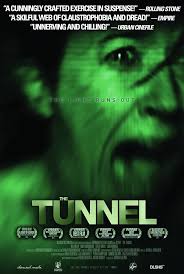
The Tunnel is a supremely creepy Australian found footage/creature feature that takes place in a vast network of subway tunnels beneath the streets of Sydney. Natasha Wagner (Bel Delía) is an ambitious journalist with water on the brain.

Specifically, Natasha wants to know why the city government abandoned a plan to recycle millions of gallons of water located in an old underground reservoir, so she picks up a map and convinces her trusty team of techs to have a look around down there and roll cameras.

Instead of civic corruption, Natasha, cameraman Steve Miller (Steve Davis), sound guy Jim “Tangles” Williams (Luke Arnold), and unit producer Pete Ferguson (Andy Rodoreda) uncover evidence of homeless folks living in the tunnels, as well as a fearsome predator that’s decimating their numbers.

Director Carlo Ledesma keeps the pace breathless and chaotic, dumping the cast in a very dark place. Fading sources of illumination prove particularly vexing to the trapped investigators, who have deduced that whatever manner of beast is stalking them, it’s frightened of light.

As is the case with media outlets these days, the whole case gets shut down at the behest of powerful interests, despite a few pesky survivors with some questionable footage.

And they never did find poor Tangles!

Wolf Man (2025)

The most impressive thing about Leigh Whannell’s Wolf Man is that it got made.

Whannell, the Australian horror maestro who introduced us to the Saw and Insidious franchises, clearly has serious show biz clout to get this turkey green-lighted.

This was obviously a “troubled” production.

Blake (Christopher Abbott) is a stay-at-home dad married to busy magazine writer Charlotte (Julia Garner). While Charlotte earns bucks, Blake looks after their daughter Ginger (Matilda Firth), until he’s notified that his father Grady (Sam Jaeger) has been declared officially dead, after being reported missing for several years.

Now the owner of the family farm, Blake drags his dubious brood out to the Middle of Nowhere, and in real time they are attacked by a strange creature (see the film’s title), and spend the evening running and hiding from same.

Meanwhile, Blake, the dutiful husband and father, begins to change into something remarkably similar to the beast that’s stalking them.

Wow. Didn’t see that one coming.

There is little dialogue, which lends itself to Mystery Science Theater ad-libbing during the howlingly bad action sequences, such as Blake gnawing on his own arm, and two guys in simian rubber masks wrestling on a dark floor.

What are we watching?

Wolf Man is simply godawful, and since Whannell directed and cowrote this mess, he gets the lion’s share of the blame.

It’s a complete waste of Julia Garner’s talents, and hopefully won’t interfere with her trajectory as one of Hollywood’s best young actresses. She’s given very little to do besides wander through the night with a flashlight.

I’ve said this before when reviewing werewolf movies and it certainly applies to Wolf Man: If you can’t come up with better transformation effects than The Howling or American Werewolf In London—both of which were made 43 years ago!—then don’t bother.

Shining Vale (2022-23)

When I was a wee sprout, and the family hive mind turned to televisual entertainment options, I invariably lobbied for something “scary” or something “funny.”

My conservative-leaning, middle-class family would not have tolerated a moment of Shining Vale, and, truth be told, most of the adult humor would have been lost on me.

Shining Vale ran for two seasons on Starz, and was created by Jeff Astrof (The New Adventures of Old Christine, S#!* My Dad Says) and Sharon Horgan (Catastrophe, Bad Sisters). Over the course of 16 half-hour episodes, we get cozy with the Phelps family, possibly the most dysfunctional brood since the Bundys showed up on Fox in 1987.

Pat Phelps (Courteney Cox) is in a dark place. She wrote a tawdry, best-selling lady porn novel 14 years before, but the follow-up hasn’t been forthcoming, and her agent Kam (Merrin Dungey) is giving her an ultimatum: deliver the book or return the advance money.

When Pat has a torrid affair with a handyman, her stubbornly optimistic husband Terry (Greg Kinnear) packs the whole family off to a huge haunted house in rural Connecticut for a fresh start, much to the dismay of teenaged daughter Gaynor (Gus Birney).

“Mom boned some rando and now we have to move,” she grumbles. Though a freewheeling sexpot herself, Gaynor becomes the unwilling head of the household, after Mom and Dad lose their marbles.

Her younger brother Jake, a plus-sized introvert, is mostly concerned with gaining levels in his Virtual Reality game, and is slow to realize that change is afoot.

“Why did we move to a hotel?” he asks, upon arrival at the dilapidated Victorian mansion they will now call home.

Jake is also the butt of (fairly benign) fat kid jokes, but gets comic revenge by farting most foul at the worst possible moments. Seemingly an innocent, he gets his own demon adversary courtesy of VR.

Once the family is settled, Pat makes instant contact with the spirit of Rosemary (Mira Sorvino), the former owner of the house who went mad and hacked up her own family with an axe.

Rosemary does a little ghost-writing on Pat’s unfinished manuscript, and an uneasy partnership is formed when Kam digs the new, darker direction the book is taking.

This is all just tip of the iceberg stuff, as Pat, Terry, and the kids go through individual transformations of various magnitudes, while dealing with ghosts, cults, demonic possession, hereditary mental illness, and infidelity in a weird little town that features homegrown businesses like The Lucky Wiccan.

As for the title of the series, yes, there are many references to The Shining. For crying out loud, it’s about a writer trying her best not to chop everyone up with an axe.

For my money, Shining Vale is the funniest and finest-written domestic horror series since The Addams Family. The cast is flawless. You’re welcome.

But what happened to Season 3?

The Substance (2024)

Your attention horror shoppers!

The Substance should be seen, full stop.

Nominated for five Oscars including best actress for Demi Moore? As it should be.

French writer-director Coralie Fargeat (Revenge) turns up the rage to Nova, and opens the taps at the blood bank in a body horror spectacle that will likely leave a bruise on your soul. It’s definitely worth the uncomfortable moments.

Fargeat gives us the impression that The Substance is another tale of dashed dreams in the Hollywood meat grinder, and it certainly is. In fact, the meat grinding has never been portrayed in such glaring and grotesque detail.

Elizabeth Sparkle (Demi Moore) is a beloved fitness guru who has gotten too long in the tooth to pump up sponsor sales. She is unceremoniously dumped by the venal head of the network (Dennis Quaid), who announces his plan to find a younger model, while angrily taking a pee.

Fearing for her fading career, Sparkle takes a chance on a miracle rejuvenation drug called The Substance, which promises a “a younger, better version” of yourself.

Her decision to join the program, which includes a grumpy operator, a squalid post office box, hellish injection regimen, and the gradual draining of her own vitality, is the trap springing shut.

It’s only proper that a trouper like Demi Moore has enough presence and pathos to make her vainglorious plight extremely moving, as she’s forced to grapple with her younger, better self (Margaret Qualley) for limited consciousness.

Of course, things get worse, and by the time the finale rolls around, with a mutated star trying to host a live New Year’s Eve special, it’s a straight-up Frankenstein heartbreaker, with an angry mob in pursuit.

Each time Coralie Fargeat reaches a narrative turning point in The Substance, she amps up the gore to the point of anguish, and I admire that audaciousness in the telling of this particular story.

Fargeat never delivers half measures or wimps out in any way, and in Demi Moore she has the perfect vehicle to bring home a brutal point.

“Women are bloody,” my wife reminds me. “Birth, menstruation, it’s gross.”

I get the picture, and so will you.

Out Of Darkness (2022)

If you have a craving for rugged terrain, Out Of Darkness is your oyster.

Otherwise, patience is required for this impressive-looking hero’s journey into the unknown against an unseen enemy.

About 45,000 years ago, a small tribe of prehistoric explorers wash up on a distant inhospitable shore, determined to carve out a future for themselves.

Fortunately they speak in subtitles or we’d be as lost as they are!

The group is led by alpha male Adem (Chuku Modu), an arrogant hothead long on bravery and short on common sense. When they determine that something is stalking them, their search for food and shelter takes on a sense of urgency, especially after Adem’s son Heron (Luna Mwezi) gets snatched away from the campfire.

As the not very tightly-knit unit comes unraveled, it’s up to Beyah (Safia Oakley-Green), a relative stranger among them, to figure out what nature of beast is decimating the tribe.

Shot in Scotland, the location scenery is the best thing about Out Of Darkness. The landscape is pure primeval desolation, and proves to be a mightier foe than the “demon” that’s assailing the company.

The atmosphere of hiding and hunting is fairly absorbing, but the pace is painfully slow and the ending is a tepid letdown that should rightfully inspire shouts of “What? That’s it?” from the home audience.

Out Of Darkness fails to live up to the potential of its savage setting—instead we get a fossilized lesson about living and dying by the sword. Or in this case, the spear.

Heretic (2024)

This is a different Hugh Grant, though there is a passing resemblance to the rom-com Don Juan with the aw-shucks manner.

Written and directed by Scott Beck and Bryan Woods, Heretic is another film set during a storm that makes the most of its few sets and small cast. Sister Paxton (Chloe East) and Sister Barnes (Sophie Thatcher) are young Mormon missionaries on bicycles visiting the home of Mr. Reed (Grant), a seemingly absent-minded scholar with an interest in religion and spiritual knowledge.

An approaching deluge induces the girls to accept Mr. Reed’s hospitality and enter his surprisingly roomy cottage. He mentions that his wife is in the kitchen making blueberry pie!

The front door closes and the camera backtracks down the foot path that approaches the house. It seems like a long way from the road.

Trap sprung.

Mr. Reed proves to be a highly intelligent and extremely well-read individual, who goes from asking questions about Mormonism to lecturing the girls on his own personal quest for the “one true religion.”

At times, he is a professor impressively expounding on several subjects at once to a class of freshmen, and Barnes and Paxton soon find themselves in over their heads as the subject matter becomes increasingly uncomfortable.

The time passes in conversation and the smell of blueberry pie fills a cozy sitting room that begins to look suspiciously normal.

Beck and Woods do a masterful job of gradually goosing up the tension without turning Mr. Reed into Dracula. Can this old duffer even be considered a physical threat?

Reed mostly remains reasonable, but the red flags are starting to pile up. Cell phones don’t work and the front door is on a time lock that won’t open till morning (!), so if the girls want to leave (and they’re always welcome to), they’ll have to exit through the back of the house.

Credit must be given to Chloe West and Sophie Thatcher for instilling their characters with brains and backbones, the ability to think and reason even when their situation hits nightmare territory.

As for Grant, the charmingly awkward Brit with the hots for Andie McDowell is a faded lobby poster, but he can still badger and beguile a captive audience. The ingratiating tendencies and ability to spin complex thoughts into amusing, provocative word bubbles remains intact in Heretic, and Grant digs deep to reach a rich vein of menace.

In A Violent Nature (2024)

There’s quite a bit more here than meets the eye.

In A Violent Nature is not, as I had been told, a slasher movie told from the killer’s point of view.

Instead, writer-director Chris Nash dials up a multitude of perspectives, as if the doomed campers were being chased through a high-tech forest equipped with dozens of surveillance angles to choose from.

Stupid, soon-to-be-deceased college students rent a cabin in the woods. While hiking they disturb a memorial to Johnny, a mentally challenged boy who got bullied to death 70 years before.

Straight away we witness a now monstrous Johnny rise from the grave to seek revenge, and we spend considerable time riding shotgun alongside this unstoppable fiend as he makes an inspired mess out of the clueless kids.

Sometimes the murders are super gory, (the girl doing yoga gets some major stretching bodywork done) and some happen at a distance in the blink of an eye, as when a comely swimmer disappears below the waterline with a yelp from across the lake.

Nash keeps refreshing the views. He employs a static wilderness cam that dispassionately records long shots of the killer walking from one side of the frame to another. Next thing you know, we’re sitting on his shoulder, then a bird’s eye view, then a worm’s eye view.

With a string of cameras at his disposal, Nash asks us to consider the single-minded plight of a creative mutilator, in this case one that wears an old-time fireman’s mask, giving him the appearance of a predatory insect.

When Johnny occasionally pauses in his gruesome quest, we can get inside his horrible head and watch the wheels turn as he considers how best to maximize his menace, though he does remove his mask to play with a toy car at one point, a tragic reminder that this thing was once a happy child.

The undead death dealer featured in In A Violent Nature isn’t a killing machine, however. He wordlessly seems to enjoy the hunt and clearly takes pride in his victim-stalking and construction of murderous tableaux.

Johnny is obviously an artist, inviting us along to spy on his process. Now there’s a view you won’t see every day.