The Substance (2024)

Your attention horror shoppers!

The Substance should be seen, full stop.

Nominated for five Oscars including best actress for Demi Moore? As it should be.

French writer-director Coralie Fargeat (Revenge) turns up the rage to Nova, and opens the taps at the blood bank in a body horror spectacle that will likely leave a bruise on your soul. It’s definitely worth the uncomfortable moments.

Fargeat gives us the impression that The Substance is another tale of dashed dreams in the Hollywood meat grinder, and it certainly is. In fact, the meat grinding has never been portrayed in such glaring and grotesque detail.

Elizabeth Sparkle (Demi Moore) is a beloved fitness guru who has gotten too long in the tooth to pump up sponsor sales. She is unceremoniously dumped by the venal head of the network (Dennis Quaid), who announces his plan to find a younger model, while angrily taking a pee.

Fearing for her fading career, Sparkle takes a chance on a miracle rejuvenation drug called The Substance, which promises a “a younger, better version” of yourself.

Her decision to join the program, which includes a grumpy operator, a squalid post office box, hellish injection regimen, and the gradual draining of her own vitality, is the trap springing shut.

It’s only proper that a trouper like Demi Moore has enough presence and pathos to make her vainglorious plight extremely moving, as she’s forced to grapple with her younger, better self (Margaret Qualley) for limited consciousness.

Of course, things get worse, and by the time the finale rolls around, with a mutated star trying to host a live New Year’s Eve special, it’s a straight-up Frankenstein heartbreaker, with an angry mob in pursuit.

Each time Coralie Fargeat reaches a narrative turning point in The Substance, she amps up the gore to the point of anguish, and I admire that audaciousness in the telling of this particular story.

Fargeat never delivers half measures or wimps out in any way, and in Demi Moore she has the perfect vehicle to bring home a brutal point.

“Women are bloody,” my wife reminds me. “Birth, menstruation, it’s gross.”

I get the picture, and so will you.

Out Of Darkness (2022)

If you have a craving for rugged terrain, Out Of Darkness is your oyster.

Otherwise, patience is required for this impressive-looking hero’s journey into the unknown against an unseen enemy.

About 45,000 years ago, a small tribe of prehistoric explorers wash up on a distant inhospitable shore, determined to carve out a future for themselves.

Fortunately they speak in subtitles or we’d be as lost as they are!

The group is led by alpha male Adem (Chuku Modu), an arrogant hothead long on bravery and short on common sense. When they determine that something is stalking them, their search for food and shelter takes on a sense of urgency, especially after Adem’s son Heron (Luna Mwezi) gets snatched away from the campfire.

As the not very tightly-knit unit comes unraveled, it’s up to Beyah (Safia Oakley-Green), a relative stranger among them, to figure out what nature of beast is decimating the tribe.

Shot in Scotland, the location scenery is the best thing about Out Of Darkness. The landscape is pure primeval desolation, and proves to be a mightier foe than the “demon” that’s assailing the company.

The atmosphere of hiding and hunting is fairly absorbing, but the pace is painfully slow and the ending is a tepid letdown that should rightfully inspire shouts of “What? That’s it?” from the home audience.

Out Of Darkness fails to live up to the potential of its savage setting—instead we get a fossilized lesson about living and dying by the sword. Or in this case, the spear.

Heretic (2024)

This is a different Hugh Grant, though there is a passing resemblance to the rom-com Don Juan with the aw-shucks manner.

Written and directed by Scott Beck and Bryan Woods, Heretic is another film set during a storm that makes the most of its few sets and small cast. Sister Paxton (Chloe East) and Sister Barnes (Sophie Thatcher) are young Mormon missionaries on bicycles visiting the home of Mr. Reed (Grant), a seemingly absent-minded scholar with an interest in religion and spiritual knowledge.

An approaching deluge induces the girls to accept Mr. Reed’s hospitality and enter his surprisingly roomy cottage. He mentions that his wife is in the kitchen making blueberry pie!

The front door closes and the camera backtracks down the foot path that approaches the house. It seems like a long way from the road.

Trap sprung.

Mr. Reed proves to be a highly intelligent and extremely well-read individual, who goes from asking questions about Mormonism to lecturing the girls on his own personal quest for the “one true religion.”

At times, he is a professor impressively expounding on several subjects at once to a class of freshmen, and Barnes and Paxton soon find themselves in over their heads as the subject matter becomes increasingly uncomfortable.

The time passes in conversation and the smell of blueberry pie fills a cozy sitting room that begins to look suspiciously normal.

Beck and Woods do a masterful job of gradually goosing up the tension without turning Mr. Reed into Dracula. Can this old duffer even be considered a physical threat?

Reed mostly remains reasonable, but the red flags are starting to pile up. Cell phones don’t work and the front door is on a time lock that won’t open till morning (!), so if the girls want to leave (and they’re always welcome to), they’ll have to exit through the back of the house.

Credit must be given to Chloe West and Sophie Thatcher for instilling their characters with brains and backbones, the ability to think and reason even when their situation hits nightmare territory.

As for Grant, the charmingly awkward Brit with the hots for Andie McDowell is a faded lobby poster, but he can still badger and beguile a captive audience. The ingratiating tendencies and ability to spin complex thoughts into amusing, provocative word bubbles remains intact in Heretic, and Grant digs deep to reach a rich vein of menace.

In A Violent Nature (2024)

There’s quite a bit more here than meets the eye.

In A Violent Nature is not, as I had been told, a slasher movie told from the killer’s point of view.

Instead, writer-director Chris Nash dials up a multitude of perspectives, as if the doomed campers were being chased through a high-tech forest equipped with dozens of surveillance angles to choose from.

Stupid, soon-to-be-deceased college students rent a cabin in the woods. While hiking they disturb a memorial to Johnny, a mentally challenged boy who got bullied to death 70 years before.

Straight away we witness a now monstrous Johnny rise from the grave to seek revenge, and we spend considerable time riding shotgun alongside this unstoppable fiend as he makes an inspired mess out of the clueless kids.

Sometimes the murders are super gory, (the girl doing yoga gets some major stretching bodywork done) and some happen at a distance in the blink of an eye, as when a comely swimmer disappears below the waterline with a yelp from across the lake.

Nash keeps refreshing the views. He employs a static wilderness cam that dispassionately records long shots of the killer walking from one side of the frame to another. Next thing you know, we’re sitting on his shoulder, then a bird’s eye view, then a worm’s eye view.

With a string of cameras at his disposal, Nash asks us to consider the single-minded plight of a creative mutilator, in this case one that wears an old-time fireman’s mask, giving him the appearance of a predatory insect.

When Johnny occasionally pauses in his gruesome quest, we can get inside his horrible head and watch the wheels turn as he considers how best to maximize his menace, though he does remove his mask to play with a toy car at one point, a tragic reminder that this thing was once a happy child.

The undead death dealer featured in In A Violent Nature isn’t a killing machine, however. He wordlessly seems to enjoy the hunt and clearly takes pride in his victim-stalking and construction of murderous tableaux.

Johnny is obviously an artist, inviting us along to spy on his process. Now there’s a view you won’t see every day.

The Final Girls (2015)

It started with Back to the Future, of course, the idea that a troubled teen could fix the present by kicking ass in the past.

The Happy Death Day series introduces horror into the equation, and recent stabs at the genre include Totally Killer, a film reviewed here.

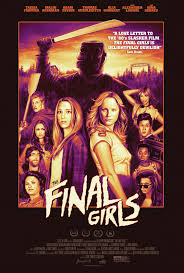
The Final Girls adds even more spice to the stew, as Max (Taissa Farmiga), grieving the death of her Scream Queen mother, Amanda Cartwright (Malin Ackerman), gets dumped into the early 1980s after a catastrophe at a screening of Mom’s most famous feature, Camp Bloodbath.

Director Todd Strauss-Schulson and writers Joshua John Miller and M.A. Fortin have a ball with a group of contemporary adolescents spun 40-plus years into the past to be fodder for a Jason Voorhees-style killing machine at a doomed summer camp.

Like the Scream franchise, the ability to adapt and survive by figuring out the “rules” of a slasher movie is the name of the game in The Final Girls, but the action also affords Max the chance to not only reconnect with her mother, but to act as a sort of spiritual advisor to a character carelessly described as “the shy girl with a guitar and a clipboard.”

Max and her friends travel even further back in time to witness the origin of the camp killer in the 1950s, and they all notice when the world around them is in black and white. One of them reckons she’s having a stroke because she’s suddenly colorblind!

The cinematography by Elle Smolkin also grabs our attention with a bevy of unbelievable shots, such as the killer, set ablaze, chasing the kids in slow motion. Or the apocalyptic purple sky during Max’s final battle.

There’s frightening fun in abundance, but there’s also inside jokes about lame movie stereotypes such as the airhead slut Tina (Angela Trimbur), who must be tied up to keep her from stripping off her clothes and summoning the killer.

Adam Devine from Workaholics delivers boffo laughs as Kurt, a one-dimensional stud from Hollywood’s disposable character drawer, who somehow makes his quest for endless nooky a righteous cause.

The Final Girls is an excellent example of a teen time-travel traumatic adventure. Maybe one of the best.

Beetlejuice (1988)

I found it inconceivable that Mrs. Sharky hadn’t seen Beetlejuice! I mean, if we go to the sequel, she’ll be lost!

The original Beetlejuice holds up extremely well, and it’s a shiny example of filmmaker Tim Burton at his most creatively unfettered, before the weight of pleasing soulless studio executives damaged his goods.

The man who gave the world Pee Wee’s Big Adventure, Edward Scissorhands, and Sleepy Hollow was firing on all cylinders, as yet unburdened with hallucinatory tasks like unsuccessfully updating Alice in Wonderland and Charley and the Chocolate Factory for new generations.

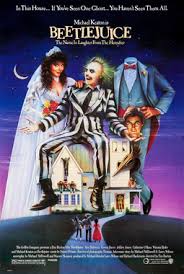
Burton casts a wild net in Beetlejuice, introducing us to Barbara Maitland (Geena Davis) and her husband Adam (Alec Baldwin), a recently deceased “normal” couple, who end up trying to haunt their own house to scare away the obnoxious family that moves in after their funeral.

The incoming Deetz family is fronted by brash, no-talent artist Deelia (Catherine O’Hara, who is wonderful),along with her fretful yuppie husband Charles (Jeffrey Jones), and darkling daughter Lydia (Winona Ryder), who has the ability to see the Maitlands and sympathizes with their plight.

The fledgling ghosts, after failing to frighten away the interlopers, summon the titular evil spirit (Michael Keaton) to handle the eviction process. Keaton is the the straw that stirs the drink, a Pu-Pu platter of perversion and patter, rightfully stealing every scene in sight.

In a movie about the importance of family—chosen and blood—we get three levels of domestic possibilities. The Maitlands, though dead, represent the most nurturing option for Lydia, while her parents are usually too distracted with their own devices to pay any attention.

But even the Deetz clan is preferable to Beetlejuice and his quest to take Lydia for his child bride so he can return to the land of the living. Yikes!

Burton earns an advanced degree in visual arts with his depiction of the afterlife, an impenetrable bureaucracy with frazzled, overworked caseworkers like Juno (Sylvia Sydney), in charge of crowded offices filled with confused corpses in various stages of dumbfounded decay.

The contrast between an increasingly bizarre real world, brought on by the arrival of the Deetz family and their awful Boho sensibilities, with a limbo full of mud-colored, take-a-number waiting rooms, helped to establish Burton’s outré credentials.

He also shows an uncanny eye for fashion, giving Lydia striking looks in both black and red. Burton definitely had a hand in Ryder’s ascent as a teen icon that learned to act and stayed forever.

The Vincent Price-loving Burton has honed a visual aesthetic of fascinating grotesquerie much like spiritual forefathers Edward Gorey and Charles Addams. And Beetlejuice is his master’s thesis, a riotous dark comedy that’s still cherished five decades later.

OK, bring on the sequel.

Oddity (2024)

Irish filmmaker Damian McCarthy made a bit of a splash with his debut, Caveat (2020), an indie-horror shocker that more than recouped the measly 250,000 pounds spent on its production.

Oddity is McCarthy’s second film, and the raw talent revealed in Caveat gains both power and polish, anchored by an incendiary performance by Carolyn Bracken, as twin sisters Dani and Darcy Timmins—the former a murder victim, the latter a blind collector of cursed objects.

Darcy decides that her sister’s murder at the hands of an escaped mental patient (Tadhg Murphy) is just a little too coincidental, considering her sister’s husband Ted (Gwilym Lee) is a psychiatrist at the nearby asylum from whence the killer came!

As if that weren’t enough to put a bee in her bonnet, Darcy discovers that Ted has a new girlfriend (Caroline Menton) less than a year after her sister’s brutal death by bludgeoning.

Through a magic ritual involving the glass eye of the alleged killer, Darcy figures out who the real culprits are and rebrands herself as an instrument of vengeance.

The obvious care and attention to detail provided by writer-director McCarthy is a pleasure to behold—the atmosphere of the mostly single set of a remote country house successfully develops layers of menace with each scene.

The narrative is bone simple, as Darcy arranges a sinister fate for the conspirators responsible for her twin’s demise, disguised as a bizarre housewarming gift: a life-sized wooden man that appears to be distressingly ambulatory.

The actual business of the revenge plot isn’t terribly intricate, but McCarthy consistently avoids the obvious choices, and the viewer is all the better for it.

Oddity is a first-rate horror experience that belies the lack of a body count, and indicates that Damian McCarthy is emerging as a confident comer in modern genre filmmaking.

Don’t believe me? See for yourself!

Night Swim (2024)

“I’ve always wanted a pool.”

Kurt Russell’s kid, Wyatt Russell, stars as an ailing baseball player who lucks into a house with a magic swimming pool.

Unfortunately, his family may not survive a comeback.

I went into Night Swim under the impression that it was a goofy monster-in-the-drain romp, accompanied by a heavy body count, but writer-director Bryce McGuire threw me a curveball.

Instead, it’s a movie about hope and how misplaced faith in miracles can be a dangerous thing. It also does a very credible job of capturing the joy and terror of owning a backyard pool.

A swimming pool used to be a mighty source of entertainment for the entire family, with a few short breaks for potato chips and kool-aid. Got a jar of change? Kids will dive after dimes all goddamn day.

A child’s introduction to liquid immersion is a unique feeling that goes back to the womb. Weightless, wet, wonderful, intoxicating, and frightening—it’s a different dimension that can play tricks on our senses.

McGuire makes fertile use of those familiar sensations, shooting every scrap of action from multiple angles for an extra slow and scary fun slide into the dark tank.

The title taps into the curious dread that comes with nocturnal aquatics, the feeling of not knowing how deep the deep end goes, and the uncertain possibility that you’re not alone in the pool.

Of course, it wouldn’t be a Hollywood film about a swimming pool without the ancient game of Marco Polo being involved. Do they really play this antique pastime in the 21st century?

I’m skeptical.

Night Swim also includes the obligatory Camel Fight sequence, and sure enough, people escape death by a hair’s breadth. Having once been pinned to the bottom of a pool during a losing Camel Fight, I can confirm that this is the sort of horseplay that can ruin everyone’s good time.

No one wants to see your stupid lungs explode.

Godzilla X Kong: The New Empire (2024)

This is what I get for not staying in touch.

It’s been quite a spell since I sat down with Godzilla. And King Kong? Forever.

This is the fourth (!) Godzilla-Kong film in the Monsterverse series that started 10 years ago with Godzilla. Since then, both creatures have been busy with their lives.

Godzilla appears in times of emergency to battle renegade monsters on behalf of humanity, though the collateral damage is usually catastrophic, as when he falls asleep in the Roman Coliseum after crushing a giant crustacean.

Meanwhile, King Kong is trying to reestablish his simian kingdom in Hollow Earth, after the destruction of Skull Island, but a bad tooth is preventing the great ape from leading his best life.

Dr. Ilene Andrews (Rebecca Hall), the head of Kong Research (I applied for that job!), is busy raising Jia (Kaylee Hottle), the last survivor of the Iwi Tribe from Skull Island, but the little native girl doesn’t seem to work and play with others.

It’s not always easy having a psychic connection to King Kong.

Oh yeah, Kong’s tooth. Andrews calls in her old friend Trapper (Dan Stevens) a swinging monster dentist, who replaces Kong’s busted canine. She also recruits Bernie Hayes (Brian Tyree Henry) a plugged-in podcaster and documentarian to interpret seismic data that suggests Godzilla is on the move.

Anyway, the humans recede into the background once the monsters start flinging each other around, only appearing in the latter part of the movie to provide exposition, which is helpful, since we‘re changing locations so often it becomes a chore to remember where we were and what we were doing before the last tumult.

There are new monsters (now referred to as Titans) on display in Godzilla X King: The New Empire, the most interesting being Shemo, an enslaved frost-breathing beastie controlled by Skar King, Kong’s villainous rival for the throne of Apeland.

With obvious tie-ins for video games and distinctive character tchotchkes up the wazoo, the running time of the movie is almost two hours, leaving you plenty of time to question your choice of accessories, as well as the decisions that led you here.

Look, Godzilla X Kong: The New Empire is little more than cutting-edge spectacle with some comedy relief, but it is extremely well-crafted by director Adam Wingard (You’re Next, Death Note). Everything, from creature effects to models and background art look sensational, the blending of live action and CGI absolutely seamless.

There is a storyline here, if you care to indulge, but it’s really not all that necessary. If something vital takes place, one of the characters will explain what it is, leaving us free to revel in big noisy carnage.

I got no problem with that, especially after a couple bowls of Cereal Milk.

Alien: Covenant (2017)

Yech!

Even with Ridley Scott directing, Alien: Covenant is another flop from a franchise that needs fresh blood more than Dracula.

Maybe we should blame Michael Fassbinder who gets to chew twice as much scenery in the dual role of Walter (the helpful, supportive android) and David (the amoral narcissist android).

Ten years after the events of Prometheus, which was also terrible, a new crew of explorers and sleeping deep-space colonists get a fragmented distress signal from a nearby habitable planet.

Surprise! It’s a trap! Didn’t see that one coming, did you?

Though there is space allotted for character development, nobody in the crew stands out from the usual trope type, except perhaps for Tennessee (Danny McBride), a good ol’ boy pilot in a beat-up cowboy hat.

See also: Lisa Standing (Kimberly Scott) in James Cameron’s The Abyss (1989).

There’s Captain Oram (Billy Crudup), a nervous newbie destined for failure; his second-in-command, Daniels (Katherine Waterston), still grieving her recently deceased husband, and Walter (Fassbinder), the android science officer who does most of the work.

We also get a bunch of Shemps, including Callie Hernandez, with very little to do other than perish.

Alien: Covenant attempts to re-create that ol’ black magic, but writers John Logan and Dante Harper spend too much time constructing familiar-looking scenes that hopefully resonate with long-suffering fans of the series. Consequently, there isn’t much of a story to hang your hat on, other than David’s mad ambitions.

There are elements aplenty wrangled from the first two (best) Alien films, including face huggers, gory birth sequences, automatic weapons, and renegade robots, but these never coalesce into anything able to stand on its own.

There’s the crew. The ship. The planet. The androids. Once again, the xenomorphs become an afterthought. In the final analysis, there is too much android angst and not nearly enough creature chaos, though it is a better-looking film than Prometheus.

The Alien series is stuck in a deep-space rut and could definitely use a change of scenery. I’ll let you know if there’s any intelligent life onboard after Alien: Romulus.