Off Season (2021)

Old School creepy goes a long way in my book. I’m always in the mood for an immersive plunge into nightmare waters.

Off Season is Old School creepy, a diabolical downward spiral with definite shades of Carnival of Souls and Dead and Buried tellingly layered into a Lovecraftian landscape.

Writer-director Mickey Keating, a former Blumhouse intern, has manifested another one of those damned tourist trap towns that visitors find impossible to leave behind.

Marie (Jocelin Donahue) is the daughter of reclusive actress Ava Aldrich (Melora Walters), who recently passed away and was laid to rest on the small coastal island where she grew up.

Funny thing, before she died, Ava told her daughter specifically to not allow her body to be buried there.

Funnier thing: Two lawyers she’s never met inform Marie that her mother changed her will, and that she wanted to be buried on the island.

Shortly thereafter, Marie receives a mysterious letter from the caretaker of the cemetery instructing her to come at once to address the recent vandalism of Ava’s grave.

Once she and her whiny husband George (Joe Swanberg) arrive on the island, the trap springs shut and the real nightmare can begin. Marie discovers the community is a hotbed of pagan idolatry and that many years before the villagers made a deal with “a man who came from the sea.”

Off Season comes foggily shrouded in a fatalistic sense of inevitability that dwarfs our petty terrestrial concerns, offering us a glimpse of life everlasting.

And we all lived happily ever after in thrall to Cthulhu, or someone like him. Well, maybe not so happily. Let’s say creepily.

Significant Other (2022)

Camping makes everything worse. Debate me.

If you’re a real horror fan, you know it’s true. Significant Other is just another case study in the facts of life.

Written and directed by Dan Berk and Robert Olson, the movie also offers relationship advice on how not to upset your boyfriend when he’s been body snatched by an alien scout checking out Earth as a possible invasion site.

Harry (Jake Lacy) convinces his anxiety ridden girlfriend Ruth (Maika Monroe) to go on a camping and hiking weekend. The communication between Harry, a hearty, upbeat outdoorsman, and his dour partner is not good.

For the first quarter of the movie, Harry ignores and dismisses every word from Ruth, which leads to a really awkward marriage proposal that puts a damper on the campers.

Ruth storms off to be alone. Harry goes for a walk to clear his head. Both make discoveries of the Third Kind, and when they meet up again, they’re not the same people.

Harry plays host to an alien consciousness, and is as surprised as anyone that his feelings for Ruth are complicating his mission.

Significant Other almost ventures into romantic comedy territory, because this relationship turns toxic in a big way, leading to a modest blood bath. Harry falls off a cliff, gets eaten by a shark, and has his head smashed into pudding, but he’s harder to kill than a cockroach.

Finally, Ruth ends up in Harry’s shoes and seemingly outwits the cosmic conqueror, making her getaway. It’s a small victory, as it turns out, because like shitty boyfriends, there are always plenty of invaders to go around.

Recommended? You betcha.

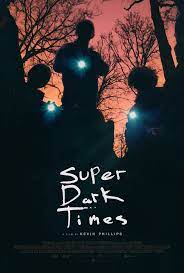
Super Dark Times (2017)

I’d heard Super Dark Times compared to Stand By Me, but it reminds me more of a much grimmer movie that came out the same year (1986), Tim Hunter’s River’s Edge.

Known primarily as a launching pad for a young Keanu Reeves, it also came with barking mad performances from Dennis Hopper and Crispin Glover.

All three movies speak volumes about adolescent friendships put under stress by the presence of a dead body.

The resemblance to Stand By Me seems deliberate. At first glance, Super Dark Times appears to take place in one of those Stephen King-like clouds of sunny nostalgia based some time in the 1990s.

Boys on their bicycles, clunky portable phones with Walkie Talkie antennas, and a TV appearance by Bill Clinton anchor us firmly in the appropriate decade, much like Donnie Darko’s sister declaring her intent to vote for Michael Dukakis.

Zach (Owen Campbell) and Josh (Charlie Tahan) are high school best buds whiling away their virgin years in a small rural town that looks Norman Rockwell on the surface, with a noticeable David Lynch underbelly.

Their lives are mostly innocent fun punctuated with declarations of impending boy horniness until a terrible mishap claims the life of Daryl (Max Talisman), a pain-in-the-ass acquaintance whom no one wanted to hang out with in the first place.

Everyone agrees it was an accident that led to Daryl’s bleeding to death, and the decision is quickly made to bury his stupid body and play dumb.

Indeed, it’s the day-to-day mundanity of the average teen that director Ken Phillips and writers Luke Piotrowski and Ben Collins, get exactly right, to the point where we actually care about Zach’s budding relationship with dream girl Allison (Elizabeth Cappucino).

However, this isn’t a John Hughes film, either. Zach cannot be redeemed by love and Josh loses his way entirely.

Once the closest of friends, Zach and Josh now view each other with increasing suspicion, that builds fiendishly low and slow.

Josh becomes angry and distant while Zach can’t sleep due to vivid nightmares about their dark deed.

The inability of friends to trust each other with a hideous secret dooms the relationship and leads to an unexpectedly bloody finale, one that slays any notion of Super Dark Times taking place in a benign Stephen King universe.

More like Dateline with Keith Morrison.

SDT is a superb, riveting thriller as well as a brutally harsh coming-of-age story, with young protagonists that have yet to develop a moral center.

Enthusiastic recommendation from this corner. I ate it up like Junior Mints.

See For Me (2021)

Blind girl in a house versus a gang of hoodlums.

No, it’s not Wait Until Dark, with Audrey Hepburn, who had to make due without a cell phone.

The protagonist in See For Me, is Sophie Scott (Skyler Davenport), an Olympic level skier who lost her sight—and seemingly her moral compass.

In order to get out from under a suffocating mother (Natalie Brown), Sophie develops a side hustle as a pet sitter for rich people, only too happy to help out an Olympic prospect down on her luck.

And so what if Sophie steals an item or two that surely won’t be missed, and splits the profits with her fence? As she herself points out, “Who would suspect the little blind girl?”

Her latest client is Debra (Laura Vandervoort), a recent divorcee with custody of a remote and massive mansion in the hills that features floor-to-ceiling glass, a solarium, a wine cellar, and $7 million in cash sitting in a safe behind a painting.

Though somewhat reluctant to hand over the keys of an ultra-modern, gazillion-dollar palace to Helen Keller, Debra debriefs Sophie on the alarm system and heads out the door.

Sadly for Sophie, she isn’t the only one with the bright idea of ripping off this piggy bank. Three hardened criminals working for a remote boss gain access to the house while she sleeps.

Fortunately, there’s an app for that.

The resourceful Sophie uses a service called See For Me, that connects visually impaired folks in distress with sighted volunteers. So she skulks about the house holding her phone in front of her so that Kelly (Jessica Parker Kennedy), an Iraqi war veteran, can guide her away from danger.

That’s the plan, anyway, but director Randall Okita keeps Sophie consistently in harm’s way (and our pulses racing) with one increasingly far-fetched development after another, none greater than the plucky blind girl herself.

Instead of a puddle of shrieking victimhood, Sophie not only picks herself up after enduring a highly unlikely barrage of obstacles, she seizes opportunity when it presents itself, and finds a way to come out ahead, as revealed in a satisfyingly unexpected conclusion.

Come for the breathless thrills, stay for the crafty anti-heroine.

Editor’s note: See For Me is based on a real application called Be My Eyes, and my wife is a volunteer. She actually got a call from a man who needed someone to read the buttons on his dishwasher during the movie!

I’m just glad it wasn’t an emergency.

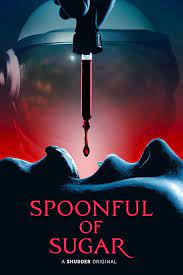
Spoonful of Sugar (2022)

Time for another installment of The Babysitter Saga, where we get to know the folks minding our precious offspring, while Mom and Dad sip martinis beneath a romantic moon, in search of dormant passion.

Spoonful of Sugar introduces us to Millicent (Morgan Saylor), an awkward college student hired to keep tabs on Johnny (Danilo Crovetti), a nonverbal autistic boy with a ton of allergies.

Johnny’s mother Rebecca (Kat Foster) is a successful writer married to Jacob (Myko Olivier), a hunky, shirtless carpenter that works from home.

Yes, this is a basic recipe for any number of Cinemax potboilers. Fortunately, director Mercedes Bryce Morgan and writer Leah Saint Marie have bigger fish to fry.

Nothing in the film is what it appears to be—it’s much, much worse, often to the point of absolute lunacy.

Millicent seems a virginal innocent, charged with caring for a seriously damaged child in an astronaut costume, whose parents are at the end of their ropes.

And that’s when Morgan brings her ingredients to a furious boil. Jacob and Millicent explore their animal attraction, even as the latter self-medicates with generous doses of LSD.

Historically (hysterically?), it could be argued that the combination of sex and drugs transforms Millicent into something evil, but the evidence presented indicates she’s already had a thriving career in the field, leaving a discreet stash of bodies in her wake.

It’s a calling she shares with young Johnny.

What ensues is a surreal, nightmarish custody battle, with both parties revealing a heart of darkness.

Millicent and Rebecca square off centerstage in a bloody contest of parenting styles, competing for Jacob, and the love of a mute boy with increasingly special needs of his own.

The outrageous extremes and shocking tableaux favored by Mercedes Bryce Morgan slow cook into a marvelously harrowing stew of taboos that satisfies a craving we didn’t even know we had.

Spoonful of Sugar is potentially dangerous medicine. Please consult your mad doctor before ingesting.

Bones and All (2022)

Horror Romance. Seems simple enough, but there are thousands of things that can go wrong, and usually do.

Absence of chemistry between the leads; indulgent editing, inane dialogue, and indifferent art direction, to name a few usual suspects.

Director Luca Guadagnino—along with screenwriter David Kajganich, and cinematographer Arseni Khachaturan—makes magic happen on all fronts in Bones and All, an absorbing and tragic love story, based on a YA novel by Camille DeAngelis.

The moods here shift like unstable weather. We’re following a narrative that’s by turns gruesome, seductive, and visually intoxicating, even when the protagonists are merely rambling down the road, which happens a fair amount during the slow-burning, 2-hour running time.

Or when they’re eating people.

Yes, we are talking about young cannibals in love, but don’t have a cow, man. Weathering the outré scenes is a small price to pay for a unique experience.

As for the subject matter, cannibalism fits snugly into the metaphor drawer under Dark Afflictions.

To say that Maren Yearly (Taylor Russell) is a little different than the other girls at her high school, would be a vicious understatement.

While playing slap and tickle with friends at a slumber party, Maren, the new girl, mistakenly bites down on some finger food, forcing she and her nervous daddy (Andre Holland) to quickly relocate—again.

Soon after, Maren awakens to find Pops has abandoned her, leaving behind a cassette tape he made to help her understand her “condition.”

With little cash and no other options, Maren heads to Minnesota in search of her mother’s relatives and hopefully a sense of her own identity.

During her journey she meets Sully (Mark Rylance), a seemingly benign drifter who identifies her as a fellow “eater,” a small cabal of carnivores that strongly prefer human hocks to anything raised on the farm.

Sully, a smiling and helpful ghoul who feeds opportunistically, is a recurring nightmare for Maren, made flesh and bloody by Rylance’s riveting portrayal.

The next “eater” she encounters is Lee (Timothee Chalamet), a wiry skate dude with a lousy dye job driving a stolen blue pickup. This one sticks, and they drive off together like Thelma and Louise on a second date.

Luca Guadagnino makes bold style and story choices throughout Bones and All, and his judgment is razor-sharp. He grants the camera enough room to shape heartbreaking tableaux of faded beauty amidst a backdrop of rural American poverty.

Like Steinbeck characters, somehow retaining their humanity in the face of crushing circumstances, Maren and Lee are devoted and determined to carve out a bloody little life for themselves, no matter the price.

While they bear some resemblance to other fugitive movie couples (Sailor and Lula in Wild At Heart, Caleb and Mae in Near Dark, Kit and Holly in Badlands), these kids are a different breed.

Hunger is present in every word and action. It’s a black current that soaks into the fabric of a strikingly gorgeous film, and the actors, especially Taylor Russell, handle that internal struggle with amazing grace.

My wife (former Theater major, I’ll have you know!) remarked that Russell is flawless, and gives one of the most naturalistic performances she’s seen in recent years.

All that’s based on a single viewing. There will be more to follow.

Bones and All is an unexpected trunk of perilous wonders, with loneliness and loss lurking among shiner coins such as love and freedom.

It’s an emotional risk to sort it all out, but worth taking if we want to get better.

Watcher (2022)

Holy Hitchcock, Batman!

From its Read Window voyeurism to Julia’s (Maika Monroe) resemblance to classic Hitchcock blonde Tippi Hedren, Watcher is a first-rate homage to the 20th century’s finest suspense filmmaker.

Best of all, it’s exquisitely crafted by writer-director Chloe Okuno, who orchestrates grinding fear and dread for a serial killer’s potential victim, a woman who knows too much in a country where she doesn’t speak the language.

Julia and her husband Francis (Karl Glusman) have just moved to Bucharest for his work. Julia, a one-time actress, is left to entertain herself in their new apartment for long periods of time while Francis wheels and deals.

Right off the bat, Julia is unnerved by a silhouette in a window across the street, a figure that seems to be fixated in her direction. In what becomes a pattern, she tries to tell Francis about the suspicious person, only to have hubby minimize her fears.

Meanwhile, women alone in their apartments are turning up headless. Yeah, thanks for your concern, Francis! Probably nothing to worry about.

There isn’t an ounce of flab on Watcher. Dialogue is minimal. Each frame is a precision brick in a wall of menace that threatens to fall on Julia at any moment. Precarious angles of endless invention are used to create a perpetual male gaze on Julia, a person seen, but not heard, due to a language (and gender) barrier.

Maika Monroe (It Follows, The Guest) continues to bloom, transcending the genre’s Final Girl status and emerging as a reluctant action hero, correctly channeling frustration and rage into not only self-preservation, but victory.

Make no mistake: in the hands of a lesser actress this film would not have achieved such thrilling peaks. As the unwilling object of a madman’s desire, Monroe is charismatic, capable, and committed to each character moment, as only someone fighting for their life can be.

Julia’s determination to find her tormentor and destroy her victimhood provides serious octane in Watcher, a sleek thriller that both embraces the Hitchcock tradition, and flips the camera back onto the audience (and Hitchcock), as if to ask, “What are you looking at?”

Definitely a Top Ten film of 2022. See it straight away.

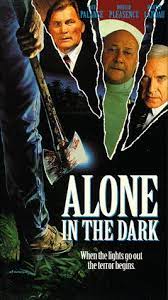
Alone in the Dark (1982)

Wow, two Oscar winners in one low-budget, 40-year-old slasher!

Jack Palance and Martin Landau are half a quartet of escaped lunatics paying a surprise visit to their new mental health practitioner in Alone in the Dark, a New Line Cinema oddity from writer-director Jack Sholder (The Hidden, A Nightmare on Elm Street 2).

Palance is underutilized as Frank Hawkes, a paranoid schizophrenic, but Landau chews the scenery like a great herbivorous swamp dinosaur as Byron Sutcliffe, a pyromaniac pastor with a permanently deranged countenance.

With the arrival of Doctor Dan Potter (Dwight Schultz, from The A-Team), the new shrink at the Haven Mental Hospital, Hawkes takes it into his head that Potter must have murdered their former doctor, and that he will soon kill all of them.

Donald Pleasance does the heavy lifting as stoner psychiatrist Leo Bain, the director of Haven Hospital. Bain’s ludicrous touchy-feely therapy encourages the patients to truly explore their various psychotic “trips.”

“Preacher likes to set fire to churches, that’s his trip. Unfortunately he does it when there are people inside,” Hawkes explains to Potter.

Along with monstrous pedophile Ronald “Fatty” Elster (Erland van Lidth, The Wanderers) and a vicious (but shy) maniac nicknamed “The Bleeder” (Phillip Clark), Hawkes and Preacher escape captivity during a power blackout caused by theatrical punk band The Sick Fucks, who are playing at a nearby bar.

Could happen.

The showdown, the siege of Dr. Potter’s house, ain’t exactly Straw Dogs, but Pleasance does his zany best confronting his runaway loonies with platitudes and mumbo jumbo.

Taken as a whole, Alone in the Dark isn’t a very good movie. It’s light on gore, characters appear and disappear randomly, and at least one subplot, involving Dr. Potter’s wife and sister going to a Nuclear Power protest, stretches credulity beyond all known limits.

Somehow, through the awkward combination of dormant star power, budget-constraint innovation, and tongue-in-cheek pseudoscience, it remains a kooky curio worthy of attention even 40 years later.

When Potter tells Bain that the escapees are armed and have killed several people, the latter shrugs, “Well, what do you expect? It’s a violent world out there.”

Right you are, doc.

The Cursed (2021)

Lovely to look at but largely bereft of beast, The Cursed, written and directed by Sean Ellis, can’t decide if it’s a werewolf movie or a period piece homage to The Thing.

In true egalitarian fashion, we get a smattering of each, leaving both camps less than satisfied.

Seamus Laurent (Alistair Petrie) is a 19th-century French landowner with a passel of problems. While slaughtering a band of gypsies who’ve taken up residence on his property, Laurent gets a horrible hex placed on him by a dying witch, who doesn’t appreciate being buried alive.

The local children immediately start having bad dreams about an evil mouth of silver teeth, supposedly constructed from the 30 pieces of silver that Judas was paid to betray Jesus.

Kids being kids, they find the enchanted teeth, start horsing around with them, and Edward (Max Mackintosh), Laurent’s son, gets bitten. Soon after, mutilated bodies begin turning up, and a visiting pathologist (Boyd Holbrook) is called in to investigate.

The Cursed is sturdily constructed and painterly pretty, but Ellis uses such a muted color palette, his framing dexterity often gets overlooked. Each set is either engulfed in fog or we get buckets of brown mud and green turf, so as to appear especially dreary. Visual monotony ensues.

And then there’s his cavalier attitude toward lycanthropy. Surviving victims of Edward’s rampage transform with tendrils emerging from their backside. Tendrils? Where did they come from? Is this Lon Chaney or Lovecraft?

Furthermore, the werewolf CGI isn’t anything special when it finally appears. Rick Baker’s seven Oscars are not in danger of being eclipsed by this bunch.

Even so, The Cursed isn’t a terrible movie, but it’s slow, overly talky, and there are way too many scenes of people waking up from nightmares. Turns out the dreams are the scariest part, unfortunately.

Editor’s Note: This is the second disappointing werewolf movie I’ve seen with this title. The 2004 Wes Craven-Kevin Williamson feature with Christina Ricci is also a dud.

Barbarian (2022)

We’re seeing an upswing of Air B&B-based horror movies, and writer-director Zach Cregger’s Barbarian currently sits alone at the top of the heap. It’s a stylistic cousin of Tarantino’s Pulp Fiction, as mood and tone careen crazily between multiple storylines that converge in one really bad house.

Our heroine Tess (Georgina Campbell) is on her way to Detroit for a job interview with a documentary filmmaker. She arrives at her rental, the only livable dwelling in a blighted suburb that looks like World War II ended last week.

To complicate matters, it’s a dark and stormy night. To further complicate matters, she finds her house already occupied by Keith (Bill Skarsgard), a somewhat intense fellow who seems determined to put her at ease, offering to share the house with Tess for the evening.

Eventually, and against her better judgment, Tess accepts Keith’s hospitality and the two get better acquainted over a bottle of wine.

Meanwhile, in another part of the movie, TV sitcom star A.J. Gilbride (Justin Long), is having a rough time with the #MeToo movement, causing his career to crumble.

He’s advised to liquidate his holdings, including some rental property in his native Michigan, currently occupied by Tess, Keith, and something else entirely.

There is a fearsome creature at the heart of Barbarian, but like any good monster, she’s highly sympathetic, certainly more so than the two male leads, neither of whom can adapt in the unexpected survival situation they all stumble into.

AJ in particular is a loathsome example of masculinity; a whiny, raging, mama’s boy, who proves to be the biggest obstacle in Tess’s escape from a hell-house that rivals the Sawyer Farm in Texas.

Frank (Richard Brake), the owner of the house and its hell, gets his story told in a narrative hopping flashback, and we realize that the thing haunting this hacienda is not the real monster here. In fact, she’s a remarkably nurturing creature considering her grim origin.

There’s a hell of a lot happening in Barbarian, and it understandably leaves the viewer a bit rung out. It’s shocking, periodically funny, and superbly realized by Zach Cregger, formerly of The Whitest Kids You Know.

Cregger’s commitment to creeping (and grossing) us out is impressive as layers of awfulness just continue stack up like mildewed laundry.

It’s also a film that’s not afraid to sound off on a laundry list of anxiety topics, including motherhood, property values, Cancel Culture, incest, hospitality industry paranoia, and awkward first dates.

Barbarian is a wild ride and there are no seat belts in this buggy.