The Invitation (2015)

I am a restless channel surfer, something that my lovely wife won’t tolerate. So, I have to sneak around like a burglar and surf on the down low when and where possible.

H is for horror. H is also for home.

This is the category I relentlessly peruse. After skimming through the same titles over and over again, I have come to the conclusion that there may be in excess of 5,000 movies about folks trying to rebound from tragedy (kid dies, kid goes missing, kid joins cult, kid kills other kid) by moving somewhere for a “fresh start.”

And it never works.

Our gradual awareness of the significant wounds we acquire (and inflict), while going about the business of our lives, is fertile turf for purveyors of contemporary horror.

We are in a weakened state, and the oceans of emotions used to somehow transform sorrow into a way of “living with it” are often identified as symptoms of madness.

The Invitation, director Karyn Kusama’s dinner-from-hell, is a wolf in sheep’s clothing, by seemingly offering its cast the chance to not only overcome grief and guilt, but to live in a serene present.

Will (Logan Marshall-Green) and his girlfriend Kira (Emayatzy Corinealdi) reluctantly agree to attend a dinner party in Laurel Canyon thrown by Will’s ex-wife Eden (Tammy Blanchard) and her new husband David (Michael Huisman).

Also present are several old friends whom Will hasn’t seen since a tragedy two years before, that resulted in the accidental death of Will and Eden’s son, Ty (Aiden Lovekamp).

Throughout a long evening of reminiscing over excellent wine, David and Eden reveal their true agenda for this jolly reunion, recruiting the guests to accept The Invitation, a growing metaphysical movement that seeks to rehabilitate poor souls suffering from overwhelming guilt.

Like Will.

“Grief, anger, depression, abuse… It’s all just chemical reactions,” Eden explains.

The soiree hits rough waters on several occasions, due to suspicion and eventually open hostility from Will, who pushes back at David’s spiritual salesmanship by storming out of the room every five minutes or so.

“I don’t pretend to know what you went through, and you don’t know me. You can’t!” he growls at David.

His friends are rightfully worried, as Will demonstrates classic post-traumatic paranoia, especially when David locks the doors, explaining that there was a recent home invasion nearby.

But what are Eden and her rather intense new hubby up to?

“Something dangerous is going on, and we’re all just ignoring it because David brought some good wine!” Will barks at the other guests.

The action is a delicately paced slow-burn, as Kusama (Girlfight, Jennifer’s Body, and TV’s Yellowjackets) and husband-screenwriter Phil Hay manifest the most nightmarish episode of dinner and drinks since Who’s Afraid of Virginia Woolf?

I urge you to accept The Invitation (at your own risk) and you will be rewarded with a sharp, uncompromising thriller that also serves as a fevered meditation on the various paths we take to process tragic events.

Apparently there is a right way and a wrong way.

The Lake (2022)

The Lake is a movie about many things. Oddly enough, a lake isn’t one of them.

Rather, Thai filmmaker Lee Thongkham has gifted us with a magnificently exotic specimen that defies easy categorization. It also has to be one of the dampest movies ever! There is pouring rain in like 75 percent of the shots!

In a humble Thai village, bordered by a river and a lake, humble Thai fishermen and toad wranglers gather in the gloomy darkness (with rain dumping buckets) to hunt their respective quarries.

While pursuing tasty amphibians one group of men discover an enormous egg and wisely decide to run off with it, no doubt with visions of enormous omelettes in their futures.

Seeking quick profit over respecting the sanctity of the nest, draws the ire of a rampaging parent monster and the interlopers are dealt with harshly.

The egg is found by May (Wanmai Chatborirack) a curious and empathetic little girl who becomes its protector, much to the dismay of her older sister and brother, who now find themselves as the heads of the household and in charge of the willful child, since their father, an unlucky fisherman, was recently squashed by the angry monster.

One of many points raised by writer-director Lee Thongkham, is that the family unit is a sacred thing, which explains why the kaiju from the lake is so thoroughly pissed at these poor starving peasants who’ve made off with her bambino.

Thongkham encourages peaceful solutions to the conflict between the enraged monster and the humans that poached its egg. On the way to forgiving and forgetting, there are many lessons to be learned, including, who knew that Thai monster movies were such a kick?

The creature effects are first-rate. Whether it’s a very nimble dude in a rubber suit raising hell among the fleeing villagers or the XXL version that’s ready rock in Bangkok, fans of monster mayhem will be tickled pink.

Go ahead and take a dip in The Lake. You’ll get all wet, but it’s quite refreshing.

Berberian Sound Studio (2012)

If you’ve ever remarked aloud words to the effect of “this job is killing me,” then perhaps you can understand the kind of hell that protagonist Gilderoy (Toby Jones) faces in Berberian Sound Studio, a meticulously unnerving film by Peter Strickland.

Gilderoy is a sound editor for movies, recognized internationally as a true artisan in a mostly vulgar industry. He takes an assignment in Italy that turns out to be a lurid horror movie about the Inquisition, and finds himself at odds with everyone around him, including the raging director (Cosimo Fusco), a playboy producer (Antonio Mancino), and various unhappy actresses who complain that they haven’t been paid.

Time is measured fitfully. Gilderoy, feeling more trapped every day, is unable to get reimbursed for his airfare by a sneering secretary (Tonia Sotiropoulo), forcing him into a captivity spent devising gruesome sound effects for a movie about (mainly) torture and screaming women.

We are witness to countless taping sessions of chopping, stabbing, boiling, and mutilating many pounds of fruits and vegetables, which never seem to get cleaned up, giving us a behind-the-scenes look at a studio full of moldy produce.

And it appears the mold is growing in direct proportion to the increasing torment depicted in the film being made, which the viewer never sees.

Meanwhile, actresses continue to scream in the sound booth. The director isn’t remotely satisfied with anyone’s terror level, and bullies the hapless audio supervisor into turning things up a bit.

Not surprisingly, the mild-mannered and repressed Gilderoy begins to lose his grip on reality, cheered only by an occasional letter from his mother. Even these become sinister as the days roll by, as if the carnage he helps create in this cursed Italian production has infected every branch in his life.

Writer-director Peter Strickland has cunningly fabricated a stinging slow-burner about the frailty of the creative spirit and how the battle between art and crass commercialism can cost you your very soul—not unlike say, Barton Fink.

Berberian Sound Studio plays out as a hypnotic and haunting collage of rolling tapes, clipping VU meters, and the turning of knobs, all of which contribute to a very soft man’s ruin, brilliantly realized by veteran stage actor Toby Jones (also sublime in The Detectorists), with whom we sympathize every awful step.

It’s also a “way homer” and worth the time it takes to puzzle over. I’m still thinking on it.

Cobweb (2023)

Pity poor Peter (Woody Norman), an eight-year-old kid who just wants a decent night’s sleep, a life without bullies, and a normal mom and dad.

In Cobweb, we learn that Peter’s school days are spent hiding from evil classmate Brian (Luke Busey, a third-generation movie psycho), while his home life is watched over by his stern parents Carol (Lizzy Caplan) and Mark (Antony Starr), an odd, secretive couple who aren’t afraid to dish out severe punishments for being too curious.

The problem is, Peter is being kept awake at night by intermittent tapping in the walls and his freaky parents dismiss his concerns by telling him he has an overactive imagination!

Peter tries to enlist the help of Miss Devine (Cleopatra Cole), his new teacher, but her appearance at his home results in the lad getting locked in the creepy basement, where he makes further contact with someone else living in their house. Someone who develops a powerful hold over the lonely tyke.

Cobweb‘s rookie director Sam Bodin shows off a fully stocked cabinet of gothic panache, creating a nightmare landscape to rival Tim Burton, one that seems all but inescapable to our young protagonist.

Bodin and writer Chris Thomas Devlin understand a child’s limited worldview and what perceived threats can endanger it.

Question: Is it my imagination or does the creative team of this movie enjoy tormenting kids just a bit too much? In any case, Cobweb is a fiercely original film that should scare the bejesus out of any average, run-of-the-mill rugrat.

It’s not for them, anyway.

No One Will Save You (2023)

If you’re a fan of witty, acerbic dialogue, this won’t be your cup of tea.

Instead, No One Will Save You is a master class in visual storytelling from writer-director Brian Duffield (Underwater, The Babysitter, Love and Monsters) who puts his leading lady Kaitlyn Dever through one helluva wringer, all without a single word of exposition.

Through views both intimate and isolating, we meet Brynn Adams (Dever) a young woman with promising artistic talent who lives a solitary existence on the outskirts of town.

On the occasion when she ventures into her small community, it is quite apparent that Brynn is not a popular citizen, as her appearance invokes scorn and derision, all conveyed by a floating camera that hovers nearby like a curious housefly.

So who does Brynn turn to when she discovers that someone has broken into her house? What measures will the nervous girl with the bad reputation take when it appears her intruder is not of this world?

There’s barely a soundtrack to serve up emotional cues—mostly a few ominous Bernard Hermann orchestral swells—so we’re as surprised as Brynn when aliens shows up prowling her pad.

No One Will Save You sucks in the viewer like a Texas Twister from the opening frame. Brynn is a friendless, reluctant heroine with a tragic past who nonetheless steps up when her home is threatened by ambitious extraterrestrials.

For the majority of the running time, it appears that the thing to do is cheer for Brynn, and remain hopeful. This course of action gets increasingly difficult when Duffield zooms out from her personal combat to reveal the state of the rest of society.

Soon, the question becomes, why fight it? Maybe subjugation isn’t such a bad deal. It could even be an effective way to work through crippling anxiety and childhood trauma.

Filmmaker Duffield has fashioned something rather remarkable with No One Will Save You. It’s a silent, sci-fi, home invasion thriller with heavy implications for us to consider, that still manages to be big-ticket entertainment.

Are we the bad guys here? If we weren’t so freaked out about defending our castles, maybe we’d learn something.

Big-time recommendation from this terrestrial citizen.

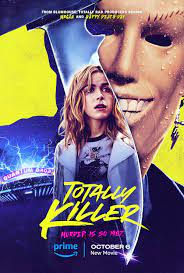
Totally Killer (2023)

“I hate time-travel movies. They never make any sense.”

Capitalizing on the resiliency of the Happy Death Day films—and with plenty of references to the Back to the Future franchise—Totally Killer takes us on another time-tripping adventure, as wisecracking teen Jamie (Kiernan Shipka) travels back to the 1980s to keep a serial killer from hacking up her over-protective mother Pam (Julie Bowen, from Modern Family) in the present.

Director Nahnatchka Khan demonstrates considerable dexterity juggling tones throughout the movie. Though primarily played for laughs, there is valuable, life-affirming subtext as well as abundant gory bits baked into the Totally Killer cake.

And who can resist a bloody cake? Not me.

In the present day, Jamie Hughes (Shipka) is a surly high school student who’d rather worship the devil at a rock concert than stay home and hand out Halloween candy with Mommy.

Pam keeps a tight rein on Jamie, because her own friends were stabbed to death 36 years ago by the “Sweet 16 Killer,” a masked maniac who was never caught.

Imagine Jamie’s chagrin when she returns from the show to find Pam fatally perforated!

Jamie ain’t the brainiest girl in town, but it helps that her best friend Amelia (Kelcey Mawema) has a prototype time machine (inside a photo booth) ready to unveil at the science fair.

Through a set of wacky circumstances, Jamie winds up in the past having to babysit her mom (Olivia Holt) and her Mean Girl friends from a knife-wielding psycho in a Beavis mask.

At the same time, she is painfully aware that her actions in the past are likely to affect the future, so Jamie has no choice but to keep her parents from “hooking up” too early, lest she not be born.

Editor’s Note: People didn’t use the term “hook up” in the ’80s.

It sounds complicated, but fun is never far away in Totally Killer, and Shipka is very droll as a fish out of water who must find cultural references that people from the 1980s will understand.

It’s also a winner if you’re watching with someone who isn’t a horror fan, as the zesty mix of comedy and suspense will definitely win them over.

Dark Harvest (2023)

I’m going to make a bold prediction that Dark Harvest becomes a Halloween movie-night staple.

Alternately luminous and vicious, Dark Harvest is a captivating adaptation of Norman Partridge’s 2006 novel about a cursed small town that must destroy a local monster every time the calendar hits October 31.

In a seasonal swash of ultra violence, the legendary Sawtooth Jack, a pumpkin-headed demon, rises from the cornfield and is hunted by a posse of hungry high school boys. Jack must be killed before the church bells chime midnight, or the community will be plagued by storms and misfortune for an entire year.

It’s a tradition, you understand.

At harvest time, the boys from the local senior class are locked up for three days without food so they’re properly motivated to bring down Sawtooth Jack, a frightening and deadly foe that is nonetheless loaded with candy.

Director David Slade and writer Michael Gilio conjure magic, madness, and terror in a coming-of-age tale that pounces on the viewer like a midnight collaboration between Ray Bradbury (luminous) and Joe Lansdale (vicious)—with a bit of Hunger Games thrown in after some focus-group input.

Editor’s Note: The kids attend Bradbury High School.

Dark Harvest could have used more exposition and context, but the fevered sepia-toned sights of raving teenagers versus an uncanny enemy, is first-rate cinematic mayhem that actually does justice to its literary origins.

Make it a welcome addition to your annual festival of fright films, m’kay?

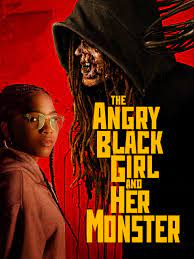
The Angry Black Girl and Her Monster (2023)

This creature has life! But what kind?

The Angry Black Girl and Her Monster is a powerhouse debut written and directed by USC film school grad, Bomani J. Story.

In another cross-stitching of Mary Shelley’s well-seasoned source material, we fade in on Vicaria (Laya DeLeon Hayes), a budding teen scientist from the ‘hood who’s just lost her older brother Chris (Edem Atsu-Swanzy) in a gang shooting.

Rather than grieve and move on, Vicaria decides to take matters into her own hands and bring him back from beyond. From her jerry-rigged laboratory in a condemned building she summons sufficient wattage to jolt Chris back to consciousness.

Oddly enough, her creation largely disappears into the woodwork, because Vicaria has plenty of other shit to deal with, namely working off a debt to Kango (Denzel Whittaker), the local drug lord that keeps her poor father (Chad C. Coleman) strung out.

The monster’s presence is often felt, particularly by Jada (Amani Summer), a chatty, precocious neighbor kid who seems quite up-to-date on its whereabouts.

Writer-director Story has fashioned a curious creature, the likes of which we haven’t seen before. While some plot developments don’t make much sense (e.g., Vicaria seems awfully into Kango, the guy who deals to her daddy), the look and feel of The Angry Black Girl and Her Monster pulses with an otherworldly glow and a fresh current of rage, not to mention a towering title character prowling the night in designer streetwear seeking revenge.

Or maybe he’s just looking for his home. In any event, he kills people.

Vicaria is the electricity that animates this action, and actress Laya DeLeon Hayes delivers high drama with a cool head. Here is a young woman that’s seen enough death for one lifetime—and does something about it, despite the endless obstacles placed in her path by institutional racism, classism, and sexism.

And if at first you don’t succeed in defeating death, try, try again, because hope springs eternal and shit.

The Tank (2023)

Tanks for nothing.

The Tank fails to capitalize on a perfectly serviceable premise reminiscent of H.P. Lovecraft’s The Shuttered Room, in which a financially strapped family inherits a long-abandoned property on the Oregon coast. (Actually filmed in New Zealand!)

Conveniently set in the 1970s (no cellphones, duh), The Tank dutifully introduces us to Ben (Matt Whelan) and his wife Jules (Luciane Buchanan), a young couple eking out a living as co-owners of a pet shop.

One day a lawyer arrives with a mysterious deed to a mysterious house that Ben’s mysterious mother (a madwoman) had in her possession, and without further prompting, Ben and Jules pack up their daughter Reia (Zara Nausbaum) and the family dog (who doesn’t die) and split for the new beach house.

Writer-director Scott Walker does an okay job of placing his protagonists in a suitably eerie environment, but there isn’t much going on for the first hour of the film, and frankly it’s not worth the time investment spent waiting for a little action.

What follows are approximately 46 scenes of Ben and Jules wandering about their property in the dark with only lanterns to the light the way, and they mostly add up to zilch. All manner of growls, grunts, and groans are investigated but nothing turns up and everyone goes back to sleep.

Finally, some flesh-eating salamanders materialize in the water tank beneath the house and make their presence known by mauling a couple of secondary characters.

The salamanders have no eyes, so that’s a bit creepy.

Where did they come from? Are they monsters? Did they kill Ben’s father and sister? Most of these mysterious queries remain unanswered, so be prepared for the bitter taste of disappointment upon conclusion of The Tank, because it will not inspire much joy—other than the dog’s survival.

Scary Stories to Tell in the Dark (2019)

“Stories hurt. Stories heal.”

Folklorist Alvin Schwartz is the author of the source material for Scary Stories to Tell in the Dark, but in the fertile hands of director Andre Ovredal (Trollhunter) and producer Guillermo del Toro, these words not only spring to life, they chase us down a long dark hallway.

With the 1968 presidential election of Richard Nixon serving as an ominous backdrop, we are invited into the picturesque community of Mill Valley, Pennsylvania, where Halloween is in full swing.

Stella (Zoe Margaret Colletti), a fan of horror movies and a burgeoning writer, is putting the finishing touches on her witch costume in preparation for an evening out with Auggie (Gabriel Rush), and Chuck (Austin Zajur), her two doofus friends.

In short order, they manage to piss off Tommy Milner (Austin Abrams), the town bully, and he and his goon buddies chase the luckless teens into a drive-in showing Night of the Living Dead. There, they take refuge in a car belonging to Ramon (Michael Garza), a stranger in town, who coincidentally is also on the run.

With Ramon in tow, Stella and her friends decide to explore the Bellows Mansion, the local haunted house of mystery, and in doing so, release the spirit of Sarah Bellows, a raging ghost bent on revenge.

While the connecting narrative of Scary Stories to Tell in the Dark is an increasingly familiar page torn from Ray Bradbury, Stephen King, Stranger Things, etc, the monsters conceived by del Toro and Ovredal bring the zing to this production.

The Fat Lady, Harold the Scarecrow, the Jangly Man, and the Big Toe Zombie are the stuff of newer, fresher nightmares, elbowing aside worn-out boogeyman templates that neither frighten nor satisfy.

Scary Stories to Tell in the Dark also ends in such a way that a second film is practically required so Stella can rescue Auggie and Chuck. I only hope that the sequel is likewise handled by del Toro and Overdal, who are perfectly suited to the task.

In case my review is too ambiguous, I heartily recommend Scary Stories to Tell in the Dark, now and in the future.