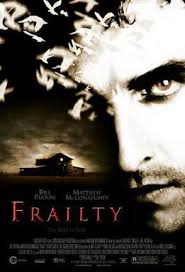
Frailty (2001)

The late Bill Paxton (1955–2017) will always be remembered for his distinguished genre credentials. As the not-so-brave Private Hudson in Aliens (1986), he got all the best lines, including “Game over, man!”

A year later he was part of a kick-ass vampire gang in the criminally underrated Near Dark, reunited with his Aliens costars, Lance Henriksen and Jenette Goldstein.

Still not impressed? How about this action? Paxton is the only actor to play a character killed by a Predator (Predator 2, 1990), a Xenomorph (Aliens) and a Terminator (The Terminator, 1984).

Serious respect!

In Frailty, Paxton directs and stars as a mild-mannered mechanic who becomes a divinely inspired killer after a visitation from an angel.

Rather than keep this to himself, he awakens his two young sons Fenton (Matt O’Leary) and Adam (Jeremy Sumpter), informing them that they will be helping Dad destroy demons in human form.

Adam, the younger son, is gung-ho to please his avenging father, while older brother Fenton doesn’t like the idea one bit.

Too bad the Lord’s will must be served.

The brothers’ upbringing is recounted years later by a grown-up Fenton (Matthew McConnaughy) to incredulous FBI agent Wesley Doyle (Powers Boothe), who reluctantly gets reeled into a twisted tale of a family under the dominion of a terribly unbalanced man.

As a director, Paxton imbues Frailty with a naturalistic, small-town feel that makes the episodic violence particularly jarring. As an actor, he delivers a nuanced, but emotionally reserved performance that evokes a little sympathy and a whole lot of terror.

Anyone expecting the unhinged Hudson, or perhaps the belligerent bully Chet from Weird Science will see nothing of the sort here.

By the time he locks Fenton in the basement for a week (no food, one glass of water per day) in an effort to drive out any demonic influences, the horror has gotten uncomfortably real, as Paxton dons the face of unblinking fundamental fanaticism, reminiscent in tone of Kevin Smith’s Red State.

Bill Paxton’s ability to goose the tension as a filmmaker in Frailty, is more than matched by his extraordinary performance as an ordinary man called upon to serve God by fighting evil.

But it’s not easy. Just ask Abraham.

Sinners (2025)

Enthusiastically recommended and watch out at awards time!

Sinners is the fifth collaboration between writer-director Ryan Coogler (Creed, Black Panther, Fruitvale Station) and star Michael B. Jordan, and it’s an epic whopper of a movie with a blistering blues soundtrack and a depth of soul not typically found in an era of easily disgested entertainment options.

Twin brothers Smoke and Stack (both played by Jordan) return to Clarksdale, Mississippi—after working for Al Capone’s mob in Chicago for seven years—determined to open a juke joint, a place where hard-working sharecroppers and field hands can be free to eat, drink, and dance the night away.

The brothers have contrasting demeanors, but their ambition, to own something free and clear that’s designed to serve the black community, is helped greatly by the large amounts of cash they’ve brought back from the Windy City.

Smoke recruits his former lover Annie (Wunmi Mosaku), a New Orleans hoodoo practitioner, to cook catfish for the crowd, while Stack hustles hooch and henchmen in an effort to keep the peace in their new joint.

On opening night, the club is jammed with folks stomping away to spirited music provided by guitar prodigy Sammy Moore (Miles Caton) and blues elder statesmen Delta Slim (Delroy Lindo).

Coogler is in absolute artistic control of the frenetic proceedings, and the verve and excitement he is able to capture during the dance sequences is unreal. We’re talking mesmeric scenes flowing so organically they’re worthy of repeated watches on their own.

While patrons shake and shimmy, Coogler enlarges the cultural lens to include a heartfelt vision of artists—past and future—caught in the dervish rhythms of the juke joint, and the effect is breathtaking.

“Blues weren’t forced on us like that religion,” Slim tells Sammy. “We brought this with us from home.”

Just when we’re having a peak cultural moment, a trio of vampires disguised as itinerant Irish folk musicians, crash the party and a bloodbath ensues.

There is no reason to believe, as some grumpy critics have implied, that Sinners unexpectedly goes off the rails at this point. Coogler doesn’t bring in the undead as a deux machina or as a concession to a larger, edgier demographic.

The taking of blood and the quick assimilation (exploitation) of blacks into a “protective” white society is a historical hot-button issue at play in Sinners, but it’s far from the only one.

There’s subtext and pointed references worth investigating everywhere, including a mysterious connection between the Choctaw Tribe and Irish immigrants. It’s all intentional on Coogler’s part, as he dares us to consider alternative histories to the ones we’ve been spoon fed.

Visually, musically, and dramatically, Sinners kicks more ass than a 1000 superhero flicks. Add yours to the queue.

Ouija: Origin Of Evil (2016)

Prolific genre dynamo Mike Flanagan (Haunting of Hill House, Oculus, Dr. Sleep) created this prequel to Ouija (2014), and consensus opinion holds that Ouija: Origin of Evil, is far superior to its predecessor, though that may have more to do with the “meh” quality of the original material, rather than an auteur’s magic wand.

We travel back to the year 1967, where widowed mother Alice (Elizabeth Reaser) makes a modest living as a phony fortune teller, aided in her deceptive practices by daughters Lina (Annalise Basso) and Doris (Lulu Wilson).

Alice and eldest daughter Lina consider adding a Ouija board to their seance shtick, but all too quickly this occult stepping stone gets a grip on Doris, the youngest, resulting in a once-innocent child playing host to a number of spiritual entities, good and bad, including her late father (good) and a fiendish Nazi doctor (bad).

Flanagan and cowriter Jeff Howard weave together enough plot points for seven sweaters, but don’t sweat the details. Ouija: Origin of Evil is trademark Flanagan territory, as a fractured family faces a perilous paranormal presence coming from inside the house.

The technicians Flanagan puts to work on his projects are first-rate, intuitively establishing the tone, time, and terroir in which his particular domestic terror can take hold of hearts and spines.

Here, art director Alberto Gonzalez-Reyna and cinematographer Michael Fimognari mute the sunny ’60s California scenery in dark shades of green and gold, so wardrobe colors appear especially vivid and blooming—a keen counterpoint to the carnage being carried on behind closed doors at the local fortune teller’s house!

Despite being a minor entry in Mike Flanagan’s filmography, Ouija: Origin of Evil is a compelling and highly watchable film in its own right, and needn’t be seen in the company of any other Ouija entries in the hopes of additional illumination.

Abandoned (2022)

I’ve spent enough hours surfing for movie options that I can read a plot summary in about three seconds flat.

Thanks to several years of immersive research, I can now safely testify that approximately 70 percent of ALL horror entertainment must include a struggling couple with kids (living or recently deceased) relocating to a house of questionable repute in search of a fresh start.

Usually for such an egregious error in judgment, the hopefully healing family gets placed in a potentially paranormal hot seat, somehow stemming from one of the parent’s festering trauma.

Abandoned, which benefits from a thoroughly committed Emma Roberts as a new mom with a vicious case of postpartum depression, is another such film. Director Spencer Squire digs deep into the tortured psyche of Sara (Roberts), but doesn’t find anything new or interesting to report.

Sara and husband Alex (John Gallagher Jr) get a sweet deal on some rural acreage that comes with a bonus room that the previous owner only used for murder and suicide.

Their infant son Liam spends most of his screen (scream?) time lustily crying his lungs out, so we definitely sympathize with the rapidly disintegrating Sara.

The fragile lass gets saddled with a wailing infant all damn day, and has nothing better to do than figure out the dark history of the house while suffering a nervous breakdown.

Meanwhile, her veterinarian hubby is facing his own challenges putting down a pen of infected pigs, necessitating many hours spent out of the house, leaving Sara and little Liam to deal with a creepy neighbor (Michael Shannon), voices in the walls, and a bunch of missing toys (resulting in even more loud lamentations).

Alex euthanizing sickly swine is supposed to provide some kind of narrative parallel to Sara’s mentally unstable parenting style, but in the end, she accepts her crybaby and bravely snatches the little nipper back from a pair of feral kids.

Or maybe they’re ghosts, I dunno.

Even with Roberts giving it her deranged best, Abandoned never rises above the level of reheated leftovers, sadly lacking in flavor and originality. But if you’re not in a hurry it might inspire memories of better meals. I mean, movies.

Preferably ones not ruined by the presence of shrieking children.

The Visit (2015)

As someone rapidly approaching senior citizen status, I get why old people are perceived as weird and scary.

The aging mind is undependable, and at times downright incomprehensible. With life expectancy continuing to rise, the question becomes: What do we do with all these crazy old coots?

It’s clearly something that occupies the mind of speculative filmmaker M. Night Shyamalan, as he addresses the issue in The Visit, as well as in Old (2021). Let’s call it Golden Age Anxiety.

Becca (Olivia DeJonge) and her rap-happy kid brother Tyler (Ed Oxenbould) are spending a week with their grandparents on the family farm.

So far, so good.

Mom (Katherine Hahn) has been estranged from her conservative parents for many years, so the teen travelers have never actually met Nana (Deanna Dunagan) and Pop Pop (Peter McRobbie), and have no idea what’s in store for them.

An aspiring documentarian, Becca brings along a couple of cameras to commemorate the reconciliation of a fractured family, and provide the found footage foundation of Shyamalan’s feature.

Suffice to say that The Visit doesn’t go as planned. As Becca and Tyler try their best to get better acquainted with the kinfolk, the latter just keep turning up the freaky to a point that becomes impossible to ignore.

They are given a 9:30 curfew, and instructed to stay in their rooms, lest they witness Nana screaming and vomiting in the nude, or Pop Pop taking another trip out to his locked shed.

Being inquisitive kids, Becca and Tyler investigate further, discussing their discoveries with Mom over Skype, rightfully concluding that something is strangely amiss.

As the cuckoo grandparents, Peter McRobbie and Deanna Dunagan are captivating, both in terms of their gamut of lunacy, and increasingly failing attempts to conceal the craziness.

Often funny, a little sweet, and madly unpredictable, The Visit culminates in a 100 percent slasher movie ending, that should feed those hungry for mayhem after numerous attempts at domestic bonding.

Not the most creative solution, but a satisfying one.

Shyamalan doesn’t always hit what he’s aiming for, but he capitalizes on the singular terror experienced by kids upon meeting batshit relations for the first time—and realizing that they’re trapped with them.

Recommended.

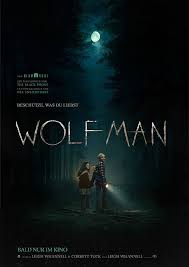
Wolf Man (2025)

The most impressive thing about Leigh Whannell’s Wolf Man is that it got made.

Whannell, the Australian horror maestro who introduced us to the Saw and Insidious franchises, clearly has serious show biz clout to get this turkey green-lighted.

This was obviously a “troubled” production.

Blake (Christopher Abbott) is a stay-at-home dad married to busy magazine writer Charlotte (Julia Garner). While Charlotte earns bucks, Blake looks after their daughter Ginger (Matilda Firth), until he’s notified that his father Grady (Sam Jaeger) has been declared officially dead, after being reported missing for several years.

Now the owner of the family farm, Blake drags his dubious brood out to the Middle of Nowhere, and in real time they are attacked by a strange creature (see the film’s title), and spend the evening running and hiding from same.

Meanwhile, Blake, the dutiful husband and father, begins to change into something remarkably similar to the beast that’s stalking them.

Wow. Didn’t see that one coming.

There is little dialogue, which lends itself to Mystery Science Theater ad-libbing during the howlingly bad action sequences, such as Blake gnawing on his own arm, and two guys in simian rubber masks wrestling on a dark floor.

What are we watching?

Wolf Man is simply godawful, and since Whannell directed and cowrote this mess, he gets the lion’s share of the blame.

It’s a complete waste of Julia Garner’s talents, and hopefully won’t interfere with her trajectory as one of Hollywood’s best young actresses. She’s given very little to do besides wander through the night with a flashlight.

I’ve said this before when reviewing werewolf movies and it certainly applies to Wolf Man: If you can’t come up with better transformation effects than The Howling or American Werewolf In London—both of which were made 43 years ago!—then don’t bother.

Shining Vale (2022-23)

When I was a wee sprout, and the family hive mind turned to televisual entertainment options, I invariably lobbied for something “scary” or something “funny.”

My conservative-leaning, middle-class family would not have tolerated a moment of Shining Vale, and, truth be told, most of the adult humor would have been lost on me.

Shining Vale ran for two seasons on Starz, and was created by Jeff Astrof (The New Adventures of Old Christine, S#!* My Dad Says) and Sharon Horgan (Catastrophe, Bad Sisters). Over the course of 16 half-hour episodes, we get cozy with the Phelps family, possibly the most dysfunctional brood since the Bundys showed up on Fox in 1987.

Pat Phelps (Courteney Cox) is in a dark place. She wrote a tawdry, best-selling lady porn novel 14 years before, but the follow-up hasn’t been forthcoming, and her agent Kam (Merrin Dungey) is giving her an ultimatum: deliver the book or return the advance money.

When Pat has a torrid affair with a handyman, her stubbornly optimistic husband Terry (Greg Kinnear) packs the whole family off to a huge haunted house in rural Connecticut for a fresh start, much to the dismay of teenaged daughter Gaynor (Gus Birney).

“Mom boned some rando and now we have to move,” she grumbles. Though a freewheeling sexpot herself, Gaynor becomes the unwilling head of the household, after Mom and Dad lose their marbles.

Her younger brother Jake, a plus-sized introvert, is mostly concerned with gaining levels in his Virtual Reality game, and is slow to realize that change is afoot.

“Why did we move to a hotel?” he asks, upon arrival at the dilapidated Victorian mansion they will now call home.

Jake is also the butt of (fairly benign) fat kid jokes, but gets comic revenge by farting most foul at the worst possible moments. Seemingly an innocent, he gets his own demon adversary courtesy of VR.

Once the family is settled, Pat makes instant contact with the spirit of Rosemary (Mira Sorvino), the former owner of the house who went mad and hacked up her own family with an axe.

Rosemary does a little ghost-writing on Pat’s unfinished manuscript, and an uneasy partnership is formed when Kam digs the new, darker direction the book is taking.

This is all just tip of the iceberg stuff, as Pat, Terry, and the kids go through individual transformations of various magnitudes, while dealing with ghosts, cults, demonic possession, hereditary mental illness, and infidelity in a weird little town that features homegrown businesses like The Lucky Wiccan.

As for the title of the series, yes, there are many references to The Shining. For crying out loud, it’s about a writer trying her best not to chop everyone up with an axe.

For my money, Shining Vale is the funniest and finest-written domestic horror series since The Addams Family. The cast is flawless. You’re welcome.

But what happened to Season 3?

The Secret Of Crickley Hall (2012)

Sounds like a Hardy Boys Mystery that never made it to the editing stage, but The Secret Of Crickley Hall is a cracking good BBC miniseries (three one-hour episodes) based on the book by James Herbert.

Written and directed by Dr. Who alum Joe Ahearne, the story straddles past/present timelines, spilling the dramatic details of the Caleigh family, who are hoping for a fresh start in the North of England after the disappearance of their son.

The idea of turning the page on tragedy seems highly unlikely at this location, as Crickley Hall turns out to be a former orphanage that was overseen by seriously damaged WW I veteran Augustus Cribben (Douglas Henshall) and his seething sister Magda (Sarah Smart).

In keeping with the popular paranormal theory that those who’ve experienced loss are more sensitive to the plight of the deceased (The Changeling, et al), motivated mom Eve Caleigh (Suranne Jones), intuits that her still-missing child is somehow connected with the orphans who died in a flood at Crickley Hall during WW II.

This leads to a parallel narrative from the past about Nancy Linnet (Olivia Cooke), a determined young teacher hired to educate the wayward waifs of Crickley Hall. Instead, she uncovers terrible abuses visited upon the children by the cruel Cribben siblings, who unfortunately remain above suspicion in their community.

With a few splashes of redemption, revenge, and romance, and featuring a realistically frightening ghost, The Secret Of Crickley Hall is well-above-average haunted house hoopla handled by a cast of top drawer talent that includes David Warner and Donald Sumpter in crucial character roles.

Ghosts may or may not be scarier in the English countryside, but their tales fit this bleak territory like a black glove.

Recommended!

Hush (2016)

Tonight! The War Between the Sexes! Right here on Pay Per View! Let’s give it up for Hush!

Writer-director Mike Flanagan (Haunting of Hill House, Fall of the House of Usher, Midnight Mass, Oculus) and his wife, writer-actress Kate Siegel constructed this lean, mean thriller about a deaf-mute author fighting for her life against a sadistic killer.

Hush also makes sense as an anxiety inducing metaphor about unwanted male attention, as Maddie Young (Siegel), a best-selling author, can’t even have a reasonable expectation of privacy IN THE MIDDLE OF A FRIGGIN’ FOREST!

Maddie lives in a nice house (with lots of doors and windows) somewhere in the deep woods. A bout with meningitis at age 13 has left her without speech and hearing, but she has a crafty writer’s brain that never stops ticking, as we squeamishly witness her reviewing potential escape options that never materialize.

The plucky scribe finds herself trapped in her bucolic hacienda by a masked madman (John Gallagher Jr) with a crossbow, who just recently finished an evisceration job on Maddie’s neighbor (Samantha Sloyan).

Who? Why? Not important. Perhaps Cupid’s in a real bad mood today. Flanagan and Siegel play the cat-mouse game to the hilt, which usually ends up plunging into someone’s neck or torso.

Nosey neighbors don’t fare well in Hush, but the timely arrival of a cat named Bitch provides Maddie with enough of a diversion to go on the offensive against toxic masculinity. The killer reminds Maddie that he’s enjoying himself, and that he can take her whenever he wants.

The maniac clearly derives grim pleasure in cutting off her limited means of communication (he also collects cell phones) and watching Maddie react to the mounting stressors he places upon her.

The entire movie is gaze-oriented. Maddie is either keeping track of her assailant roaming around in her yard (he makes no effort at stealth or concealing his identity, which makes the situation even more dire)—or the killer is feverishly observing Maddie as she tries to hide and barricade herself inside a house with too many access points.

As I mentioned, Hush is all killer, no filler. No competing storylines, no comedy relief, no shaky camera tomfoolery. Just two people (one of whom can’t call for help) airing their differences. To the death.

This is what happens when you don’t respect boundaries.

Out Of Darkness (2022)

If you have a craving for rugged terrain, Out Of Darkness is your oyster.

Otherwise, patience is required for this impressive-looking hero’s journey into the unknown against an unseen enemy.

About 45,000 years ago, a small tribe of prehistoric explorers wash up on a distant inhospitable shore, determined to carve out a future for themselves.

Fortunately they speak in subtitles or we’d be as lost as they are!

The group is led by alpha male Adem (Chuku Modu), an arrogant hothead long on bravery and short on common sense. When they determine that something is stalking them, their search for food and shelter takes on a sense of urgency, especially after Adem’s son Heron (Luna Mwezi) gets snatched away from the campfire.

As the not very tightly-knit unit comes unraveled, it’s up to Beyah (Safia Oakley-Green), a relative stranger among them, to figure out what nature of beast is decimating the tribe.

Shot in Scotland, the location scenery is the best thing about Out Of Darkness. The landscape is pure primeval desolation, and proves to be a mightier foe than the “demon” that’s assailing the company.

The atmosphere of hiding and hunting is fairly absorbing, but the pace is painfully slow and the ending is a tepid letdown that should rightfully inspire shouts of “What? That’s it?” from the home audience.

Out Of Darkness fails to live up to the potential of its savage setting—instead we get a fossilized lesson about living and dying by the sword. Or in this case, the spear.