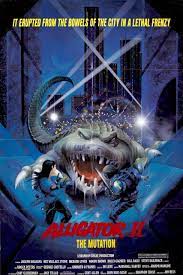
Alligator 2: The Mutation (1991)

Eleven years after Joe Dante and John Sayles delivered one of the best giant critter movies ever, the not-as-good (but not bad!) sequel, Alligator 2: The Mutation shows up.

It lacks the satirical bite of its predecessor, but the plot is a carbon copy of Alligator, with a smattering of Jaws, once again pitting a wise-cracking cop against a reptilian nightmare lurking in the city sewer system.

Speaking of cities, A2 is filmed in Echo Park dressed up to look like a small town where everyone knows each other. Here, local Latino families are threatened by an evil developer (Steve Railsback) with a lot of toxic waste to unload.

David Hodges (Joseph Bologna) is the detective in charge of the mutilated bodies that start piling up, and he’s beset on all sides by difficult choices, not made any easier by the fact that his scientist wife Christine (Dee Wallace Stone) wants him to quit smoking for his birthday.

Taking another page from the original movie, Vinnie Brown (Railsback), the black-hearted villain of our story, hires comic-relief hunters, led by Hawk Hawkins (Richard Lynch, in a scene-chewing special) as a Cajun gator-getter flanked by a brood of gun-toting rednecks.

Good old Major Healy, Bill Daily, is on hand as the spineless mayor, and veteran faces like Wallace, Brock Peters, and Kane Hodder add some seasoning to the soup.

It’s a fun flick, but Alligator 2: The Mutation can’t duplicate the depth and daring of the first film, which is what happens when you replace director Joe Dante with Jon Hess, and screenwriter John Sayles with Curt Allen.

The practical effects depicting gore and gator mayhem aren’t nearly as good as the first movie, released a decade earlier. Fluctuating gator size doesn’t help. Come on people! Keep up with technology!

In the final reckoning, it checks a bunch of boxes, and you’ll have a decent time chuckling at all the ridiculous hair-dos and don’ts, and occasional cheese-metal anthems.

Leaving D.C. (2012)

Welcome to another edition of I Should Have Stayed In the City.

In Leaving D.C., a surprisingly anxiety inducing found-footage thriller, writer-director Josh Criss stars as Mark Klein, a 20-year veteran of working like a donkey as a technical writer in our nation’s capitol.

After achieving some measure of financial independence, Mark buys his “dream house” that comes with 17 acres of land—smack dab in the middle of Nowhere, West Virginia.

To chart his return to nature, Mark sends video updates to the members of his OCD support group back in Washington. These start out in relatively benign fashion, but it soon becomes apparent that our humble narrator is obsessed with the idea that he’s not alone in this remote wilderness.

Every night at a little after three in the morning, some form of disturbance takes place that causes the already anxious Mark Klein to devolve into a nervous wreck, despite the fact that he’s installed a state-of-the-art security system and even bought a handgun.

As an OCD sufferer myself, I found Mark’s slippery slope into extreme agitation a comically familiar one, as rational thinking is replaced with desperation and poor decision making.

The weirdest manifestation Mark has to deal with is flute playing right outside his window. In the middle of the woods. Miles from his nearest neighbor.

That would be enough for me to abandon ship, but Mark digs in his heels.

I don’t think I’m spoiling anything when I reveal that our man Mark is not up to the task of solving this mystery.

Instead, it solves him.

We are enthusiastically recommending Leaving D.C., and let it be a lesson to you.

Scary Stories to Tell in the Dark (2019)

“Stories hurt. Stories heal.”

Folklorist Alvin Schwartz is the author of the source material for Scary Stories to Tell in the Dark, but in the fertile hands of director Andre Ovredal (Trollhunter) and producer Guillermo del Toro, these words not only spring to life, they chase us down a long dark hallway.

With the 1968 presidential election of Richard Nixon serving as an ominous backdrop, we are invited into the picturesque community of Mill Valley, Pennsylvania, where Halloween is in full swing.

Stella (Zoe Margaret Colletti), a fan of horror movies and a burgeoning writer, is putting the finishing touches on her witch costume in preparation for an evening out with Auggie (Gabriel Rush), and Chuck (Austin Zajur), her two doofus friends.

In short order, they manage to piss off Tommy Milner (Austin Abrams), the town bully, and he and his goon buddies chase the luckless teens into a drive-in showing Night of the Living Dead. There, they take refuge in a car belonging to Ramon (Michael Garza), a stranger in town, who coincidentally is also on the run.

With Ramon in tow, Stella and her friends decide to explore the Bellows Mansion, the local haunted house of mystery, and in doing so, release the spirit of Sarah Bellows, a raging ghost bent on revenge.

While the connecting narrative of Scary Stories to Tell in the Dark is an increasingly familiar page torn from Ray Bradbury, Stephen King, Stranger Things, etc, the monsters conceived by del Toro and Ovredal bring the zing to this production.

The Fat Lady, Harold the Scarecrow, the Jangly Man, and the Big Toe Zombie are the stuff of newer, fresher nightmares, elbowing aside worn-out boogeyman templates that neither frighten nor satisfy.

Scary Stories to Tell in the Dark also ends in such a way that a second film is practically required so Stella can rescue Auggie and Chuck. I only hope that the sequel is likewise handled by del Toro and Overdal, who are perfectly suited to the task.

In case my review is too ambiguous, I heartily recommend Scary Stories to Tell in the Dark, now and in the future.

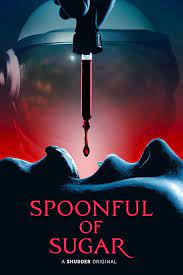
Spoonful of Sugar (2022)

Time for another installment of The Babysitter Saga, where we get to know the folks minding our precious offspring, while Mom and Dad sip martinis beneath a romantic moon, in search of dormant passion.

Spoonful of Sugar introduces us to Millicent (Morgan Saylor), an awkward college student hired to keep tabs on Johnny (Danilo Crovetti), a nonverbal autistic boy with a ton of allergies.

Johnny’s mother Rebecca (Kat Foster) is a successful writer married to Jacob (Myko Olivier), a hunky, shirtless carpenter that works from home.

Yes, this is a basic recipe for any number of Cinemax potboilers. Fortunately, director Mercedes Bryce Morgan and writer Leah Saint Marie have bigger fish to fry.

Nothing in the film is what it appears to be—it’s much, much worse, often to the point of absolute lunacy.

Millicent seems a virginal innocent, charged with caring for a seriously damaged child in an astronaut costume, whose parents are at the end of their ropes.

And that’s when Morgan brings her ingredients to a furious boil. Jacob and Millicent explore their animal attraction, even as the latter self-medicates with generous doses of LSD.

Historically (hysterically?), it could be argued that the combination of sex and drugs transforms Millicent into something evil, but the evidence presented indicates she’s already had a thriving career in the field, leaving a discreet stash of bodies in her wake.

It’s a calling she shares with young Johnny.

What ensues is a surreal, nightmarish custody battle, with both parties revealing a heart of darkness.

Millicent and Rebecca square off centerstage in a bloody contest of parenting styles, competing for Jacob, and the love of a mute boy with increasingly special needs of his own.

The outrageous extremes and shocking tableaux favored by Mercedes Bryce Morgan slow cook into a marvelously harrowing stew of taboos that satisfies a craving we didn’t even know we had.

Spoonful of Sugar is potentially dangerous medicine. Please consult your mad doctor before ingesting.

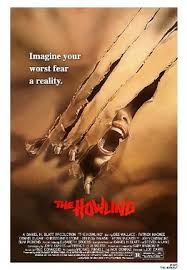
The Howling (1981)

I had an old friend crashing on my couch for the night so we decided to watch something horrific. After complaining about the paucity of decent werewolf features, we came upon The Howling, and the poor slob confessed to never having seen it.

Well, that settles that.

Plucky Los Angeles TV anchorwoman Karen White (Dee Wallace) has caught the eye of local serial killer Eddie Quist (Robert Picardo), who phones her to arrange a classy tryst at a local porn theater.

Of course, the police have Karen wired so they can capture the maniac. Sadly, surveillance technology is still in its infancy and the cops lose contact with the nervous reporter.

Eddie is gunned down but Karen can’t remember anything about their deadly encounter at the dirty movie house.

In order to dredge up every lurid detail of her trauma, renowned psychiatrist Dr. George Waggner (Patrick Macnee) recommends Karen and her husband Bill (Christopher Stone) take a restful vay-kay at his coastal retreat, The Colony.

There they meet Slim Pickens, John Carradine, James Murtaugh, and Elisabeth Brooks, all of whom are probably werewolves.

“Join us Karen! It feels wonderful!”

The Howling is a fantastic werewolf movie, maybe the best one. The only problem is, it came out the same year as An American Werewolf in London, which is generally acknowledged as the apex of the lycanthrope genre.

Granted, AAWiL is a terrific film, and special effects wizard Rick Baker’s transformation makeup hasn’t been equalled in over 40 years. Baker was also an effects consultant on The Howling, but the man in charge was Rob Bottin (The Thing, Total Recall, Fight Club), a man with a resume nearly as impressive as Baker’s.

In other words, prosthetics on both wolf and victim in The Howling totally shred.

Director Joe Dante and screenwriter John Sayles bring a keen combination of wit and irreverence to the shaggy subject matter, mainly in the person of occult bookstore owner Walter Paisley (Dick Miller), who, when asked if he believes in the supernatural, replies, “What am I? An idiot? I’m trying to make a buck here.”

Cameos by Roger Corman, Forrest J. Ackerman, and Sayles himself should keep the film school nerds energized, and everyone else will be sated by premium werewolf carnage.

Note: There are a bunch of Howling sequels and I might revisit a few, to ensure I didn’t miss anything.

Brides of Dracula (1960)

“Count Dracula, monarch of all vampires, is dead, but his disciples live on, to spread the cult and corrupt the world.”

Like the gloomy narrator indicates in his ominous introduction to Brides of Dracula, the marquee bloodsucker, played by Christopher Lee, managed to get himself skewered in a previous Hammer Films production, so this time around we get Baron Meinster (the dashing David Peel), certainly one of the first examples of vampire as pop star.

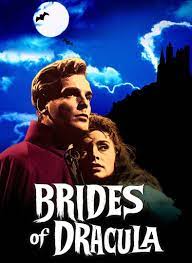
When Meinster materializes at the Transylvania Academy of Proper Young Ladies to visit Marianne (Yvonne Monlaur), the pretty new French teacher, the gathered gals go gaga over the dapper blonde Baron.

Check out the image above used to promote the film. It looks Heathcliff and Catherine off to a make-out sesh on the moors.

But I’m getting ahead of myself.

By this point in the movie, Marianne has already freed Meinster from captivity by his daffy dowager mother the Baroness Meinster (Martita Hunt), who for years has kept vigil over her evil offspring, aided by Greta (Freda Jackson), her equally loony servant.

Earlier, the Baroness discovers Marianne stuck at the local pub, abandoned by her cowardly coachman (Michael Ripper). Lonely for educated company, the increasingly unstable noblewoman invites Marianne up to her castle, to sleep in one of her many guest bedrooms.

From her window, Marianne spies the young Baron wandering on his own balcony below. Throwing common sense to the wind, she instantly believes the beautiful man has been wrongfully incarcerated and helps him to escape.

Nice going, Marianne!

The newly liberated nosferatu is soon feasting on the hottest peasant woman in the village (Marie Deveraux), as well as Marianne’s jealous roommate Gina (Andree Melly).

Greta, once his captor, has decided to help out Meinster by digging up the dead girls and making them more presentable for their master.

Now that’s what I call Goth!

True, there is no Dracula on hand, but we do get Doctor Van Helsing (Peter Cushing) the Hall of Fame vampire slayer, operating at the top of his game. Cushing is typically excellent and erudite as the dedicated undead destroyer, who has a couple gnarly brawls with the new count on the block.

After getting a bite from Meinster, Van Helsing demonstrates uncanny resourcefulness, by treating his unholy hickey with a hot branding iron and some H20 blessed by the local priest.

Despite the absence of the iconic Christopher Lee, Brides of Dracula gallops along at a brisk clip, with impending danger reliably signaled by Malcolm Williamson’s anxious orchestration, that during moments of high drama seems on the verge of complete nervous collapse.

The veteran supporting cast is spot on. Freda Jackson is a howling mad domestic that nonetheless adapts to new duties with surprising confidence. And the enchanting Andree Melly glowingly epitomizes the movie’s tagline: “He turned innocent beauty into unspeakable horror!”

Even minor characters, like Dr. Tobler (Miles Malleson), the dipsomaniac local sawbones, are given sufficient space by director Terence Fisher to have small comic interludes that prove successful more often than not.

Speaking of comic interludes, there is some lame-ass bat puppetry happening here that might also inspire a few laughs. That should not deter anyone in the slightest.

Brides of Dracula is Hammer horror at its hottest, featuring a plethora of glaring bloodshot eyes, heaving bosoms, and a fair amount of fang action.

Required viewing in my estimation. See what all the fuss is about.

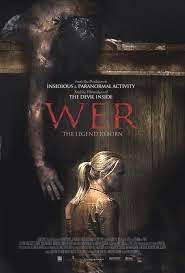
Wer (2013)

I’m reasonably sure that this movie would have more of a following if it wasn’t saddled with such a clunker of a title.

Wer? Really, that’s the best we can do?

It’s a shame because Wer is top-shelf lycanthrope mayhem all day, every day.

Co-writer and director William Brent Bell wisely saved his nickels and dimes by filming in Romania and calling it France, where American lawyer Kate Moore (A.J. Cook from Criminal Minds) is defending a hulking peasant (Brian Scott O’Connor) accused of tearing up a family of tourists. Limb from limb.

And taking huge bites out of them.

The makeup and prosthetic work by Almost Human Inc. is worth the price of the ticket. The scene when Kate examines the shredded remains of the victims is startlingly savage. Seldom has bodily harm been rendered in such vicious detail.

A shaking hand-held camera gives Wer the appearance of a found footage police procedural, with lengthy talking sequences that flare into bloody chaos without warning.

Now that’s what I’m talking about. Modest movies that turn out to be way better than I expect are the coin of my realm. They’re my jam.

Now if you’ll excuse me, I’m going to make some toast.

Editor’s Note: Come and have a hang at our new Facebook site!

Prey (2022)

About 20 minutes into Prey, I made an offhand comment to my wife.

“This seems more like a Disney movie than a horror movie.”

A few momnets later, Barb replied, “Good call. It’s from 20th Century Studios, owned by Disney.”

Therein lies the rub.

Co-writer and director Dan Trachtenberg (10 Cloverfield Lane) has assembled a violent, R-rated action movie that nonetheless features a headstrong and resourceful heroine who isn’t satisfied with her gender-defined role in life.

Prey also provides new management for the Predator series, which has been floundering since Schwarzenegger flew the coop. Here, an interstellar big-game hunter makes a landing in early 18th century America, amongst a tribe of sturdy Comanches.

Naru (Amber Midthunder), is a bad-ass hunter and tracker who wants to be a warrior. Unfortunately, she lives in the shadow of her older brother Taabe (Dakota Beavers), the tribe Alpha Male.

In a refreshing turn, Taabe is actually supportive of his sister, speaking highly of her skills to his fellow hunters.

His encouragement pays off, as Naru is the only one with the smarts to figure out that whatever is killing nearby wildlife is not a bear or a mountain lion.

Eventually, Naru gets her most fervent wish: to hunt something that is simultaneously hunting her.

Prey is visually stimulating and full of arboreal wonder as the tale and the landscape itself unfold without the presence of Western man—except for some dastardly French trappers who get in the way of the Predator’s safari.

As for the main monster itself, we don’t get any major developments other than their hunting technology is more rudimentary than that one time with Arnold.

Overall, it seems a less formidable opponent, which takes some of the steam out of the narrative.

Equally bothersome, there’s CGI work involving some of the animal fight scenes (Predator versus Bear, Naru versus Mountain Lion) that seems crudely rendered and rather clunky. It makes you think, for a second or two, that the whole picture must be a bloody animated feature, rather than live action.

Yet the Disney thematic parachute is unmistakably present in Prey, and the result is an uneasy alliance between dueling Market Powers (Action Fans versus Disney Moral Authority).

My wife liked it more than I did.

Note: Naru has a brave dog sidekick that doesn’t get killed.

Alligator (1980)

Alligator is the correct and proper way to make a giant critter movie. People create the monster. Monster eats people.

A vacationing couple and their daughter watch an alligator nearly bite a man’s leg off at a hick circus in Missouri. Struck by the wonder of this magic moment, they buy their little girl her own baby gator from a nearby huckster.

Soon after the family’s return to Chicago, Dad flushes the little lizard down the crapper. See you later, alligator.

Fast forward 12 years and there’s a monster-sized alligator in the sewer.

While we could blame the irresponsible father who bought the damn thing in the first place, John Sayles’ civic conspiracy-minded script points the guilty finger at Slade (Dean Jagger), a cadaverous old CEO whose company’s clandestine experiments with growth hormones have dramatically affected the local food chain.

Troubled-but-honest cop David Madison (Robert Forester) is the detective saddled with the thankless job of going into the sewer and capturing the rampaging reptile. Through his frustrating quest, Sayles and director Lewis Teague reveal that corrupt politicians and muckraking journalists are no help whatsoever, and deserve to be eaten.

Madison enlists the help of gorgeous herpetologist Marisa Kendall (Robin Riker) in an effort to get inside the lizard brain, while the mayor (Jack Carter) brings in famous big game hunter Colonel Brock (Henry Silva) to slay the beast.

When Madison’s investigation gets too close to Slade Industries, the spineless mayor has him fired, removing the one competent person in Chicago that’s committed to stopping the creature.

Soon the alligator is popping up all over the place. A backyard swimming pool, a nearby canal, dark alleys, and eventually the posh wedding at Slade Mansion, where the monster eats its fill of the elite guest list and dispenses justice at the same time.

The reason Alligator is revered as a classic of the genre, is usually attributed to the presence of Sayles, who went on to direct lauded art-house fare like Matewan, Lone Star, and Passion Fish, making him a favorite among the well-heeled brie and festival crowd.

It doesn’t hurt that plot and characters mirror the Jaws template, even twisting the knife a little deeper into the culpability of swinish local officials.

The cast of marvelous professionals, including Forester, Riker, Silva, and Michael Gazzo as a beleaguered police chief, really nail the story in place and bring it to life. Every actor, from top to bottom, brings humor and humanity to their roles, and that gives the production a big lift.

Even ancient faces like Jagger and Mike Mazurki get a little screen time!

And let’s not forget the titular terror. There’s no CGI here, just miniature sets and strong practical effects that emphasize flailing bodies in the gator’s mouth, with blood gushing, and bones crunching.

As it should be. People getting eaten by monsters is, perhaps, the highest form of cinema.

The Requin (2022)

What the hell is a “Requin?”

Oh, it’s French for shark. Seems odd to name the movie after a character that doesn’t even show up for the first hour.

Prior to the shark’s arrival, we get Alicia Silverstone emoting all over the place as a woman on a tropical vacation with her husband (James Tupper).

Jaelyn (Silverstone) is having trouble getting her groove back after a recent bloody miscarriage. She and hubby Kyle take an exotic trip to coastal Vietnam, where a recuperative idyl is interrupted by a storm so fierce, their little hut on the beach is pulled out to sea.

As if they didn’t face enough obstacles as a couple.

The bickering duo spend a few months adrift (it sure feels like it, anyway) until the signal fire they build to attract planes and ships burns up their raft.

Still no shark.

Kyle and Jaelyn eventually reach a place in their relationship (and in the ocean) where they’re comfortable forgiving each other and working together to achieve mutual goals.

It’s at this point, about an hour into the movie, that director Le-Van Kiet finds the key to the shark cage. Suddenly the water is full of fins, despite the fact Kyle has been gushing Type O since Day One.

Rather than continue to listen to his batty wife, Kyle manages to get his legs eaten, effectively freeing his soul to go anywhere else.

I would like to offer a modest round of applause to Kyle, who never stops being a supportive, caring spouse, even after many hours spent floating in a water tank with a cranky costar. His ability to crack jokes in an effort to buoy his wife’s ever-changing moods is nothing less than heroic.

“I’m going to ask for a discount on the room,” he quips, earning him a brief smile.

As for Miss Silverstone, she endures mounting misery in true Perils Of Pauline fashion. One shark in particular (they named the movie after him!) pursues Jaelyn and devours the Vietnamese fisherman (Danny Chung) who rescues her, because no good deed goes unpunished.

The Requin is a big bucket of smelly chum with Amateur Hour special effects, but you kind of want to see it through—if only to find out how much worse things get for Alicia Silverstone, who is clearly having a real bad year.