What happens when all the clues point to the stars?
Cleverly disguised as a true-crime documentary, Strange Harvest unfolds around a pair of Inland Empire detectives on the trail of an extremely fiendish serial killer known to the fearful public as Mr Shiny.
Writer-director Stuart Ortiz has an infallible sense for the trappings of true crime television, designing a mockumentary that clears every hurdle of credibility.
From the sad parade of victim friends/relatives grieving for an off-camera journalist, to police body cam footage that gets mighty hairy, Ortiz gets all the familiar elements exactly right, further blurring the reality line.
Most significantly, the soul weariness of the cops (played by Peter Rizzo and Terri Apple) is entirely convincing as they painfully recall every harrowing step of their pursuit of Mr Shiny (Jessee Clarkson), a phantom butcher whose murderous motives and penchant for occult ritual defy ordinary reason.
Borrowing a page from the Zodiac Killer’s stylebook, Mr Shiny, aka Leslie Sykes, taunts the police with lunatic letters, signed with a mysterious tripod symbol that also shows up at the disturbing crime scenes.
Any reader of Lovecraft will recognize the red flags that pop up during the course of the investigation (Shambler from the Stars? Mysteries of the Worm?), leading inevitably to a showdown during a cosmic event that only happens every 800 years.
And wouldn’t you know it? The sacrifice of an infant is required. Sorry, I don’t make the rules.
The good news is that you don’t have to wait till the stars are aligned to reap this Strange Harvest. It’s on Hulu and it’s a lulu.
Ray Milland won a Best Actor Oscar courtesy of his spirited dip into dipsomania in Billy Wilder’s Lost Weekend (1946), so let’s cut him some slack for Frogs, an unintentionally hilarious stinker from American International Pictures.
First things first: At no point in the film is anyone eaten by a giant frog. The poster is complete bullshit.
Since it’s a horror movie with an environmental message, Milland is cast as Jason Crockett, a venomous industrialist in a wheelchair ruling over a polluted private island plantation, fussed over by his feckless family intent on currying the old man’s financial favor.
Keeping Milland company is a naked-lipped Sam Elliott playing Pickett Smith, a hippie nature photographer in a canoe accidentally swamped by Clint Crockett (Adam Roarke), one of the patriarch’s progeny of sycophants and spoiled brats.
The exception is Karen Crockett (Joan Van Ark from Knot’s Landing), a lovely and luminous free spirit, who naturally gravitates to Smith, the stranger in the group, and the only other decent human being for miles.
It seems the senior Crockett wants his island free of frogs, and presumably snakes, spiders, gators, gulls, geckos, skinks, skunks, squirrels, and any other member of the animal kingdom that dares show its face.
“I still believe man is master of the universe,” he sneers at Smith.
Crockett instructs his minions to spray pesticides on the flora and fauna surrounding the estate. The flora and fauna don’t care for this one bit and mount a counter attack.
There is not a single sequence in the movie that isn’t punctuated (padded) with additional nature footage of creeping critters hopping and slithering closer to the Crockett house. Frogs are lobbed haphazardly into frame by production assistants, occasionally piling up in abundance, and photographed from menacing low angles to show they clearly mean business.
Directed by TV veteran George McCowan, Frogs boasts some of the most howlingly cheap and awful death scenes ever, rivaling poor Bela Lugosi wrestling an inanimate octopus in Ed Wood’s Bride of the Monster.
I was reminded of this as I watched Stuart Martindale (George Skaff), a bald guy in a velour suit, forced to grapple with an unconscious crocodile.
A snapping turtle claims one victim! Another gets lost in the swamp chasing butterflies, and after what seems like several weeks of wandering and weeping, finally succumbs to a surfeit of snake bites.
Yet another of Crockett’s foppish relatives ends up poisoned in a closed greenhouse thanks to a bunch of reptiles shattering multiple bottles of industrial strength pesticide, as is their wont.
The best/worst demise, undoubtedly belongs to Michael Martindale (David Gilliam), which involves being cocooned by moss and having spiders spilled upon his person, including one right in the mouth.
As for Ray Milland, the conservative think-tank commander goes down with the ship, deserted by everyone including his dog. He is seen taking his final agonizing breath amidst another barrage of tossed toads, glaringly accompanied to the grave by Les Baxter’s shrieking, atonal score.
What a sorry way to croak!
Frogs isn’t so bad it’s good. But the low-rent laughs are all over the place, just like the titular terrors who pounce on Crockett’s star-spangled birthday cake, ruining his crappy family celebration.
Remember: Environment good! Old rich white men bad! Too bad this populist message didn’t help George McGovern in ’72.
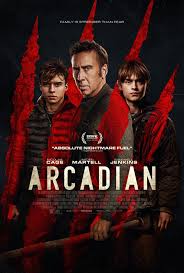
Told as a post-apocalyptic fairy tale, Arcadian stars Nicolas Cage as an anxious father of twins trying to navigate single parenthood while fighting off vicious monsters come nightfall.
Bummer. At least he doesn’t have to drive them to soccer practice.
For 15 years, Paul (Cage, in an extremely understated role) has forged a hardscrabble existence putting food on the table for his adopted sons Thomas (Maxwell Jenkins) and Joseph (Jaeden Martell), whom he rescued as infants during the initial collapse of civilization.
Holed up in a remote farmhouse, Paul teaches the lads everything they need to know about off-the-grid survival, most importantly, being home by sundown to secure their hacienda from nightly visits by protean creatures with sharp claws and turbo-charged choppers that show up like broke relatives at suppertime.
Joseph is a homeschooled DaVinci, intuitively figuring out how things work and devising ingenious inventions. His brother Thomas has the hots for Charlotte (Sadie Soverall), a lovely lass who lives on a farm some distance away, causing the crushed-out kid to test the limits of Paul’s strict curfew.
Arcadian director Benjamin Brewer and writer Mike Nilon tell a simple story as simply as possible. When Thomas visits Charlotte on her farm, they play a game in which they have to explain how the world ended in 10 seconds. Charlotte theorizes that alien insects infected humanity, and Thomas says that a purple haze turned people into werewolves.
After providing us with that handy exposition summary, Thomas realizes he’s been wooing Charlotte for too long, and is forced into a cross-country sprint to get his ass home before dark. He ends up unconscious at the bottom of a ravine, necessitating a rescue from Paul.
Poor old Dad barely survives an explosive confrontation with the burrowing alien wolf bugs, and now it’s up to the boys to adapt and survive on their own. Arcadian works best as a coming-of-age story, with the brothers painfully applying the lessons they’ve learned about their nocturnal enemies.
Jospeh is methodical, taking careful notes about the intensity and duration of the attacks. Thomas, ruled by his passions, favors direct action, but benefits from listening to his wiser sibling.
The action is occasionally marred by poor lighting and clumsy edits. Paul, finding Thomas at the bottom of a crevasse, suddenly appears at his son’s side after finding some alternate route down.
The ensuing battle with a suddenly subterranean foe is almost all quick cuts with a shaky camera in the darkness so we don’t really figure out what happened to Paul until the sun comes up.
The monsters are formidable, though vague, never holding still long enough to get a gander at. Their inexplicable hive-mind decision to assemble into a giant flaming attack wheel is certainly a head-scratcher.
Ultimately, the pros of a fast-moving story outweigh the clunky cons in Arcadian, and you will be sufficiently entertained.
When I was a wee sprout, and the family hive mind turned to televisual entertainment options, I invariably lobbied for something “scary” or something “funny.”
My conservative-leaning, middle-class family would not have tolerated a moment of Shining Vale, and, truth be told, most of the adult humor would have been lost on me.
Shining Vale ran for two seasons on Starz, and was created by Jeff Astrof (The New Adventures of Old Christine, S#!* My Dad Says) and Sharon Horgan (Catastrophe, Bad Sisters). Over the course of 16 half-hour episodes, we get cozy with the Phelps family, possibly the most dysfunctional brood since the Bundys showed up on Fox in 1987.
Pat Phelps (Courteney Cox) is in a dark place. She wrote a tawdry, best-selling lady porn novel 14 years before, but the follow-up hasn’t been forthcoming, and her agent Kam (Merrin Dungey) is giving her an ultimatum: deliver the book or return the advance money.
When Pat has a torrid affair with a handyman, her stubbornly optimistic husband Terry (Greg Kinnear) packs the whole family off to a huge haunted house in rural Connecticut for a fresh start, much to the dismay of teenaged daughter Gaynor (Gus Birney).
“Mom boned some rando and now we have to move,” she grumbles. Though a freewheeling sexpot herself, Gaynor becomes the unwilling head of the household, after Mom and Dad lose their marbles.
Her younger brother Jake, a plus-sized introvert, is mostly concerned with gaining levels in his Virtual Reality game, and is slow to realize that change is afoot.
“Why did we move to a hotel?” he asks, upon arrival at the dilapidated Victorian mansion they will now call home.
Jake is also the butt of (fairly benign) fat kid jokes, but gets comic revenge by farting most foul at the worst possible moments. Seemingly an innocent, he gets his own demon adversary courtesy of VR.
Once the family is settled, Pat makes instant contact with the spirit of Rosemary (Mira Sorvino), the former owner of the house who went mad and hacked up her own family with an axe.
Rosemary does a little ghost-writing on Pat’s unfinished manuscript, and an uneasy partnership is formed when Kam digs the new, darker direction the book is taking.
This is all just tip of the iceberg stuff, as Pat, Terry, and the kids go through individual transformations of various magnitudes, while dealing with ghosts, cults, demonic possession, hereditary mental illness, and infidelity in a weird little town that features homegrown businesses like The Lucky Wiccan.
As for the title of the series, yes, there are many references to The Shining. For crying out loud, it’s about a writer trying her best not to chop everyone up with an axe.
For my money, Shining Vale is the funniest and finest-written domestic horror series since TheAddams Family. The cast is flawless. You’re welcome.
Sounds like a Hardy Boys Mystery that never made it to the editing stage, but TheSecret Of Crickley Hall is a cracking good BBC miniseries (three one-hour episodes) based on the book by James Herbert.
Written and directed by Dr. Who alum Joe Ahearne, the story straddles past/present timelines, spilling the dramatic details of the Caleigh family, who are hoping for a fresh start in the North of England after the disappearance of their son.
The idea of turning the page on tragedy seems highly unlikely at this location, as Crickley Hall turns out to be a former orphanage that was overseen by seriously damaged WW I veteran Augustus Cribben (Douglas Henshall) and his seething sister Magda (Sarah Smart).
In keeping with the popular paranormal theory that those who’ve experienced loss are more sensitive to the plight of the deceased (The Changeling, et al), motivated mom Eve Caleigh (Suranne Jones), intuits that her still-missing child is somehow connected with the orphans who died in a flood at Crickley Hall during WW II.
This leads to a parallel narrative from the past about Nancy Linnet (Olivia Cooke), a determined young teacher hired to educate the wayward waifs of Crickley Hall. Instead, she uncovers terrible abuses visited upon the children by the cruel Cribben siblings, who unfortunately remain above suspicion in their community.
With a few splashes of redemption, revenge, and romance, and featuring a realistically frightening ghost, The Secret Of Crickley Hall is well-above-average haunted house hoopla handled by a cast of top drawer talent that includes David Warner and Donald Sumpter in crucial character roles.
Ghosts may or may not be scarier in the English countryside, but their tales fit this bleak territory like a black glove.
Tonight! The War Between the Sexes! Right here on Pay Per View! Let’s give it up for Hush!
Writer-director Mike Flanagan (Haunting of Hill House, Fall of the House of Usher, Midnight Mass, Oculus) and his wife, writer-actress Kate Siegel constructed this lean, mean thriller about a deaf-mute author fighting for her life against a sadistic killer.
Hush also makes sense as an anxiety inducing metaphor about unwanted male attention, as Maddie Young (Siegel), a best-selling author, can’t even have a reasonable expectation of privacy IN THE MIDDLE OF A FRIGGIN’ FOREST!
Maddie lives in a nice house (with lots of doors and windows) somewhere in the deep woods. A bout with meningitis at age 13 has left her without speech and hearing, but she has a crafty writer’s brain that never stops ticking, as we squeamishly witness her reviewing potential escape options that never materialize.
The plucky scribe finds herself trapped in her bucolic hacienda by a masked madman (John Gallagher Jr) with a crossbow, who just recently finished an evisceration job on Maddie’s neighbor (Samantha Sloyan).
Who? Why? Not important. Perhaps Cupid’s in a real bad mood today. Flanagan and Siegel play the cat-mouse game to the hilt, which usually ends up plunging into someone’s neck or torso.
Nosey neighbors don’t fare well in Hush, but the timely arrival of a cat named Bitch provides Maddie with enough of a diversion to go on the offensive against toxic masculinity. The killer reminds Maddie that he’s enjoying himself, and that he can take her whenever he wants.
The maniac clearly derives grim pleasure in cutting off her limited means of communication (he also collects cell phones) and watching Maddie react to the mounting stressors he places upon her.
The entire movie is gaze-oriented. Maddie is either keeping track of her assailant roaming around in her yard (he makes no effort at stealth or concealing his identity, which makes the situation even more dire)—or the killer is feverishly observing Maddie as she tries to hide and barricade herself inside a house with too many access points.
As I mentioned, Hush is all killer, no filler. No competing storylines, no comedy relief, no shaky camera tomfoolery. Just two people (one of whom can’t call for help) airing their differences. To the death.
This is what happens when you don’t respect boundaries.
It’s been quite a spell since I sat down with Godzilla. And King Kong? Forever.
This is the fourth (!) Godzilla-Kong film in the Monsterverse series that started 10 years ago with Godzilla. Since then, both creatures have been busy with their lives.
Godzilla appears in times of emergency to battle renegade monsters on behalf of humanity, though the collateral damage is usually catastrophic, as when he falls asleep in the Roman Coliseum after crushing a giant crustacean.
Meanwhile, King Kong is trying to reestablish his simian kingdom in Hollow Earth, after the destruction of Skull Island, but a bad tooth is preventing the great ape from leading his best life.
Dr. Ilene Andrews (Rebecca Hall), the head of Kong Research (I applied for that job!), is busy raising Jia (Kaylee Hottle), the last survivor of the Iwi Tribe from Skull Island, but the little native girl doesn’t seem to work and play with others.
It’s not always easy having a psychic connection to King Kong.
Oh yeah, Kong’s tooth. Andrews calls in her old friend Trapper (Dan Stevens) a swinging monster dentist, who replaces Kong’s busted canine. She also recruits Bernie Hayes (Brian Tyree Henry) a plugged-in podcaster and documentarian to interpret seismic data that suggests Godzilla is on the move.
Anyway, the humans recede into the background once the monsters start flinging each other around, only appearing in the latter part of the movie to provide exposition, which is helpful, since we‘re changing locations so often it becomes a chore to remember where we were and what we were doing before the last tumult.
There are new monsters (now referred to as Titans) on display in Godzilla X King: The New Empire, the most interesting being Shemo, an enslaved frost-breathing beastie controlled by Skar King, Kong’s villainous rival for the throne of Apeland.
With obvious tie-ins for video games and distinctive character tchotchkes up the wazoo, the running time of the movie is almost two hours, leaving you plenty of time to question your choice of accessories, as well as the decisions that led you here.
Look, Godzilla X Kong: The New Empire is little more than cutting-edge spectacle with some comedy relief, but it is extremely well-crafted by director Adam Wingard (You’re Next, Death Note). Everything, from creature effects to models and background art look sensational, the blending of live action and CGI absolutely seamless.
There is a storyline here, if you care to indulge, but it’s really not all that necessary. If something vital takes place, one of the characters will explain what it is, leaving us free to revel in big noisy carnage.
I got no problem with that, especially after a couple bowls of Cereal Milk.
Maybe the world isn’t ready for a sci-fi/horror Western starring a nonwhite cast, but I sure as hell am.
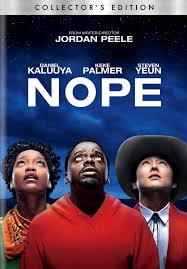
Writer-director Jordan Peele muses on a number of subjects in Nope, some in subtle fashion, others with blunt force trauma.
Otis Junior (OJ, played by Daniel Kaluuya) is a hard-working fella who runs the Haywood family horse training business somewhere in the California desert, following the recent passing of his father (Keith David) under mysterious circumstances.
His wayward sister Emerald (Keke Palmer) is trying to help out, but the fast-talking urbanite hype gal and the plainspoken cowboy are clearly not on the same page when it comes to getting work, resulting in a blown TV audition for one of their horses.
Not too far away, Ricky “Jupe” Park (Steven Yeun), a former child actor, runs an amusement park-frontier theme town. Park, a frequent customer of Haywood’s Hollywood Horses, lets OJ know that he would be interested in buying his entire operation.
These are the dramatic bones that make up the story, and Peele does his utmost to flesh out the situation by sensibly introducing creatures from another world on safari for exotic culinary specimens.
Time to cowboy up!
Peele delivers a ton of thematic groceries to the table, and it’s good eating. The pursuit of fame regardless of personal danger, appears to be his thesis statement, as both OJ and Ricky Park want to exploit the alien menace that hovers nearby for their own gain.
Fortunately, OJ comes to his senses. Others aren’t so lucky.
Nope stretches over two hours but Peele keeps everything smelling fresh. He definitely flexes a fondness for John Ford and Steven Spielberg, with bright, postcard vistas from the mysterious desert contrasted with tight indoor framing that clearly defines two different worlds—tamed and untamed.
Peele’s stinging observations about the invisibility of blacks and other minorities in the history of the motion picture industry are squarely on topic, and he remedies this historical omission with a brave black cowboy hero for us to root for.
When was the last time we saw one of those outside of Blazing Saddles?
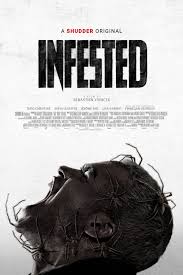
French filmmaker Sebastien Vanicek spins an undeniably creepy tale about the rag-tag residents of a dilapidated apartment building besieged by Middle-Eastern spiders that reproduce at an alarming rate.
Our hero, Kaleb (Théo Christine), is an exotic animal fancier and sneaker pimp with a troubled personal life. Seeking to numb his sorrows with a little retail therapy, he buys an expensive spider from a shady agent and promptly loses the little bugger once he gets home.
Next thing you know, there are spiders everywhere! Big ones, small ones, nasty ones, climbing out of every nook and cranny!
The poisonous pests lay eggs in their human victims, so they can emerge from the corpse, en masse, for maximum “ick” factor.
Kaleb’s flat is in the remarkable Picasso Arenas, near Paris, designed by architect Manuel Núñez Yanowsky, which makes for an artfully labyrinthine backdrop for the anxious apartment dwellers trapped between advancing arachnids and brutal, unsympathetic cops trying to contain the threat.
My main beef with Infested is that the spiders themselves are rather lacking in character. Once ensconced in the building, they aren’t especially aggressive, though they do erupt in an impressive array of shapes and sizes.
When I saw Arachnaphobia (1990) in the theater, the audience was so rapt that we were continually brushing our clothes due to imagined, unseen invaders.
Perhaps it was the smaller screen, but the uncanny feeling of being trapped in a web never really materialized in Infested, though not for a lack of effort by Vanicek and a likable cast that spends most of its screen time cowering in dark corners.
This is where the lion’s share of the character development takes place. Old friends confessing their various misdeeds and misunderstandings, diminishing the sense of urgency necessary to sustain tension or terror.
It’s a pretty good movie, just not all that scary. Let’s see if the Arachnophobia reboot can do any better.
The Tank fails to capitalize on a perfectly serviceable premise reminiscent of H.P. Lovecraft’s The Shuttered Room, in which a financially strapped family inherits a long-abandoned property on the Oregon coast. (Actually filmed in New Zealand!)
Conveniently set in the 1970s (no cellphones, duh), The Tank dutifully introduces us to Ben (Matt Whelan) and his wife Jules (Luciane Buchanan), a young couple eking out a living as co-owners of a pet shop.
One day a lawyer arrives with a mysterious deed to a mysterious house that Ben’s mysterious mother (a madwoman) had in her possession, and without further prompting, Ben and Jules pack up their daughter Reia (Zara Nausbaum) and the family dog (who doesn’t die) and split for the new beach house.
Writer-director Scott Walker does an okay job of placing his protagonists in a suitably eerie environment, but there isn’t much going on for the first hour of the film, and frankly it’s not worth the time investment spent waiting for a little action.
What follows are approximately 46 scenes of Ben and Jules wandering about their property in the dark with only lanterns to the light the way, and they mostly add up to zilch. All manner of growls, grunts, and groans are investigated but nothing turns up and everyone goes back to sleep.
Finally, some flesh-eating salamanders materialize in the water tank beneath the house and make their presence known by mauling a couple of secondary characters.
The salamanders have no eyes, so that’s a bit creepy.
Where did they come from? Are they monsters? Did they kill Ben’s father and sister? Most of these mysterious queries remain unanswered, so be prepared for the bitter taste of disappointment upon conclusion of The Tank, because it will not inspire much joy—other than the dog’s survival.
You must be logged in to post a comment.