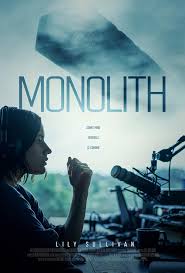
Monolith (2022)

An investigative journalist (Lily Sullivan) has suffered a career setback. Hoping to salvage her reputation with a new podcast about unexplained phenomenon, she retreats to her parents’ posh pad in the Australian wilderness to brainstorm some ideas.

“I need a story,” she tells her boss on the phone. To paraphrase Apocalypse Now, for her sins, they gave her one.

Monolith, written by Lucy Campbell and directed by Matt Vesely, is confined to one location, with a single actress interacting with other characters online and over the telephone.

The journalist, at first reluctantly, and then with single-minded vigor, pursues a juicy conspiracy story revolving around the mysterious distribution of “black bricks” that exert a kind of power over those who receive them.

As she assembles and submits episodes of her podcast, her listeners begin to take notice, and soon her inbox is full of testimony from people who’ve had experiences with these bricks, the effects of which include visions, loss of appetite, cognitive decline, and occasionally a fatal illness.

As often happens with conspiracy cases, the reporter gets swept up and goes down a very deep, dark rabbit hole, that originates surprisingly close to home.

Lily Sullivan dramatically carries Monolith and she’s quite up to the task, as her increasingly odd situation requires a fully stocked arsenal of emotional firepower. She threatens, cajoles, pleads, and does a remarkable job inhabiting what appears to be a nervous breakdown of some sort, that also could be a fight for her very soul.

Sullivan’s transformation from a sulky ego-driven internet personality to an obsessed participant in her own developing story, is astonishing and completely believable.

Well worth the watch, in my opinion.

Alien: Covenant (2017)

Yech!

Even with Ridley Scott directing, Alien: Covenant is another flop from a franchise that needs fresh blood more than Dracula.

Maybe we should blame Michael Fassbinder who gets to chew twice as much scenery in the dual role of Walter (the helpful, supportive android) and David (the amoral narcissist android).

Ten years after the events of Prometheus, which was also terrible, a new crew of explorers and sleeping deep-space colonists get a fragmented distress signal from a nearby habitable planet.

Surprise! It’s a trap! Didn’t see that one coming, did you?

Though there is space allotted for character development, nobody in the crew stands out from the usual trope type, except perhaps for Tennessee (Danny McBride), a good ol’ boy pilot in a beat-up cowboy hat.

See also: Lisa Standing (Kimberly Scott) in James Cameron’s The Abyss (1989).

There’s Captain Oram (Billy Crudup), a nervous newbie destined for failure; his second-in-command, Daniels (Katherine Waterston), still grieving her recently deceased husband, and Walter (Fassbinder), the android science officer who does most of the work.

We also get a bunch of Shemps, including Callie Hernandez, with very little to do other than perish.

Alien: Covenant attempts to re-create that ol’ black magic, but writers John Logan and Dante Harper spend too much time constructing familiar-looking scenes that hopefully resonate with long-suffering fans of the series. Consequently, there isn’t much of a story to hang your hat on, other than David’s mad ambitions.

There are elements aplenty wrangled from the first two (best) Alien films, including face huggers, gory birth sequences, automatic weapons, and renegade robots, but these never coalesce into anything able to stand on its own.

There’s the crew. The ship. The planet. The androids. Once again, the xenomorphs become an afterthought. In the final analysis, there is too much android angst and not nearly enough creature chaos, though it is a better-looking film than Prometheus.

The Alien series is stuck in a deep-space rut and could definitely use a change of scenery. I’ll let you know if there’s any intelligent life onboard after Alien: Romulus.

The Haunting Lodge (2023)

A beleaguered Georgia landowner summons a husband-wife team of investigators to document possible paranormal parties driving away his customers at a remote hunting lodge.

The hunters are scared of ghosts that noisily walk around at night, and whose presence is felt by virtually everyone who stays there.

Filmmakers Kendall and Vera Whelpton set up shop in the antler-festooned farmhouse, promptly noting atmospheric changes on their EMF readers, and seemingly making contact with an entity that flashes lights in response to questions.

Eventually the Whelptons bring in a rather theatrical psychic, Jill Morris, who makes her own connections into the spirit realm that causes a minor metaphysical ruckus.

Keep in mind, The Haunting Lodge is a DOCumentary and not a MOCKumentary.

The Whelptons maintain that what we are watching is a genuine event, a legitimately filmed paranormal happening.

Therefore, the doors opening and closing by themselves, accompanied by the sounds of booted feet marching down the hallway, are real ghosts.

And there are a few glimpses of beings (?) that appear and move digitally through the darkness.

With plenty of “Did you see that?” moments, the footage allows disbelief to be temporarily and precariously suspended.

Actually, it doesn’t matter if you believe what you see here. It’s the storytelling equivalent of saying, “I swear! It’s true! It happened to my Mom’s cousin’s sister!”

In any case, The Haunting Lodge clocks in at a lean 67 minutes, so it’s not much of a time investment.

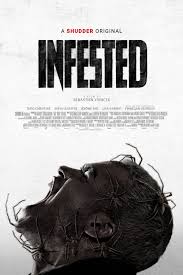
Infested (2023)

Even Stephen King loves Infested!

So how come I don’t?

French filmmaker Sebastien Vanicek spins an undeniably creepy tale about the rag-tag residents of a dilapidated apartment building besieged by Middle-Eastern spiders that reproduce at an alarming rate.

Our hero, Kaleb (Théo Christine), is an exotic animal fancier and sneaker pimp with a troubled personal life. Seeking to numb his sorrows with a little retail therapy, he buys an expensive spider from a shady agent and promptly loses the little bugger once he gets home.

Next thing you know, there are spiders everywhere! Big ones, small ones, nasty ones, climbing out of every nook and cranny!

The poisonous pests lay eggs in their human victims, so they can emerge from the corpse, en masse, for maximum “ick” factor.

Kaleb’s flat is in the remarkable Picasso Arenas, near Paris, designed by architect Manuel Núñez Yanowsky, which makes for an artfully labyrinthine backdrop for the anxious apartment dwellers trapped between advancing arachnids and brutal, unsympathetic cops trying to contain the threat.

My main beef with Infested is that the spiders themselves are rather lacking in character. Once ensconced in the building, they aren’t especially aggressive, though they do erupt in an impressive array of shapes and sizes.

When I saw Arachnaphobia (1990) in the theater, the audience was so rapt that we were continually brushing our clothes due to imagined, unseen invaders.

Perhaps it was the smaller screen, but the uncanny feeling of being trapped in a web never really materialized in Infested, though not for a lack of effort by Vanicek and a likable cast that spends most of its screen time cowering in dark corners.

This is where the lion’s share of the character development takes place. Old friends confessing their various misdeeds and misunderstandings, diminishing the sense of urgency necessary to sustain tension or terror.

It’s a pretty good movie, just not all that scary. Let’s see if the Arachnophobia reboot can do any better.

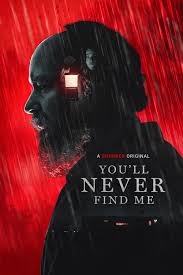
You’ll Never Find Me (2023)

Welcome to a dark night of the soul. Even bad people have them.

In some nameless Australian trailer park, Patrick (Brendan Rock) sits in his living room drinking whiskey. Outside, there is thunder and lightning, just like the night Frankenstein’s creature woke up.

Patrick is alone, but not for long.

A wayward woman (Jordan Cowan), lost in the storm and soaked to the skin, pounds on his door seeking a telephone.

“You’ve knocked on the wrong door,” Patrick tells the shoeless visitor.

Of course, things are not that simple. The wrong door depends on who’s standing where.

You’ll Never Find Me, written and co-directed by Australian newcomer Indianna Bell, is an intricately constructed two-person play, featuring unexpected shifts in the power dynamic taking place over the course of a dark and stormy evening.

It’s Patrick’s house, and he’s obviously a formidable man who prefers solitude. A drenched woman with no shoes can’t possibly be a threat.

So why is he uneasy?

Patrick explains to her that feral kids living in the park routinely beat on his door and run away. Even at two in the morning during a violent storm?

That’s enough to drive anyone mad.

Gradually, Patrick warms up to his guest and promises to help her, but he’s also clearly suspicious about her point of origin. She claims she fells asleep at the beach.

“The beach?” Patrick wonders aloud, as if he’d never heard the word.

Viewers are left to puzzle and ponder the scant information provided by these mysterious players, as both sides continue to distract and interrogate the other while passing the time with a few hands of cards.

We can tell from the outset that Patrick is a (deservedly) haunted man, and as the tension in the trailer escalates, a very big decision about his future—the same one faced by Hamlet—becomes an unbearable burden.

With its single set, minimal action, and tiny, terrific cast, You’ll Never Find Me is a harrowing and claustrophobic watch, with revolving doors of trust and deception leading to the ultimate question: To be or not to be.

Original, highly rewarding, and vigorously recommended.

The Changeling (1980)

George C. Scott in an understated role as a classical composer bedeviled by spooks in Seattle? It’s true!

I reviewed The Changeling upon its release for my high school newspaper, wherein I declared it “really scary.”

More than 40 years later, I am revising my opinion. Sometimes “scary” doesn’t age well. But then, neither do I.

Ivory tickler John Russell (GCS) is a recent widower, having lost wife and daughter in a wintery road accident. He takes a teaching job at a small college in Washington state to hopefully get his head together and start composing again.

Instead, the massive mansion generously rented to him by Claire Norman (Trish Van Devere, his real-life wife) from the local historical society, comes with a ghost in the attic that wastes no time banging around upstairs, depriving the maestro of much-needed rest.

A seance arranged by Claire with a psychic couple confirms the presence of a restless child murdered in the house, and it becomes Russell’s mission to bring metaphysical justice to the situation.

Director Peter Hyams (The Relic, Time Cop), a thoroughly capable and professional filmmaker, does a thoroughly capable and professional job on The Changeling.

The problem isn’t him, it’s me.

I suppose a scene in which a possessed antique wheelchair chases Claire around the upper floors of the mansion was sufficient to make teenaged me go, “eek!”

Since then, I’ve logged thousands of hours of community service watching ghosts, ghouls, creatures, cruel killers, and assorted hell-spawn ravaging their way through humanity.

The Changeling, even with its star cast and engaging mystery, comes off as quaint and dated. Weak tea and dry toast.

It’s not simply an age thing. A masterpiece of atmosphere such as Robert Wise’s The Haunting (1963) requires nothing more than sound and camera movement to convince us that the supernatural world is all around us.

The Great Scott, who does not bellow, growl, or bloviate, is convincing as Russell, a (literally) haunted man vulnerable/receptive to unseen forces, due to the fresh tragedy in his life.

Though Hyams, Scott, et al, give it the old college try, their collective efforts fail to generate any genuine shock wattage in the 21st century.

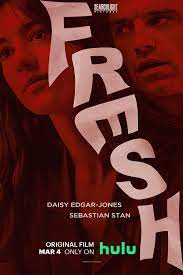
Fresh (2022)

Ask anyone. The dating scene can be murder, especially if the relationship consumes you.

In director Mimi Cave’s black-comic thriller Fresh, Noa (Daisy Edgar-Jones) is a smart, witty, modern girl just looking for a meaningful nibble in her stagnant dating pool when she meets Steve (Sebastian Stan), a super-attractive doctor at her local produce market.

After a quick roll in the sack, Noa is whisked off for a magical weekend trip with the too-good-to-be-true Steve, despite warnings from her lesbian BFF Mollie (Jonica T. Gibbs) that there are some definite red flags in this picture.

Next thing Noa knows is waking up chained to a floor. This is never a good sign.

Turns out Steve has a thriving black market business that needs new blood occasionally.

“What the fuck is happening?” Noa screams at Steve.

“I’ll tell you, but you’re going to freak out,” Steve replies.

Noa is in a very bad place, but she shows grit and determination by convincing her captor that she shares his unusual tastes for the very finest cuts of meat.

Yes, it’s every bit as gruesome as you think, and then some, but Cave also sneaks in stress-relieving laughs when we need them most, particularly after one of the director’s many rapid-fire meat-cutting-and-eating montages designed to make the viewer queasy with self-loathing.

“I don’t eat animals,” Steve tells Daisy in the early days of their courtship. Not ones with four legs, anyway.

Fresh doesn’t pull any punches in its portrayal of toxic masculinity, embodied by the charmingly evil Steve, a respectable man with a home and family who just can’t resist a tempting morsel.

Unfortunately, as any upset stomach commercial ably demonstrates, sometimes your food will fight back.

Big Trouble In Little China (1986)

It appears I’m on a Carpenter Kick.

While The Thing (1982) remains one of my absolute favorite horrors, Big Trouble In Little China finds John Carpenter at the top of his game. I’d be hard-pressed to think of a film that can match it for sheer volume of fun, fights, and full-tilt frenetic action.

It’s the ideal midnight movie.

We must remember that Kurt Russell has been a leading man in Hollywood since The Computer Wore Tennis Shoes. Big Trouble is essentially a live-action comic book, and Russell plays hero Jack Burton as a bumbling John Wayne caricature who’s routinely saved by his buddy Wang Chi (Dennis Dun).

Indeed, Burton’s capacity to stupidly screw up and still save the day is unmatched in my cinematic memory.

Trucker Jack Burton (Russell) gets his rig stolen after an all-night game of cards in SF’s Chinatown. The culprits are connected to David Lo Pan (James Hong) a sinister sorcerer/crime boss who has also arranged for the kidnapping of Wang’s girlfriend Miao Yin (Suzee Pai), a beautiful woman with green eyes.

From here, the plot thickens into a dark, delicious pudding of ghosts, monsters, sorcery, aerial martial arts, and a flying blade ceremony designed to make Lo Pan flesh and blood so he can wed Miao Yin after centuries of living as a formless ghost.

Unless he chooses Gracie Law (Kim Cattrall), another beautiful woman with green eyes.

Like a good paella, Big Trouble is a feast for the senses as Carpenter’s cameras fly alongside supernatural warriors locked in thunderous conflict. When you combine the movie’s breathless pace with acrobatic cinematography and those distinctively quotable tough-guy cracks from Burton, the results are pure gold.

But don’t take my word for it. Let the man speak for himself.

“Just remember what ol’ Jack Burton does when the earth quakes, and the poison arrows fall from the sky, and the pillars of Heaven shake.

“Yeah, Jack Burton just looks that big ol’ storm right square in the eye and he says, ‘Give me your best shot, pal. I can take it.'”

Indeed, you really can’t go wrong with the team of John Carpenter and Kurt Russell.

Let’s watch ’em all.

Prince of Darkness (1987)

Funny thing, I went to the theater and saw this when it came out. I remember liking it well enough, but Prince of Darkness is a relatively small-scale production for John Carpenter.

His previous run of films included Halloween, The Thing, The Fog, Escape From New York, and Big Trouble In Little China, so perhaps I was missing the star power typically provided by Kurt Russell and Jamie Lee Curtis.

The real reason, I now suspect, is that Prince of Darkness is more akin to Carpenter’s earlier, grittier Assault on Precinct 13, a no-name thriller about cops fighting off a crowd of vengeful gang members while trapped in a shuttered police station.

The cast of Prince of Darkness, including vintage TV stars Jameson Parker (Simon & Simon), Thom Bray (Riptide) and Dirk Blocker (son of Dan Blocker/Hoss), are similarly under siege, this time by a seemingly synchronized horde of hobo schizophrenics led by a menacing Alice Cooper.

Carpenter’s resident authority figure Donald Pleasence plays Father Loomis (Doctor Loomis’s twin brother?), a nervous priest who discovers an infernal device in the basement of an abandoned Los Angeles church.

The ancient artifact, which resembles a moldy lava lamp, appears to contain some kind of organic material that’s rapidly developing consciousness after lying dormant for untold centuries.

Loomis calls in Professor Birack (Victor Wong, Egg Shen from Big Trouble) and a group of his top physics students to study the strange canister and possibly decipher the accompanying doomsday grimoire also found on the premises.

How could they know they’d be hastening the return of the titular character, even providing a human vessel for its gestation period?

Nope, didn’t see that one coming.

I would expect college students to be dopey enough to take on this insane extra-credit assignment, but distinguished scientists?

All hell proceeds to break loose, as the assembled eggheads fall victim to having unholy water squirted in their faces from newly made zombies, or getting torn apart by the mute mob of street people that have surrounded the accursed church.

Professor Birack and the increasingly agitated Loomis deduce that the evil essence contained in the canister is now fully awake and influencing people on a subatomic level. Like ants working together toward a common goal.

You get it? Carpenter? Ants?

Carpenter is at his most diabolical depicting a wounded world, teeming with swarms of furious insects, that’s clearly reached end time, requiring an act of selfless sacrifice to save the day and keep the devil—and his creeping minions—away.

The dour final frame of Prince of Darkness indicates that he won’t be gone for long. A hell of a movie.

Project Metal Beast (1995)

I will begin by reintroducing a pair of the descriptive phrases I use when reviewing my HorrificFlicks.

Anonymous Industrial Walkabout: This means the majority of the action takes place in a generic location, usually festooned with pipes, control panels, and endless nondescript doors, offices, and hallways.

Serviceable Piece of Shit: A movie that transcends its budget constraints and offers genuine entertainment value.

Project Metal Beast is a shining example of both.

Our story opens somewhere in the Carpathian Mountains, as U.S. agent Donald Butler (John Marzilli) and a red-shirt subordinate are on a dangerous, top-secret mission to acquire werewolf blood.

Pretty standard, really.

Butler watches idly as a nasty specimen noshes on his comrade before dispatching the beast with silver bullets and retrieving the precious blood sample.

We quickly discover that Butler is hot-headed and impulsive, as he ignores his orders and injects himself with the dreaded Type O Super Negative.

“I will be a new kind of warrior,” he boasts. “One that can shape-change at will! With senses of an animal and the mind of a man!”

Before he can take his powers for a proper test drive, Butler is immobilized by Colonel Miller (Barry Bostwick), his sociopathic commanding officer, and frozen for 20 years.

Eventually, Butler is thawed out of retirement and given metal skin by Dr. Anne De Carlo (Kim Delaney) at the direction of Colonel Miller.

When Butler changes into an armored lycanthrope, he goes on a reasonable rampage slaughtering a stereotypical Italian chef, a nerdy scientist, and a few other nonentities.

How do you kill a metal werewolf, anyway?

Writer and director Alessandro de Gaetano is definitely operating on the cheap side of the street. The werewolf effects are ok, but the costume (worn by Friday The 13th‘s most famous Jason, Kane Hodder!) looks like a gorilla suit that went on tour with Gwar.

Between the scenes of fairly awesome wolfen mayhem there are many, many interludes of educated characters contemplating their dire situation and spouting pseudo-scientific jibber jabber.

Feel free to mute these parts and invent your own smart-ass dialogue. It’s fun!

Project Metal Beast wouldn’t be nearly such a hoot if not for Barry Bostwick’s kooky performance as the power-mad Colonel Miller, a man who seems quite delighted with the havoc he causes.

In one scene, Miller gleefully shoots a superior officer in both legs so he can’t escape the werewolf, who, sure enough, comes along and shreds the poor guy.

And when the monster turns on Miller, he is disciplined enough to straighten his uniform before being disemboweled.

Once again, we observe that it’s those little human touches that make for a memorable metal monster movie experience.