Dark Skies (2013)

You can’t run, you can’t hide.

There is an air of grim inevitability that permeates Dark Skies, the feeling that any precautions taken are futile, because the extraterrestrial enemy faced by the Barrett family is simply beyond their comprehension.

“People think of aliens as these beings invading our planet in some great cataclysm, destroying monuments, stealing our natural resources,” states UFO expert Edwin Pollard (J.K. Simmons).

“But it’s not like that at all. The invasion already happened.”

The Barretts are a normal, run-of-the-mill family just trying to make ends meet. Mom Lacy (Keri Russell) is a real estate agent in a slump; Dad Daniel (Josh Hamilton) is an unemployed architect working on his anger issues. Older son Jesse (Dakota Goyo) has a crush on a neighborhood girl, while younger son Sammy (Kadan Rockett) is more of a sensitive introvert.

Without warning, weird shit starts happening. Food and garbage gets strewn around the kitchen. Household items are stacked in geometric configurations. Photographs disappear. Swarms of starlings hit the house.

Even more disturbing, episodes of sleepwalking plague various Barretts, resulting in a tightening noose of paranoia and distrust between Lacy and Daniel, who despite their dire financial circumstances, continue to invest in pricey home security measures that prove fruitless.

After enduring a series of inexplicable events, Lacey reaches out via the internet to Pollard, a man who has been visited by aliens known as “the Grays” since he was a youngster.

“I don’t even fight them anymore,” he tells Lacey and Daniel, and further informs them that one of their children is being groomed for abduction, sooner rather than later,

Instead of providing the parents with hope, all Pollard can suggest is to fight back and hope the extraterrestrials get frustrated and move on to other specimens.

Writer-director Scott Stewart dispenses with the usual CGI wonder parade, and keeps things low-tech, naturalistic, and increasingly tense. The absence of special effects adds a mundane realism to Dark Skies, that sharply contrasts with the utterly unknowable nature of the Grays.

“What answer would a lab rat understand from a scientist in a white coat putting electrodes in its brain, giving it cancer?” Pollard asks.

Best of all, Dark Skies is a riveting example of story craft that shows, rather than tells us what we need to know. Even so, answers are few and far between.

Heavily recommended.

Bad Fish (2024)

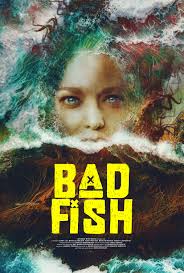
If Shadow Over Innsmouth was adapted as a Grade-Z horror film, it might play out something like Bad Fish, written and directed by West Coast indie filmmaker Brad Douglas.

Filmed for measly money over a two-year period in locations near Brookings, Oregon and Crescent City, California, Bad Fish follows alcoholic marine biologist John Burton (Jonny Lee) on a quest for clues in a remote coastal community where fishermen’s body parts keep washing ashore.

After confabbing with Sheriff Porter (Mark Schneider), Burton examines a mangled torso and concludes that this was no boating accident. But it wasn’t a shark either, he decides.

Giant squid? Not known to inhabit these water. And what’s driving away all the salmon?

Turns out it’s all the work of Abby (Abby Wathen), the beguiling bartender at the local boozer, who comes with a whopper of a backstory. Seems when she isn’t mixing martinis, Abby is the leader of a nasty deep-water cult in search of fresh blood (and other fluids).

Despite a few too many talky scenes enacted by amateur thespians, Bad Fish is an admirable, atmospheric, small-town mystery that concludes with Burton getting left without a leg to stand on in a very bad domestic situation.

Not to worry, Douglas has Bad Fish II in the works, so maybe someone will throw the poor sap a lifeline.

Just don’t buy him socks for Christmas.

Frogs (1972)

Ray Milland won a Best Actor Oscar courtesy of his spirited dip into dipsomania in Billy Wilder’s Lost Weekend (1946), so let’s cut him some slack for Frogs, an unintentionally hilarious stinker from American International Pictures.

First things first: At no point in the film is anyone eaten by a giant frog. The poster is complete bullshit.

Since it’s a horror movie with an environmental message, Milland is cast as Jason Crockett, a venomous industrialist in a wheelchair ruling over a polluted private island plantation, fussed over by his feckless family intent on currying the old man’s financial favor.

Keeping Milland company is a naked-lipped Sam Elliott playing Pickett Smith, a hippie nature photographer in a canoe accidentally swamped by Clint Crockett (Adam Roarke), one of the patriarch’s progeny of sycophants and spoiled brats.

The exception is Karen Crockett (Joan Van Ark from Knot’s Landing), a lovely and luminous free spirit, who naturally gravitates to Smith, the stranger in the group, and the only other decent human being for miles.

It seems the senior Crockett wants his island free of frogs, and presumably snakes, spiders, gators, gulls, geckos, skinks, skunks, squirrels, and any other member of the animal kingdom that dares show its face.

“I still believe man is master of the universe,” he sneers at Smith.

Crockett instructs his minions to spray pesticides on the flora and fauna surrounding the estate. The flora and fauna don’t care for this one bit and mount a counter attack.

There is not a single sequence in the movie that isn’t punctuated (padded) with additional nature footage of creeping critters hopping and slithering closer to the Crockett house. Frogs are lobbed haphazardly into frame by production assistants, occasionally piling up in abundance, and photographed from menacing low angles to show they clearly mean business.

Directed by TV veteran George McCowan, Frogs boasts some of the most howlingly cheap and awful death scenes ever, rivaling poor Bela Lugosi wrestling an inanimate octopus in Ed Wood’s Bride of the Monster.

I was reminded of this as I watched Stuart Martindale (George Skaff), a bald guy in a velour suit, forced to grapple with an unconscious crocodile.

A snapping turtle claims one victim! Another gets lost in the swamp chasing butterflies, and after what seems like several weeks of wandering and weeping, finally succumbs to a surfeit of snake bites.

Yet another of Crockett’s foppish relatives ends up poisoned in a closed greenhouse thanks to a bunch of reptiles shattering multiple bottles of industrial strength pesticide, as is their wont.

The best/worst demise, undoubtedly belongs to Michael Martindale (David Gilliam), which involves being cocooned by moss and having spiders spilled upon his person, including one right in the mouth.

As for Ray Milland, the conservative think-tank commander goes down with the ship, deserted by everyone including his dog. He is seen taking his final agonizing breath amidst another barrage of tossed toads, glaringly accompanied to the grave by Les Baxter’s shrieking, atonal score.

What a sorry way to croak!

Frogs isn’t so bad it’s good. But the low-rent laughs are all over the place, just like the titular terrors who pounce on Crockett’s star-spangled birthday cake, ruining his crappy family celebration.

Remember: Environment good! Old rich white men bad! Too bad this populist message didn’t help George McGovern in ’72.

Weapons (2025)

And now, the rest of the story.

If we examine Weapons alongside Zach Cregger’s previous oddball odyssey, Barbarian, what we’re seeing is the emergence of a different school of narrative filmmaking, in which a mystery morphs into a profound horror.

Both movies feature people disappearing under outré circumstances, and the subsequent investigation, told Pulp Fiction-like in chapters from assorted points of view, reveals the “monster” lurking at the center.

In Weapons, an entire classroom of children awaken in their beds at 2:17 am, leave their homes, and go missing. Only their teacher, Justine Gandy (Julia Garner), and a single student, Alex (Cary Christopher), were unaffected by this strange occurrence.

Justine bears the brunt of her community’s rage, but the real story unfolds quietly around Alex, and the coincidental arrival of his eccentric Aunt Gladys (Amy Madigan) into the family home.

Recounting plot details diminishes the wonderful WTF factor at work in Weapons. Letting the story open up and swallow you is the correct path forward, as the interested parties play their parts in nonlinear fashion, leading to another shit-crazy finale full of strange shots and unhinged images you aren’t likely to forget, such as a pack of possessed children pursuing Aunt Gladys through an entire neighborhood of homes and their stunned denizens.

As for Madigan’s very specific portrayal of the uniquely wicked Aunt Gladys, it’s the stuff of nightmares, a thermometer-shattering motherlode of malevolence. Small wonder that Creggar is busy working on a prequel based on Gladys’ origin story.

The horror that lives beneath the surface in Weapons, has to do with influence, and the impossibility of truly knowing one’s neighbors and what they’re up to. Anyone can wake up weaponized.

So basically, no one is safe, not even in their own home with Mom and Dad.

Creggar’s roundabout approach to the genre trumps traditional terror tropes at every turn. And that’s reason enough to to see Weapons, post-haste.

Found Footage: The Making of the Patterson Project (2025)

Layers upon layers upon layers.

Writer-director Max Tzannes opens Pandora’s Box in Found Footage: The Making of the Patterson Project, and what emerges is a very entertaining hot mess.

As we’ll see, there are no other outcomes possible.

See if you can follow this. Chase Bradner (Brennan Keel Cook), a low-budget filmmaker, makes commercials for used furniture salesman Frank (Dean Cameron).

Chase and Frank decide to make a found footage horror film about Bigfoot that somehow attracts the attention of a French documentary crew that tags along for the ride.

Funding for the movie comes from a $20,000 loan from Frank’s dotty client Betsey (Suzanne Ford), under the condition that her favorite actor, Alan Rickman, will play the lead. This becomes especially difficult when they figure out the actor passed away eight years before.

Chase and Frank are under the impression that they have secured the talents of Daniel Radcliffe to act in their feature, but he turns out to be a chick named Danielle (Rachel Alig).

The location, a remote time-share cabin belonging to the parents of Chase’s girlfriend and producer Natalie (Erika Vetter) appears to be inhabited by a demon from Sam Raimi’s Evil Dead universe.

Add to that a conundrum straight out of Waiting For Guffman, when it proves too dangerous to have anyone running about in the meticulously made Bigfoot costume after the first actor is shot by a hunter.

It’s to his credit that Tzannes manages to keep most of his subplot balls in the air. We actually care about Natalie’s growing frustration with Chase and her budding romance with his best friend Mitchell (Chen Tang), despite the silly chaos erupting all over the place.

Natalie gets respect points by being the only adult on the set capable of seeing the big picture, but her boyfriend is too preoccupied with his vanity project to pay attention.

And it all builds to what is called the Grand Jubilee, a surprisingly downbeat WTF ending, that explains why no bodies were ever found.

Yep. You should watch it.

Arcadian (2024)

Once upon a time…

Told as a post-apocalyptic fairy tale, Arcadian stars Nicolas Cage as an anxious father of twins trying to navigate single parenthood while fighting off vicious monsters come nightfall.

Bummer. At least he doesn’t have to drive them to soccer practice.

For 15 years, Paul (Cage, in an extremely understated role) has forged a hardscrabble existence putting food on the table for his adopted sons Thomas (Maxwell Jenkins) and Joseph (Jaeden Martell), whom he rescued as infants during the initial collapse of civilization.

Holed up in a remote farmhouse, Paul teaches the lads everything they need to know about off-the-grid survival, most importantly, being home by sundown to secure their hacienda from nightly visits by protean creatures with sharp claws and turbo-charged choppers that show up like broke relatives at suppertime.

Joseph is a homeschooled DaVinci, intuitively figuring out how things work and devising ingenious inventions. His brother Thomas has the hots for Charlotte (Sadie Soverall), a lovely lass who lives on a farm some distance away, causing the crushed-out kid to test the limits of Paul’s strict curfew.

Arcadian director Benjamin Brewer and writer Mike Nilon tell a simple story as simply as possible. When Thomas visits Charlotte on her farm, they play a game in which they have to explain how the world ended in 10 seconds. Charlotte theorizes that alien insects infected humanity, and Thomas says that a purple haze turned people into werewolves.

After providing us with that handy exposition summary, Thomas realizes he’s been wooing Charlotte for too long, and is forced into a cross-country sprint to get his ass home before dark. He ends up unconscious at the bottom of a ravine, necessitating a rescue from Paul.

Poor old Dad barely survives an explosive confrontation with the burrowing alien wolf bugs, and now it’s up to the boys to adapt and survive on their own. Arcadian works best as a coming-of-age story, with the brothers painfully applying the lessons they’ve learned about their nocturnal enemies.

Jospeh is methodical, taking careful notes about the intensity and duration of the attacks. Thomas, ruled by his passions, favors direct action, but benefits from listening to his wiser sibling.

The action is occasionally marred by poor lighting and clumsy edits. Paul, finding Thomas at the bottom of a crevasse, suddenly appears at his son’s side after finding some alternate route down.

The ensuing battle with a suddenly subterranean foe is almost all quick cuts with a shaky camera in the darkness so we don’t really figure out what happened to Paul until the sun comes up.

The monsters are formidable, though vague, never holding still long enough to get a gander at. Their inexplicable hive-mind decision to assemble into a giant flaming attack wheel is certainly a head-scratcher.

Ultimately, the pros of a fast-moving story outweigh the clunky cons in Arcadian, and you will be sufficiently entertained.

The end.

Parasite (2019)

When was the last time a horror movie won a Best Picture Oscar?

How about a horror movie from South Korea?

Wait! Is this even actually horror?

Bong Joon Ho’s Parasite was recently named the best movie of the 21st century by the New York Times, as well as in a poll of more than 500 actors, writers, and assorted Hollywood riff raff.

The accolades were enough to prompt a rewatch, so the wife and I buckled in with a tasty spread from Hawaiian Bros Grill, and let the good times roll.

We open on the Kim clan, a quartet of creative and industrious con artists living in a smelly basement apartment in Seoul. Bong’s set design standards are incredibly detailed, with the Kims’ ridiculous elevated toilet serving as a mocking throne over their scheming degradation.

From the squalid floor of their stinking dungeon, the Kims watch as a parade of drunks pee on their window to the outside world.

Fortunately, son Ki-woo (Lee Sun-kyun) lands a gig as a tutor to a bored rich high school girl (Jo Yeo-jeong) and soon, through Machiavellian machinations and good old teamwork, the enterprising Kims have securely attached themselves to the wealthy, but blandly oblivious Park family, serving comically in a number of unlikely household occupations.

As the title implies, the Kims dig deep into their new situation, even taking on airs of pretension themselves, while pillaging the fancy foods in the bourgeois pantry.

Speaking of pantries, the Parks’ fabulous modern house is itself a metaphor for a society that could do a better job of feeding and housing its less-prosperous citizens.

Consider the plight of Oh Geun-sae, (Park Myung-hoon) the hider in the house with nowhere else to go. The husband of the Parks’ former housekeeper has gone insane living on food scraps in a hidden underground bunker. It’s his terror at the prospect of being homeless that’s responsible for the blood that eventually flows all over a beautifully manicured backyard.

Parasite is a marvelous creature, neither fish nor foul, bursting with darkly comic observations about the pathetic need to feel superior—to anyone. The Kims want that smug insulation of their own, but they don’t pass the smell test.

The American Dream, at least in South Korea, involves fastening yourself to a fat host. While waiting for the trickle down to take effect, you must keep others away from the living meal ticket.

Bong’s masterpiece makes for a wondrously uncomfortable safari through a human ecosystem. Parasite is mind-growing artistry containing an ocean of insights on the class struggle, all awaiting your repeated viewing.

That’s called time well spent. Ask the New York Times.

Final Destination: Bloodlines (2025)

Note: Final Destination: Bloodlines works just fine as a stand-alone feature. It’s not necessary to be familiar with the previous films, but it helps provide context.

The Final Destination franchise is pure boilerplate. Someone has a realistic, sweat-inducing vision of an impending disaster and manages to save lives that would have otherwise been lost in the carnage.

In Bloodlines, it becomes painfully clear that rules are rules when it comes to your expiration date. Through careful vigilance, Iris Campbell (Gabrielle Rose)—who saved a ton of folks from perishing in the nerve-wracking collapse of a Space Needle-like restaurant 50 years ago—is able to keep the Reaper at bay by cloistering herself away as a hermit in a one-room fortified cabin in the middle of nowhere.

Even so, you can’t hide forever.

Iris’s granddaughter Stefani Reyes (Kaitlyn Santa Juana) and Stefani’s younger brother Charlie (Teo Briones) are next in line to be shredded out of existence unless they can somehow solve the pattern of Death’s List.

Recurring character William John Bludworth (Tony Todd) is a mystical mortician who provides cryptic clues for at-risk protagonists throughout the six-film series. As he tells the latest batch of soon-to-be goners, “Death doesn’t like being cheated.”

Note 2: This was Todd’s last screen performance, and the distinguished horror actor exits in classic fashion, addressing the characters (and us) thusly: “I intend to enjoy the time I have left, and I suggest you do the same. Life is precious. Enjoy every single second. You never know when. Good luck.”

The prospect of being exceedingly vulnerable to dismemberment in everyday situations is the cake and frosting in this formula. Here is the reason we bought the tickets. How do these poor fools meet their doom? Will it be artful and intricate or just the sudden splat of another ill-timed bus?

As usual, the focus falls on objects seen around the house or existing in nature, and directors Zach Lipovsky and Adam Stein helpfully tick off all the nearby instruments of destruction for our consideration, just before the tragic events unfold in Rube Goldberg fashion.

A wayward shard of broken glass in someone’s cocktail should cause a bloody catastrophe, and it does, but the process is open to variables coming into play.

The only certainty here is someone is going out with a bang, style points appreciated.

“Death doesn’t take no for an answer,” Bludworth reminds us.

So it’s no surprise when Death catches up with you, he’s justifiably pissed that you got away, and that’s why the elements leading to the inevitable demise are so squishy and graphic. It’s a warning to anyone who thinks they can escape a (gruesome) fate.

It also provides us with the “aahhh” moment; a cathartic conclusion of a fancy fireworks display.

Final Destination: Bloodlines is a succinct, stylish summation of the entire series, an invitation to certain death that deals us in; a rousing game of Clue with extra corpses.

Like a heckling a good/bad movie, the joy of watching Final Destination: Bloodlines is best shared interactively with friends and family. Everyone can choose a victim and figure out their own Mousetrap method of mutilation.

Wheee!

MadS (2024)

Kids! Don’t do drugs!

Unless you want to slowly transform into a cackling, bloodthirsty Deadite.

Writer-director David Moreau and his camera crew of French daredevils have assembled MadS, a micro-zombie tale that maintains a breathless pace, thanks to it being filmed in one exhausting take!

For 89 minutes nonstop minutes, we tag along with Romain (Milton Riche), a swinging teen (?) on his 18th (?) birthday, as he visits his dealer driving a classic Mustang convertible.

After snorting several lines of a dark red powder, Romain scores a few bindles of the stuff and blasts off through the French countryside in his sweet ride, soon to be tripping balls.

At this early stage, we almost envy the lad. It’s his dad’s car but Romain cuts a dashing figure behind the wheel, like Jean-Paul Belmondo or something.

As the powerful drugs take hold of his system his special birthday night rapidly degenerates into hell. He inadvertently gives a ride to a feral madwoman who seems to be on the run from nefarious forces.

Romain, who is expected to be at a blowout rager for his birthday, instead brings the nonverbal, unstable refugee to his father’s fancy house—and loses track of her.

The constant motion of the narrative gives MadS a major advantage in holding our attention. I realized while watching it, that I was standing up for much of the time. That’s called tension and it just keeps coming.

There’s a particular scene with a woman riding a scooter, trying to outrace an infected friend who is madly pursuing on foot and calling out to her that burns like a fuse.

The visual excitement is top drawer throughout. Moreau’s sensibility is slick, sleek, and sleazy, and MadS rates highly as finely-crafted, Old World, Eurotrash with a pedal that’s always on the metal.

The movie dovetailed nicely with my reading a trilogy of post-apocalyptic books by English author Rich Hawkins (The Last Plague, The Last Outpost, and The Last Soldier; recommended!) that are really grim.

And so is this. But it kicks major ass.

There’s Something Wrong with the Children (2023)

Camping and looking after someone else’s kids? There’s a pair of concepts I find extremely disturbing!

Director Roxanne Benjamin and writers T.J. Cimfel and David White definitely know how to create the potential for a scary experience as they put two couples into a paranormal powder keg and hand a book of matches to some thoroughly corrupted moppets .

In There’s Something Wrong with the Children, Ben (Zach Guilford) and Margaret (Alisha Wainwright) are cabin camping with longtime friends Ellie (Amanda Crew) and Thomas (Carlos Santos), and their two kids Lucy (Briella Guiza) and Spencer (David Mattle).

While exploring some industrial ruins nearby, Lucy and Spencer become fascinated with a mysterious well found on the abandoned property. And by fascinated, I mean hypnotized and enslaved by a malevolent entity, who soon has the little rug rats doing the devil’s business, which primarily consists of driving Ben loony.

Not that they had to drive very far.

The most rightfully horrifying element at play here, are the malicious kids. Lucy gads about in a red devil hoody, evil-eyeing everyone in sight, and her younger brother shows genuine promise as a budding psycho killer.

There is much subtext given over to the topic of Breeding versus Not Breeding, and the latter wins by a country mile. As evidenced here by a reasonable body count, expanding your brood beyond the number two is like inviting Evil to share your campfire and sharpening them up a weenie stick.

Margaret becomes the de facto Final Girl and she’s not a very good one. But by the end of the movie it’s apparent that she has finally resolved any conflicts she may have had about family planning.

It’s a middling effort, let’s give it a C (see).