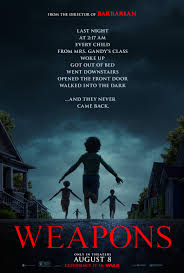
Weapons (2025)

And now, the rest of the story.

If we examine Weapons alongside Zach Cregger’s previous oddball odyssey, Barbarian, what we’re seeing is the emergence of a different school of narrative filmmaking, in which a mystery morphs into a profound horror.

Both movies feature people disappearing under outré circumstances, and the subsequent investigation, told Pulp Fiction-like in chapters from assorted points of view, reveals the “monster” lurking at the center.

In Weapons, an entire classroom of children awaken in their beds at 2:17 am, leave their homes, and go missing. Only their teacher, Justine Gandy (Julia Garner), and a single student, Alex (Cary Christopher), were unaffected by this strange occurrence.

Justine bears the brunt of her community’s rage, but the real story unfolds quietly around Alex, and the coincidental arrival of his eccentric Aunt Gladys (Amy Madigan) into the family home.

Recounting plot details diminishes the wonderful WTF factor at work in Weapons. Letting the story open up and swallow you is the correct path forward, as the interested parties play their parts in nonlinear fashion, leading to another shit-crazy finale full of strange shots and unhinged images you aren’t likely to forget, such as a pack of possessed children pursuing Aunt Gladys through an entire neighborhood of homes and their stunned denizens.

As for Madigan’s very specific portrayal of the uniquely wicked Aunt Gladys, it’s the stuff of nightmares, a thermometer-shattering motherlode of malevolence. Small wonder that Creggar is busy working on a prequel based on Gladys’ origin story.

The horror that lives beneath the surface in Weapons, has to do with influence, and the impossibility of truly knowing one’s neighbors and what they’re up to. Anyone can wake up weaponized.

So basically, no one is safe, not even in their own home with Mom and Dad.

Creggar’s roundabout approach to the genre trumps traditional terror tropes at every turn. And that’s reason enough to to see Weapons, post-haste.
Found Footage: The Making of the Patterson Project (2025)

Layers upon layers upon layers.

Writer-director Max Tzannes opens Pandora’s Box in Found Footage: The Making of the Patterson Project, and what emerges is a very entertaining hot mess.

As we’ll see, there are no other outcomes possible.

See if you can follow this. Chase Bradner (Brennan Keel Cook), a low-budget filmmaker, makes commercials for used furniture salesman Frank (Dean Cameron).

Chase and Frank decide to make a found footage horror film about Bigfoot that somehow attracts the attention of a French documentary crew that tags along for the ride.

Funding for the movie comes from a $20,000 loan from Frank’s dotty client Betsey (Suzanne Ford), under the condition that her favorite actor, Alan Rickman, will play the lead. This becomes especially difficult when they figure out the actor passed away eight years before.

Chase and Frank are under the impression that they have secured the talents of Daniel Radcliffe to act in their feature, but he turns out to be a chick named Danielle (Rachel Alig).

The location, a remote time-share cabin belonging to the parents of Chase’s girlfriend and producer Natalie (Erika Vetter) appears to be inhabited by a demon from Sam Raimi’s Evil Dead universe.

Add to that a conundrum straight out of Waiting For Guffman, when it proves too dangerous to have anyone running about in the meticulously made Bigfoot costume after the first actor is shot by a hunter.

It’s to his credit that Tzannes manages to keep most of his subplot balls in the air. We actually care about Natalie’s growing frustration with Chase and her budding romance with his best friend Mitchell (Chen Tang), despite the silly chaos erupting all over the place.

Natalie gets respect points by being the only adult on the set capable of seeing the big picture, but her boyfriend is too preoccupied with his vanity project to pay attention.

And it all builds to what is called the Grand Jubilee, a surprisingly downbeat WTF ending, that explains why no bodies were ever found.

Yep. You should watch it.

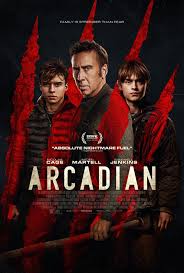
Arcadian (2024)

Once upon a time…

Told as a post-apocalyptic fairy tale, Arcadian stars Nicolas Cage as an anxious father of twins trying to navigate single parenthood while fighting off vicious monsters come nightfall.

Bummer. At least he doesn’t have to drive them to soccer practice.

For 15 years, Paul (Cage, in an extremely understated role) has forged a hardscrabble existence putting food on the table for his adopted sons Thomas (Maxwell Jenkins) and Joseph (Jaeden Martell), whom he rescued as infants during the initial collapse of civilization.

Holed up in a remote farmhouse, Paul teaches the lads everything they need to know about off-the-grid survival, most importantly, being home by sundown to secure their hacienda from nightly visits by protean creatures with sharp claws and turbo-charged choppers that show up like broke relatives at suppertime.

Joseph is a homeschooled DaVinci, intuitively figuring out how things work and devising ingenious inventions. His brother Thomas has the hots for Charlotte (Sadie Soverall), a lovely lass who lives on a farm some distance away, causing the crushed-out kid to test the limits of Paul’s strict curfew.

Arcadian director Benjamin Brewer and writer Mike Nilon tell a simple story as simply as possible. When Thomas visits Charlotte on her farm, they play a game in which they have to explain how the world ended in 10 seconds. Charlotte theorizes that alien insects infected humanity, and Thomas says that a purple haze turned people into werewolves.

After providing us with that handy exposition summary, Thomas realizes he’s been wooing Charlotte for too long, and is forced into a cross-country sprint to get his ass home before dark. He ends up unconscious at the bottom of a ravine, necessitating a rescue from Paul.

Poor old Dad barely survives an explosive confrontation with the burrowing alien wolf bugs, and now it’s up to the boys to adapt and survive on their own. Arcadian works best as a coming-of-age story, with the brothers painfully applying the lessons they’ve learned about their nocturnal enemies.

Jospeh is methodical, taking careful notes about the intensity and duration of the attacks. Thomas, ruled by his passions, favors direct action, but benefits from listening to his wiser sibling.

The action is occasionally marred by poor lighting and clumsy edits. Paul, finding Thomas at the bottom of a crevasse, suddenly appears at his son’s side after finding some alternate route down.

The ensuing battle with a suddenly subterranean foe is almost all quick cuts with a shaky camera in the darkness so we don’t really figure out what happened to Paul until the sun comes up.

The monsters are formidable, though vague, never holding still long enough to get a gander at. Their inexplicable hive-mind decision to assemble into a giant flaming attack wheel is certainly a head-scratcher.

Ultimately, the pros of a fast-moving story outweigh the clunky cons in Arcadian, and you will be sufficiently entertained.

The end.