Die Alone (2024)

Screen history repeats itself, as Carrie-Anne Moss is once again paired with an amnesia victim (Douglas Smith) searching for answers in Die Alone, a Canadian post-apocalypse drama crawling with a verdant variety of zombies that have gone to seed.

Writer-director Lowell Dean makes sensible use of Saskatchewan’s panoramic grasslands to anchor the action, following a few hardy survivors stumbling through a barren landscape largely stripped of humanity thanks to a plant-based virus that’s amped up the vegetation to lethal levels.

Ethan (Smith) and Emma (Kimberly Sue Miller) are a young couple on the run when the environmental shit hits the fan. Despite making a plan to meetup at a remote cabin in case they get separated, Ethan’s trauma-induced amnesia keeps getting in the way, and the two predictably lose track of each other.

Luckily clueless Ethan gets rescued by rugged survivalist May (Moss), who agrees to help him locate his lost love and provide reasonable room and board in exchange for farm labor.

Instead of gratitude, Ethan steals May’s truck and goes off to search for Emma on his own, but the absent-minded protagonist requires frequent rescuing. That means many scenes begin with Ethan regaining consciousness in different locations, usually covered in blood, sweat, and ears.

The zombie community is represented by hungry humanoids that have been reclaimed by the earth, each with its own distinctive look fusing foliage and fashion. The makeup department deserves the donuts for creating such intriguing new creatures.

Strangely, Dean mostly employs the undead as set dressing, rather than as a serious threat, limiting their fright potential to a precious few moments.

But it’s not a dealbreaker.

That Die Alone succeeds as a movie is largely due to the unbreakable strength of its central relationships and the filmmaker’s fully developed arsenal of appreciation for those that came before him.

Cinema nerds will eagerly recognize shots paying tribute to everyone from John Ford to Terrence Malick to Sam Raimi. Dean’s script, though maddeningly fractured and episodic, leads to a crushing finale that I’m still chewing on like old Milk Duds.

Be like the cows. Keep chewing. It’s making more sense all the time.
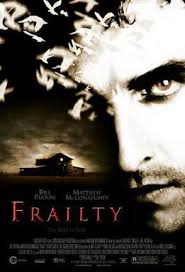
Frailty (2001)

The late Bill Paxton (1955–2017) will always be remembered for his distinguished genre credentials. As the not-so-brave Private Hudson in Aliens (1986), he got all the best lines, including “Game over, man!”

A year later he was part of a kick-ass vampire gang in the criminally underrated Near Dark, reunited with his Aliens costars, Lance Henriksen and Jenette Goldstein.

Still not impressed? How about this action? Paxton is the only actor to play a character killed by a Predator (Predator 2, 1990), a Xenomorph (Aliens) and a Terminator (The Terminator, 1984).

Serious respect!

In Frailty, Paxton directs and stars as a mild-mannered mechanic who becomes a divinely inspired killer after a visitation from an angel.

Rather than keep this to himself, he awakens his two young sons Fenton (Matt O’Leary) and Adam (Jeremy Sumpter), informing them that they will be helping Dad destroy demons in human form.

Adam, the younger son, is gung-ho to please his avenging father, while older brother Fenton doesn’t like the idea one bit.

Too bad the Lord’s will must be served.

The brothers’ upbringing is recounted years later by a grown-up Fenton (Matthew McConnaughy) to incredulous FBI agent Wesley Doyle (Powers Boothe), who reluctantly gets reeled into a twisted tale of a family under the dominion of a terribly unbalanced man.

As a director, Paxton imbues Frailty with a naturalistic, small-town feel that makes the episodic violence particularly jarring. As an actor, he delivers a nuanced, but emotionally reserved performance that evokes a little sympathy and a whole lot of terror.

Anyone expecting the unhinged Hudson, or perhaps the belligerent bully Chet from Weird Science will see nothing of the sort here.

By the time he locks Fenton in the basement for a week (no food, one glass of water per day) in an effort to drive out any demonic influences, the horror has gotten uncomfortably real, as Paxton dons the face of unblinking fundamental fanaticism, reminiscent in tone of Kevin Smith’s Red State.

Bill Paxton’s ability to goose the tension as a filmmaker in Frailty, is more than matched by his extraordinary performance as an ordinary man called upon to serve God by fighting evil.

But it’s not easy. Just ask Abraham.

Sinners (2025)

Enthusiastically recommended and watch out at awards time!

Sinners is the fifth collaboration between writer-director Ryan Coogler (Creed, Black Panther, Fruitvale Station) and star Michael B. Jordan, and it’s an epic whopper of a movie with a blistering blues soundtrack and a depth of soul not typically found in an era of easily disgested entertainment options.

Twin brothers Smoke and Stack (both played by Jordan) return to Clarksdale, Mississippi—after working for Al Capone’s mob in Chicago for seven years—determined to open a juke joint, a place where hard-working sharecroppers and field hands can be free to eat, drink, and dance the night away.

The brothers have contrasting demeanors, but their ambition, to own something free and clear that’s designed to serve the black community, is helped greatly by the large amounts of cash they’ve brought back from the Windy City.

Smoke recruits his former lover Annie (Wunmi Mosaku), a New Orleans hoodoo practitioner, to cook catfish for the crowd, while Stack hustles hooch and henchmen in an effort to keep the peace in their new joint.

On opening night, the club is jammed with folks stomping away to spirited music provided by guitar prodigy Sammy Moore (Miles Caton) and blues elder statesmen Delta Slim (Delroy Lindo).

Coogler is in absolute artistic control of the frenetic proceedings, and the verve and excitement he is able to capture during the dance sequences is unreal. We’re talking mesmeric scenes flowing so organically they’re worthy of repeated watches on their own.

While patrons shake and shimmy, Coogler enlarges the cultural lens to include a heartfelt vision of artists—past and future—caught in the dervish rhythms of the juke joint, and the effect is breathtaking.

“Blues weren’t forced on us like that religion,” Slim tells Sammy. “We brought this with us from home.”

Just when we’re having a peak cultural moment, a trio of vampires disguised as itinerant Irish folk musicians, crash the party and a bloodbath ensues.

There is no reason to believe, as some grumpy critics have implied, that Sinners unexpectedly goes off the rails at this point. Coogler doesn’t bring in the undead as a deux machina or as a concession to a larger, edgier demographic.

The taking of blood and the quick assimilation (exploitation) of blacks into a “protective” white society is a historical hot-button issue at play in Sinners, but it’s far from the only one.

There’s subtext and pointed references worth investigating everywhere, including a mysterious connection between the Choctaw Tribe and Irish immigrants. It’s all intentional on Coogler’s part, as he dares us to consider alternative histories to the ones we’ve been spoon fed.

Visually, musically, and dramatically, Sinners kicks more ass than a 1000 superhero flicks. Add yours to the queue.