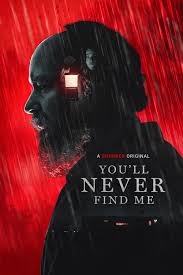
You’ll Never Find Me (2023)

Welcome to a dark night of the soul. Even bad people have them.

In some nameless Australian trailer park, Patrick (Brendan Rock) sits in his living room drinking whiskey. Outside, there is thunder and lightning, just like the night Frankenstein’s creature woke up.

Patrick is alone, but not for long.

A wayward woman (Jordan Cowan), lost in the storm and soaked to the skin, pounds on his door seeking a telephone.

“You’ve knocked on the wrong door,” Patrick tells the shoeless visitor.

Of course, things are not that simple. The wrong door depends on who’s standing where.

You’ll Never Find Me, written and co-directed by Australian newcomer Indianna Bell, is an intricately constructed two-person play, featuring unexpected shifts in the power dynamic taking place over the course of a dark and stormy evening.

It’s Patrick’s house, and he’s obviously a formidable man who prefers solitude. A drenched woman with no shoes can’t possibly be a threat.

So why is he uneasy?

Patrick explains to her that feral kids living in the park routinely beat on his door and run away. Even at two in the morning during a violent storm?

That’s enough to drive anyone mad.

Gradually, Patrick warms up to his guest and promises to help her, but he’s also clearly suspicious about her point of origin. She claims she fells asleep at the beach.

“The beach?” Patrick wonders aloud, as if he’d never heard the word.

Viewers are left to puzzle and ponder the scant information provided by these mysterious players, as both sides continue to distract and interrogate the other while passing the time with a few hands of cards.

We can tell from the outset that Patrick is a (deservedly) haunted man, and as the tension in the trailer escalates, a very big decision about his future—the same one faced by Hamlet—becomes an unbearable burden.

With its single set, minimal action, and tiny, terrific cast, You’ll Never Find Me is a harrowing and claustrophobic watch, with revolving doors of trust and deception leading to the ultimate question: To be or not to be.

Original, highly rewarding, and vigorously recommended.
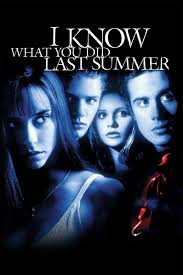
I Know What You Did Last Summer (1997)

Has it really been 27 years since that summer when everyone knew what we did?

Type O Negative’s gloomy cover of Seals & Crofts’ “Summer Breeze” playing over the opening credits should have tipped me off.

There’s angst in the air, probably from Y2K, just over the horizon.

We’ve got major marquee value here. I Know What You Did Last Summer has a formerly fresh cast to die for, led by Sarah Michelle Gellar as Helen Shivers, a small-town beauty queen being chased by a vengeful fisherman decked out in foul weather gear.

Along for the ride is her angry douche boyfriend, Barry Cox (Ryan Phillippe), the group’s moral compass, Julie James (Jennifer Love-Hewitt), and Julie’s working-class beau, Ray Bronson (Freddie Prinze, Jr).

Best-looking cast ever assembled? No dogs in that bunch.

On a fateful Fourth of July evening, the four most attractive graduating teens in a North Carolina fishing community accidentally run over a pedestrian on their way home from a make-out sesh at the beach.

The formerly close-knit quartet quickly comes apart at the seams. They decide to ditch the stiff in the Atlantic Ocean, and seal their secret by vowing never to speak of this unfortunate incident again.

We skip ahead one year to find out that our pretty protagonists are suffering the effects of collective guilt as their lofty ambitions have fizzled out.

Instead of heading off to New York to become a star, Helen is stuck in town working at her family’s bridal shop. You know, in the fishing village.

Julie, the brain, is bombing out of college, and rich kid Barry is holed up at his parents’ house drinking and brooding. Ray is on a boat.

Then Julie gets a note with the title of the movie in it, and the band gets back together!

The script by Kevin Williamson (Scream) is played with a straight face, so anyone expecting witty insights into horror movie tropes, are simply left with a bunch of tropes to sort through.

The plot proffers suspects aplenty, red herrings, and a few surprises, but it’s all pretty standard cat-and-mouse revenge stuff that unfolds at a leisurely pace.

The kills, courtesy of a maniac mariner armed with a gaff hook, are nothing special, and the eventual unmasking contains zero drama.

Tack on a WTF ending and cue the music.

Most of the “entertainment” value derived from IKWYDLS comes from screen time spent with the spirited ensemble, but Gellar, Phillippe, and company aren’t given much to work with.

The principal characters are rough sketches from better movies, and our comely cast is mostly reduced to fleeing and fretting.

There’s something fundamentally wrong with seeing TV’s Buffy Summers afraid of some swab in a raincoat, and eventually being snuffed out in cursory fashion.

I get it, this is a different character, but even so…

Apparently there were sequels and a remake. I can’t imagine why.

The Changeling (1980)

George C. Scott in an understated role as a classical composer bedeviled by spooks in Seattle? It’s true!

I reviewed The Changeling upon its release for my high school newspaper, wherein I declared it “really scary.”

More than 40 years later, I am revising my opinion. Sometimes “scary” doesn’t age well. But then, neither do I.

Ivory tickler John Russell (GCS) is a recent widower, having lost wife and daughter in a wintery road accident. He takes a teaching job at a small college in Washington state to hopefully get his head together and start composing again.

Instead, the massive mansion generously rented to him by Claire Norman (Trish Van Devere, his real-life wife) from the local historical society, comes with a ghost in the attic that wastes no time banging around upstairs, depriving the maestro of much-needed rest.

A seance arranged by Claire with a psychic couple confirms the presence of a restless child murdered in the house, and it becomes Russell’s mission to bring metaphysical justice to the situation.

Director Peter Hyams (The Relic, Time Cop), a thoroughly capable and professional filmmaker, does a thoroughly capable and professional job on The Changeling.

The problem isn’t him, it’s me.

I suppose a scene in which a possessed antique wheelchair chases Claire around the upper floors of the mansion was sufficient to make teenaged me go, “eek!”

Since then, I’ve logged thousands of hours of community service watching ghosts, ghouls, creatures, cruel killers, and assorted hell-spawn ravaging their way through humanity.

The Changeling, even with its star cast and engaging mystery, comes off as quaint and dated. Weak tea and dry toast.

It’s not simply an age thing. A masterpiece of atmosphere such as Robert Wise’s The Haunting (1963) requires nothing more than sound and camera movement to convince us that the supernatural world is all around us.

The Great Scott, who does not bellow, growl, or bloviate, is convincing as Russell, a (literally) haunted man vulnerable/receptive to unseen forces, due to the fresh tragedy in his life.

Though Hyams, Scott, et al, give it the old college try, their collective efforts fail to generate any genuine shock wattage in the 21st century.